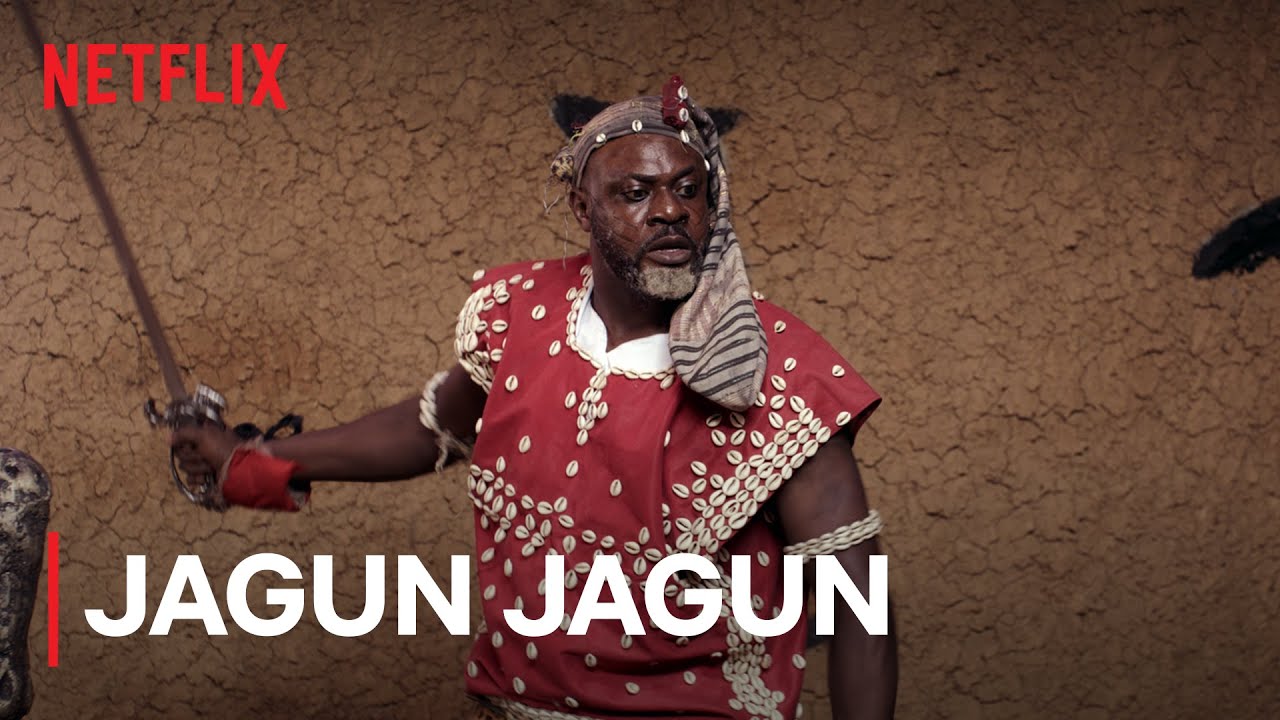
NETFLIX’s Yoruba-Nollywood film, Jagun Jagun (The Warrior), is the rave of the moment and the crux and icebreaker of most discussions in town. Femi Adebayo, Nigerian veteran actor and film producer, pulled a rabbit out of a hat on this one. The curious thing is that Femi Adebayo was able to attain this great fit in less than fifteen months after he delivered Agesinkole (King of Thieves) which reportedly surpassed its targets at the Nigerian Cinemas in about three weeks. Femi Adebayo is certainly not a diminutive artist and film maker in Yoruba Nollywood, and his Jagun Jagun is not a mere case of Nigerians knowing how to hype their things.
Jagun Jagun premiered on NETFLIX on Thursday, August 10, 2023. Within 48 hours of its release, the movie reportedly trended in the top 10 chart of more than 18 countries worldwide, including UK, US, UAE, South Africa and Nigeria. However, I have come across a couple of critics who think the movie is overrated. I observed in high disbelief how the movie’s misanthropists superfluously tender their paltry analysis on the social media. On the contrary, I think Jagun Jagun is a well cooked meal, deftly served in a fine dish.
Plot Summary
Gbotija the son of Lagbayi sets out with admirable bravery and sanguinity to learn the Art of war at the feet of Ogundiji, a great warlord. Gbotija’s motivation is revenge. He wants to avenge his father’s death during the invasion of his hometown, Iwon Kingdom, by some unidentified soldiers. Lagbayi is able to hide his teenage son inside the Isi tree before he’s killed by a gunshot in the middle of the raid. Strong-willed Gbotija discovers his master, Ogundiji, masterminded the invasion of his hometown which led to his father’s death several years ago. The student stabs his master multiple times to death, dedicating each piercing of the dagger into him to every victim of his atrocities.
Analysis and Commentary
The dominant idea of the movie is ‘’the destructive nature of war.’’ This idea is deftly conveyed and buttressed through the multiple subplots that developed in the storyline. The central characters are Gbotija who is the protagonist and Ogundiji who is the super villain.
Gbotija became an orphan and lost many significant persons in his life as a result of war. Against his own will, Gbotija became a beast and an instrument of mass destruction wielded by Ogundiji. When Ogundiji noticed Gbotija was becoming too powerful under his watch, he subjected his apprentice to a series of acid tests with the hope he would not survive them. Gbotija was forced to kill his father-figure, Gbogunmi and his lover, Ogunkitan, masqueraded as Agemo. Gbotija’s dilemma and empathy were demonstrated at the verge of executing his destructive mission in the Alaje Kingdom where the villagers were currently performing the Aje festival, a celebration of wealth and prosperity.
The King sends one on an errand; the tide on the way is high and lethal. It is not possible to go against the king’s orders as much as it is ill-advised to dive into the tide.
In spite of its apparent bitterness, war is often thought of as a necessary evil in some contexts. The interpretation of war and warfare as a necessary evil is common among the elite and the political class who invariably profits from fanning the embers of discord among the masses. The elite use the instrumentality of their wealth and statuses for personal aggrandizement rather than the social good. And when there is a clash of interest among the elites, they excite and sponsor the ordinary men to go into war on their behalf.
The foregoing revelation in the story will probably resonate mostly with many Nigerians since it mirrors the nation’s political landscape and socio-political realities. In the story, Ogundiji is the grand assassin hired by the elite and the political class to execute their biddings of forcefully taking over power while they circumvent due processes with impunity. Ogundiji’s personal prowess and popularity among the elite contribute to his image as a highly dreaded warlord.
The story also recalls the political history and evolution of the political economy of the Yoruba people. Oyo became the capital of the Yoruba nation and dominated many parts of the Sub-Saharan African region partly due to its Military strength. The rise and fall of the Oyo Empire was driven by many intra and inter regional wars such as the Dahomie, kiriji, modakeke, Nupe, Assante and Mahi wars etc. Oyo’s consolidation and reign as a super power in West Africa started in the 15th century and lasted through early 19th century when the polity became highly fragmented and its army was consequently subjugated by the Fulani Jihadist in 1825.