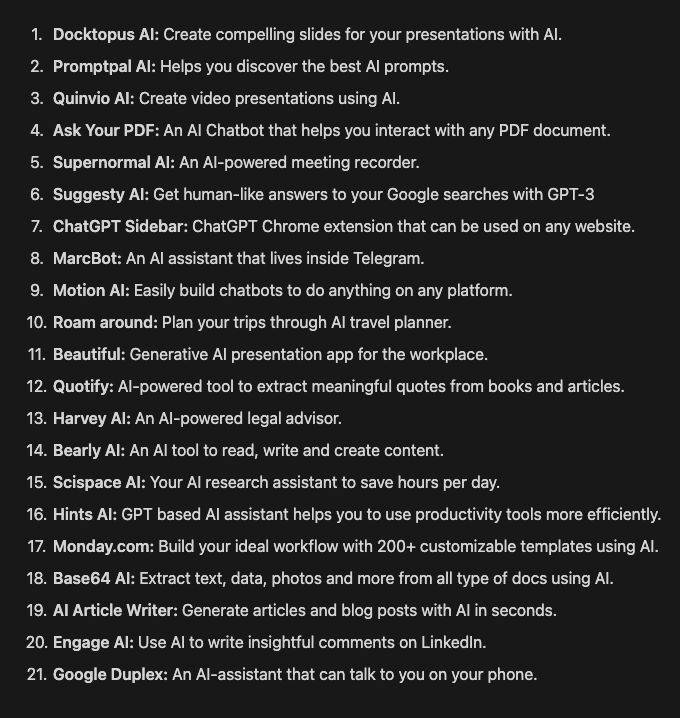
Here are 20 AI tools that will transform your productivity forever. Yes, some species of AI and they will change our world.
Tekedia is offering a course on AI in the next Tekedia Mini-MBA.



Here are 20 AI tools that will transform your productivity forever. Yes, some species of AI and they will change our world.
Tekedia is offering a course on AI in the next Tekedia Mini-MBA.

The UK-Nigeria Tech Hub, an initiative by the UK Government to support the growth of the Nigerian tech ecosystem has collaborated with tech giant company Google to support female-led startup founders.
Through this collaboration, the sum of $3 million in Google Cloud credits will be awarded to women founders in Nigeria, subsidizing cloud technology expenses for their startups, and enabling them to focus on innovation, customer acquisition, and growth.
Speaking on the collaboration, the British High Commission Senior Press & Public Affairs Officer Ndidiamaka Eze said,
“This support will subsidize cloud technology-related costs for startups, allowing them to focus on innovation, customer acquisition, and growth. The joint effort by the UK-Nigeria tech hub and Google for startups in Africa will help to promote digital inclusion and jointly support technology businesses run by women founders.
“To commemorate International women’s day in March, the two organizations co-hosted an event in Lagos, bringing together women founders, investors, and ecosystem stakeholders. The event aims to help women founders understand the technology funding landscape and position themselves to secure funding for startups.
“This partnership is a testament to our commitment to supporting women founders and helping them reach their full potential. Partnerships like this are one of the great ways that stakeholders can come together to advance Nigeria’s tech ecosystem at an accelerated pace”.
Lately, Women startup founders have been getting much-needed recognition as well as increased funding. Recall that earlier this month, Google announced 15 women-founded startups in its inaugural accelerator. The selected women founders will receive business and technical training alongside mentoring and investment networking opportunities, tying into Google’s long-standing strategy to empower Africa’s women in business.
The 15 selected startups were pulled from eight African countries and are leveraging innovation and technology to develop solutions that are impacting lives and communities. Google’s program is coming at the back of its consistent effort to achieve gender parity in the funds it deploys into African startups.
Also, ALAT by Wema a youth-focused startup competition aimed to provide a platform that enables innovators and startup founders with tech-driven skills, in its latest edition of its 2023 Hackaholics 4.0, tagged “reimagine” has disclosed that as a way of honoring its commitment to inclusivity, women-led teams will be given recognition and rewards.
It is also interesting to note that against the backdrop of a funding boom for African startups, women-led startups which have been long starved of funds, have seen a dramatic increase in financing. Investments made into African female-led startups have grown by nearly seven-fold over the last three years, highlighting their potential to haul in investment.
In 2021, the share of investments that went to female-owned tech start-ups stood at about 6.5 percent, which implies that just 1 in every 15 dollars raised in the African start-up ecosystem went to women-owned tech startups. Though incredibly low, it was much higher in 2021 than in previous years.

The Bayh-Dole Act is arguably the most important business legislation of the last few decades in the United States. It made it possible for government-funded research to be commercialized by individuals and entities. In other words, in the past, after great discoveries, only government entities were expected to commercialize the outcomes. But when this Act came, the researchers could under license take those outcomes to the market.
Without Bayh-Dole, there will be no Google, Akamai and a host of many companies, which began life in university labs, funded by the US government.
For Africa, our challenge is not just doing quality research. But also, finding a mechanism to commercialize the little we have done. The US reduced the barriers, and companies can go to US patent libraries, discover great ideas and then push to commercialize them. The outcome: you do not leave great ideas on shelves; you take them to markets where people and companies can buy products created out of them. My PhD thesis was a beneficiary as the US government saw it, and paid to use the idea out of it.
Indeed, Africa can learn from the Bayh-Dole Act especially now the nations are trying to emerge from the most devastating global recession since the Second World War, with policymakers, business communities, academia, and governments looking at ways to accelerate growth and competitiveness. Governments matter and a single legislation could have impacts that can redesign a nation’s economic destiny. Globalization makes it necessary that nations must compete not just on technologies, but on policies upon which those technologies are developed and commercialized. It is the policy that makes it possible that two universities in two separate countries can develop similar technologies with one creating Fortune 500 companies within a decade and another having the idea locked up in a cabinet. So the policies or legislations made by our parliaments on what happens to inventions funded with public money matter.
Comment 1: I did a quick Google search after reading this and found out that the Nigerian government approved N4.7b research grant for academics.
Do you have any idea if the academicians or affiliated institutions can commercialise their works?
My Response: Since Nigeria has no system, any professor can commercialize government-funded research provided you are not very successful in the market. But if that idea becomes very successful, and it can be linked to a government grant, you may have a legal matter to deal with in that university/government.
I will not fund any professor’s idea, coming out of a government grant, unless we see a written document from the minister of science/tech (for federal) or commissioner (for state school), granting rights as appropriate, in Nigeria. But in South Africa, I do not have that problem as they’ve created an equivalent and unambiguous Bayh-Dole clone which removes any future expropriation risk.
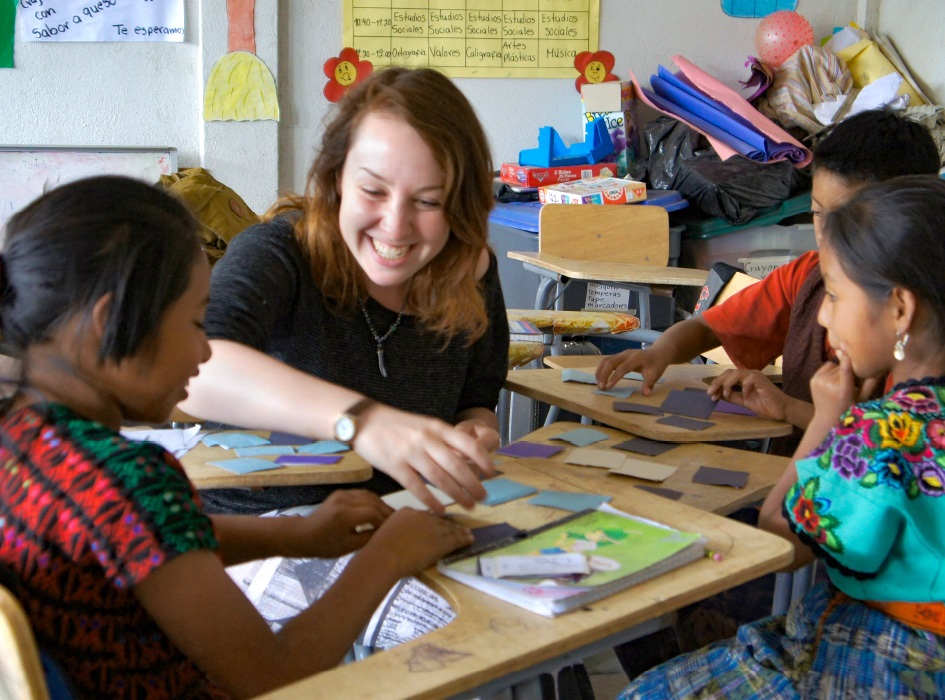
In a time when many people are delighted to be working from home, others choose to leave their comfort zone behind and explore new horizons teaching English as a foreign language (TEFL) abroad. If you are one of those who have recently obtained your TEFL certificate, congratulations! It is a huge achievement that will certainly help you take the first steps in your teaching career. In time, you might decide to focus on one area of TEFL, like teaching exam preparation classes, business or academic English, or specific age groups.
You probably already know whether you have an interest in teaching young learners or not, and you might be aware of the fact that teaching children is very different from teaching adults. More specifically, it requires strong classroom management skills. If this is your first experience teaching young learners, however, it might feel daunting and intimidating. Let’s see how you can set yourself up for success.
Setting up rules for young pupils from the beginning of the course is necessary for children to know what is expected of them. If you are worried about giving them the impression of being too bossy, set up a group activity that will allow them to come up with their own rules for themselves and the teacher. Get each group to present their ideas and discuss them together.
Establishing their own rules as a class makes it more likely that children will stick to them. Adding a few rules for the teacher too would make them appreciate you even more. Try to keep the rules positive and remember to review them regularly, especially when a new student joins the class. Some students’ rules could be:
For the teacher, here are some ideas:
Although most children like to have a classroom routine, nobody likes repetitive lessons. To keep your students engaged and involved, mix things up with games and songs. Try to include different types of activities, changing from quiet and individual tasks, like listening or drawing, to activities that allow children to move around and be loud. In this way, there shouldn’t be any unexpected outbursts of energy, and their excitement will be concentrated in specific parts of the lesson.
Your teaching style, lesson plans and materials are heavily affected by the country in which you work. Cultural differences and the local education system can have a huge impact on how you deliver your lessons and on how your learners experience the classroom environment.
Let’s take teaching in South Korea as an example. There, young learners are considered to be between the age of 5 and 12, when they finish primary school. Although South Korean children don’t start learning English at school until they are 8 years old, many parents enrol their children in English language learning programmes in private schools – hagwons – from the age of 5.
Many private schools across the globe rely heavily on coursebooks. For young learners, these books are mainly story/picture books. Although they are extremely helpful for teachers and students, their images often exclusively represent western culture. This could cause confusion among young learners who are in the process of making sense of their own culture. It is therefore advised that teachers implement some adaptations during their lessons using additional pictures showing South Korean individuals and culture.
One way of having more fun in the classroom is to turn the lesson into a song. From vocabulary to grammar, anything could fit in a song, as long as it is connected to the learning objectives of your lessons. When choosing a song, you should always keep in mind the age and the language level of your learners, as well as their culture and traditions. Remember to include the song in your lesson by introducing the topic first, and present the target language you want your students to focus on. Last but not least, don’t forget the technical aspect of playing the song in the classroom – do you have access to YouTube?
As well as using pictures, another way to keep your young learners engaged is to use realia – real objects – particularly useful to teach vocabulary. This can work very well especially when new words are smoothly integrated into everyday dialogues.
Games are always a winner with children, but be careful – it is easy to fall into the trap of using games just to fill up the last five minutes of your lesson. Instead, choose what game would work best and include it in your lesson at the planning stage. In this way, not only will the game be fun, but it will promote learning. You might find that your students prefer one game to another. If that’s the case, don’t feel that you have to use a different game every time: find ways of adapting their favourite game to suit your lessons.
Mindless repetition can bore even the most enthusiastic of learners. However, repetition is one of the best ways to memorise new language items. Rehearsing role-plays are a clever way to get students to repeat the target language multiple times while they pretend to be actors! Get their creativity going by making up costumes for their role-plays using scarves and build glasses and crowns using cardboard boxes.
Teaching young learners can be an exciting experience that needs to be carefully planned. From songs to games, from role-plays to arts and crafts, you can let your creativity go wild when teaching young learners wherever you are in the world. If you are in the process of choosing your first (or next!) teaching destination, take a look at this article about teaching English in South Korea salary information.
Despite regulatory efforts by the Central Bank of Nigeria (CBN) to sanitize the banking industry, curtailing cases of fraud – arbitrary charges and unresolved customer complaints, cases of unreversed ATM-trapped funds and money disappearing from customers’ accounts persist.
The situation is exacerbated by the insouciant attitude of financial institutions when they receive such complaints from depositors, leaving the victims with limited choice of suing the responsible financial company or losing their money.
In view of this, the CBN on Friday last week released a guide on how depositors can lodge a complaint against financial institutions such as Deposit Money Banks (DMBs), Microfinance Banks (MFBs), Primary Mortgage Institutions (PMBs) and Merchant banks, under its regulation.
In 2021, in an attempt to curtail the banks’ lackluster approach to cases of ATM dispense error, the central bank initiated a policy under Consumer Protection Regulation, to fine guilty banks N10,000 for every failed transaction not reversed within 24 hours. But that did not change much as most banks’ customers don’t know how to escalate the matter to the CBN.
Early last year, the central bank issued a guideline on how customers affected by any of the shortcomings could file a complaint. Notwithstanding, as reports of banking fraud and other shortfalls liter social media daily, the CBN has deemed it necessary to remind the public of what to do when they have a complaint against their banks.
Consequently, if you have a complaint against your bank, you must first report the complaint at the bank/branch where the issue originated and then allow two weeks (it might be less or more in some cases) for the issues to be resolved.
You have the right to escalate your complaint to the Director, Consumer Protection Department (CPD) of the CBN after lodging your complaint, when your bank fails to acknowledge within three days or issue a tracking number, or fails to resolve the complaint within the timelines as stipulated by the Consumer Protection Regulation (CPR).
You can only direct your Complaints to CPD upon the failure of your Bank/ Financial Institution to resolve your complaint within the timeline stipulated by the Consumer Protection Regulation (CPR).
You can contact the CPD through the following channels: cpd@cbn.gov.ng, letter to the director, Consumer Protection Department Garki, Abuja.
Your letter of Complaint should be addressed to the director, Consumer Protection Department. You can submit your letter at the CBN head office or at any of the CBN branches nationwide.
The CBN deals with all financial related complaints insofar as it is against a Financial Institution within its regulatory purview.