DD
MM
YYYY

PAGES

DD
MM
YYYY

spot_img

PAGES

Home Blog Page 4316

Remote Working and How to Productively Work from Home

0
Virtual event or meeting has gone mainstream, benefiting Zoom

As societies evolve, new social relations of production result from changes in the economic mode of production. In recent periods, the economic life has been highly characterized by remote working, a situation where individuals work from the comfort of their homes or anywhere other than the physical confinement of their office settings.

Remote working can be conceived as a by-product of globalization in the sense that it has made it possible for individuals to offer their labour for value creation irrespective of their geographic location per time. Consequently, many companies have been able to save cost in terms of overhead reduction by promoting remote working.

The beauty of remote working ranges from having flexible hours, ability to take in multiple jobs per time, personal comfort and convenience, absence of micromanagement from a superior, absence of office politics, and absence of commuting hassles. However, all of these depend on the self-management skills of the individual.

Remote working may go wrong and result in unproductive venture when one is not discipline enough to separate what is important and not important and what is urgent and not urgent per time. In other words, if one is not able to separate business from personal life per time while both are under the same roof, one may end up spending more time with loved ones or on other things rather than getting one’s work done.

There is also a tendency for one to be isolated from recreation and social life. In this light, experts have suggested that while working remotely, one may develop a workaholic syndrome.

What are the things you need to do to have productive time working from home?

Familiarize yourself with rules of remote working: It is important to get yourself acquainted with the rules of remote working. Two of such rules include independence and multitasking. For instance, in the formal office setting, one may have recourse to support from other workers for one to perform one’s specific job roles, but when working remotely, one will have to independently execute all the functions that lead to the completion of one’s task.

Planning and implementing a good design for your home office. Mapping out a strategic space at home for work related purposes and enlivening the same with a design that befits the nature of your job have significant influence on one’s work ethics and performance at home. A well decorated home-office equipped with necessary tools naturally provides one with motivation to work.

Inculcate work-life balance. Manage self and finance. Set hours, and manage your work-flow into those hours.

Recreation and strategic networking will help to keep you connected, informed and revitalized. You could achieve these by meeting new people at social and professional functions, getting occasional exercise outside the homestead or registering for evening classes.


#Plan because the global economy is catching a bad cold

0

This may be a time to pause that vacation or the purchase of that extra “goody”,  and focus on things which are absolutely necessary. Indeed, from the way things are looking, the world’s economy seems to be catching a bad cold. When Apple, Facebook and the broad banking sector are optimizing their workforce and expense lines, do not think they are guessing. Yes, data drives those decisions, and that data is sending a clear message: expect an economic reverse in months.

They say in natural philosophy that actions and reactions are equal and opposite. In socio-economic philosophy, that seems to also be the case, except that the reactions take months and years to show up. When your action is pumping economies with cash (excessive money), one day, you will get a reaction. We’re possibly getting close to that day.

#plan because the global economy is catching a bad cold.

Understand that planning could be as simple as scheduling a time with your bank account officer. S/he goes through your incomes, expenses, etc and develops a model. Sure, banking in Nigeria does not include that. But if you are in the US, call your bank. They offer those services for free. By having a bank account, you can get many advisory personal economy services for free.

U.S. stocks fell Wednesday, with the Dow Jones closing nearly 1% down, as the shockwaves from the collapse of Silicon Valley Bank reverberated around the world. Credit Suisse, one of Europe’s biggest banks, saw its stock drop more than 20% amid a flurry of withdrawals and a refusal by its largest shareholder to provide more funding. That in turn dragged down some major U.S. banks: Citigroup slid 5.4%, JPMorgan Chase 4.7% and Wells Fargo 3.3%. Midsize U.S. banks have also been impacted. First Republic’s credit rating was downgraded by four notches. (LinkedIn News)

Circle ‘able to access’ $3.3B of USDC reserves at Silicon Valley Bank

0

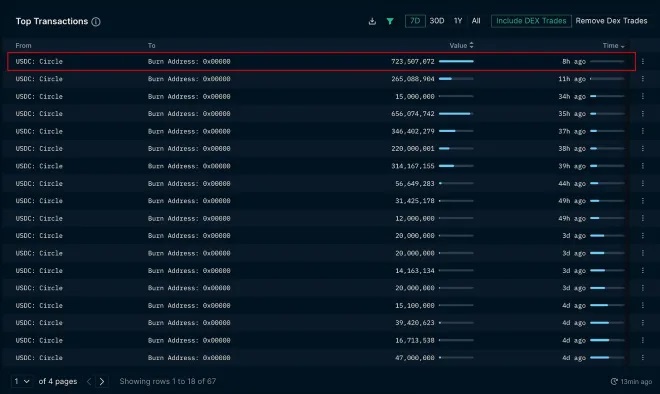
USDC, the world’s second largest stablecoin by market value, continues to make new moves to address the crisis, as it continues to struggle to gain the trust of users. Circle has signed the biggest USDC burn ever to repair broken trust.

USDC Burning increases new steps continue to be taken to restore lost trust in USDC, stablecoin issuer Circle’s stablecoin backed against the dollar.

According to data from blockchain analysis firm Nansen, the biggest burn, a record in the USDC burn, was when $723.5 million was sent to an empty address and burned.

More than $6.2 billion USDC has been burned since Friday. In addition, approximately over 3 billion dollars were printed. After these events, the net amount of USDC burned was approximately 4.5 billion dollars.

With the USDC-backed assets that is stuck in failing US banks, Circle began a burn to regain confidence. United States regulators, Silicon Valley Bank and Signature Bank had guaranteed full refunds of customer deposits. With Circle CEO Jeremy Allaire claiming that the stablecoin issuer has “access” to the $3.3 billion in funds held by the insolvent Silicon Valley Bank.

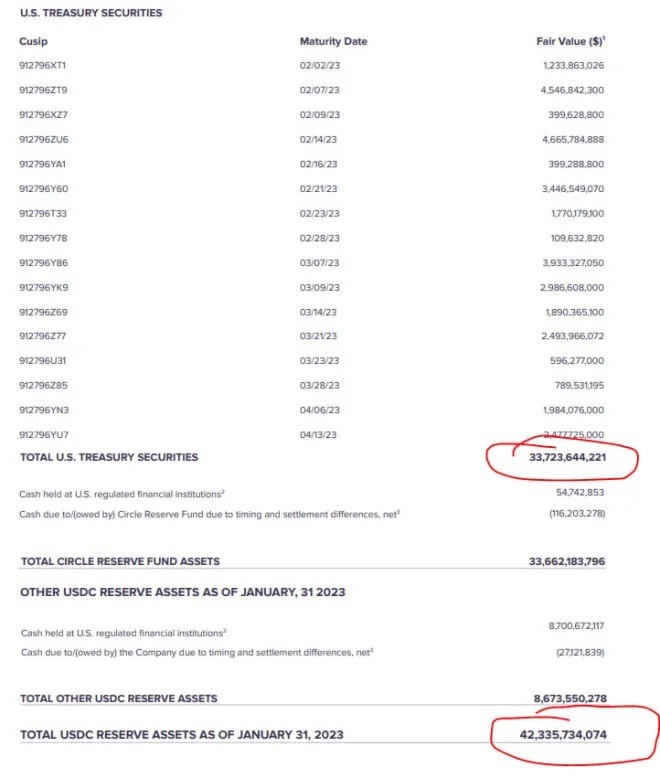
Circle holds 77% of their reserves in 1-4 month T-Bills. These T-Bills are held at BNY Mellon and managed by Blackrock. This provides an absolute floor on USDC of 0.77.

The remaining 23% is all held in cash at various entities. Approximately 1/3 of that cash was held at SVB. SVB is going to liquidate all assets over the next couple months and most estimate will return no less than 10-20% of total asset value.

Dante Disparte, chief strategy officer and head of global policy at Circle highlighted the issues faced by crypto companies due to the lack of confidence in banks, noting that the shutdown of Silicon Valley Bank (SVB) and Signature Bank, two major lenders to the crypto industry, demonstrates the risks that traditional financial institutions pose to the crypto ecosystem.

“The bank failures in the United States have demonstrated that banks themselves are introducing risk to crypto assets, versus the inherent direction of travel of risk, that a lot of the regulators were concerned about, is that crypto would introduce risk to banking,” said Disparte.

Shib Trader Makes Million of Dollars on Arbitrage

0

A mysterious Shiba Inu trader has pocketed millions of dollars in the wake of the USD Coin USDC depegging, according to on-chain data.

Blockchain tracking firm Lookonchain says that as the USDC stablecoin lost its peg to the US dollar over the weekend, an unknown crypto trader made a profit of $4.14 million in about 48 hours.

According to Lookonchain, the mysterious trader spent 67.58 million USDC to acquire 47,670 Ethereum on March 10th. ETH was trading at $1,418 at the time.

About two days later, the mysterious trader converted 47,668 ETH to stablecoin Tether USDT worth approximately $71.72 million. Lookonchain says the unknown trader pocketed a return on investment of 6%.

“We found that 15 addresses (may belong to the same person) bought 47,670 ETH with 67.58 million USDC at $1,418 on March 10th.

Then sold 47,668 ETH at $1,505 for 71.72 million USDT on March 12th, He made approximately $4.14 million in two days, the return on investment is 6%.”

On why the 15 responsible addresses possibly belong to one individual or entity, Lookonchain says,

“According to the on-chain data, we found that these 15 addresses may belong to the same person, because they received a large amount of SHIB from the same address ‘0x7617’ on April 21st, 2021.

Address ‘0x7617’ started trading SHIB very early, and bought approximately 5.5 trillion SHIB before the price of SHIB rose sharply in May 2021 with a cost of only approximately 180 ETH ($400,000). Then address ‘0x7617’ sold all SHIB for more than 35,000 ETH in May and October 2021 through 34 addresses.”

Nigeria’s Headline Inflation Rose to 21.91% in February – National Bureau of Statistics

0

Nigeria’s headline inflation rose to 21.91 percent in February, indicating 0.09 percent increase from the 21.82 percent recorded in January, according to the latest report shared by the National Bureau of Statistics (NBS) on Wednesday.

The Bureau attributed the rise to increase in prices of different food items amid the cash crunch emanating from the redesigned naira policy by the Central Bank of Nigeria.

“On a year-on-year basis, the headline inflation rate was 6.21% points higher compared to the rate recorded in February 2022, which was 15.70%. This shows that the headline inflation rate (year-on-year basis) increased in February 2023 when compared to the same month in the preceding year (i.e., February 2022),” it said.

“Looking at the trend, the February 2023 inflation rate showed an increase of 0.09% points when compared to January 2023 headline inflation rate.”

“The contributions of items on a class basis to the increase in the headline index are presented, thus: Bread and Cereal (21.67%), Actual and Imputed Rent (7.74%), Potatoes, Yam and Other Tubers (6.06%), Vegetable (5.44%) and Meat (4.78%).”

The NBS noted that on a month-on-month basis, the percentage change in the All-Items Index in February 2023 was 1.71 percent, which was 0.16 percent points lower than the rate recorded in January 2023 (1.87 percent).

“This means that in February 2023, on average, the general price level was 0.16% percent lower relative to January 2023.

“The percentage change in the average CPI for the twelve months period ending February 2023 over the average of the CPI for the previous twelve months period was 19.87%, showing a 3.15% points increase compared to 16.73% recorded in February 2022. The increases were recorded in all COICOP divisions that yielded the headline index.”

The CBN introduced the naira redesign policy in late October 2022, but its implementation became chaotic due to the insufficiency of the redesigned naira notes. The poor circulation of the new 200, 500 and 1,000 naira notes, which yielded cash scarcity, cast further strains on the economy.

The policy which came as part of efforts to curb money laundering and vote-buying ahead of the elections nearly crippled the informal sector as the banking industry struggles to contain the shift to digital transactions.

The Supreme Court had on March 3, annulled the policy, which it described as an affront to the 1999 Constitution. The judgment follows a suit instituted by 16 states against the federal government, challenging the policy.

However, the CBN did not comply with the judgment until Monday, March 13, when the financial regulator directed banks to start collecting and dispensing the old naira notes until December 31, in compliance with the apex court judgment. This means that Nigeria’s economy is still grappling with a cash shortage. Experts say it will take weeks before economic activities return to normal.