DD
MM
YYYY

PAGES

DD
MM
YYYY

spot_img

PAGES

Home Blog Page 4333

The US Should Not Bail Out SVB Investors! Privatizing Profit and Socializing Loss Must STOP Even As Depositors Are Protected

0

It is a very tough call when $billions can just disappear in minutes. But I hate bailouts because only the rich are made whole whenever they do them. Sure, you can argue that it is only when we take care of the rich people that the ordinary citizens will have a chance. Good luck with your trickle down economics; I do not buy it.

In Nigeria, I have argued that we privatize profits but socialize losses when men borrow mindlessly and enjoy lives, only for AMCON, a government entity, to bail them out when they run into troubles. In America, I also posit the same thesis: bailing out millionaires when poor kids with $10,000 student loans cannot get help makes no sense.

Student-loan repayments are likely to restart this summer, and that will mean additional financial pressures for millions of younger Americans who are already in a hole. In the fourth quarter of 2022, Americans 30 and younger fell behind on credit-card payments at a rate similar to that during the end of the 2009 financial crisis, The Wall Street Journal reports. The majority of borrowers haven’t made student-loan payments since the beginning of the pandemic, and with it about to start up again, approximately 40 million people are on the hook for $1.6 trillion, WSJ reports. (LinkedIn News)

Those millionaires privatized their gains and profits as they invested, and when bad things happen, expecting the government to come to save them seems unfair, and out of sync with the spirit of capitalism. For SVB, any help should go to depositors; full access to funds, insured or otherwise. The Wall Street investors should chill. But if the government has to do it and bailout Wall Street, it must first push legislation that makes Joe Biden’s student loan forgiveness possible, making the current litigation at the Supreme Court irrelevant.

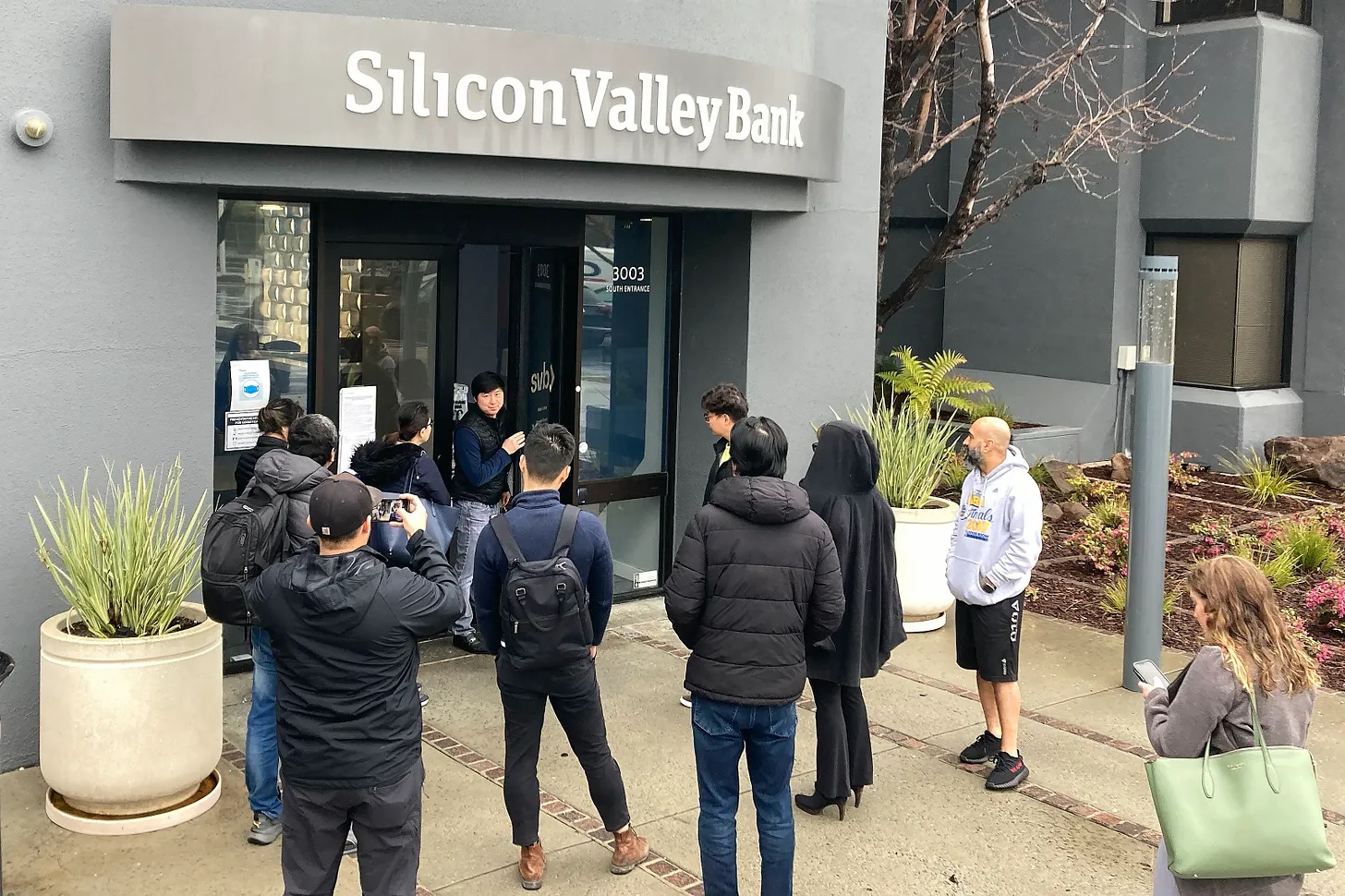
Silicon Valley Bank is no more. The FDIC seized the assets of the bank, a fixture of the VC world and a prolific lender to the tech and life sciences sectors, on Friday, marking the largest bank failure since the height of the 2008 financial crisis.

Silicon Valley’s clubby world of venture capital investors and entrepreneurs plunged into panic on Thursday amid fast-spreading reports of financial trouble at one of the startup industry’s most important banks.

SVB announced a day earlier that it was selling off securities and seeking to raise billions in a public share sale to cover steep losses on its balance sheet. Shares of Silicon Valley Bank crashed by roughly 60% in regular trading on Thursday, while the bank’s tech clients scrambled to figure out whether to withdraw their deposits, sparking concerns of an old-fashioned bank run. (Fortune newsletter)

Good one that Secretary of Treasury thinks that no bailout will happen.

“Let me be clear that during the financial crisis, there were investors and owners of systemic large banks that were bailed out, and the reforms that have been put in place mean that we are not going to do that again. But we are concerned about depositors and are focused on trying to meet their needs”.

Protect depositors and make them whole but do not save Wall Street investors. This bank possibly failed because of the panic created by the CEO’s statements and that is the risk therein.

Perspectives from Bill Ackman on Twitter

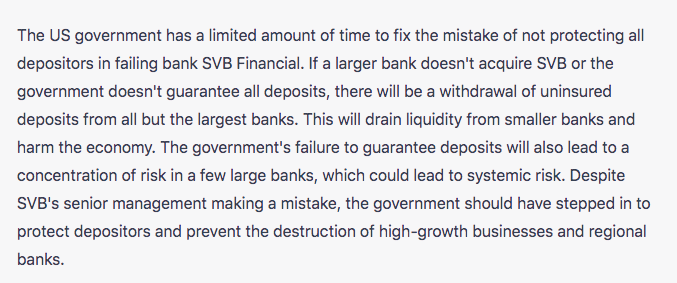
Reproduced below for clarity: “The gov’t has about 48 hours to fix a-soon-to-be-irreversible mistake. By allowing @SVB_Financial to fail without protecting all depositors, the world has woken up to what an uninsured deposit is — an unsecured illiquid claim on a failed bank. Absent @jpmorgan @citi or @BankofAmerica acquiring SVB before the open on Monday, a prospect I believe to be unlikely, or the gov’t guaranteeing all of SVB’s deposits, the giant sucking sound you will hear will be the withdrawal of substantially all uninsured deposits from all but the ‘systemically important banks’ (SIBs).

 These funds will be transferred to the SIBs, US Treasury (UST) money market funds and short-term UST. There is already pressure to transfer cash to short-term UST and UST money market accounts due to the substantially higher yields available on risk-free UST vs. bank deposits. These withdrawals will drain liquidity from community, regional and other banks and begin the destruction of these important institutions. 

The increased demand for short-term UST will drive short rates lower complicating the @federalreserve’s efforts to raise rates to slow the economy. Already thousands of the fastest growing, most innovative venture-backed companies in the U.S. will begin to fail to make payroll next week. Had the gov’t stepped in on Friday to guarantee SVB’s deposits (in exchange for penny warrants which would have wiped out the substantial majority of its equity value) this could have been avoided and SVB’s 40-year franchise value could have been preserved and transferred to a new owner in exchange for an equity injection. We would have been open to participating. This approach would have minimized the risk of any gov’t losses, and created the potential for substantial profits from the rescue. 

Instead, I think it is now unlikely any buyer will emerge to acquire the failed bank. The gov’t’s approach has guaranteed that more risk will be concentrated in the SIBs at the expense of other banks, which itself creates more systemic risk. For those who make the case that depositors be damned as it would create moral hazard to save them, consider the feasibility of a world where each depositor must do their own credit assessment of the bank they choose to bank with. I am a pretty sophisticated financial analyst and I find most banks to be a black box despite the 1,000s of pages of @SECGov filings available on each bank. SVB’s senior management made a basic mistake. They invested short-term deposits in longer-term, fixed-rate assets. Thereafter short-term rates went up and a bank run ensued. Senior management screwed up and they should lose their jobs.

 The @FDICgov and OCC also screwed up. It is their job to monitor our banking system for risk and SVB should have been high on their watch list with more than $200B of assets and $170B of deposits from business borrowers in effectively the same industry. The FDIC’s and OCC’s failure to do their jobs should not be allowed to cause the destruction of 1,000s of our nation’s highest potential and highest growth businesses (and the resulting losses of 10s of 1,000s of jobs for some of our most talented younger generation) while also permanently impairing our community and regional banks’ access to low-cost deposits.

 This administration is particularly opposed to concentrations of power. Ironically, its approach to SVB’s failure guarantees duopolistic banking risk concentration in a handful of SIBs. My back-of-the envelope review of SVB’s balance sheet suggests that even in a liquidation, depositors should eventually get back about 98% of their deposits, but eventually is too long when you have payroll to meet next week. So even without assigning any franchise value to SVB, the cost of a gov’t guarantee of SVB deposits would be minimal. On the other hand, the unintended consequences of the gov’t’s failure to guarantee SVB deposits are vast and profound and need to be considered and addressed before Monday. Otherwise, watch out below.”

This is the ChatGPT summary of this tweet:
Y Combinator Begins a Petition for “backstop of depositors”

To the Honorable Secretary Janet Yellen, Chairman Martin J. Gruenberg, Chairman Brown, and Chairman McHenry:

We, the undersigned, are deeply concerned about the rapid failure of Silicon Valley Bank, a leading financial institution that has played a vital role in supporting the technology industry in the United States. We are not asking for a bailout for the bank equity holders or its management; we are asking you to save innovation in the American economy.

We ask for relief and attention to an immediate critical impact on small businesses, startups, and their employees who are depositors at the bank. According to the NVCA, Silicon Valley Bank has over 37,000 small businesses with more than $250,000 in deposits. These balances are now unavailable to them, and without further intervention, according to the FDIC website, may be inaccessible for months to years.

In the Y Combinator community, one-third of startups with exposure to SVB used SVB as their sole bank account. As a result, they will fail to have the cash to run payroll in the next 30 days. By that measure, we can estimate that payroll-related furlough or shutdown will impact more than 10,000 small businesses and startups. If the average small business or startup employs 10 workers, this will have an immediate effect of furlough, layoff, or shutdown, affecting over 100,000 jobs in the most vibrant sector of innovation in our economy.

Silicon Valley Bank’s failure has a real risk of systemic contagion. Its collapse has already instilled fear among founders and management teams to look for safer havens for their remaining cash, which can trigger a bank run on every other smaller bank.

If we allow this to happen, it will immediately impact the US technology industry and US competitiveness worldwide and ultimately set back US competitiveness by a decade or more, while the rest of the world races forward.

We have a simple ask:
– Small business depositors at Silicon Valley Bank should be made whole. Regulators need to conduct a backstop of depositors. We are not asking for a bank bailout.
– Longer term, Congress should work to restore stronger regulatory oversight and capital requirements for regional banks, and any malfeasance or mismanagement on the part of SVB executives leading to this failure should be investigated.

This requires swift and decisive action in order to prevent further shockwaves through the economy that could lead to financial crisis and layoffs of more than 100,000 workers. We must protect US competitiveness in the world.

Thank you for your attention to this important matter.

Sincerely,
Garry Tan, CEO & President Y Combinator

US Government Will Protest All Deposits

WASHINGTON, DC — The following statement was released by Secretary of the Treasury Janet L. Yellen, Federal Reserve Board Chair Jerome H. Powell, and FDIC Chairman Martin J. Gruenberg:

Today we are taking decisive actions to protect the U.S. economy by strengthening public confidence in our banking system. This step will ensure that the U.S. banking system continues to perform its vital roles of protecting deposits and providing access to credit to households and businesses in a manner that promotes strong and sustainable economic growth.

After receiving a recommendation from the boards of the FDIC and the Federal Reserve, and consulting with the President, Secretary Yellen approved actions enabling the FDIC to complete its resolution of Silicon Valley Bank, Santa Clara, California, in a manner that fully protects all depositors. Depositors will have access to all of their money starting Monday, March 13.  No losses associated with the resolution of Silicon Valley Bank will be borne by the taxpayer.

We are also announcing a similar systemic risk exception for Signature Bank, New York, New York, which was closed today by its state chartering authority. All depositors of this institution will be made whole.  As with the resolution of Silicon Valley Bank, no losses will be borne by the taxpayer.

Shareholders and certain unsecured debtholders will not be protected. Senior management has also been removed. Any losses to the Deposit Insurance Fund to support uninsured depositors will be recovered by a special assessment on banks, as required by law.

Finally, the Federal Reserve Board on Sunday announced it will make available additional funding to eligible depository institutions to help assure banks have the ability to meet the needs of all their depositors.

The U.S. banking system remains resilient and on a solid foundation, in large part due to reforms that were made after the financial crisis that ensured better safeguards for the banking industry. Those reforms combined with today’s actions demonstrate our commitment to take the necessary steps to ensure that depositors’ savings remain safe.

Comment on Feed

Comment 1: Prof. your submission is so apt. I remember writing a post some years ago for AMCON to be shutdown completely. I was forced to delete post. I see no reason why a reckless capitalist take gains and profits in private but put their losses into the hands of the society due to their unreasonable and high risk appetite all in the name of bailout.

Comment 2: Hmm. Like you said Sir, it is indeed a very tough call. And I agree with you as many of these elites borrow and spend recklessly only to run into problems and cry out for bail outs.

With that said I believe there should be a balance which would mean creating standards to qualify for bail outs should the unthinkable happen.

Comment 3: I think this is a good decision from the regulators. It will send a warning to others. You can’t get greedy, taking risks with reckless abandon. And except when things go wrong government will bail out.

Comment 4: Honestly, if the government bails out SVB without forgiving my $10,000 in student loan first, I would carry a placard. The 1 percent of the population of every country can no longer hedge their greatest risks which is total annihilation on the backs of the middle class while enjoying their gains by themselves. If SVB lost $2.2 Billion dollars, why was Billiornaire depositors allowed to withdraw their funds. Whose $2.2 Billion was lost?

My Response:  SVB was worth and traded well above $10 billion in NASDAQ before it went under. Those men are the ones tweeting for bailout!

Comment 5: But Prof, these firms serve public good despite the privatalisation of their gains or profits. Bailing them out protect a social course and advance societal growth.

In times of crisis, focusing on the general good should be of importance. You can bail out the company and let the culprits face the full rigors of the law.

My Response: “But Prof, these firms serve public good despite the privatalisation of their gains or profits. Bailing them out protect a social course and advance societal growth.” – As I wrote, I do not believe in trickle down economics.

On the law, there is no law possibly broken. When banks fail due to bank runs, nothing illegal /criminal needs to happen.

I will be fine with a bailout provided the $10k student loans bailout will go through for students. That is also public good.

Comment 6: I think it is all about perspective, I’ve always been a supporter of bailouts because there is a socialist angle to it. Just imagine the number of people that might lose their jobs and number of dependents that might be hit as a result of SVB crisis, if government decides to look away. Imagine the value of individual income tax that government will lose, and so many more. Of course, those who dropped the ball (Directors and Significant Shareholders) can be punished in another way, but firstly, we must save the employees and their families.

My Response: I am in 100% provided they approve the $10k student loans. If you graduate without student loans, you have choices. But if you have piles of loans, you cannot have freedom in many ways. The argument that bailing out Wall Street is great when trial lawyers are telling the government not to help students is what I do not buy. (I have no student loans, I went through Fellowships in Johns Hopkins)

Comment 7: Very well said Professor, you may not agree with me but bail out is necessary in my opinion and the reason is simple. Without the bail out, the billionaires and millionaires will lose money but they’ll still be fine at the end of the day. What about the middle class who’ll lose their lively hood? We are looking at the 150k jobs going down the drain. The US already lost the manufacturing war, it can afford to lose tech.

U.S Government Bailout of Silicon Valley Bank Won’t Happen, Says Treasury Secretary

0

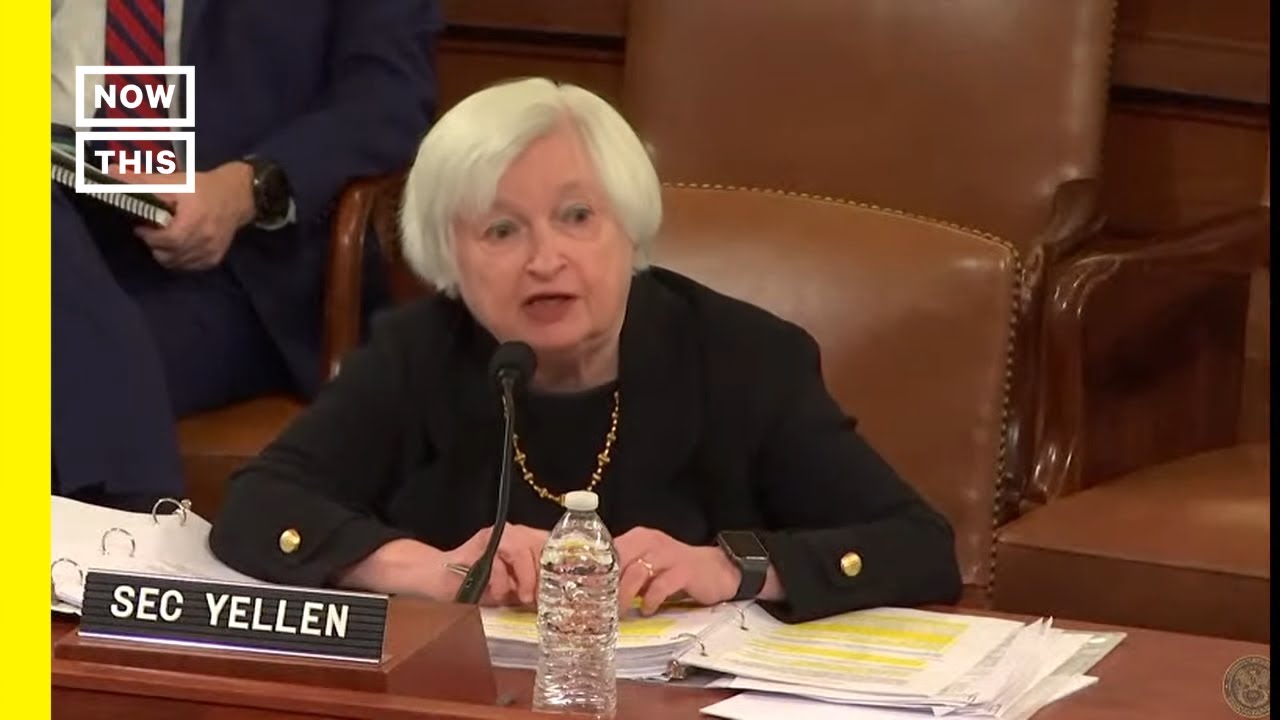
As people continue to make sense of the collapse of startup-focused lender Silicon Valley Bank (SVB), U.S. Treasury Secretary Janet Yellen has recently disclosed that the U.S. government will not in any way bail out the bank.

She added that the government is more concerned about depositors and is focused on trying to meet their needs.

In her words,

“Let me be clear that during the financial crisis, there were investors and owners of systemic large banks that were bailed out, and the reforms that have been put in place mean that we are not going to do that again. But we are concerned about depositors and are focused on trying to meet their needs”.

Yellen’s comment is coming after several investors called on the U.S. government to step in after the Silicon Valley bank witnessed a financial implosion. Venture capitalist and former tech CEO David Sacks had called on the government to push another bank to buy SVB’s assets.

While responding to a tweet with the heading “Treasury and the fed cannot execute a bailout or force a bank merger on their own”. He tweeted, “where is Powell?, where is Yellen?, Stop this crisis now. Announce that all depositors will be safe. Place SVB with a top 4 bank. Do this before Monday opens or there will be contagion and the crisis will spread”.

Venture Capitalists investor Mark Muster agreed, he wrote, “I suspect this is what they are working on. I expect statements by Sunday. We will see. I hope so or Monday will be brutal”.

It is interesting to note that some U.S politicians opposed any bailout by the government with Rep. Matthew Louis Gaetz disclosing that if there is an effort to use taxpayer money to bail out Silicon Valley Bank, the American people can count on the fact that he will be there leading the fight against it.

Meanwhile, Investors are reportedly concerned that SVB collapse could lead to a lack of confidence in the banking sector, particularly mid-sized banks with under $250 billion in deposits. Benchmark investor Eric Vishria disclosed that if Silicon Valley Bank depositions are not made whole, then corporate boards will have to insist their companies use two or more of the big four banks which will crush smaller banks and make them too big to fail which may become a challenge.

Since the collapse of Silicon Valley Bank, reports disclose that financial regulators have taken over its deposits. According to press releases from regulators, the California Department of Financial protection and Innovation named the FDIC as the receiver.

The FDIC’s standard insurance covers up to $250,000 per depositor, per bank, for each account ownership category. The FDIC stated that uninsured depositors will get receivership certificates for their balances. The regulator said it will pay uninsured depositors an advanced dividend within the next week, with potential additional dividend payments as the regulator sells Silicon Valley Bank’s assets.

Whether depositors with more than $250,000 ultimately get all their money back will be determined by the amount of money the regulator gets as it sells Silicon Valley assets or if another bank takes ownership of the remaining assets.

The fallout of the Silicon Valley Bank collapse could be far-reaching. Startups may be faced with the challenge of paying salaries of employees in the coming days, venture investors may struggle to raise funds, and an already battered sector could face a deeper problem.

However, reports disclose that the FDIC could help startup companies with payroll in the case that there is a systemic risk exception, which could be an extraordinary procedure. SVB was a major bank for venture-backed companies which were already under pressure due to higher interest rates and a slowdown for initial public offerings (IPO) that made it more difficult to raise additional cash.

Silicon Valley Bank’s financial implosion began late Wednesday when it informed investors with the unpleasant news that it needed to raise $2.25 billion to shore up its balance sheet. This spurred customers to withdraw a staggering $42 billion of deposits by the end of Thursday.

The shares of the company fell 60% on Thursday and dropped another 60% in premarket trading on Friday before being halted. While many Wall Street analysts predict that the financial crisis of Silicon Valley Bank is unlikely to spread to the broader banking system, shares of the midsized and regional banks came under pressure on Friday.

American entrepreneur and venture capitalist Mark Suster believes that several bad actors in VC (venture capital) led to the collapse of Silicon Valley bank. He stated that he believes the biggest risk to startups AND VCs (and to SVB) would be a mass panic which would further compound more problems for the bank.

Within 48 hours, a panic induced by the very venture capital community that SVB had served and nurtured ended the bank’s 40-year run. Silicon Valley Bank’s failure is reported to be the largest since Washington Mutual went bust in 2008, a hallmark event that triggered a financial crisis that hobbled the economy for years.

Crypto Weekend Round Up

0

This weekend the Cryptocurrency industry witnessed a huge clap back owing to the the winding up of crypto friendly bank Silvergate, Crash of Silicon Valley Bank, Fed Tax introduction on Crypto Mining Electricity and Circle USDC and stablecoins like Frax and DAI losing its 1:1 peg against the US dollar. The market sentiment had been negative with many Crypto assets depreciating in value within a relatively short span.

Litecoin was trading at $66.020 by 07:38 (07:38 GMT) on Saturday, down 10.21% on the day. It was the largest one-day percentage loss since November 9, 2022.

The move downwards pushed Litecoin’s market cap down to $5.131B, or 0.54% of the total cryptocurrency market cap. At its highest, Litecoin’s market cap was $25.609B.

Litecoin had traded in a range of $66.020 to $73.740 in the previous twenty-four hours. Over the past seven days, Litecoin has seen a drop in value, as it lost 21.45%. The volume of Litecoin traded in the twenty-four hours to time of writing was $1.096B or 1.18% of the total volume of all cryptocurrencies.

It has traded in a range of $66.0200 to $91.7300 in the past 7 days. At its current price, Litecoin is still down 84.28% from its all-time high of $420.00 set on December 12, 2017.

Bitcoin was last at $20,049.5, up 0.50% on the day trading chart, Ethereum was trading at $1,447.81 on the CoinGecko Index, a gain of 2.54%.Bitcoin’s market cap was last at $395.334B or 41.96% of the total cryptocurrency market cap, while Ethereum’s market cap totaled $179.199B or 19.02% of the total cryptocurrency market value.

Over the next 6-18 months we are setting up a monster rally for $BTC. World will wake up to the reality that $BTC is the most useful bearer asset in existence and that credit assets are dangerous. Bank failures one year before halving. Could not have written a better script, Avi Felman noted.

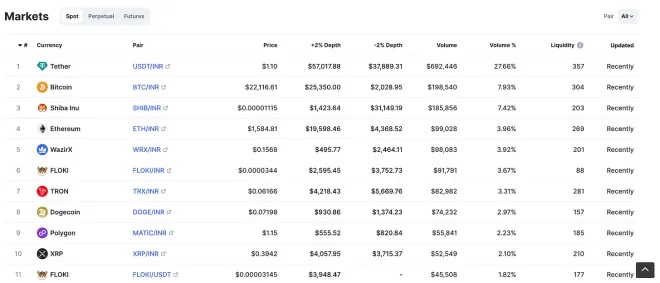
Floki is currently the third most traded cryptocurrency on India’s largest and most recognized exchange WazirX days after its listing. It is ranked after $BTC and $SHIB.

$FLOKI is also the only cryptocurrency with two trading pairs in the top 10 that is not a stablecoin.

Polygon zkEVM Hype Intensifies

Polygon has been recently hyping up its zkEVM scaling solution, something that very few teams are currently working on.

That’s because zkEVMs are notoriously hard to develop. A zkEVM stands for zero-knowledge Ethereum Virtual Machine and is considered to be the holy grail of Ethereum scaling. zkEVMs improve throughput and decrease gas prices by computation and storage off-chain and generating zero-knowledge proofs to verify the validity of off-chain transaction batches.

There are currently no zkEVMs that are deployed on Ethereum mainnet but Polygon’s co-founder Sandeep Nailwal tweeted on January 17 that the team developing Polygon’s zkEVM has set a launch date and that it’s “soon.”

On top of that, Eduardo Antuña, Polygon zkEVM’s core developer, tweeted on Thursday that Polygon has managed to increase its zkEVM’s proving time and costs. Really excited about our results on the Polygon zkEVM Prover, Batchproof 2:30 (2min soon) ~500 or ~250 ERC20 tx/batch.

On a spot m6id.metal prover’s cost: $0.064/proof ($0.0001/tx) The fastest ZK tech and the first production-ready zkEVM. The prover is no longer a bottleneck. All of this indicates that Polygon’s zkEVM, at least in theory, will soon be deployed on Ethereum mainnet. That would be an achievement like none other and potentially take MATIC to new highs.

Death of the financial system: Our much-needed hard reset after SVB implosion

0

I concluded in my last article on Silicon Valley Bank (SVB) that (1) the Federal Reserve of US should step in (2) cut rates and start a quantitative easing (QE) program (QE is a monetary policy where central banks spur economic activity by buying a range of financial assets in the market).  I now stand to be corrected as I hold only my first conclusion. Yes, the Fed should step in but stay put on rates or hike slightly to continue to check inflation, which is on its way higher if a FUD takes place or a rate cut or QE happens.

Not to be alarmist but we’re in Armageddon and the end of an era of money. The current monetary and financial system cannot survive for long in the internet age where it takes 48 hours to tumble a bank and an economy.

Since all roads lead to inflation, the most important solution now is reducing the impact of the FUD, which is bound to happen regardless because everywhere is already heated up, except something miraculous happens. We actually need a miracle at this point, we need a break from all these uncertainties, I didn’t think I’ll be spending my early to mid-twenties under an economically repressive regime in Nigeria and my late twenties in a global economic meltdown.

The Fed should as a matter of urgency ensure that SVB continues operations as normal under a new entity, providing some level of relief to the market frenzy. If the frenzy is left unchecked, inflation will spiral out of control with increasing cash in circulation due to mass withdrawals, and the economy overheats and burst. Bailouts, especially for individuals, will also heat up the economy until there is a burst.

Let me add that a flight to treasuries will send bond prices higher and drop yields so hard that it will be more profitable to hold cash and spend, leading to inflation of course again. Many will argue about a flight to crypto or alternative assets but I don’t see that happening at least in the short term. It will be difficult to educate everyone in one year on the difference between custodial and noncustodial wallets.

The current inertia is crazy. We’re dealing with a loss of trust in everything we know about finance and money. Centralized crypto failed last year, and now the banking and fiat system. The only miracle now, which is highly unlikely, is that we don’t give into FUD and avoid triggering mass bank withdrawals, either way, we may have a crisis. The best bet as I mentioned is a hawkish Fed stance ~ hike rates even further or stay put. The Fed may also potentially ensure that there is enough liquidity in the banking sector to meet the withdrawal frenzy, which will increase system liquidity and inflation again. Inflation seems to be our nemesis in all of this. You fight it, you kill the economy, you allow it, you kill the economy.

The great reset is here

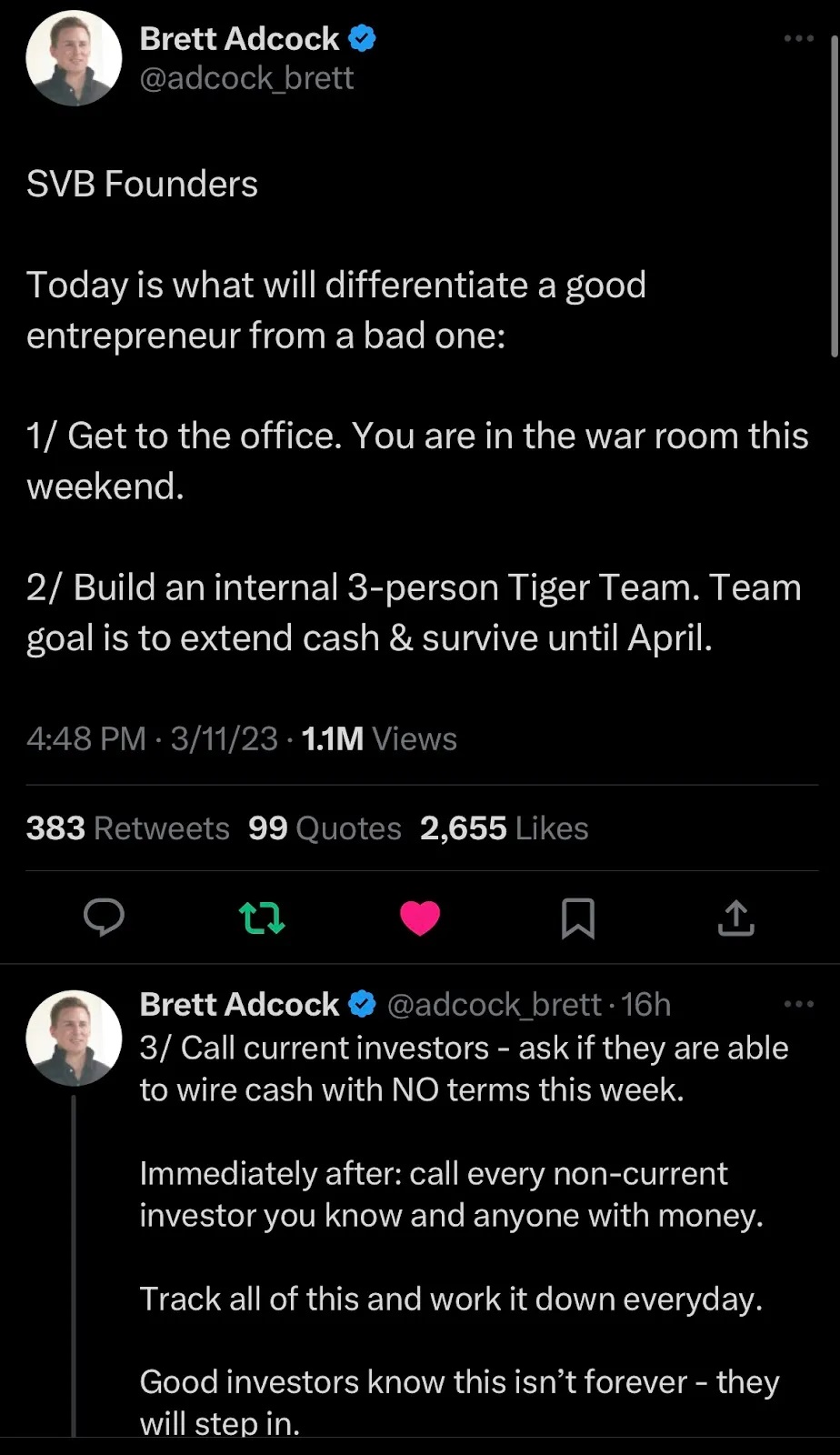
Now, this is where I rant. I saw a thread where founders were advised to cut costs and be in wartime mode, which is true. But it is very ridiculous that we went on a money-spending spree and jettisoned unit economics under the guise of high growth not minding the broader economic implications.

Crazy high valuations, oversized venture rounds, mismanaged funds, stupendous marketing budgets & CAC spending, excessive salaries pricing talent too high, now we can all rest and build more sustainable businesses. Startups and VCs also threw risk management out the door concentrating all their funds in single accounts. We will see less competition from too many businesses doing the same thing and racing to zero with revenue. I continue to expect more consolidations, faster exits, and the emergence of category kings.

Before I continue my rant, I’m now more curious about businesses that enable business models and individuals to manage and operate multiple bank accounts and wallets at the same time.

Now back to my rant; for banks like SVB, it’s even more annoying when you think about it. The concept of fractional reserve banking means that a bank doesn’t need to have all of its deposits readily available to meet withdrawals. They just need to have a portion and can chase yields by investing or creating loans. This may have worked in the pre-internet world, but in today’s world, it takes just 48 hours to crumble one of the world’s largest financial institutions by spreading information about insolvency.

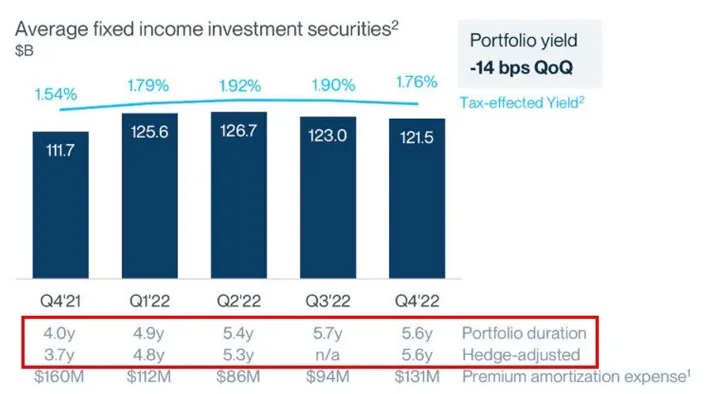
The chart below shows poor management of risk as SVB’s duration and interest rate risk were essentially the same, implying they didn’t even have any interest rate hedges on nearly $200B of assets.

For me, this is the end of an era of money, fractional reserve banking is dead at least without strict withdrawal limits, yield chasing is dead as demand for securities will drive prices up and lower yields, and everything we know about inflation and fighting it is also dead. Trust in the financial system and regulators guiding the economy is dead.

All of a sudden, we all agree on the need for regulation and institutions to save us from ourselves somehow; despite spending the better part of the last decade building innovation to replace regulation. I honestly think the age of regulation is also dead. I make it bold to say that the Fed has lost its control of the economy in the Information Age. I already highlighted in my last article about Fed’s role in the whole crisis by sending wrong signals to the market.

The new reality is until we embrace a new financial order, we will keep having these frequent boom and bust cycles in a much faster-paced world.

Final thoughts

I’m sorry to break the sad news, but we are in for a long haul, the next five years at least are set before us. I don’t see how we can escape a meltdown. Money and banking need to be fixed, or else we keep having frequent cycles of boom and burst. In a digital, more connected, and faster world, we could be seeing these cycles every three years, until we collectively rethink money. Perhaps, we may all eventually agree that crypto – “Internet money” is sound money and the future of money.

The best option is to start thinking of how to profit from the market. I have ideas.

I will be watching how things unfold over the next 6-9 months and if my postulations hold through, I’m going all in on the market.

With an equity-first strategy, I’d pick up blue-chip tech and non-tech stocks with strong cash flows and reserves at cheap prices in a couple of months. I’d also buy bitcoin and ethereum when they collapse. At least, we get a rare opportunity to start all over. Might be an actual wealth transfer as we get to invest at the bottom of the market.

One can also look out for breakout companies in AI, the future of work and money, with sound corporate governance. On fixed income, yields are dead, so lending especially venture debt to them with strict covenants may flourish.

Most importantly, swift rotation between cash and investment is important to win in these times. Same old buy low and sell high or wait for 20-30 years in hope of an innovation that truly advances human progress.

Be safe. Hope to write again soon.

Entertainment Law :- The Most Important Legal Validity Requirements For Music Producer Contracts in Nigeria.

0

Under the laws of Intellectual Property in Nigeria, creative service contracts like music producer agreements come with a lot of legal implications and come in many variants.

This article will be focused on the topics of :-

– What music production contracts are.

– The different types of music production contracts available in Nigeria.

– The requirements of a valid music production contract.

– The legal effect/implication of each type of music production contract in Nigeria.

What is a music production contract?

A music production contract is an agreement for the delivery of music production services (including but not limited to composing, licensed sampling and synthesization) between one party known as a music producer or a  producer and another party which can either be a musical artiste, a music record company, or any other individual or company that would qualify as a client.

What are the different types of music production contracts in Nigeria?

There are several types of music production contracts namely :-

– Producer/Record Company Contracts :- These are music production contracts that are usually paid for on an upfront & one-off but renewable basis by a record company.

– Publishing Split Sheet Contracts :- These are contracts for back-end consideration in place of upfront payments to the producer to be advanced for music production services. 

Such agreements are to be documented as split-sheet percentage sharing formulas between the producer, the artiste, and the record company for earnings from royalties, publishing rights, neighbouring rights and masters recording sales among others.

– Sync Licensing Agreements :- These are agreements for the licensing by a producer where he’s a part or full owner of the copyright of a creative work allowing his content to be used in an audiovisual format such as advertisements or movie soundtracks.

What are the requirements of a valid music production contract?

To be valid and enforceable music production contract must meet the following requirements :-

– It must have a set of defined parties :- This means that in cases where a client in a music production agreement is a label or record company seeking production services for its signed artiste, it is proper to have the agreement signed with the record company rather than the artiste.

– It must clearly define the services to be rendered by the producer.

– It must clearly outline the production process utilized by the producer.

– It must clearly state who has proper ownership of all intellectual property rights following any output produced under the contract.

This agreement must also not be contrary to public policy and statutory provisions on copyright law which expressly state that individual ownership of copyrights are to last for life and 70 years afterwards.

– It must clearly state appropriate dispute resolution measures in place.

What are the legal implications of each type of contract mentioned in this article so far?

Each type of music production contract comes with the following implications:-

– Producer/Record Company Contracts :- Agreements of this nature come with the major implication of usually stripping the producer of any right to copyright ownership of material produced pursuant to the contract, placing him strictly in the category of an independent contractor.

– Split-Sheet Contracts :- Typically the most commonly used musical production contract, split-sheet agreements carry the legal effect of rendering a producer a part-owner of all Copyrights created by such an agreement, placing him in the category of contracting partner.

– Sync Licensing Agreements :- Agreements of this nature render the rights of the producer enforceable where his musical output is delivered or used in any audiovisual format without his permission.