DD
MM
YYYY

PAGES

DD
MM
YYYY

spot_img

PAGES

Home Blog Page 4354

Roku Said $487m, 26% of its $1.9bn Cash is Trapped in Failed SVB

0

Roku has been caught in the Silicon Valley Bank collapse, where it has kept 26% of its cash. The streaming company said Friday that it had $487 million stashed in a lender that was shut down on by regulators.

The failure of Silicon Valley Bank exposed several tech companies to risk of losing their funds parked in the bank. In its disclosure to the US Securities and Exchange Commission (SEC), Roku said the $487 million held at SVB represents approximately 26% of the $1.9 billion in total cash and cash equivalents it has as of Friday.

Roku also said that most of its funds with the SVB are not insured, significantly minimizing its chances of recovering them. The Federal Deposit Insurance Corporation (FDIC) had said in a statement that when the bank opens on Monday, March 13, all insured depositors will have access to their insured deposits.

“At this time, the Company does not know to what extent the Company will be able to recover its cash on deposit at SVB,” Roku said in the filing. It added that its “existing cash and cash equivalents balance and cash flow from operations will be sufficient to meet its working capital, capital expenditures, and material cash requirements from known contractual obligations for the next twelve months and beyond.”

SVB’s shutdown marks the largest bank failure in the US since the 2008 recession. Roku said in the filing that its remaining $1.4 billion in cash and cash equivalents have been distributed across “multiple large financial institutions.”

However, the company told Insider via email that the trapped fund will not impact its operation. “As stated in our 8-K, we expect that Roku’s ability to operate and meet its contractual obligations will not be impacted and we continue to have access to $1.4 billion in cash and cash equivalents which are distributed across multiple, large financial institutions,” Roku’s spokesperson said.

SVB was shut down on Friday by the FDIC. The regulator then transferred the lender’s assets to a newly created bank, the Deposit Insurance National Bank of Santa Clara. The bank’s collapse became inevitable after it announced Wednesday it was trying to raise more capital, after selling part of its portfolio at a $1.8 billion loss.

The collapse of the bank, which lends heavily to venture-backed tech startups, has thrown the US banking industry into disarray – with many VC firms seeking secure financial institutions to lodge their money.

Reviewing the Utah DAO Act of 2023

0

On March 1, 2023, the Utah Legislature passed HB 357, the “Utah Decentralized Autonomous Organizations” Act (the “Utah DAO Act”). This was a combined effort of the Utah Legislature’s Blockchain and Digital Innovation Task Force, under the leadership of Co-Chairs, Senator Kirk Cullimore and Representative Jordan Teuscher.

Decentralized Autonomous Organizations (known as “DAOs”) are a priority for the State, and a priority for the Blockchain and Digital Innovation Task Force. Utah is a fast-rising technology hub, with a sophisticated and advanced approach toward on-chain, decentralized, Web3 software and financial platforms, making legislation giving legal recognition and limited liability to DAOs a priority for the Task Force. In short, technology innovators and leaders are demanding that legislation keeps pace.

We have been students, practitioners and admirers of the states that have used the “LLC wrapper” approach to grant DAOs limited liability protections and legal entity status. These states were the first through the gates and should be commended for their visionary leadership. There are, however, limitations to the “LLC wrapper” approach, which we sought to address in Utah’s approach.

The Utah DAO Act adopted a version of the COALA model law, which does more, goes further and achieves a level of “legal personality”, limited liability protections, and avenues for decentralization and anonymity than the simple “LLC wrapper” approach. More specifically, the Utah DAO Act, among other things:

– Defines the DAO ownership/participant base in the abstract consistent with the realities and ethos of a complex and vast DAO community.

– Incorporates a technology gatekeeping function to assure the DAO is indeed a DAO.

– Uses “Bylaws” (not an Operating Agreement) to protect the DAO ownership/participants with anonymity redactions and protections.

– Introduces quality assurance requirements for DAO protocols.

– Creates a clear and more nuanced tax treatment consistent with current DAO functionalities.

– Establishes that there are no implicit fiduciary duties owed by DAO participants unless those duties are explicitly stated to apply.

– In short, a limited liability company is not a DAO, and a DAO is not a limited liability company. The Utah DAO Act grants the DAO a form of legal recognition that is unique to DAOs.

The Utah DAO Act passed both the House and Senate committees (with narrow approval) and robust discussion. There were concerns –and compromises. The three major concerns were:

  1. Full “unaccountable” anonymity for the DAO base.
  2. (Original) tax language that was “LLC flow through” inconsistent with potential state and federal tax realities.
  3. Lack of ramp-up time to assure the Utah Division of Corporation is prepared to handle new applications.

Our approach to compromise was as follows:

  1. Accountability. Require each DAO to have a disclosed incorporator, while still allowing the DAO participant base to remain anonymous (and “redacted”).
  2. Tax Language. We solicited the participation of the Utah Tax Commissioners’ office to propose acceptable tax language, which is indeed more nuanced and consistent with the tax complexities of a DAO (that language can be reviewed under Section 48-5-406 of the Bill).
  3. Ramp-Up Time. We agreed to make the effective date of the bill 2024. We made that compromise so we would have another year to edit, adjust and assure the practical implementations can be made for a smooth adoption.

The Utah Department of Commerce, which oversees the Division of Corporations and the Division of Securities, both critical for the roll-out and adoption of the new legislation, has been hands-on, cooperative, and visionary in the eventual adoption of the new Utah DAO Act.

On March 1, with the amendments (and compromises stated above) the Utah DAO Act was passed unanimously by both the House and the Senate.

 What Now

The Task Force will continue to work closely with the Utah Department of Commerce for the 2024 implementation of the new Utah DAO Act. We will engage closely with relevant industries (technology, finance and legal) to assure the new law is efficacious to need and purpose.

We will spend the remainder of 2023 exploring any weaknesses in the legislation and working toward fixes, while at the same time preparing for administrative onboarding. The Task Force will also be looking for opportunities to build and eventually pass complementary DAO legislation.

 Challenges Remain

We understand the challenges of the current environment. We are not naive nor ignorant of many of the federal and judicial impediments of fractional sharing and tokenization, which are associated with DAOs. We also understand, however, that there is no going back, that the best technologies are being built in shared decentralized environments, and that law and policy should participate in and facilitate this movement.

The continued overreaching and (mis)application of isolated terms in Depression-era laws (and “intent”) to revolutionary technology poised to define the next generation of the internet needs to be reconsidered. It is like applying 1900 horse and buggy speed codes to the era of automobiles. There is a path out of the oversimplified dichotomy of securities versus non-securities “analysis”, and that path starts with bold legislation which leans into new technologies.

If the United States and other similar sovereign states don’t find that path they will get left behind — literally placed behind exclusionary firewalls where the best ideas and innovations are taking hold. The US’s failure to embrace these technological innovations has already resulted in a sharp decline in America’s share of blockchain developers as compared to the rest of the world.

So, starting in January 2024, a “Utah LLD” (a DAO designation under the new law) may be formed in Utah, and the State will become a welcoming environment for decentralization and on-chain innovation. We are excited about the possibilities.

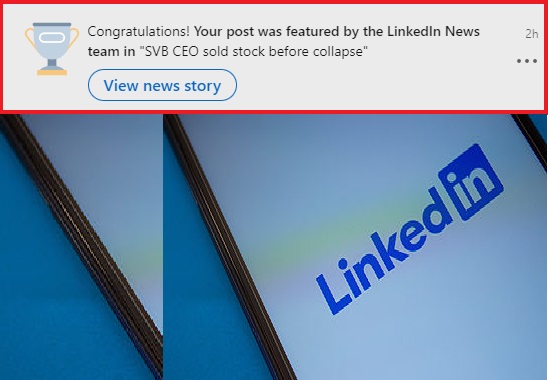
LinkedIn News Features Our Piece on Banking 101 And Bank Failures

0

LinkedIn News featured our post on Banking 101 and why Silicon Valley Bank struggled and collapsed. As a former Lagos banker (a really good one; ask my supervisors, they rated me 5/5 continuously), that piece explained the systemic risks of the high interest rate regimes in the United States.

Now, the government has a choice: socialize losses after the millionaires had privatized their gains during the boom times. Indeed, now they are in trouble, the taxpayers will be needed to bail them out.

Read the feed here – thanks LinkedIn team for the assist; very appreciated.

Less than two weeks before Silicon Valley Bank had sold part of its portfolio at a $1.8 billion loss and was trying to raise more capital, CEO Greg Becker sold $3.6 million worth of company stock, Bloomberg reports. Regulators shut down Silicon Valley Bank on Friday amid liquidity worries and a run on deposits — the biggest bank failure since the 2008 financial crisis. The stunning collapse has at least one notable investor calling on the government to consider a “highly dilutive” bailout of the bank.

Here is the latest news on the collapse:

  • Circle Internet Financial, which operates USD Coin, a digital stablecoin, said it had $3.3 billion tied up in Silicon Valley Bank. As a result, the virtual currency fell below 87 cents on Saturday, according to CoinDesk.
  • Silicon Valley Bank has been put under the control of the US Federal Deposit Insurance Corporation, which is serving as the tech lender’s receiver.
  • According to the FDIC, insured depositors will have access to their deposits by Monday morning, at the latest.
  • Some analysts and investors are arguing that Silicon Valley Bank’s downfall is an indicator that interest rate hikes have been too aggressive, The Washington Post reports.

SVB’s Speedrun: A bankrun in the internet world

0
FILE PHOTO: SVB (Silicon Valley Bank) logo and decreasing stock graph are seen in this illustration taken March 10, 2023. REUTERS/Dado Ruvic/Illustration

How fast can you crumble a bank and an economy today? 48 hours. I write about the chilling story of Silicon Valley Bank’s collapse, what it means for all of us.

The last 24 hours have been all about the collapse of US bank ~ Silicon Valley Bank (SVB) but what really is SVB, how bad is it, and what should we expect from the second largest bank collapse in US history and the first bank run of the internet world?

SVB was the 16th largest bank in the US with $200B+ assets at the time of failure, banking 50% of the US tech, VC, healthcare & biotech ecosystem; which has now become its Achilles heel.

Made by internet-age businesses, SVB was also killed by the digital era. It took less than 72 hours of panic withdrawals enabled by transfer technology to bring the bank to its knees with $40B+ in withdrawal requests – “a speedrun”, as described by Slow’s General Partner, Sam Lessin.

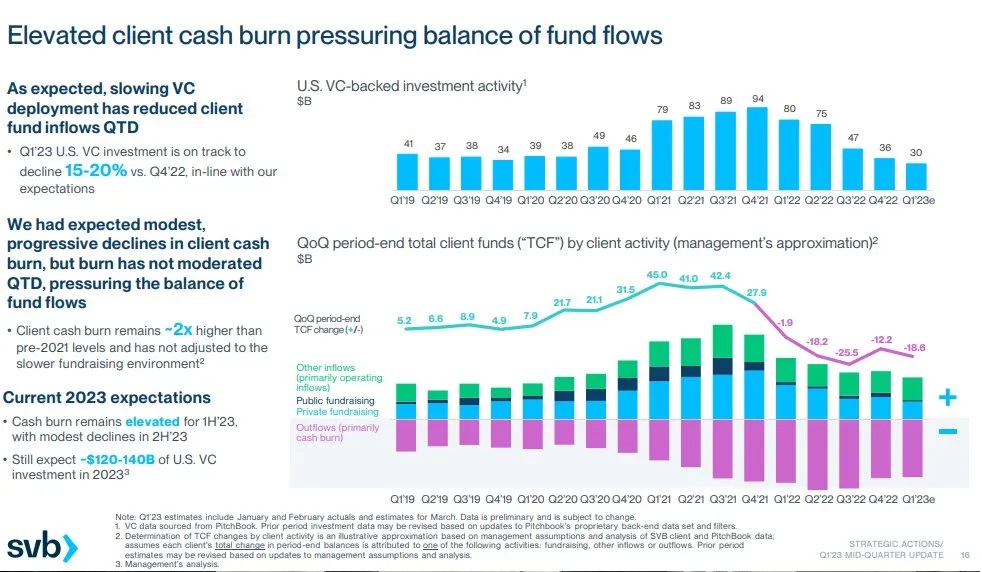
SVB customers are high-growth businesses and are products of a low-interest rate environment, where funding was awash. The chart below shows continued spend by SVB customers despite a slowdown in inflows.

To meet its growing liquidity needs, SVB bowed to duration risk, losing nearly $2B from selling $21B+ of medium to long-term securities. SVB quickly attempted to raise $3B in equity to cover its position. Once this became public, panic about the bank’s solvency spread like wildfire. SVB’s stock sunk by 60% on Thursday. Apparently, in the era of Twitter and Reddit, it’s much easier to crumble a bank and the economy.

Notable leaders like Peter Thiel, founder of Paypal & Founders Fund asked customers to withdraw their money from SVB, sparking what will be the end of SVB. You know the rest. If you short SVB and sparked a withdrawal frenzy, you should be smiling to the bank. That is now more of an irony in this case, as everyone will be affected directly or indirectly. In my opinion, it shouldn’t have been SVB, an agelong partner of the innovation ecosystem.

This is all so similar to the FTX situation last year, which the crypto market is still struggling to recover from, although FTX was a grossly criminal situation. Unlike crypto, there is a big brother in the fiat market – the regulators. At the time of writing, the FDIC has seized control of the bank and will be commencing the process of selling down its assets to pay SVB depositors. Let me add that 97% of SVB’s assets are uninsured deposits, exceeding FDIC’s $250,000 payout for insured accounts.

To be fair, another culprit is the Fed. After signaling lower interest rates, and rushing everyone into longer-dated securities, you make a dramatic u-turn and start an aggressive rate hike campaign, leading to significant mark-to-market losses from the fall in bond prices. Anyway, the Fed can mitigate this situation. By cutting rates and starting an aggressive bond purchase ~ QE program, the Fed might be able to save us from ourselves. This is particularly important because just like SVB, many institutions hold a similar investment strategy and are booking losses from falling bond prices.  However, the prisoner’s dilemma for the Fed, is sacrificing its fight to keep rising US inflation in check with rate hikes.

What should we expect?

  • If we give in to FUD, the immediate order effect will be a widespread test of bank solvency from mass withdrawals which may crumble the US financial system and cause a global economic meltdown just like 2008.
  • Mid-month payroll is next week and companies may struggle with salary payment, which is quite chaotic when you recall that 51% of Americans earning over $100,000 a year mostly tech workers, are living paycheck to paycheck. This implies a slowdown in consumer spending, except the US government, steps up with a cash transfer scheme.
  • What’s even scarier is the fact that VCs who are the lifeline of the technology market might have been affected by SVB’s collapse. That’s $200B worth of assets, so this is very possible.
  • We should be expecting a slower funding market, and steep cost-cutting measures like hiring freezes and layoffs.
  • Let me add that one concept I’ve been fascinated with of late, is remote work & global talent. Hiring cheaper and same quality talents from Africa or Asia may prove to be one of the cost-cutting measures, that will make businesses more resilient in a market like this.
  • Just to note, SVB’s assets are still very much alive. The authorities will just need some time to sell down the assets if SVB doesn’t find a buyer pretty soon, which is why the Fed should come in and stop falling bond prices.
  • This presents a good opportunity for other banks to cannibalize with a lending product backed by SVB deposits. Brex has already swung into action with this. Regardless, it’s a market for the taking, so other players can start their own lending products.
  • I’m not sure if crypto or “non-custodial wallets” will reap many gains from this. USDC’s de-pegging after Circle announced that it holds part of its treasury in SVB will likely not age well for web3. I’m actually rooting for Circle, as I am a big fan. Nonetheless, if you were stanning SVB just a few days ago and gave into hope, you’re definitely facing some challenges right now. On the flip side, liquidity line business models may thrive as web 2 & web 3 financial companies grapple with rising liquidity pressures during this period.
  • To suffice, holding cash as Bloomberg predicted, and keeping burn low while not compromising productivity will be a winning strategy. All roads do not lead to a good end, so I’d say for the umpteenth time that someone needs to step in and save us from ourselves.

Naira Redesign: 10 States Move to File Contempt Proceeding Against CBN, Nigerian Government

0

About 10 states are preparing to file a contempt suit against the federal government and the Central Bank of Nigeria (CBN) over their refusal to obey the Supreme Court judgment, ordering that both old and new N200, N500 and N1,000 notes be allowed to coexist till the end of the year.

The apex court’s judgment was in response to a suit filed against the federal government by 16 states, challenging the naira redesign policy, which was announced late last year by the central bank. The court had described the policy as an affront to Nigeria’s constitution.

The federal government and the CBN have refused to comply with the court’s judgment, prolonging the chaos that was unleashed by the policy. The policy has exposed the Nigerian public to severe cash crunch that has scuttled economic activities.

President Muhammadu Buhari, in his February 16 national broadcast, said the policy was targeted at curbing money laundering, terrorism financing and moneybag politics. He appealed to Nigerians to be patient as the measure will lead to “the collapse of Illegal Economic Activities which would help to stem corruption and acquisition of money through illegal ways.”

However, the disadvantages of the policy have outweighed the gains. The federal government had disobeyed the Supreme Court earlier order, restraining it from enforcing the February 10 deadline set by the CBN to phase out old naira notes.

Following the March 3 judgment, the federal government and the CBN have been mum, creating anxiety as banks are restrained from implementing the judgment. The banks said they’re waiting on the CBN’s directive on the judgment, which has not come. This means that the despite the Supreme Court’s ruling, the old naira notes are not regarded as legal tender, compounding the cash crunch crisis.

On Friday, the governments of Kaduna, Kogi, Zamfara, Ondo, Ekiti, Katsina, Ogun, Cross River, Lagos and Sokoto states served the Attorney General of the Federation (AGF) Abubakar Malami, the enrolled order and certified true copy (CTC) of the supreme court judgment. They were among the 16 states that initiated the suit against the CBN and the federal government.

“We have finally served the Attorney-General of the Federation the enrolled order of the Supreme Court,” the plaintiffs’ lead counsel, Abubakar Mustapha said.

“What we did on Friday was to fulfill all righteousness by serving the enrolled order on the AGF. The Federal Government has been evasive by claiming that it had not received the Certified True Copy (CTC) of the judgment, which we have obtained and made available to it. The burden is on Malami to act as the Chief Law Officer of the Federation to comply with the order.

“There is no hiding place for the government; there is no excuse again. While we are waiting for the government’s decision, the law provides us backing for Plan B.”

Mustapha said serving the enrolled order is the first step to instituting a committal proceeding against the CBN and federal government if they do not comply immediately with the judgment.

“The Attorney-General of the Federation has been served now and we will take it up from there; if there is no compliance now, we will commence committal proceedings against the attorney-general and the CBN governor,” Mustapha told ThePunch.

“When the Supreme Court talks, the constitution makes it compulsory for all government representatives and everybody to comply with its order. It’s not discretional, you have to obey, it is the last and the final and that is why we have separation of power.

“The presence of separation of power is for checks and balances; when the Supreme Court talks, it must be complied with by all persons.”

The enrolled order reads as follows: “It is ordered that this suit has merit. That the demonetization directive/policy by the President of the Federation to wit: withdrawal of the old 200, 500, and 1000 naira notes is not consistent with the provision of the Constitution of the Federal Republic of Nigeria 1999 (as amended) which makes provision for the Executive power of the President of the Federation and the extant laws on the subject matter.

“That the three months’ notice given for the implementation and completion of the said demonetization policy by which time the old N1,000, N500 and N200 naira notes shall cease to be legal tender does not satisfy the condition set out in Section 20(3) of the CBN Act 2007.

“That the President cannot unilaterally give a directive to embark on the demonetization policy pursuant to Section 20(3) of the CBN Act 2007 in view of Nigeria’s Fiscal Federalism, the economic interest of the Constituents of the Federation and without consultation with, and advice from the plaintiff, individually, and in their capacity as members of the National Council of States and National Economic Council and that the directive cannot be given without consultation with, and advice from the cabinet, the National Security Council and other stakeholders.

“That in issuing the directive for demonetization policy pursuant to Section  20(3) of the CBN Act, 2007 on behalf of the Federation of Nigeria, the President is under an obligation to ensure that adequate structures are put in place for the plaintiffs and Nigerian citizens prior to the implementation  of the said directive.

“That the demonetization directive/policy by the President of the Federation to wit: withdrawal of the old N200, N500 and N1, 000 notes unlawfully impede the exercise of the Executive Powers of the plaintiffs’ states and other obligations to facilitate and protect the welfare of the citizens of the said states pursuant to Section 5(2) and other provisions of the Constitution of the Federal Republic of Nigeria 1999(as amended) as well as other extant laws.

“That the directive given by the President pursuant to Section 20(3) of the CBN Act 2007 limiting the amount that can be withdrawn and the charges therein without an enabling law is unconstitutional and not binding on the plaintiffs.

“That the directive of the President of the President of the Federation exercised is illegal to the extent that it restricts, without an enabling law, the rights of the plaintiffs to freely use their money in various bank accounts.

“That the old version of N200, N500 and N1,000 notes shall continue to be legal tender alongside with the new or redesigned version until 31st December, 2023.

“That the reception of old N200, N500 and N1,000 notes and the swapping of same with new Naira notes shall continue till 31st December, 2023.

“That all the consolidated suits listed in pp. 12-13 of the judgment shall abide this judgment.”