Automotive and clean energy company Tesla is recalling 3,470 Model Y vehicles in the US over concerns that bolts securing the second-row seatback frames may not have been securely tightened.
According to the National Highway Traffic Safety Administration (NHTSA), it disclosed that a loose seat frame bolt may reduce seat belt system performance, increasing injury risks during a crash.
Although the automaker told the NHTSA that it has identified five warranty claims since December that may be related to these conditions. Tesla said it was not aware of any injuries or deaths that may be related to the recall issue.
It will therefore go ahead to inspect bolts securing second-row driver-side and passenger-side seat back frames to the lower seat frames and if needed tighten them to specifications. Tesla does not plan to issue any reimbursements because there are no warranty repairs related to these conditions.
Recall that Tesla last month also recalled 362,758 of its vehicles, after it admitted that it’s Full Self-Driving (FSD) beta software causes several crashes. The FSD Beta system is reported to act unsafe around intersections such as traveling straight through an intersection while in a turn-only lane, entering a stop sign-controlled intersection without coming to a complete stop, or proceeding into an intersection during a steady yellow traffic signal without due caution.
The models involved in the recall included the 2016-2023 Model X and Model S, the 2017-2023 Model 3, and the 2020-2023 Model Y with the FSD beta. The update of the software on these models will be done over the air to address the issues.
Tesla lets thousands of drivers try new and unfinished driver assistance features on public roads in the U.S. through FSD Beta. The technology does not make Tesla electric cars autonomous, or safe to drive without a human at the wheel ready to break or steer at any second.
Meanwhile, the CEO of Tesla Elon Musk and its customers have objected to the use of the term “recall” to describe safety defects or issues that can be fixed without a software update delivered over wireless internet. Musk said the word recall for an over-the-air software update is flat wrong.
According to a Forbes report, Tesla’s latest recall of over 360,000 of its vehicles put its total recall in the last year over 4 million, the second-most among U.S. automakers, though the vast majority of its recalls have been software fixes that haven’t required visits to shops.
Ford motors comes first among the top ten car manufacturers that have recalled the most cars since 2022 with 9,141,131 cars, and 72 recalls. Tesla occupies the second position with 4,132,303 cars, and 21 recalls and General Motors occupies the third position with 3,415,313 cars, and 34 recalls.
This is my playbook: Rwanda, Gambia and most less populated African countries are not great places to launch a business to consumer (B2C) startups except in healthcare and broad food areas. In those countries, I only get interested if the company is in the business to business (B2B) space. I do think the population is small to provide numbers which can enable leverageable factors to compound towards scaling a business. In other words, in those countries, B2B could work but B2C will struggle as the scalable advantages are severely limited.
But when it comes to Nigeria, Kenya, and South Africa, anything is possible. You can launch a B2C or B2B because they have the numbers.
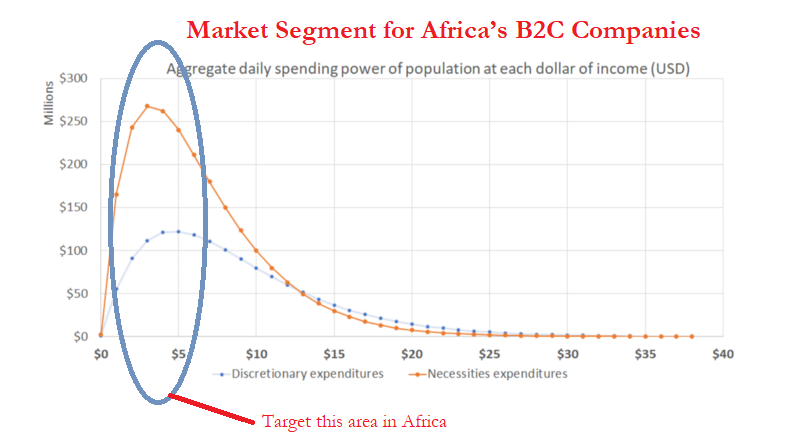
Now, you want to do business in the B2C space in Nigeria, the question is “where do you position the company”? From multiple data, the best range and the most promising is to target people making $4 — $8 per day. That income band holds the highest concentration of discretionary spending power in the nation. That is where Ariel, Cowbell, Bigi Cola, La Casera, and other resilient brands in Nigeria operate.
Interestingly, that is also where I see a big percentage of my popular 30 million people who earn relatively decent income in Nigeria; those 30 million are the core of the consumer market.
Now what if my product optimally should be in the range of $10 per day-consumer? Solution, go sachetization where you break the pricing in bands, making it easier for people to pay for what they can afford. We practice this; explore that in your business as Nigeria continues to recover from economic paralysis.
That is why you have Tekedia Mini-MBA (N90,000); with Homework review (add N10k), with Capstone (N20k), etc. We practice what we teach! Pricing-democracy, you come in at the size of your purse!
This may not be far from what The New York Times called premiumization.
Comfort Plus. Fast pass. Main cabin extra. Most of us are familiar with a corporate lexicon that gently coerces us to shell out for a little more legroom, free shipping or lower wait times. But the trend is now growing voraciously beyond airlines, The New York Times reports. A broad swath of America’s biggest companies want to exploit a buzzy new corporate catchphrase: “premiumization.” The paper notes that with soaring inflation testing many people’s spending levels, companies are aggressively targeting their affluent customers with the means to pay more.
The current earning season was dominated by talk of “premiumization,” The Times notes, with almost 60 earnings calls and investor meetings mentioning it over the past three weeks.
As more products become prohibitively expensive to more people, it’s more likely that “poorer consumers will be increasingly underserved.”
I run the largest business school in Africa. More learners will graduate here in 2023 than any university in Africa. We have learners from 41 countries. From CEOs to catholic priests, from professors to carpenters, from engineers to medical doctors, and beyond, we continue to thrive on how we can help people understand the physics of business.
Our learners out of Lagos, Nairobi, etc have gotten jobs in Microsoft, Google, and leading companies in the world. I am humbled when executives from global companies openly share their feedback. This is a public service and we will keep improving.
I invite you to register for Tekedia Mini-MBA; we just opened registrations for the next edition. Go here and begin a journey of transformation https://school.tekedia.com/course/mmba11/
Regarded as one of the fastest growing sectors in Nigeria, the contribution of the Information and Communication Technology (ICT) sector to the gross domestic product (GDP), grew by 9.76 percent in 2022, from 6.55 percent reported in 2021.
According to the executive secretary of the association of telecommunication companies of Nigeria (ATCON) Ajibola Olude, he stated that the ICT sector is reported to have grown significantly due to several factors. One of the reasons he mentioned is the steady awareness to move all services rendered by both the government and private sector online, which he believed led to an increased usage of more data by the organization.
In his words,
“With the central bank of Nigeria on the quest to promote a cashless policy economy, more individuals and organizations are gradually embracing the use of USSD, mobile, and internet banking, and many others, this also tends to improve the ICT sector.
“More money coming into the country via foreign direct investment in capital importation in the ICT sector, this also accounts for the growth in the Nigerian economy”.
According to Data reported by the industry, it indicates that the telecommunication and information sector reported the highest growth rate compared to other ICT sectors in the economy. On a year-on-year basis, the sector growth rate increased by 10.72 percent in 2022, higher than the 7.28 reported in 2021.
The ICT sector has provided 3 unprecedented contributions to the Gross Domestic Product (GDP) of the country in the last three years, which are 14.07 percent in Q1 2020, 17.92 percent in Q2 2021, and 18.44 percent in Q2 2022. It is interesting to note that each time, that has been the highest-ever contribution of the ICT sector to Nigeria’s GDP.
The growth recorded in the industry in the fourth quarter (Q4) of 2020, made it the fastest-growing sector of the Nigerian economy and the only sector to have grown by double digits. It was reported to have played a critical role in enabling Nigeria to exit the recession.
Operators in the ICT Industry disclose that the sector growth can be attributed to the increasing number of internet service subscribers, mobile service subscribers, and the growth in broadband penetration.
In 2020, while speaking at the Digital Nigeria Day (DND) with the theme “Digital Transformation: A Path To Sustainable Digital Economy”, Nigeria’s Minister of Communication and Digital Economy, Prof. Isa Ali Pantami emphasized that the implementation of a digital economy policy accelerates digitalization and this, in turn, enhances the digital economy.
The minister highlighted that digital platforms have engendered the digitization of business processes and led to significant savings. He, therefore, tasked stakeholders to persist in supporting the ministry to further accelerate the development of the digital economy sector.
Looking ahead into 2023, increased adoption of cloud computing is one of the potential trends that may shape the development of ICT. As businesses in Nigeria find means to reduce costs and improve efficiency, many citizens will turn to cloud computing solutions to store and process data.
Yesterday, a learner in Tekedia Mini-MBA program asked me to provide an example where a Nigerian company implemented the One Oasis and Double Play Business Strategy which I had postulated in Harvard Business Review. In my response, I used Tekedia Institute, the home of Tekedia Mini-MBA.
My thesis is that in the digital age where supply is unbounded and unconstrained, you cannot win via just supply (there is no business-focused video you cannot find a substitute free on YouTube or somewhere online). If that is the case, focusing on influencing demand becomes strategic. Tekedia.com is the one oasis while school.tekedia.com is our double play!
What is your one oasis? And what is your double play? Shine ya eyes because where people make money may not come from their most popular or visible products. Ask Amazon (ecommerce is popular, but money comes from AWS); Samsung (Galaxy is popular, but money comes from chip business); etc. If you focus on copying that visible and popular product without the supporting double play elements, success may not come.
In the past, business was about controlling supply to move prices. Manufacturers had control of supply but they had limited direct control on the consumers [you can control how many newspapers you produce but you have no definite control on how many people would buy]. So, winning markets was really about managing and controlling distribution as most businesses were bounded and constrained by geography, creating advantages which were largely localized [the largest newspaper in a region controlled the top news of the day].
But today, the game has shifted from control of supply to control of demand for web-anchored consumer firms. And only companies with capabilities to control demand are going to win big. Indeed, most of the greatest internet companies are simply controlling demand and that means controlling how supplies reach users and consumers.
If you plan to run an internet business, think about how you can control demand. You have already lost the power and capacity to control supply. Through tekedia.com, we influence demand which now opens the doors for the school.tekedia.com supplies.
Demand Chain Is Key
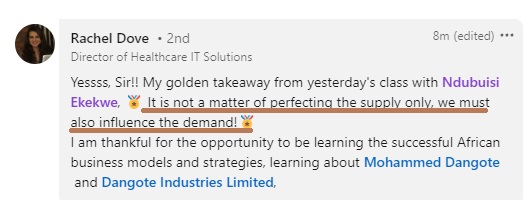
Rachel Dove provided the summary of yesterday’s lecture, in a comment: “Yessss, Sir!! My golden takeaway from yesterday’s class with Ndubuisi Ekekwe, ? It is not a matter of perfecting the supply only, we must also influence the demand!?” Indeed, most times, we invest all efforts to perfect the supply chain, while we neglect the demand chain. Yes, it cannot be only the supply chain, we need to work on the demand chain! Lol.
Later in the program, I will explain how demand chain efficiency improves marginal cost and unit economics, and advances the capacity of firms to grow and thrive. The fundamental thing is to find the mechanics on how to build category-king companies through innovation, growth and top-grade operational execution.
I run the largest business school in Africa. More learners will graduate here in 2023 than any university in Africa. We have learners from 41 countries. From CEOs to catholic priests, from professors to carpenters, from engineers to medical doctors, and beyond, we continue to thrive on how we can help people understand the physics of business.
Our learners out of Lagos, Nairobi, etc have gotten jobs in Microsoft, Google, and leading companies in the world. I am humbled when executives from global companies openly share their feedback. This is a public service and we will keep improving.
Comment: “I was taken aback with that answer last night. Considering that in focusing on demand you undermined the importance of the content of the course over visibility of the school.”
My Response: We have the best content and our program quality is the best. I hope I can make that point before you. Yet, even if we have the best content and no one knows about it, we will fail. There is no topic in business that someone has not provided FREE on YouTube. The deal now is How Do You Break Through for people to pay attention? That is where the strategy comes in because in digital, supply of quality content is unbounded (many of them) and if you do not help demand narrow down, you fail.
If you need a paytech fintech, there are more than 200 companies that can help you collect money online in Nigeria. The one which influences you will get your attention. You will not have enrolled in Tekedia if not that you have read a post I wrote or watched my video. By doing that, I am influencing you, giving you confidence to go ahead and pay, trusting that quality will be high. That is influencing demand.
Open your mind because Tekedia is structured to bring new perspectives to our learners.
Of course as that happens, we expect questions/exploratories from our learners. But our goal is not to just teach the boring standard things. That is why we work hard to develop new frameworks. More than 15 companies have cloned Tekedia Mini-MBA, but all failed. Why? They do not have tekedia.com which makes it very hard for them to even tell people what they have.
But tekedia.com is not required in all businesses; my point is that you need to understand what drives your strategy. Elon Musk’s reputation is more than 50% of Tesla’s value. If he resigns from Tesla, the company will lose more than 50% of its value in 5 days. So, he has used his genius perception to influence demand even though other car companies may be closing on on Tesla car quality.
Comment 2: Unbounded opportunities abound to those who can look deeper beyond what is visible.
Like I said yesterday afternoon that for every lecture at Tekedia Institute one will not want to miss the next one. It was an awesome experience yesterday at the lecture.
Comment 3: I started thinking deeply after last night meeting, on how to implement such efficacious strategy in my space. Another good example of the one Oasis and double play is McDonald’s fast food.
While its restaurant serve food and is popular, they make most of their earning in real estate.
Thanks alot Prof.
Comment 4: How about MTN? Its key products have to decide amongst themselves which should be the oasis: voice, data, mobile mobile? They are on a march to reach an unbeatable self reinforcing equilibrium. Something to watch out for…
My Response: Yes, the greatest of companies can have many oases, not just an oasis. Microsoft has Windows, Office Suite as oases as those are money-makers.