DD
MM
YYYY

PAGES

DD
MM
YYYY

spot_img

PAGES

Home Blog Page 440

Trump Announces 100% Film Tariff, Threatening Hollywood and Global Cinema Trade

0

US President Donald Trump on Monday said he would impose a 100 percent tariff on all foreign-made films, an unprecedented move that extends his protectionist trade agenda into cultural industries and risks disrupting the global movie business.

The announcement, made in a post on Trump’s Truth Social platform, claimed that America’s moviemaking industry was being stolen by international rivals.

“Our movie making business has been stolen from the United States of America, by other countries, just like stealing candy from a baby,” he wrote.

The measure, if enforced, would directly threaten Hollywood’s reliance on international co-productions and box office revenue while also striking at foreign film industries that depend on exporting movies to the lucrative US market. Netflix shares dropped 1.5 percent in early trading following the announcement.

It remains unclear what legal authority Trump would use to apply a tariff on films. But trade lawyers point out that films are often categorized as intellectual property or services rather than goods, which complicates the use of tariffs. Studio executives have expressed confusion about how the measure could be enforced in an era where movies are funded, shot, and edited across multiple borders.

The president had first floated the idea in May without offering details, leaving the industry “flummoxed,” especially over how co-productions would be classified. Modern blockbusters often combine American financing with European post-production, Asian special effects, and international talent, raising questions about how the line between foreign and domestic films would be drawn.

Shockwaves Beyond Hollywood

While the policy has alarmed Hollywood studios, its ripple effects would extend far beyond the United States. Foreign film industries that have steadily grown their footprint in the US market now face the prospect of losing access or watching ticket prices double under tariffs.

  • China, now the world’s second-largest movie market, has long used cultural exports as soft power. Big-budget titles such as The Wandering Earth and Wolf Warrior 2 have found audiences abroad, while Chinese studios increasingly partner with American distributors. A 100 percent tariff would make these imports far more expensive, eroding their competitiveness and possibly pushing Beijing to retaliate against US films seeking entry into Chinese theaters.
  • India, home to Bollywood, Tollywood, and a sprawling regional film ecosystem, would also be affected. Indian films like RRR and Pathaan have enjoyed breakthrough success with US audiences in recent years, boosting the global profile of the industry. A tariff would blunt that momentum, especially for mid-budget productions that rely on the diaspora market in North America. For Indian studios, which already operate on thinner margins than Hollywood, doubling the cost of entry into the US market could prove prohibitive.
  • Nigeria’s Nollywood, the world’s second-largest film industry by volume, has built an expanding audience base in the United States through streaming platforms and theatrical releases targeting African diaspora communities. Films like The Wedding Party and King of Boys have gained international traction. With a 100 percent tariff, Nigerian films could lose affordability and exposure in US cinemas, slowing Nollywood’s global expansion at a critical moment when it is beginning to gain wider recognition.
  • Europe has long been a steady exporter of prestige cinema, with French, British, Italian, and Spanish films regularly securing US theatrical releases, awards recognition, and festival distribution. Co-productions between Europe and Hollywood are also a pillar of the industry, from arthouse dramas to streaming hits. A tariff would complicate financing structures and undermine cultural exchange, potentially reducing the flow of European films into the US while inviting retaliatory measures from Brussels.

Hollywood’s Global Dependence

The irony is that Hollywood itself depends heavily on foreign markets. Overseas audiences account for the majority of box office receipts for many blockbusters, while production is often outsourced abroad for cost and tax benefits. Trade analysts warn that targeting foreign films could spark retaliation from China, India, or Europe, making it harder for American studios to distribute their own films internationally.

Trump has introduced uncertainty into one of America’s most successful export sectors by venturing into cultural industries. Films and related services have traditionally delivered a trade surplus for the US, with Hollywood productions dominating global markets. Tariffs, analysts argue, risk undermining that advantage.

Gold Hits New ATH of $3831 Per Ounce

0

Gold has surged to a fresh all-time high today, September 29, 2025, with spot prices reaching $3,831.28 per ounce amid ongoing safe-haven demand and expectations of further Federal Reserve rate cuts.

This marks the 38th record high of the year, pushing gold up 43% year-to-date and on pace for its strongest annual performance since 1979. U.S. gold futures settled 1.1% higher at $3,815.70, while the broader rally has seen prices climb nearly 35% since January, outpacing major asset classes.

Escalating tensions and U.S. recession fears are driving investors to gold as a hedge, with 85% of central bankers citing its role in mitigating geopolitical risks. Anticipation of additional rate cuts into 3%+ inflation has boosted inflows into gold ETFs and central bank reserves, which hit a record 710 tonnes quarterly.

The weakening U.S. dollar down 9% YTD mechanically lifts gold’s dollar-denominated price. Global reserves are expanding, with the U.S. now holding over $1 trillion in gold—2.4 times more than Germany’s. No central banks expect to reduce holdings this year.

Analysts remain bullish, with forecasts pointing to $3,800 by year-end and potential climbs above $4,000 in 2026, driven by sustained demand from central banks, ETFs, and investors hedging against stagflation and U.S. policy risks.

However, short-term overbought conditions could lead to tactical pullbacks. Traders are calling it “insane” and linking it to Bitcoin’s potential rally, with posts noting gold’s edge over BTC 0 days without a new ATH vs. 46 for Bitcoin.

Gold’s fresh all-time high at $3,831.28 per ounce isn’t just a win for traditional safe-haven seekers—it’s a macro signal that’s lighting a fire under cryptocurrencies, especially Bitcoin.

The same drivers fueling gold’s 43% YTD surge geopolitical tensions, Fed rate cuts, dollar weakness, and inflation fears are creating fertile ground for crypto’s risk-on rotation. While gold acts as the “boomer hedge,” BTC and alts are positioned as the superior, programmable upgrade—scarce, divisible, and borderless.

Gold’s rally signals capital fleeing fiat into hard assets, but as risk appetite returns, that liquidity often rotates into higher-beta plays like crypto. Historically, when gold breaks ATHs amid rate-cut cycles, Bitcoin has followed with amplified gains—up 150-300% in the subsequent 6-12 months in past parallels.

With the Fed eyeing more easing into 3%+ inflation, expect inflows to Bitcoin ETFs to rebound from August’s outflows, potentially pushing BTC toward $185K-$220K if gold hits $5,000, per Goldman Sachs models.

Central bank gold buying forecast at 900 tonnes in 2025 underscores a “hard money” theme, but tokenized gold on blockchain could integrate with DeFi, using BTC/ETH as settlement layers for trillions in RWA. This isn’t zero-sum—it’s symbiotic, with gold’s $15T+ market dwarfing crypto’s $4.14T cap, priming explosive adoption.

BTC’s BTC/GOLD ratio is tightening, with an “arb bid” emerging as Bitcoin becomes more attractive relative to gold’s physical limitations. On a power-law trajectory, BTC could surpass all above-ground gold’s value by 2033, turning holders “gold-rich” in dollar terms while capturing reserve asset flows—Harvard estimates BTC needs just 1/3 of gold’s $7-8T monetary role for massive re-pricing.

Gold’s unlimited supply 2,500-3,500 tonnes mined yearly vs. Bitcoin’s 21M cap amplifies this: As fiat distrust grows like US debt erosion, BTC’s scarcity drives outsized moves. PlanB’s models suggest BTC/GOLD could rise 8-10% annually, adjusted for liquidity, signaling BTC’s “other force” is kicking in.

Ethereum could hit $4,495-$5,190 in 2025 on Web3 adoption, with Solana, XRP, and Cardano benefiting from institutional stablecoin flows. Gold-collateralized DeFi loans could refinance US debt indirectly, boosting perps and risk management in crypto.

DOGE’s ETF odds at 80% by year-end could spark liquidity, tying into the “gold with Bitcoin” alliance where safe-haven flows prime speculative runs. Short-term caution—gold’s overbought status and Nasdaq/gold/BTC divergence hint at liquidity favoring trad assets, with BTC ETFs seeing $27M outflows recently.

A DXY breakdown lags crypto by months, so near-term consolidation is possible before the “most hated rally.” This gold ATH isn’t a threat—it’s confirmation. Crypto lags by weeks/months but amplifies the move, with BTC poised for divergence and outperformance.

As one trader put it: “Gold rallies on fear, Bitcoin on inevitability.” Stay long on dips; the hard money revolution is just heating up. If you’re allocating, BTC remains the core play, with ETH and select alts for rotation upside. DYOR—markets can whipsaw on Fed surprises.

OpenAI Rolls Out Parental Controls for ChatGPT Amid Safety Concerns and Political Scrutiny

0

OpenAI has introduced long-awaited parental controls for ChatGPT users on the web, with a mobile rollout expected soon, marking its most significant attempt yet to address mounting concerns about the platform’s impact on teenagers.

The new system, announced in August and now available, allows parents to limit or remove certain content such as sexual roleplay, graphic imagery, and extreme beauty ideals. It also gives them the option to disable ChatGPT’s memory of past transcripts, switch off voice mode or image generation, restrict access during “quiet hours,” and prevent teens’ conversations from being used to train OpenAI’s models.

Parents must hold their own OpenAI accounts to set up the controls. Teens must opt in by linking their accounts, and they retain the ability to disconnect at any time, though parents will be notified. Notably, parents cannot view their children’s conversations, except in rare cases when the system flags a serious safety risk and alerts parents with minimal details.

OpenAI also unveiled a flexible notification system, allowing parents to choose alerts via email, SMS, or push notifications. A resource page has been created to guide parents through the new tools.

A Response to Tragedy and Lawsuits

The launch comes against the backdrop of intense public scrutiny and legal challenges following the death of Adam Raine, a 16-year-old who died by suicide after reportedly confiding in ChatGPT. His parents sued OpenAI earlier this year, alleging the chatbot groomed their son into taking his own life.

The case quickly drew political attention. Just weeks later, parents of teens who died by suicide testified before a U.S. Senate panel investigating the risks of generative AI to minors. In emotional remarks, Adam’s father, Matthew Raine, told lawmakers, “As parents, you cannot imagine what it’s like to read a conversation with a chatbot that groomed your child to take his own life. What began as a homework helper gradually turned itself into a confidant and then a suicide coach.”

He accused OpenAI of negligence, citing CEO Sam Altman’s own words about the company’s philosophy of releasing systems to the public and adjusting later.

“On the very day Adam died, Sam Altman … made their philosophy crystal-clear in a public talk,” Raine said. “He said OpenAI should deploy AI systems to the world and get feedback while the stakes are relatively low.”

Safety vs. Privacy Dilemma

The parental controls reflect OpenAI’s attempt to strike a balance between teen safety and user privacy. In a blog post, Altman said the company is working on an “age-prediction system” to better estimate a user’s age based on behavioral signals, suggesting stricter safeguards may follow.

OpenAI acknowledged in August that ChatGPT’s personalization and memory features sometimes worked against safety guardrails. In one example, the company said the model might correctly point a distressed teen toward a suicide hotline at first, but could later shift its responses after repeated interactions, undermining its own protections.

What’s Missing?

One planned feature that has not materialized is the ability for parents to set an emergency contact who could be reached with “one-click messages or calls” from inside the chatbot. Instead, OpenAI appears to be relying on its internal monitoring and parent-notification system to catch warning signs of serious risk.

Part of a Wider Industry Reckoning

The rollout reflects broader pressures on AI firms to address youth safety. Lawmakers in the U.S. and Europe have criticized the sector for failing to implement adequate safeguards, while privacy regulators have probed how companies handle minors’ data.

Meta, TikTok, and YouTube have all introduced more restrictive teen accounts in recent years, adding limits on late-night usage, disabling certain features, and curbing algorithmic recommendations. OpenAI’s controls go further in some respects — particularly the ability to reduce exposure to sexual and violent roleplay — but stop short of giving parents full oversight of their children’s conversations.

The issue has quickly become political. Senators at the hearing signaled bipartisan frustration with AI companies over their rapid deployment of powerful tools without comprehensive protections for young users. Some lawmakers pushed for binding regulations requiring child-safety features, while others argued that firms like OpenAI have a moral obligation to do more without waiting for legislation.

OpenAI has pitched ChatGPT as an educational tool for teens, while simultaneously facing criticism for exposing them to harmful content and complex conversations that could encourage isolation. With Washington sharpening its gaze, the rollout of parental controls represents both a defensive move against lawsuits and an effort to show regulators that the company is acting responsibly.

3 Best Cryptos to Buy as the Market Picks Up Pace

0

The crypto market is staging a strong recovery, with Bitcoin’s stability fueling optimism. Historically, when momentum returns, certain altcoins break out faster than the rest. They often deliver exponential gains for early investors.  Right now, several tokens are standing out from the pack. They are showing both resilience and strength as capital rotates back into high-upside plays. Below are the three best cryptos to buy as the market picks up pace.

Little Pepe (LILPEPE): Meme Power Meets Real Infrastructure

Little Pepe (LILPEPE) is not just another meme coin trying to ride the viral wave. It’s carving out a lane of its own by blending meme culture with real blockchain infrastructure. At its core, LILPEPE is launching on its own Layer 2 chain, an upgrade that places it well ahead of many competitors still stuck on legacy networks.  This design brings lightning-fast transaction speeds, ultra-low fees, and protections against sniper bots. Hence, it gives traders a fairer and more efficient experience. However, what truly sets Little Pepe apart is its timing. The meme sector is heating up again, and while older players like Dogecoin and Shiba Inu continue to rely on brand recognition, Little Pepe is introducing fresh utility to back its cultural hype.

Central to this is Pepe’s Pump Pad, the project’s dedicated meme launchpad. Every new meme coin launched there feeds liquidity and attention back into LILPEPE itself. This creates a sustainable ecosystem rather than a short-lived trend. Investor momentum has already been remarkable. The presale has raised more than $26 million, a figure that signals overwhelming community confidence before the token even hits major exchanges.  Confirmed listings on multiple top-tier CEXs and a mega giveaway to energize early adopters give Little Pepe one of the strongest launch lineups in the market. Ultimately, what separates LILPEPE is its ability to merge timeless meme culture with scalable blockchain tech. It’s not just a coin to speculate on. It’s a platform for building, trading, and fueling the next wave of meme innovation. With the market recovering, LILPEPE is positioned as one of the most explosive tokens to watch in 2025. Analysts projections suggest targets between 30x to 50x increase.

Solana (SOL): Strong Momentum, Institutional Support, Big Breakout Potential

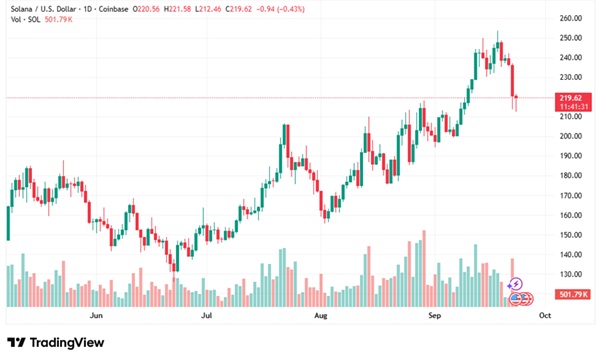
Solana (SOL) is drawing renewed attention as markets recover, anchored by real on-chain progress. Over the past week, whales accumulated over $381 million in SOL, pointing to renewed institutional confidence. Meanwhile, DeFi protocols on Solana have pushed TVL past $12 billion, a multi-year high. This signals growing trust and active usage across its ecosystem.

SOL/USD 1D Price Chart|Source: TradingView

Institutional signals are also heating up. The U.S. Securities and Exchange Commission recently approved generic standards that streamline approval for crypto spot ETFs, including those for SOL. Analysts anticipate $3–8 billion in inflows when these ETFs go live, which could move SOL significantly. Trading around $219-$220, SOL is supported around $220-$225. Meanwhile, resistance is near $245-$250. If SOL can decisively close above the $250 line and hold that as new support, the path is clear for it to move toward $300 in the near-term.

Pepe Coin (PEPE): Accumulation, Liquidity, and a Clear Breakout Path.

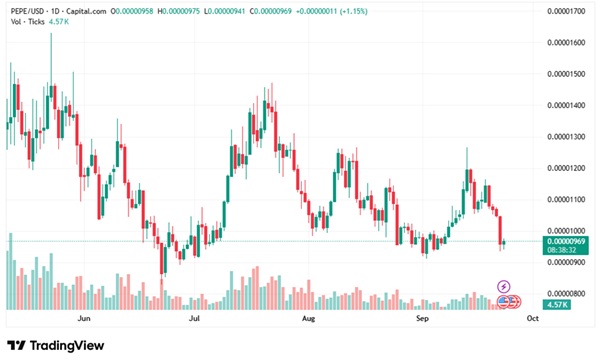
PEPE is trading around $0.000009, with a market cap in the $4 billion range. Its daily volumes are approaching nine-figure levels. These are signs that this meme veteran still commands deep market liquidity.

PEPE/USD 1D Price Chart|Source: TradingView

On-chain behavior over the past week has been constructive. Analytics indicate that top wallets are increasing their holdings by approximately 1.38% among large addresses. Moreover, several whale transfers moved multi-million-dollar PEPE into private storage. This classic accumulation footprint can precede strong rallies if retail demand follows. Exchange balances have concurrently tightened, which may reduce immediate sell pressure.  Currently, PEPE is struggling to surpass $0.000012. A clean breakout will push it to the $0.000016–$0.000022 range. But the decline might be steeper if it loses support. These mixed signals suggest PEPE could deliver outsized moves in a renewed meme-coin cycle. But outcomes hinge on continued whale accumulation, exchange liquidity trends, and broader market risk appetite.

Conclusion

With the market regaining momentum after Bitcoin’s recovery, some altcoins are already flashing strength. Little Pepe (LILPEPE) stands out as a meme-layer pioneer, backed by an explosive presale. Solana (SOL) is leading with expected institutional investment. Pepe Coin (PEPE) is showing renewed interest from whales and technical rebounds that could fuel a comeback. Together, these three stand out as the three best cryptos to buy as the market picks up pace. Little Pepe is currently in presale, offering a unique opportunity to get in early. With projections suggesting a 30x increase by 2025, it’s a promising pick.  Join the presale at littlepepe.com before the token listing.


For more information about Little Pepe (LILPEPE) visit the links below:

Website: https://littlepepe.com

Whitepaper: https://littlepepe.com/whitepaper.pdf

Telegram: https://t.me/littlepepetoken

Twitter/X: https://x.com/littlepepetoken

Why TikTok Likes Are Crucial for Influencers Growth

0
Why TikTok Likes Are Crucial for Influencers Growth

TikTok has quickly risen to become a leading platform for social media personalities. Getting noticed on TikTok can be challenging due to its algorithmic content distribution and the millions of videos uploaded every day. One key factor that determines an influencer’s success on the platform is the number of likes their posts receive. TikTok Likes are a crucial metric for growth, as they increase visibility and engage audiences.

In this post, we’ll explore why TikTok Likes are so important for influencers and how the number of likes can significantly impact an account’s growth.

Why TikTok Likes Matter for Influencers

  1. Drive Content Visibility

TikTok Likes are important for the growth of influencers due to one big reason- It gets your content across more people. The TikTok algorithm favours content that has high engagement, most notably likes. If a video earns enough likes, it can be recommended in TikTok’s “For You” feed where the majority of content is consumed. This wider visibility greatly improves the likelihood of your content finding a larger audience.

As an influencer, this means your content can be displayed to people outside of your current followers which can help you attract a larger audience. TikTok Likes are essentially the currency that can expose your account and content to a larger audience.

2.     Building Social Proof

TikTok Likes act as a form of social proof, which is crucial for building credibility and trust with your audience. Social proof is a psychological and social phenomenon wherein people copy the actions of others in an attempt to undertake behaviour in a given situation. This means that for influencers, the more your videos are liked, the more new users may engage with them.

People are more likely to watch, like and share a video with lots of likes already on it. This becomes a loop where more engagement will result in more likes and attract even bigger audience. Likes help you to create social proof, which is an essential factor in trust and success on TikTok.

  1. Enhance Credibility

Credibility is the name of the game for influencers. Your TikTok Likes are a reflection of the quality and relevancy of your content. When an influencer gets likes on every video, it tells the algorithm as well as viewers that these videos are worth watching. This is the street cred you need to also begin bringing in brand partnerships, collaborations and an audience that keeps coming back.

Content that is good enough to get ‘liked’ will have an increased likelihood of being shared, commented on and promoted by TikTok’s algorithm. For influencers, it means more likes and a higher digital status.

  1. Boost Engagement Rates

TikTok’s algorithm leans into videos that provoke a reaction. Likes are one the major engagement forms, and the more people like it the more likely others will see it. TikTok Likes can help to influence engagement like comments, shares and followers which play a part in your likelihood of going viral.

As an influencer, the content you share should matter to your audience. If you continue to get likes, there’s a much greater chance that the next batch of your videos will be sent to new users who have not yet seen your content. The circle of influence is a ripple effect that will make it easier for you to grow your following and likes as time passes.

  1. Foster Community Growth

Forming a community is critical to influencer achievement, and TikTok Likes help tremendously. With a heavy liftoff of likes to their posts it gets other folks to jump in, comment and share. This fosters a sense of community, and invites the followers to connect with influencer in more profound way.

Likes also help to build up a loyal following that values your content. It’s a snowball effect: The more people who like your posts, the more people are likely to engage with them and thus be inspired join your following. TikTok Likes play a huge role in building this community, and that is vital to influencer growth over time.

  1. Gain Algorithm Favor-ability

The TikTok algorithm is designed to push videos that drive strong engagement, and likes are a key form of engagement. The more people who like a video, the more likely TikTok is to push that video out to other users and feature it on the “For You” page.

As an influencer, you want to make your content favourited in the algorithm and TikTok Likes is one of the best way to do so. The more likes you get, the higher your odds of getting even more exposure and thus closer to reaching that elusive viral status. More visibility leads to more likes, creating a virtuous cycle of growth.

  1. Unlock Monetization Options

As an influencer, you are trying to increase your audience and also figure out how to monetize that following. TikTok Likes are crucial to secure brand deals, sponsored posts and media partnerships. It’s because brands are more likely to partner with influencers whose content is received well by a large and engaged audience, and likes are an important measure of engagement.

Getting a lot of likes on your videos makes other possible sponsors think you have some power over people, so it’s worth actually bringing you on their team. This creates new income opportunities and enables you can make your TikTok account a lucrative one.

  1. Increase Followers Easily

One of the most straight forward advantages of getting TikTok Likes is may lead to more followers. When you get a lot of likes in your videos, it attracts people who like what you do. This additional exposure can result in more fans who will interact with your content to like, share and comment on it.

When you amass a large enough following, your power on the platform increases. With that and a better, more engaged follower base, you can keep the momentum going and add to your successes with an onslaught of likes, views and engagement. TikTok Likes is the key to that great network where people are looking at your content.

9.     Purchase to Boost Growth Quickly

If you are looking immediately visibility and popularity by getting to buy TikTok Likes can be trusted as an option. Purchasing likes helps you increase social proof and visibility quickly, giving your content the initial momentum it needs to gain traction.

Media Mister is reputable and trusted provider for purchasing TikTok Likes which is a reliable solution to increase your visibility and engagement. When you buy TikTok Likes, you give your videos that head start which ensures they reach a wider audience. Between Media Mister’s quick delivery and quality services, it is ideal for influencers interested in elevating their presence on TikTok and maintaining growth.

Conclusion

Having likes on your content directly helps you gain views from users interested in your posts. They bring visibility, create social proof, build credibility, and drive engagement, all essential for growing your influence and attracting more followers.

By understanding the value of TikTok Likes and implementing effective strategies to increase them, creators can optimize their growth potential and move toward influencer success more quickly and effectively.