DD
MM
YYYY

PAGES

DD
MM
YYYY

spot_img

PAGES

Home Blog Page 4431

CoreDAO to Airdrop 25% Mined $CORE, Will List on Top CEX Today

6

CoreDAO Airdrop is one of the largest smart contract interactions of all time. Due to the sheer scale of the event, heavy network congestion is expected on February 8th. 25% $CORE coins ‘mined’ on the Satoshi app will be airdropped to users in a few days from now through a Decentralized Smart Contract. The remaining 75% will be airdropped to users on a monthly basis within a two years venting period.

Core DAO is the official decentralized organization developing the Satoshi Plus ecosystem. It represents an opportunity for miners to access new revenue streams by contributing hash power to the chain. Inspired by the principles of both blockchains, Core displays a deep appreciation for the crypto ecosystem’s history and an even greater excitement for Core’s role in its future.

Core DAO released a Twitter thread explaining the nature of the Core airdrop distribution. Users were advised to be aware of unauthorized $CORE tokens created on several sites using the Satoshi Plus consensus protocol. The company claimed that scammers will be able to con Core aficionados using the airdrop. Users are advised to consult Core DAO’s official sources for further information regarding the airdrop in order to prevent frauds as the Core mainnet is now operational.

Although the airdrop will increase $CORE liquidity, market volatility is unavoidable. Top-tier market makers and exchanges support legal early market $CORE formation in order to control market challenges.

Secret to Core’s success is Satoshi Plus Consensus which starts with the efficient PoW algorithm that Bitcoin uses. Each transaction is validated by having miners Delegate all of their Hash to a preferred Validator, thereby creating proper decentralization, secured and reliable ledger. Another essential mechanism is the DPoS system, all CORE holders can delegate their asset to a validator, so even those with a small number of tokens can vote to validate transactions.

This enhances decentralization and makes the system much more scalable. To combine PoW and DPoS, Core starts with a pool of validators who have both hash power and staked tokens. They then pick a blend of these validators with an algorithm designed to select an efficient mix of both mechanisms. The result is high transaction rate that can maintain optimal security and decentralization

Apparently, February 8th at 12 PM UTC is the scheduled time for the $CORE airdrop. The team has released information on the airdrop, including crucial mainnet information for the community, ahead of the significant development milestone.

The liquid $CORE markets will open around the same time as the Feb 8th airdrop. In the coming days, $CORE transactions from Core DAO’s public reserve multi-sig will be executed to get CORE tokens to partner market makers so that liquid markets exist when the airdrop occurs, .“Having legitimate $CORE token markets available when the airdrop occurs will allow for safer, faster, and more accessible trading for Core users.”Users can start staking when the airdrop is over to take part in the network’s growth.

Core Price Predictions

Many received 0.1 Core which serve as gas fees from Core mainnet to Metamask or Trust wallet, going by the price shown on Metamask ($6000/1 Core) there is price speculations among Core miners, some sees it as a glitch while others opines its going to start with a price from $6000.

As Centralized Exchanges; Huobi, MEXC Global, BKEX, Bybit and others plan to list CORE today, the real price value of the token will become visible.

Google Set to Roll Out SafeSearch Blurring Setting to Ensure Safer Internet

0
A picture shows a You Tube logo on December 4, 2012 during LeWeb Paris 2012 in Saint-Denis near Paris. Le Web is Europe's largest tech conference, bringing together the entrepreneurs, leaders and influencers who shape the future of the internet. AFP PHOTO ERIC PIERMONT (Photo credit should read ERIC PIERMONT/AFP/Getty Images)

Tech giant company Google is set to roll out a new SafeSearch blurring setting in the coming months to ensure safer internet for users.

This setting will blur out explicit images in users search results such as Violence, Sexually explicit content like pornography, etc.

The setting, which is already on default for users below 18 years, will be expanded, which will see the feature become a default for people who do not have the SafeSearch filter turned on.

Once this setting becomes the default setting on the search engine, it will notify users that the SafeSearch feature has been turned on. However, users can choose the “filter” option, which helps filter explicit images, text and links or select the “off” option, which means that they will view all of the relevant results for their query, even if they’re explicit.

Speaking on the launch of this feature, Google’s senior vice president of Core Systems & Experiences Jen Fitzpatrick, said, “A new setting rolling out in the coming months, will blur explicit imagery if it appears in Search results when SafeSearch filtering isn’t turned on.

“This setting will be the new default for people who don’t already have the SafeSearch filter turned on, with the option to adjust settings at any time.”

Google also notes that while SafeSearch isn’t 100% accurate, it helps filter out explicit content in Google search results for all your queries across images, videos and websites.

It is however interesting to note that Google SafeSearch only works on Google search results, which implies that it won’t block explicit content users come across on other search engines or websites that they decide to use.

Also, Google has no doubt continued to play a key role in helping parents keep their children safe online. Last year, the tech giant created an app called “Family Link”, to help parents set up a supervised account for their child/children as they start to use their own device to explore the Internet.

Whether the children are younger or in their teens, Family Link allows them to approve what apps and games they should use, helping them to keep an eye on screen time and help set digital ground rules for their kids.

The tech giant also created YouTube Kids, a safer environment for children to explore their interests through curated online videos. The tech Giant revealed it invested heavily to ensure it creates a safe place where kids can explore their curiosity without encountering any explicit content.

On YouTube Kids, kids can find family-friendly videos on all different topics and for different ages helping them to be entertained, learn new things or discover the world around them.

How the United States Dollar Dominates the Global Trade Space

0

It’s not surprising to anyone that the United States is the world’s leading superpower, from its dominant economy to its powerful military.

In the modern era, the international role of the US dollar is unrivaled.

There are over 180 currencies in circulation worldwide but only a handful play an outsized role in central bank foreign exchange reserves, finance, and international trade like the US Dollar (USD).

But how did the Dollar grow to become the principal reserve currency?

In this article, we’ll look at the USD’s journey to world dominance in the global trade space.

How the US Dollar Became Dominant in International Transactions and The Financial Markets

A reserve currency is a foreign currency held by central banks in substantial quantities.

It’s widely used to conduct international trade and financial transactions, eradicating the costs of settling transactions involving different currencies.

The US dollar has become the dominant currency in international transactions and financial markets for 5 main reasons:

1. The United States Has the Largest Economy in The World

Since the Dollar is used as the national currency for most international transactions involving the US, this gives the Dollar a unique level of liquidity and stability that other currencies lack.

Additionally, the US dollar is seen as a safe haven currency, meaning that investors often flock to it during times of economic uncertainty. Finally, the US government and central bank, the Federal Reserve, have a strong track record of maintaining the Dollar’s stability, which has helped to build trust in the currency and further cement its position as the dominant currency in international markets.

The United States dollar is the dominant currency in international transactions and financial markets due to its vast economy, with a gross domestic product (GDP) that is larger than the combined GDPs of the next three largest economies. This makes the Dollar a natural choice for many international transactions, as it is widely available and easily convertible into other currencies.

2. The United States Has A Stable Political System

This, along with a well-established system of property rights and contracts, makes it a safe and reliable place to do business.

This stability and predictability attract investors and businesses from around the world, who use the Dollar to buy and sell goods and services in the United States and abroad.

3. The United States Has A Large and Sophisticated Financial System

The US boasts a network of banks, investment firms, and other financial institutions capable of handling complex international transactions.

This financial infrastructure makes it easy for people and businesses to buy and sell dollars and to use them to make payments and investments around the world.

4. The United States Has A Long History of International Trade and Investment

For decades, the Dollar has been used in these transactions.

Over time, the Dollar has become a widely accepted and trusted currency, and many businesses and governments around the world have come to rely on it for their financial transactions.

5. The United States Has A Strong Military and A Dominant Position in Global Politics

This gives the United States a certain degree of influence and power in international affairs.

This has helped to reinforce the Dollar’s position as the dominant currency and has made it difficult for other currencies to challenge its dominance.

A Timeline of how the US Dollar Dominated the Global Trade Space

For most of the last century, the outstanding role of the USD in the global economy has been reinforced by the size and strength of the American economy, its stability and openness to trade and capital flows, the rule of law and strong property rights.

  • The first documented use of paper currency in the US dates back to 1690 when the Massachusetts Bay Colony issued colonial notes.
  • It wasn’t until 1776 that the first $2 bill was introduced—9 days before independence.
  • 9 years later, in 1785, the U.S. officially adopted the dollar sign, using the symbol for the Spanish American peso as a guide.
  • The government established the Office of the Comptroller of Currency (OCC) and the National Currency Bureau in 1863. These 2 agencies were charged with handling new banknotes.
  • Centralized printing began at the Bureau of Engraving and Printing in 1869.
  • The U.S. Treasury assumed the official responsibility of issuing the nation’s legal tender in 1890.
  • The Federal Reserve Act of 1913 created the Federal Reserve Bank to respond to the unreliability and instability of a currency system that was previously based on banknotes issued by individual banks. This was the same time the U.S. economy became the world’s largest.
  • Printing began a year after the establishment of the Federal Reserve as the nation’s central bank with the passing of the Federal Reserve Act in 1914.
  • Countries pegged their currencies to the Dollar after WW1, ending the gold standard. The United States became the lender of choice for many countries that wanted to buy dollar-denominated U.S. bonds.
  • Three decades later, the Dollar officially became the world’s reserve currency. Britain finally abandoned the gold standard in 1931, which decimated the bank accounts of international merchants who traded in pounds. By then, the Dollar had replaced the pound as the leading global reserve currency .
  • In WW2, the United States served as the Allies’ main supplier of weapons and other goods. Most countries paid in gold, making the U.S. the owner of the majority of the world’s gold by the end of the war. This made a return to the gold standard impossible for the countries that depleted their reserves.
  • WW2 reshaped the global financial system. When WW2 was coming to an end, global leaders started deliberating on a stable financial system for international transactions.
  • In 1944, more than 700 delegates from 44 Allied countries met in Bretton Wood, New Hampshire, to devise a system to manage foreign exchange that would not disadvantage any country. The delegation decided that the world’s currencies would no longer be linked to gold but could be pegged to the U.S.
  • Thanks to the Bretton Woods Agreement, the U.S. dollar was officially crowned the world’s reserve (global) currency and was backed by the world’s largest gold reserves. Instead of gold reserves, other countries accumulated reserves of U.S. dollars. The US fixed the value of the Dollar to gold at $35 an ounce.
  • Other countries then fixed their exchange rate in tune with the Dollar, making it the central mode of exchange of the system.
  • In the 1960s, the US started racking up huge deficits and running out of its gold reserves, and the government found it too expensive to maintain the promise.
  • The Bretton Woods system of currency pegs had outlived its usefulness. Japan and Europe had rebuilt their economies, and growing consumer demand made fixed exchange rates unsustainable. This led to fears of a run that could wipe out United States gold reserves.
  • By the early 1970s, countries began demanding gold for the dollars they held. They needed to combat inflation. Rather than allow Fort Knox to be depleted of all its reserves, President Nixon separated the Dollar from gold.
  • This led to the floating exchange rates that exist today. The Dollar’s value was now set by a mishmash of economic and political forces, ranging from the frenetic buying and selling of traders worldwide to central bank decisions.
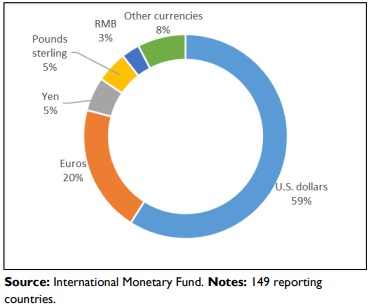
  • According to the International Monetary Fund (IMF), the Dollar remains the world’s reserve currency today. Central banks hold around 59 percent of their reserves in U.S. dollars , more than double the collective foreign holdings of euros, renminbi, and yen. That makes it the de facto global currency, even though it doesn’t hold an official title.
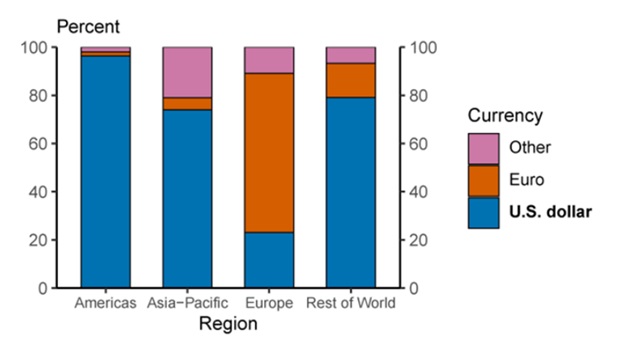
  • The Dollar has a huge footprint in offshore funding markets. Here, financial market participants obtain loans or raise debt in foreign currency. Over 60 percent of the world’s debt is issued in dollars, meaning foreign banks need a lot of dollars to conduct business.
  • In 2015, The Economist revealed that the United States accounts for 12 percent of merchandise trade and 23 percent of the global GDP.
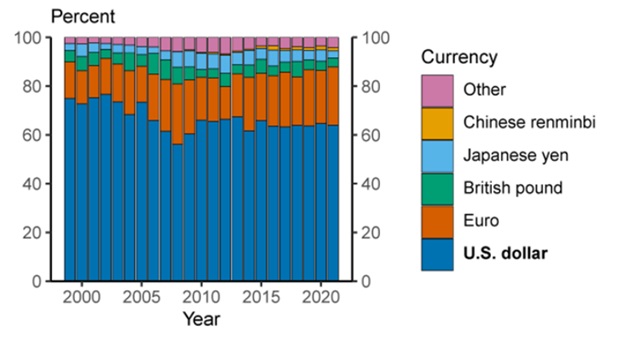
  • In part because of its dominant role as a medium of exchange, the U.S. dollar is also the dominant currency in international banking.
  • The relative strength of the U.S. economy supports the value of the Dollar. It’s the reason the Dollar is the most powerful currency . As of the end of 2020, the U.S. had $2.04 trillion in circulation.
  • The dollar rules in the foreign exchange market. Approximately 90 percent of forex trading involves the U.S. dollar. The US Dollar’s dominance in global FX markets is generally linked to its use as a vehicle currency for forex transactions, meaning that non-US dollar currency pairs aren’t exchanged directly but via the Dollar.
  • Although there are many speculations that the US dollar will be dethroned by the Chinese Yuan, the general consensus is that the US dollar will remain the world’s global currency.

Will the US Dollar Continue to Dominate World Trade?

You may think that after holding the title of “the world’s most dominant currency” for so long and experiencing a series of events that negatively affected the US economy, the USD would be replaced. After all, no king rules forever.

It’s difficult to predict with certainty whether the US Dollar will continue to dominate world trade in the future.

Recent developments have the potential to enhance the international usage of other currencies.

Factors such as shifts in political and economic conditions, changes in the global monetary system, technological developments (e.g., crypto assets), and the increasing economic power of other countries could potentially lead to a decline in the Dollar’s dominance.

  1. The Rapid Growth of China

China’s GDP already exceeds United States GDP on a purchasing power parity basis and is expected to exceed United States GDP in nominal terms in the 2030s.

While the US dollar accounts for the lion’s share of international trade, a small subset of other currencies (renminbi, Euro, British Pound, Japanese Yen, and Swiss Franc) is also actively used in international trade alongside the U.S. dollar.

China has been working to internationalize its currency, the renminbi (RMB), to cut its dependence on the US dollar and assert more control over its own economy. Some economic experts believe that the RMB could eventually challenge the US dollar as a dominant currency in international trade.

However, many experts agree that the RMB will not overtake the Dollar as the world’s leading reserve currency anytime soon.

  1. The Race to Create Widespread Digital Currencies

Over the past decade, the private sector has developed thousands of cryptocurrencies over the past decade.

A cryptocurrency is a digital currency that uses cryptography for security. It’s decentralized and operates independently of a central bank or government.

While cryptos remain a small, volatile, and niche market, they have gained a significant amount of attention and investment in recent years. Some large multinational corporations like JP Morgan seek to create more stable digital currencies for use on a larger scale.

Central banks are also exploring the possibility of issuing their own digital currencies, which could also impact the future of the monetary system.

However, the diminution of the USD’s status seems unlikely in the near future. There has been only one instance of a predominant currency switching in modern history —the replacement of the British pound by the Dollar.

The US dollar still holds many benefits over other currencies, such as the stability of the US political system, the large size and liquidity of the US economy, and the depth of US financial markets. It’s also widely used as a reserve currency by central banks and international organizations.

Therefore, it’s unlikely that the US dollar will stop playing a major role in international trade in the near future.

Conclusion

Overall, the dominance of the US dollar in international transactions and financial markets is the result of a combination of factors, including the size and strength of the US economy, the stability of its political system, the sophistication of its financial system, its history of international trade and investment, and its military and political power. These factors have all contributed to making the Dollar the most dominant currency in the world today.

The Supreme Court Ruling on Old Naira Note And Why It Can Also Rule on Exchange Rate

4

The Supreme Court of Nigeria has ruled – and the citizens must respect that decision: “The Supreme Court Wednesday ordered the Central Bank of Nigeria (CBN) not to end the use of old naira notes on 10 February.” Why many may not like the pause on the new Naira policy, there is no reason to cause problems. If you shift the deadline past the election day, the policy has no value. If you allow the old Naira notes to be used past the election day, the policy has no value.

Yet, it is no more about the election, it is about the institutions in the nation. I do not like the ruling since it will certainly bring back money politics, but I also must understand that anytime goes in Nigeria.

Can we get the Supreme Court to rule to make exchange rate $1 to N200 now that it can overrule the apex bank, entrusted with the nation’s monetary policy. There is a precedent to that call: the court ruled on the pricing of electricity, freezing the rates which had attracted many foreign investors into the industry.

When it finalized its approved rates, since then, no investor wants to touch the Nigerian electricity sector because doing so is largely wasting money at the distribution phase. Possibly, had the court left the pre-deal rates, more investments would have arrived. Today, most investors in Discos abandoned the plan because there is nothing there.  Those new rates remain a big challenge why the sector is not attracting adequate funding.

We respect the rule of law and the power of the courts. But Nigeria is getting into a new territory where pricing, monetary policies, etc are now largely set by the Court. We have to watch the implications. Sure – we can get our electricity from the courts because they can rule “let there be electricity in all homes for free”. Waiting for that ruling soon.

The Supreme Court Wednesday ordered the Central Bank of Nigeria (CBN) not to end the use of old naira notes on 10 February.

The News Agency of Nigeria (NAN) reports that a seven-member panel of the court, led by John Okoro, gave the order of interim injunction amid acute scarcity of newly redesigned N200, N500, and N1,000 currency notes.

The court gave the order temporarily, cancelling the CBN’s 10 February deadline to end the validity of the old versions of the banknotes based on an ex parte application filed by three northern states being controlled by the All Progressives Congress (APC).

The three applicant states are – Kaduna, Kogi and Zamfara.

Comment on Feed

Comment 1: Once upon a time, we believed that the judges’ wigs symbolized wisdom, but now no wisdom has been shown in this ruling. Perhaps the courts have the plan to rule on interest rates soon. The judiciary now is somewhat laughable!

Comment 2: Are we saying the policy was about the election in the first place? As far as i am concerned, we still need the courts in this part of the world to act on some needed debates. If the framework on electricity was properly done, i believe investors will come to the party. The Apex court is the sole defender of the ordinary man, and we appreciate the judgment.

My Response: “If the framework on electricity was properly done, i believe investors will come to the party.” – they are waiting for 7 years. You told me that one shoe is N400, I invest. After my investment, your court says it is now N150. I will abandon the shoe. And they did and everyone is using generators. Waiting for the court to rule on Interest Rate to be set at 0%!

Comment 3: As much as I respect the institution of the CBN, I think the Supreme Court stands to protect the interest of the common Nigerian people. If the CBN makes a policy the negatively impact on the people, is it not right the court comes in. The redesign of the Naira may have the good intentions of checkmating vote buying but if the country runs into anarchy before even Election Day then what has been achieved. People are really suffering. I mean major suffering

My Response: ” I think the Supreme Court stands to protect the interest of the common Nigerian people.” – that is a problem. The apex court is primarily to interpret the laws of the nation as written by the parliament. The goal is not to rule on emotions and feelings. The court destroyed the electricity sector when it reversed the rates the government agreed with investors in our Disco. Today, because the court ruled, no one wants to put in more money.

Sure, it can rule on the exchange rate tomorrow and fix N200 to $1 since we’re suffering due to exchange rate issues. Indeed, it can rule on the vacation days of a CBN guard.

What is the CBN for if the Supreme Court will make the calls. Today, NERC, the electricity regulator, is irrelevant because it is unable to fix rates because the court froze it.

Do you know why you do not have water in your city? A court ruled that water rates cannot be increased and in some cities in Nigeria, the rates have not changed in 20 years. Get me right, I respect the rule of law. But that you have power does not mean you must fight every war. Our courts are not helping on these issues.

Comment 3R: Ndubuisi Ekekwe well then the law stands to protect the people. The really on ground is no longer emotional and sentimental. It is pure anarchy. The CBN should have done full risk assessment before putting up the policy. People are hurting. Like they said ‘Rome is the people’ CBN has the now to prove that the court decision was wrong

My Response: I am not writing about this particular case. I am focusing on the whole concept that a Court will be ruling on this type of issue. This is not about a good or bad policy on the people, my focus is why the Court becomes the only agency since it can wage legal wars on any agency. It froze NERC on its electricity regulation by fixing prices people pay for light. Think beyond this current rule where we’re going.  Can it rule also on exchange rate and interest rate? Yes, because we’re suffering due to them.

Comment 4: The Judgement has been hailed by many! The untold hardship that CBN and its political bandwagon and associates wanted to achieve has been halted and We Move till after the election before the hearing of the court case will be open. Hopefully, both the old notes and new notes will be released by the banks so that normalcy will return to the country. Whoever then wanted to cry because of vote buying should do so of their own volition.

My Response: We are suffering due to high interest rates in the banking sector. Can it rule and make it 0%?

Comment4A: High interest is based on risk and market forces.
The New notes debacle is based on incompetence and hubris.

My Response: It is a CBN policy and could be used to influence the market forces, pushing the interest rate to a new level. Interest rate is not set in isolation. You bring other mechanisms at play. My issue is not this current ruling, it is the idea that a Court can rule on pricing of electricity, water rates, and things you would not have expected the Court to decide.

WeTransfer is Venturing into NFTs and Web3 Cloud Storage

0

WeTransfer, a freemium file-sharing company founded in 2009, based in Amsterdam has taken a step toward Web3 integration by enabling users to generate and share NFTs from their phones through a partnership with Blockchain firm Minima based in FranceMinima is a cooperative network that enables everyone to freely connect to a blockchain where every user runs a complete constructing and validating node.

WeTransfer has an infrastructure that enables easy integration with privacy script that blockchain users can leverage on. WeTransfer also allows large files to be downloaded without requiring you to create an account to receive the files sent.

According to Damian Bradfield, the Chief Creative Officer at WeTransfer, the decision to partner with Minima came due to a closely-aligned vision and target market.

WeTransfer is thrilled to work with Minima, whose vision is aligned strongly with ours to seamlessly connect people and facilitate innovation and creativity without sacrificing privacy.

WeTransfer, which allows large files to be downloaded without requiring you to create an account to receive the files sent, does indeed have an infrastructure that should enable relatively easy integration with the privacy afforded to blockchain users who take advantage of it.

In order to run a node, a Minima user will only have to download the blockchain’s app and allow it to run in the background. Minima Coin, the blockchain’s proprietary token, might be the payment method of choice for NFT transactions that will be carried out due to the partnership.

According to Hugo Feiler, the CEO of Minima, the collaboration will allow his project to get a foothold in the digital art industry from the get-go, attracting NFT artists who will be able to collect royalties on digital artworks sold via Minima for as long as they wish.

We as a partnership look forward to supporting the development and acceleration of creativity in the digital age where individuals retain ownership and control of their workThis partnership will explore the practical use of NFT technology, something which interests not only the crypto industry, but will be a test case to demonstrate the potential of wider adoption of this innovative digital tool.

The Minima blockchain – and presumably the NFT capability developed alongside WeTransfer – will be launched later this month. The app is allowing users to run their own Minima node, and will be available for download in over 180 countries, joining other hosting providers like Google and AWS in enabling blockchain-based operations on cloud storage.