DD
MM
YYYY

PAGES

DD
MM
YYYY

spot_img

PAGES

Home Blog Page 4448

How Nigerian Presidential Candidates Are Pushing People Towards Suicidal Ideation and Toxic Relationships

0

Since September 28, 2022, the candidates of the 18 political parties cleared for the 2023 presidential election by the Independent National Electoral Commission (INEC) have been campaigning aggressively using different platforms. From the digital sphere to the physical sphere, each candidate has informed Nigerians and is still engaging with them on programmes and policy agendas that would be implemented when he is elected as the new president on February 25, 2023. Like the previous presidential campaigns, where candidates dished out party manifestos using different techniques, the 2023 presidential candidates are not quite different in their adoption of words and terms that are elusive in their meanings and practicability.

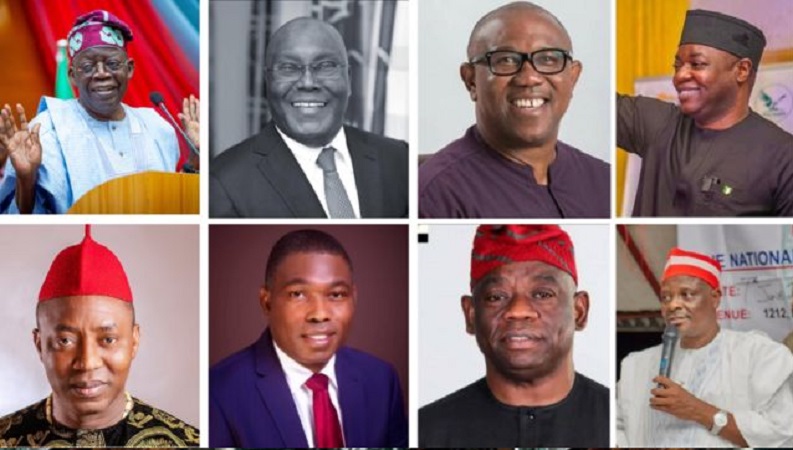
The candidate of the All Progressives Congress, Senator Bola Ahmed Tinubu, has been promoting and marketing himself and the party with the message of “renewed hope.” Mr. Peter Obi, the Labour Party candidate, has largely campaigned using “Our Pact with Nigerians,” aiming to create a new Nigeria. Many have described him as the “new bird” and a “person with the potential of rewriting patterns of presidential election outcomes in Nigeria” because of his acclaimed youth-supportive movement across the country. Alhaji Atiku Abubakar, the candidate of the People’s Democratic Party, does not really see reason in changing his campaign message theme because contesting for the Office of the President is not new to him. For the 2023 presidential election, Alhaji Atiku Abubakar decided to use his 2019 policy document tagged “My Covenant with Nigerians.”

These candidates have used and are still using themes for building and creating divisions based on their use of an organised persuasive communication strategy that has elements such as fake news, misinformation, disinformation and purposeful manipulation of citizens’ religious interests and ethnic hegemony. For many citizens, who could not separate politics from personal and business relationships, discussing the candidates and their ideological differences has mainly consisted of exchanging severe banter as well as unnecessary criticism. Our analysis of several political-related interactions on digital platforms, especially Facebook, Twitter and WhatsApp, shows people are attacking personalities rather than addressing the issues and needs the candidates are promoting.

This is not new in a democratic setting. Other democracies in the global south, where Nigeria belongs, and the global north have experienced a toxic campaign environment like this. In the United States of America and the United Kingdom, for instance, many academics and think tanks reported how presidential candidates’ campaign strategies increased people’s toxic relationships and possible interest in considering suicide when their preferred candidates lost the election.

A recent poll in the USA noted that many Americans dropped friends and family members who have different political views. According to the poll, nearly one in five voters said political divisions hurt their relationships. This means that they felt unsupported, misunderstood, demeaned, or attacked. This, according to many scholars and established reports, may contribute to a toxic social environment that can lead to stress, depression, anxiety, and even suicide.

With this background insight, our analyst examines the interest of Nigerians who use the Internet to seek information about the candidates and the two issues (toxic relationships and suicide, one of the possible outcomes of toxic relationships) between September 28, 2022 and February 3, 2023. In terms of having interest in the candidates, our analysis shows that Nigerians developed more interest in Mr. Peter Obi and Senator Bola Ahmed Tinubu than Alhaji Atiku Abubakar when they (Nigerians) were considered within the campaigns and elections category of Google Trends. During the period, the interest in suicide was greater than the interest in toxic relationships. Further analysis reveals an 18.3% connection between toxic relationships and suicide, indicating that the more Nigerians engaged in conversations that were toxic during the period, the more they developed an interest in understanding suicide. In essence, an interest in toxic relationships led to more than 18 searches for suicide information.

Exhibit 1: Public interest in candidates and two issues by state
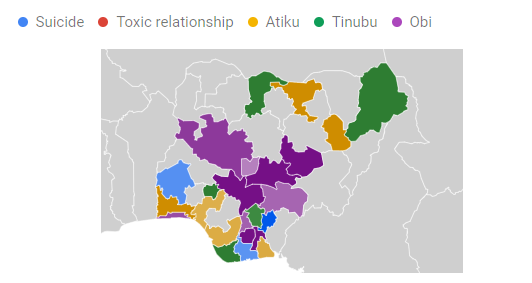
Source: Google Trends, 2023

The interest in the three candidates collectively accounted for 12.6% interest in suicide ideation and 17.2% interest in toxic relationships. Individually, having interest in Mr. Peter Obi was more determined by a toxic relationship (2.1%) than other candidates (Alhaji Atiku Abubakar = 0.4% and Senator Bola Ahmed Tinubu = 0.5%). Nigerians’ interest in suicidal ideation was more determined by their having an interest in Senator Bola Ahmed Tinubu (0.9%) and Mr. Peter Obi (0.5%) than Alhaji Atiku Abubakar (0.2%). These results suggest that mental health experts, family members and relatives of people who are having toxic conversations in the digital sphere and in various physical settings need to pay specific attention to them. They need to be comforted every time. This is primarily imperative for people in Ebonyi, Benue, Rivers, Oyo and Ogun States, including the Federal Capital Territory, where people significantly developed interest in the two issues (suicide ideation and toxic relationships) during the period of our analysis.

Exhibit 2: Position of candidates and the key issues relative to public volume of searches
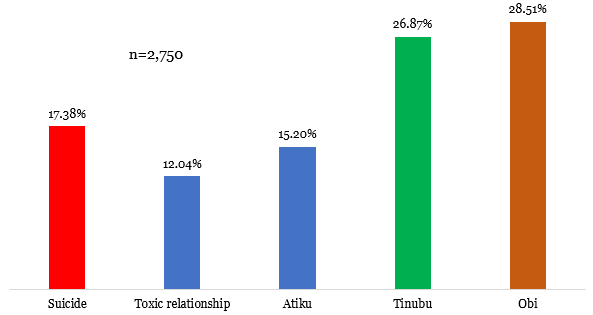
Source: Google Trends, 2023; Infoprations Analysis, 2023

Exhibit 3: Connection of public interest in the two issues with candidates
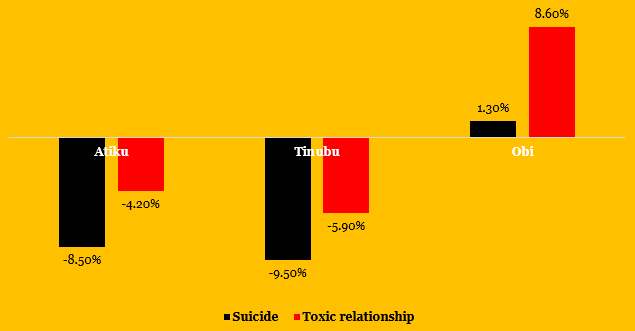
Source: Google Trends, 2023; Infoprations Analysis, 2023

Fidelity Bank Pledges to Double up on Cash Deposit and Payment Following Tussle by Customers Over Redesigned Notes

0

The management of Fidelity Bank Plc has assured customers of cash payment across all its branches nationwide.

This was made known in a statement reported to have been issued by Fidelity bank management on Thursday following a trending video in which two customers were spotted fighting inside a Fidelity bank branch over difficulty in accessing the new Naira notes.

The statement issued by the Head of Corporate Communications of Fidelity Bank, Dr. Meksley Nwagboh, reads as follows:

“Our customers can rest assured that we are working to meet their banking needs.

“All our branches nationwide are open to customers to pay in their old notes and withdraw the new notes in accordance with the Central Bank of Nigeria’s policy on Naira redesign.”

Nwagboh, therefore, enjoined customers of the bank to visit the nearest branch to carry out their banking transactions.

It is not a hidden knowledge that many Nigerians have been hard-pressed lately due to difficulty in depositing the old naira notes and withdrawing the redesigned notes at their various commercial banks despite efforts to meet up with Central Bank deadline which had earlier been slated for January 31, 2023.

Many of the Point of Sales outlets which hitherto provide alternatives for individuals who quickly need to withdraw cash or make other transactions fro their bank accounts have also complained about not getting enough cash from the commercial banks. Therefore, some of the payment agents have resorted to charging exorbitantly on cash withdrawal for as much as 1000 Naira per 10,000 Naira as against the usual 200Naira per 10,000Naira cash withdrawal.

Due to pressures from the media and the National Assembly, the CBN has extended the deadline for the deposit of the old Naira notes up until February 10. The Apex bank also issued a directive for the commercial banks to swiftly commence over-the-counter payment of the new naira notes to their customers across the country.

https://m.youtube.com/shorts/ebDRFm__BlY

Upcoming Halving Events from Litecoin (LTC) and Bitcoin (BTC) Boost Snowfall Protocol’s (SNW) Presale Event

0

Bitcoin and Litecoin Halving

The Bitcoin Halving is an event that happens roughly every 210,000 blocks (or roughly every four years) in the Bitcoin network. At each halving event, the number of new Bitcoins (BTC) generated per block is reduced by half. The halving limits the supply of new bitcoins and helps control inflation. This process makes it harder to “mine” new Bitcoins, leading to a slower growth rate in the overall currency supply.

The effect of halving the price of Bitcoin (BTC) is a topic of much excitement among market participants. The reduced supply of new Bitcoins will increase demand and therefore drive up the price. Historically, the two previous halvings in 2012 and 2016 were followed by significant price increases.

The effect of halving on the price of Litecoin (LTC) is similar to that of Bitcoin; Litecoin is a fork of Bitcoin and follows Bitcoin’s tokenomics. Like Bitcoin, Litecoin also has a halving event that occurs roughly every four years, reducing the number of new Litecoins generated per block by half.

Halving can boost crypto prices

As with Bitcoin, Litecoin’s halving has historically stirred up prices and bolstered investor sentiment.

Altcoins, or alternative cryptocurrencies, often follow the price trend of Bitcoin, especially during periods of strong market performance for Bitcoin. This is because many investors and traders see Bitcoin as the benchmark for the cryptocurrency market and may use it as a barometer for the market’s overall health.

Fortunes were made through altcoins riding shotgun on the Bitcoin and Litecoin halving bull-runs.

And those bull runs are coming.

The next Bitcoin halving is expected on 18 March 2024, and Litecoin is expected six months earlier in August 2023.

The market is already anticipating the halving bull run, with cryptocurrencies raising their heads from the 2022 slumber, with Bitcoin’s January 2023 candle closing 40% higher, and it’s just getting started.

Right now: The right time to invest in Snowfall Protocol (SNW)

Traditional values underpin crypto investing as much as conventional investing: buy early and buy cheap. Right now is the perfect time to invest in cryptocurrencies: the floor of the bear market has been reached, the candles are turning green again, and the anticipation of the halving is underpinning investor confidence.

This confidence has bolstered the presale of a new altcoin set to shake up the cryptoverse. Snowfall Protocol (SNW) is a new cross-chain trading solution that bridges cross-platform architectural divides and facilitates the transactions of both traditional tokens and non-fungible tokens (NFTs) across both EVM (Ethereum Virtual Machine) and non-EVM platforms.

Invest in Snowfall Protocol now

Snowfall Protocol (SNW) is the solution crypto traders have been looking for since Vitalik launched Ethereum and is set to become a major player in the cryptoverse. Crypto traditionally rewards early adopters, and Snowfall Protocol is now available at presale: the earliest it is possible to get. A hundred million coins will be made available at $0.005 during phase one.

The presale will culminate in phase three when another 100 million coins are made available at $0.75 – a 1,400% value increase between phases one and three. This is an opportunity the savvy crypto investor will be foolish to miss – Snowfall Protocol (SNW) is something to take seriously in your crypto investment portfolio, and you can Invest in Snowfall Protocol here.

For more information on Snowfall and its workings, see their whitepaper, or follow them on Twitter and Telegram.


Click the links below to learn more now!

Presale: https://presale.snowfallprotocol.io

Website: https://snowfallprotocol.io

Telegram: https://t.me/snowfallcoin

Twitter: https://twitter.com/snowfallcoin

The Gwarinpa, Abuja collapsed building; what caused it?

3

Nigeria is not a real place, you can die like a chicken anytime in Nigeria. Now I really understand the “Japa” gospel: most people relocating out of Nigeria are not just doing that for the sake of greener pastures, most are relocating for the sake of their safety and security. It is today that I understood better.

The apartment you rented to dwell with your family can collapse and bury you alive inside it at any time because it is possible that the builders maneuvered their way through the development control agencies and erected a structure that was not legally approved or suitable for that location. Incidents like this occur regularly in Lagos and it occurred today in Abuja.

On my way home this afternoon, just five minutes away to my house and I saw vehicles making U-turns by the Hmedix mall on 4th Avenue, Gwarinpa, I saw ambulances driving past me at full speed, I saw policemen, civil defence, road safety and other law enforcement agents mounting road and controlling traffic, there was a lot of confusion and commotion which was quite unusual. I asked one of the police officers controlling traffic what was going on, and after much hesitation, he told me that a multi-storey shopping plaza that is still under construction along the road just collapsed and many people lost their lives.

I packed by the Hmedix mall to go see for myself, it was a terrible sight. Some people that were lucky to be excavated alive were brought out without limbs. I have never seen anything like that.

It is more ironic that this kind of thing could happen in Abuja,” a whole of Abuja”; the capital city, the seat of power. From the location where the incident occurred to Aso rock villa should be less than a twenty minutes drive.

The first question that came to mind was; “Who approved the building of this structure? Which Director in the Federal Capital Development Agency (FCDA) or development control approved this building, or was the building erected by the contractors without getting all the appropriate approvals? If so , why didn’t the development control seal up the building for illegal structure? These questions are begging for answers so we can get to the root of this tragedy that occurred today in the Federal Capital Territory.

If you are quite familiar with 4th Avenue, Gwarinpa where the incident took place, you will know that the place that structure is situated is quite sloppy and you don’t need to have a degree in structural or civil engineering or building mechanics to know that for a gigantic structure of that nature to mount comfortably in a sloppy land like that it will need a lot of reinforcement if not it will only be a ticking bomb waiting to explode as it did exploded today.

We can only thank God that the building was not yet completed before it collapsed or it had not yet been commissioned for commercial use when it collapsed, if not it would have been more tragic than this.

Cutting corners have cost a lot of innocent lives in Nigeria. Builders need to stop cutting corners or stop paying bribes to get illegal structures approved by government agencies. If a location is been accessed and it is said that it will be only suitable for a two-storey building to be mounted, please build a two-storey or even less, do not try to build more than two-storey so as to maximize more profit; it is a huge risk and the development control should be demolishing building of such or be sealing it up despite whoever owns it, this is how we can safeguard lives and properties.

The lives that were lost today were lost because of the carelessness of the builders, corruption of development control officials, greed and ineptitude of government agencies and we can do much better.


Zuckerberg Announces Future Plan for Meta As the Company’s shares Leaped to Stunning 23%

0
Facebook founder and properties

Meta is seeing a rebound from its disappointing market performance that saw over $700 billion wiped off its valuation last year, triggering criticism of the CEO, Mark Zuckerberg’s leadership.

On Thursday, the shares of the social media conglomerate jumped over 23%, marking its best outing in the market in a long time. Meta shares recorded its highest point since September 2022, beating topline estimates with $32.17 billion in revenue.

The surprising gain has shushed analysts across Wall Street, who after the company’s disastrous third-quarter report last year, became so critical of Zuckerberg’s leadership. The CEO’s decision to delve into metaverse, sinking billions of dollars in it, was at the center of the criticism.

Zuckerberg in an earnings call on Wednesday attributed the revenue growth to strong community and engagement increase across Facebook, Instagram, WhatsApp, and Messenger.

“We reach more than 3.7 billion people monthly across our family of apps. On Facebook, we now reach 2 billion daily activities and almost 3 billion monthly. The number of people daily using Facebook, Instagram and WhatsApp is the highest it’s ever been,” he said.

Meta, Facebook’s parent company, announced a series of operational changes geared toward boosting its declining user numbers. Facebook lost around 500,000 daily users in the last three months of 2021, its first loss of daily active users. That was followed by more losses, resulting in ad revenue decline.

Zuckerberg said the changes, which included a shift to short-form videos, were responsible for the company’s latest performance. He said that Meta’s priorities haven’t changed since last year, pointing to AI today and over the longer term the metaverse, as the two major technological waves driving “our roadmap.”

Analysts said Meta’s decision to cut down operational cost was key to its stunning revenue growth. Meta laid off 11,000 workers in early November as part of its efforts to reduce running cost.

“Before getting into our product priorities, I want to discuss my management theme for 2023, which is the “year of efficiency”. We closed last year with some difficult layoffs and restructuring some teams. When we did this, I said clearly that this was the beginning of our focus on efficiency and not the end,” Zuckerberg said on Wednesday.

He talked further about his plan to cement the progress by focusing on areas such as flattening [Meta’s] org structure and removing some layers of middle management to make decisions faster, as well as deploying AI tools to help [the company’s] engineers be more productive.

Read his full statement:

More details on the state of our business from today’s earnings call:

2022 was a challenging year, but I think we ended it having made good progress on our main priorities and setting ourselves up to deliver better results this year as long as we keep pushing on efficiency. I said last quarter that I thought our product trends look better than most of the commentary out there suggests. That’s even more the case now. We reach more than 3.7 billion people monthly across our family of apps. On Facebook, we now reach 2 billion daily actives and almost 3 billion monthly. The number of people daily using Facebook, Instagram and WhatsApp is the highest it’s ever been.

Before getting into our product priorities, I want to discuss my management theme for 2023, which is the “year of efficiency”. We closed last year with some difficult layoffs and restructuring some teams. When we did this, I said clearly that this was the beginning of our focus on efficiency and not the end. Since then, we’ve taken some additional steps like working with our infrastructure team on how to deliver our roadmap while spending less on capex. Next, we’re working on flattening our org structure and removing some layers of middle management to make decisions faster, as well as deploying AI tools to help our engineers be more productive. As part of this, we’re going to be more proactive about cutting projects that aren’t performing or may no longer be as crucial, but my main focus is on increasing the efficiency of how we execute our top priorities.

I think there’s more we can do to improve our productivity, speed, and cost structure, and by working on this over a sustained period I think we’ll both build a stronger technology company and become more profitable. I’m very focused on doing this in a way that helps us build better products, and because of that, even if our business outperforms our goals, this will stay our management theme for the year since I think it’s going to make us a better company. At the same time, I’m also focused on delivering better financial results than what we’ve reported recently and on meeting the expectation I outlined last year of delivering compounding earnings growth even while investing aggressively in future technology.

Next, I want to give some updates on our priority areas. Our priorities haven’t changed since last year. The two major technological waves driving our roadmap are AI today and over the longer term the metaverse.

So first, let’s talk about our AI discovery engine. Facebook and Instagram are shifting from being organized solely around people and accounts you follow to increasingly showing more relevant content recommended by our AI systems. This covers every content format — which makes our services unique — but we’re especially focused on short-form video since Reels is growing so quickly. And I’m really proud of our progress here, Reels plays across Facebook and Instagram have more than doubled over the last year, while the social component of people resharing Reels has grown even faster and has more than doubled on both apps in just the last 6 months.

The next bottleneck that we’re focused on to continue growing Reels is improving monetization efficiency, or the revenue that’s generated per minute of Reels watched. Currently, the monetization efficiency of Reels is much less than feed, so the more that Reels grows, even though it adds engagement to the system overall, it also takes some time away from feed and we actually lose money. But people want to see more Reels though, so the key to unlocking that is improving our monetization efficiency so that way we can show more Reels without losing increasing amounts of money. We’re making progress here, and our monetization efficiency on Facebook has doubled in the past six months. In terms of the revenue headwind, we’re still on track to be roughly neutral by the end of this year or maybe early next year, and then after that we should be able to profitably grow Reels while keeping up with the demand that we see.

In our broader ads business, we’re continuing to invest in AI and we’re seeing our efforts pay off here. In the last quarter, advertisers saw over 20% more conversions than in the year before. And combined with a declining cost per acquisition, this has resulted in higher returns on ad spend.

We continue to be excited about the monetization opportunity with business messaging too. Facebook and Instagram are the first two pillars of our business, and in the next few years we hope to bring messaging online as the next pillar. One way of doing this is click-to-message ads, which is now at a $10 billion run rate.

And paid messaging is the other piece of this. We’re earlier here, but we continue to onboard more businesses to the WhatsApp Business Platform, where they can answer customer questions, send updates, and sell directly in chat. So for example, AirFrance started using WhatsApp to share boarding passes and other flight information in 22 countries and in 4 languages. Businesses often tell us more people open their messages and they get better results on WhatsApp than other channels.

AI is the foundation of our discovery engine and ads business – and we also think it’s going to enable many new products and additional transformations in our apps. Generative AI is an extremely exciting new area with so many different applications, and one of my goals for Meta is to build on our research to become a leader in generative AI in addition to our leading work in recommendation AI.

The last area that I want to talk about is the metaverse. We shipped Quest Pro at the end of last year, and I’m really proud of it. It’s the first mainstream mixed reality device, and we’re setting the standard for the industry with our Meta Reality system. As always, the reason we’re focused on building these platforms is to deliver better social experiences than what’s possible today on phones. The value of MR is that you can experience the immersion and presence of VR while still being grounded in the physical world around you. We’re already seeing developers build out some impressive new experiences like Nanome for 3D modeling molecules and drug development, Arkio for architects and designers to create interiors, and of course a lot of great games. The MR ecosystem is relatively new, but I think it’s going to grow a lot in the next few years. Later this year, we’re going to launch our next generation consumer headset, which will feature Meta Reality as well, and I expect that this is going to establish this technology as the baseline for all headsets going forward, and eventually of course for AR glasses as well.

Beyond MR, the broader VR ecosystem continues growing. There are now over 200 apps on our VR devices that have made more than $1 million in revenue.

We’re also continuing to make progress with avatars. We just launched avatars on WhatsApp last quarter and more than 100 million people have already created avatars in the app. Of those, about one in five are using their avatar as their WhatsApp profile photo. I thought that was an interesting example of how the Family of Apps and metaverse visions come together. Because even though most of our Reality Labs investment is going towards future computing platforms — glasses, headsets, and the software to run them — as the technology develops, most people are going to experience the metaverse for the first time on phones and start building up their digital identities across our apps.

Alright, so those are the areas we’re focused on: AI, including our discovery engine, ads, business messaging, and increasingly generative AI, and the future platforms for the metaverse. And from an operating perspective, we’re focused on efficiency and continuing to streamline the company so we can execute these priorities as well as possible and build a better company while improving our business performance.

As always, I’m grateful to our teams for your work on all of these important areas, and to all of you for being on this journey with us.