DD
MM
YYYY

PAGES

DD
MM
YYYY

spot_img

PAGES

Home Blog Page 4489

Reviewing SBF’s Substack Post On FTX and Alameda Research Implosion- Part 2

0

January 17th, 2023, Sullivan & Cromwell (S&C) released some more information about FTX US. Some of this information was extremely helpful. They gave substantially more information on the assets that FTX US holds.

Some of what S&C released is extremely misleading. In particular, they write: “The assets identified as of the Petition Date are substantially less than the aggregate third-party customer balances suggested by the electronic ledger for FTX US.” And in a presentation, they said “Investigation has confirmed shortfalls at both International and U.S. Exchanges”.

These claims by S&C are wrong, and contradicted by data later on in the same document. FTX US was and is solvent, likely with hundreds of millions of dollars in excess of customer balances.

In the presentation that S&C formally filed on the Delaware Chapter 11 court docket, S&C failed to include $428m in FTX US’s bank accounts as an asset:

  1. $181m of digital assets, not including $428m USD in banks
  2. More than $181m of customer balances, including USD
  3. Thus, they concluded that FTX US had a “shortfall”

Later in the same report, S&C reveals that FTX US has an additional $428m USD in bank accounts, on top of the $181m of tokens—for roughly $609m of total assets.

Customer balances are likely around $199m, and certainly less than $497m (which they were a day earlier before massive withdrawals).

Thus FTX US had at least $111m, and likely around $400m, of excess cash on top of what was required to match customer balances.

FTX US is solvent. Customers should be given access to their funds.

Details

In my previous post, I outlined the last FTX US balance sheet we had created. This was created early in the morning on November 10th, 2022.

This balance sheet showed FTX US overcapitalized by roughly $350m.

As a contrast, S&C is now claiming that there is a “shortfall” at FTX US, where “the assets identified as of the petition date are substantially less than the aggregate third-party customer balances”. As far as I can tell, by “petition date” they mean November 11th, 2022. (November 11th is in fact the petition date for most entities, but not actually for FTX US; that was the 14th. You can tell they mean the 11th because they sequence this as happening before the hack late on the night of the 11th when they say “$90 million of which was subject to unauthorized third-party transfers post-petition”.)

That means that they’re using a snapshot about one day after mine, which means that while our net numbers should be similar, they are likely to find substantially lower asset and substantially lower customer balances that I did—as there were net withdrawals on November 10th.
A straightforward reading of S&C’s statements suggests they are making a large and basic mistake. They claim that “the FTX Debtors have identified approximately $181 million of digital assets associated with FTX US as of the Petition Date”. “Digital assets” isn’t defined, but one might interpret it to include tokens but not bank balances. They go on to say that “The assets identified as of the Petition Date are substantially less than the aggregate third-party customer balances suggested by the electronic ledger for FTX US.” ‘The assets’ is not defined, but it would be reasonable to suspect it’s the same asset class as referenced above—which is to say, potentially only tokens and not cash. ‘Third-party customer balances’, on the other hand, does not specify anything about non-USD balances, and so one could imagine it referring to full customer balances, including USD. If both of those guesses were true, their statement would merely be saying that full customer balances, including USD, were larger than digital wallet assets, excluding bank balances, and that the “shortfall” might simply be customer balances that are fully backed by dollars in one of FTX US’s bank accounts—not a real shortfall at all.

This does in fact seem to be the mistake they made. They claim there were “$181m of digital assets” on November 11th. As of November 11th, FTX US Derivatives (LedgerX) had $250m in a segregated bank account, meant to eventually be used as regulatory capital if the futures margin proposal were to be approved. $250m > $181m, so we can prove that, in fact, the $181m does not include bank balances.

And a graphic confirms this: that the whole $181m ended up in either a hot wallet, BitGo cold storage, or hacked. In other words, digital tokens.

So we can confirm that they are not including bank balances as part of “the assets”, and are then comparing “the assets” to “customer balances” (including customer USD balances). It’s a meaningless comparison!

We can do more here, though, because they gave out more info in the slide deck.

$428m! That’s $428m of cash in bank accounts that S&C failed to include when they determined there was a ‘shortfall’ based on $181m of assets.

There are a few nuances here. The bank balances they quote show $128.4m in LedgerX. That likely means it was taken after they transferred some money from LedgerX to FTX US (possibly to cover the FTX US hack); given that I think there was previously $250m in LedgerX, they likely moved roughly $122m or so over. It’s not exactly clear to me what “Other Restricted Cash” means. My calculations are all prior to the $88m hack; so as of today, maybe things are $88m worse. And finally, there seems to be roughly $34m in corporate bank accounts of other subsidiaries that aren’t part of the Chapter 11 process.

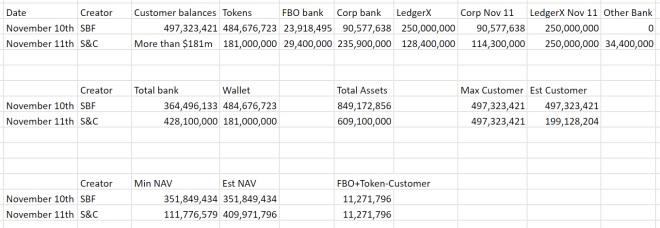
Anyway—here’s what I get, comparing my records to S&C’s presentation.

The presentation and press release don’t actually say what customer balances are, but by claiming that FTX US has $181m of digital assets and also has a customer shortfall, S&C is implying that customer balances are greater than $181m. They’re almost certainly less than $497m—what they were a day earlier—given the withdrawals in between. So that gives two bounds on what it could be. My best guess comes from looking at changes in FBO bank accounts and tokens. In theory those two should be at least equal to customer balances; in the balance sheet on the 10th, FBO + tokens were roughly $11m greater than customer balances. “Max Customer” and “Min NAV” make the conservative assumption that somehow customer balances were still $497m on the 11th; “Est” makes the reasonable assumption that [FBO + Token – Customer Balances] stayed constant at $11m between the two days. Or, in other words: if nothing unusual happened on November 10th, the $298m decrease in FTX US’s custodial assets would imply a $298m decrease in customer balances, both stemming from $298m of customer withdrawals.

That would imply that customer balances were roughly $199m. Anyway, this is a long way of saying: I had estimated roughly $350m more cash on hand than customer balances required (NAV). Using the extremely conservative estimates, their presentation implies a NAV of roughly +$111m, and using the more reasonable estimate you get a NAV of +$409m—pretty close to my number.

All of which is to say: one way or another, their data actually confirms that FTX US was extremely likely to be solvent when I handed it off, with at the very least $111m of excess cash; it also implies that my estimate of +$350m excess cash was probably roughly correct, though there isn’t enough information to actually prove that

S&C claims that FTX US has a shortfall. That claim is false. Based on S&C’s own data provided in the same court presentation, FTX US had roughly $609m of assets ($428m USD in bank accounts, plus $181m of tokens) backing roughly $199m of customer balances. FTX US was solvent when it was turned over to S&C, and almost certainly remains solvent today.
Video Streaming Platform Netflix Revamps iPhone App With Latest Modernized User Interface

0
London, UK - August 01, 2018: The buttons of Spotify, Podcasts, Netflix, WhatsApp and Music on the screen of an iPhone.

Video streaming platform Netflix has revamped its iPhone app by giving it a modernized user interface.

The tech Giant no doubt seeks to improve users’ experience by introducing new card transitions, new animation for both the launch and the profile screens, updated haptics, and many more.

When users tap any program’s art cover, it expands to reveal all the information about the program. Also, the “coming soon” page has been changed to “what’s new” as it now displays users recommended items.

Other latest features include a new billboard layout that responds as users move their device which comes with a subtle lighting effect and a new card transition that’s fully interruptible/interactive.

Reports disclose that the tech giant began working on the project in 2022 after former UI designer at Netflix Janum Trivedi disclosed that last year, he has been leading a UI refresh to make Netflix feel more fluid, delightful, and polished.

Previously, the card transition was less fluid on the app. When a title is selected, the info section would simply slide up. Now, the new card transition shows the card grow bigger, and then the information opens into a full-screen version.

The former Netflix employee disclosed that the tech company is “giving it some love” for the Apple TV version of its app while disclosing that Netflix may eventually release a redesigned user interface for tvOS.

He also posted a video on his Twitter handle where he made a quick test run of Netflix’s latest UI feature which is no doubt appealing.

Also speaking on Netflix’s latest UI design on the iOS app, a spokesperson said, “We recently updated the Netflix iOS app with better visuals, more responsive interactions, and motion design.

“This latest global update includes features like a new style for promoting what to watch, thematic background on your favorite shows and movies, new profile animations, and more”.

Last year, Netflix released an option in its iOS app that takes users to its website in order to finish a new Netflix subscription.

The Netflix app now uses the new iOS API for reader apps that takes the user to an external website before making a subscription.

It is however interesting to note that due to recent antitrust investigations, Apple has finally allowed some types of apps to offer alternative subscription methods outside of the App Store without having to pay a commission to the company. 

Twitter Ad Revenue Drops by 40% As Advertisers Shun the Platform

0

Twitter is facing a deeper financial crisis as advertisers turn their back on the microblogging platform, despite new owner, Elon Musk’s claim that more users have joined the platform since he took over late last year.

According to a report by The Information on Wednesday, more than 500 of Twitter’s advertisers have paused spending on the platform since Musk’s takeover. This means that the company’s daily revenue has significantly dropped compared to 2022 before Musk took over.

The Information, citing a person familiar with Twitter’s ad business, reported that the social media company’s daily revenue on Jan. 17 was 40% lower than the same day a year ago.

The drop in Twitter’s revenue, which was first reported by technology newsletter Platformer on Tuesday, was 40% year-over-year. Advertising accounted for Twitter’s $5.1 billion revenue in 2021, but has seen a downturn, which was exacerbated by Musk’s acquisition bid in 2022.

Clients like Audi, Pfizer and Coca Cola have paused advertising on Twitter following the changes introduced by Musk. Their decision was fueled by concerns about an increase in hate speech on the platform.

Musk’s ‘free speech’ mantra, which has seen several banned accounts, including former US president Donald Trump, reinstated, is another cause for concern to advertisers. The advertisers said they are pausing spending to see what direction Musk takes with the platform. This is against Musk’s claim that activist groups, who he accused of “trying to destroy free speech in America”, were pressuring advertisers.

Musk had promised to uphold Twitter policies on hate speech and cyberbullying, but had backtracked, dissolving the platform’s content moderation team. Twitter recently reversed its 2019 ban on political ads and said that it would relax advertising policy for “cause-based ads” in the United States and align its ad policy with TV and other media outlets, per Reuters.

This has created further concerns that he will scale back misinformation and security protections on the platform.

Instead of working the concerns out, Musk has opted to generate income for Twitter by monetizing verification. In October, the Tesla and SpaceX CEO announced plan to charge as much as $20 per verification badge. The price was later reviewed downwards to $8, following a poll he conducted asking users how much they would pay.

However, the decision to monetize Twitter verification unleashed chaos as impersonator accounts flood the platform, forcing the company to halt the plan. Musk said the blue tick scheme for verified users will be relaunched after he figures a way to deal with scammers’ impersonation.

With the verification scheme chaos, Musk’s plan to create an alternative revenue stream for Twitter was scuttled. Advertisers are parting ways with Twitter as the chief executive is still bent on his absolute free speech-based idea of running the social media company, forcing its revenue to nosedive.

Fall Behind on Office Rent Payments Forces Twitter to Auction Some Equipment at Headquarters – by Ojukwu Emmanuel

Meanwhile due to lateness on rent payments, Twitter is auctioning some equipment at the company.

Several reports disclose that Twitter has allegedly failed to pay rent at offices around the globe, including their San Francisco HQ,

A representative of Heritage Global Partners, the company which is currently handling the auctioning of some of Twitter’s equipment, Nick Dove, however, told Fortune magazine that the sale had nothing to do with recouping costs for the $44bn purchase.

In his words, “If anyone genuinely thinks that the revenue from selling a couple of computers and chairs will pay for the mountain there, then they’re a moron”.

Twitter is currently auctioning off its computers, Kegerators, espresso machines, and oversize neon displays that come along with the company’s logo which is currently bidding at $17,500.

Also, the company’s kitchen supplies are not left out as they include a rotisserie cooker, multiple refrigerators, and pizza ovens, while some of the office equipment includes numerous televisions, desks, and conferencing gear which are all up for sale.

Buyers who are interested in the equipment can visit the website of Heritage Global Partners, which is currently conducting the auction.

Reports disclose that these sales at Twitter were necessitated as the company is trying to cut costs while going through a financial crisis.

Ever since Musk took over as CEO of the company, he has been constantly looking for ways to cut costs, as well as increase the company’s revenue.  He has also ended most of Twitter’s perks, such as free meals.

Recall that when he acquired the company for $44 billion in October, he laid off thousands of workers while some left at their own volition, citing Musk’s unpredictable nature and a rigid workplace.

Last November, Musk tweeted that the company had seen a “massive drop in revenue” following the departure of several advertisers, although in late December he reportedly said it was no longer in the “fast lane” to bankruptcy.

Consider World Economic Forum’s YGL – Nomination, CMU and my Experience

0

The World Economic Forum (WEF) is currently on. And I can write that it is the MOST impactful and prestigious networking organization in the world. Consider the Young Global Leader if you are doing something amazing. I count my career before and after I was honoured and admitted as a  Young Global Leader (YGL) by WEF. When you join, they give you access to a database. In that database, you will have access to any important business, political, etc, leader in the world.

Mine came while out of Pittsburgh, USA, we were setting up Carnegie Mellon University in our continent. And quickly, many organizations reached out. From that moment, one connected to the 1%.

If you are doing something amazing and you are looking for an organization that can scale your mission, I recommend WEF YGL; it is the most prestigious because you can suddenly have access to any leader who can help your mission. Of course, someone has to recommend you since you cannot apply by yourself (till today, I do not know who submitted my name. Whoever that person is, thank you). See the form here 

2023 Nigeria Elections: Conceptual Map of INEC’s Credible Election Discourse at Chatham House

0

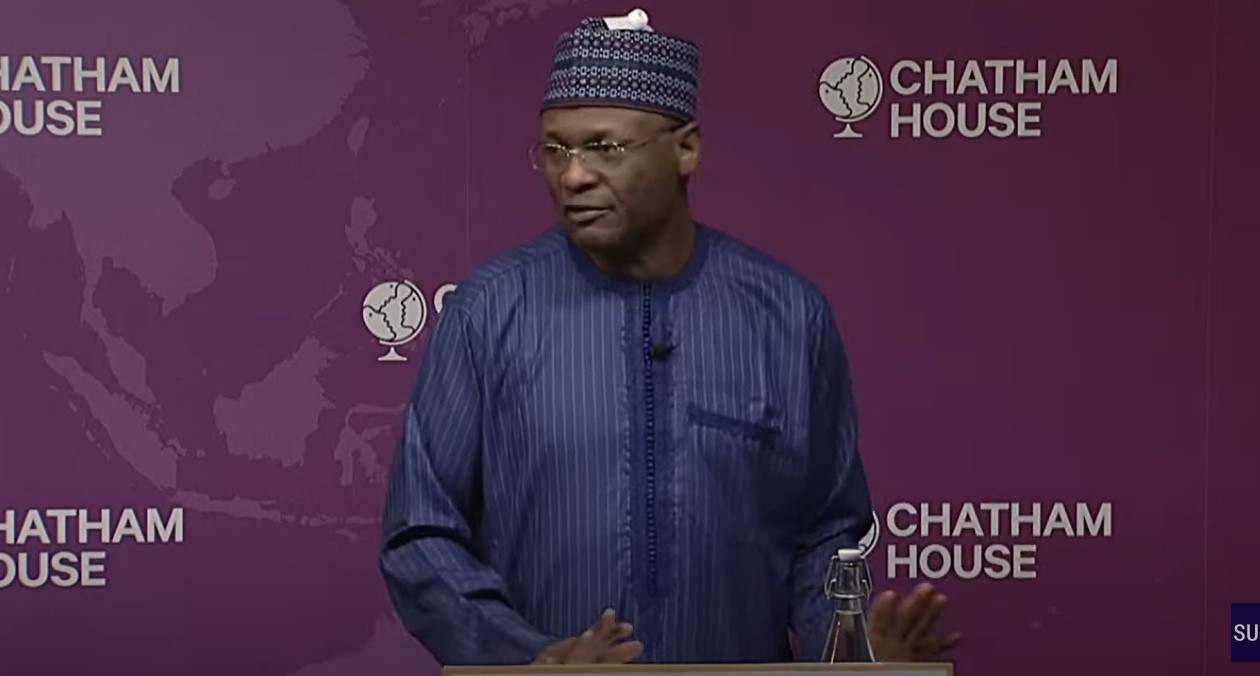
In this piece, the views of Professor Yakubu Mahmood, chairman of the Independent National Electoral Commission, were examined as part of our analyst examination of political and electoral actors’ presence at Chatham House. Professor Yakubu’s speech came a day after the Labour Party’s presidential candidate, Mr Peter Obi, discussed his agenda for Nigeria in the House on January 16th, 2023. According to the chairman, Nigeria will hold her seventh consecutive general election in 2023.

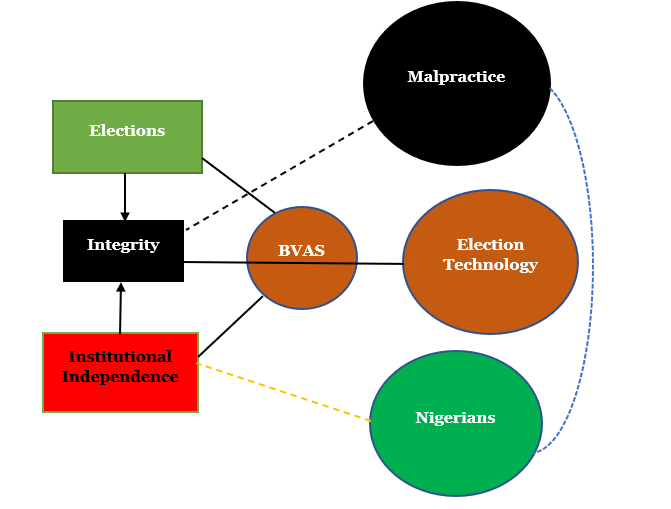
The over 7,000-word speech revealed the Commission’s successes and challenges during the previous general elections, particularly the 2015 and 2019 general elections. Using a conceptual discourse map approach, our analyst discovered that INEC requires complete institutional independence in order to conduct credible elections. This independence would allow it to use technologies to avoid potential malpractices orchestrated by political actors and their supporters. Our analyst also concluded from Professor Yakubu’s speech that having credible elections requires more than the Commission’s efforts.

Nigerians must support it. According to our analyst, this appeal is primarily directed at politicians and supporters who believe in inciting violence before, during, and after elections. Politicians and supporters who believe elections should be a do-or-die affair are also urged by the electoral body’s chairman, who claims the Commission’s only commitment is to Nigerians. These insights were derived primarily from five extracts in which integrity serves as the focal point of his credible election discourse.

  1. As Zavadskaya and Garnett aptly note, the question of integrity of elections is relevant for “all elections, whether in new democracies or jurisdictions that have held election for decades”, because they are all “vulnerable to malpractice.
  2. …we are preparing for a general election of high integrity and inclusiveness in Nigeria in 2023.
  3. For election technology, early decision is central to maintaining its integrity, popularising it among voters and addressing any challenges that could arise.
  4. On 4th January 2023, we received the final batch of the BVAS to be used for the election. That puts us on course to perform functional and integrity tests on every BVAS to be deployed for the election, which has been concluded in many States nationwide.
  5. Our commitment remains only to Nigerians and not to any political party or candidate. That is what the law requires of us. We cherish the institutional independence and integrity of the Commission.

Exhibit 1: conceptual map of integrity discourse in relation to other key knots

Source: Yakubu Mahmood, 2023; Infoprations Analysis, 2023