DD
MM
YYYY

PAGES

DD
MM
YYYY

spot_img

PAGES

Home Blog Page 449

A $500 Billion Valuation for Tether Would Have Profound Implications Across Crypto and Finance

0

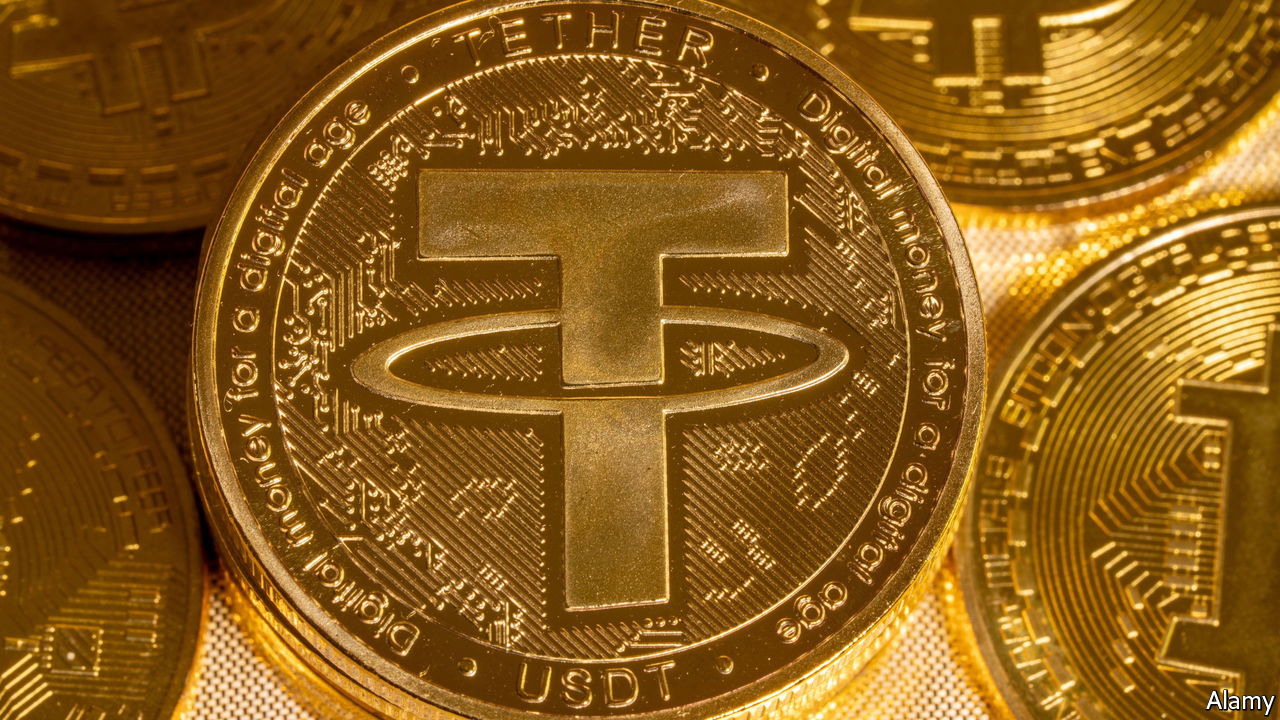
Tether Holdings SA, the issuer of the world’s largest stablecoin USDT, is actively exploring a major capital raise that could value the company at approximately $500 billion—potentially making it the most valuable private company globally.

This would surpass current leaders like SpaceX valued at around $350 billion in recent rounds and OpenAI at $300 billion earlier in 2025, based on the scale of Tether’s operations and profitability.

Tether is in talks to raise $15–20 billion through a private equity placement, offering roughly 3% of the company to investors. Cantor Fitzgerald is advising on the deal. The implied valuation of $500 billion is ambitious but tied to the stake size; final terms could adjust lower depending on negotiations.

Discussions are ongoing as of late September 2025, with CEO Paolo Ardoino confirming the company is evaluating “high-profile key investors.” However, a conflicting statement from Tether USAT’s new CEO Bo Hines a U.S.-focused subsidiary indicated no immediate plans for fundraising, suggesting this may apply to the core El Salvador-based entity.

Proceeds would fuel expansion into AI, energy, communications, and other sectors, diversifying beyond stablecoin issuance. Tether has already allocated up to 15% of profits to Bitcoin purchases.

Why This Valuation Makes Sense and Why It’s Eye-Popping

Tether’s USDT has a circulating supply exceeding $170 billion, dominating over 50% of the stablecoin market. The company’s profitability is staggering: Q2 2025 profits: $4.9 billion 99% margin from U.S. Treasury yields on reserves.

Year-to-date: $5.7 billion. PE Multiple: Analysts estimate ~68x based on $173 billion in USDT circulation and a 4% yield. Rival Circle (USDC issuer) is valued at ~$30 billion, highlighting Tether’s lead despite past regulatory scrutiny (e.g., 2021 disclosures on reserve backing).

Buzz is building, with users hyping it as a “stablecoin king flex” and speculating on BTC implications amid $118K prices. Posts emphasize Tether’s BTC stacking and whale activity. Falling U.S. interest rates could squeeze yields, and centralization concerns loom in a market where Tether holds outsized influence.

Regulatory hurdles persist, especially with U.S. re-entry plans. If successful, this cements stablecoins as a trillion-dollar asset class bridge between crypto and TradFi. If it closes at $500B, Tether won’t just be the top private company; it’ll redefine crypto’s role in global finance.

Tether’s USDT, with over $170B in circulation, already commands ~50% of the stablecoin market. A $500B valuation would solidify its lead over rivals like Circle’s USDC ($30B valuation), potentially discouraging competition and centralizing stablecoin influence.

A $500B valuation puts Tether on par with major banks (e.g., Goldman Sachs at ~$170B), signaling stablecoins’ growing role in global finance. This could accelerate institutional adoption of crypto for payments and settlements.

Tether’s size and U.S. re-entry plans via Tether USAT will likely intensify regulatory oversight, especially given past concerns about reserve transparency. Stricter rules could reshape stablecoin operations or spark U.S. policy shifts on digital assets.

Tether’s ~$5B quarterly profits rely on U.S. Treasury yields. Falling interest rates could compress margins, impacting valuations and forcing diversification into AI, energy, or communications as planned.

USDT’s peg to the U.S. dollar reinforces its global use, but a $500B Tether could amplify debates about dollar dominance in a world exploring CBDCs and de-dollarization.

The $15–20B raise would fund Tether’s expansion into AI, energy, and communications, potentially disrupting these sectors. Success could position Tether as a cross-industry titan, akin to tech conglomerates.

Tether’s raise is framed as a “stablecoin king” moment, potentially shifting public perception of crypto from speculative to foundational. This could drive mainstream adoption. A $500B valuation concentrates wealth among Tether’s investors and leadership, raising questions about inequality in crypto’s growth.

If Tether secures a $500B valuation, it could redefine crypto’s role in global finance, accelerate stablecoin adoption, and reshape private markets. However, its success hinges on navigating regulatory hurdles, maintaining reserve stability, and delivering on diversification.

Research Institute Bain Warns of $800bn Shortfall in Global AI Compute Funding by 2030

0

The global race to scale artificial intelligence may hit a financial and infrastructure wall sooner than expected. New research from Bain & Company’s sixth annual Global Technology Report, released Tuesday, finds that by 2030, the world will need $2 trillion in annual revenue to fund the computing power required for anticipated AI demand.

Even after factoring in AI-driven savings, Bain projects an $800 billion shortfall—raising alarms about whether global supply chains, capital markets, and power grids can keep pace.

The report estimates that incremental AI compute requirements could reach 200 gigawatts by the end of the decade, with the United States alone accounting for half. Meeting that need would require technology executives to deploy roughly $500 billion in capital expenditures on new data centers while identifying $2 trillion in revenue streams to sustain profitability.

“By 2030, technology executives will be faced with the challenge of deploying about $500 billion in capital expenditures and finding about $2 trillion in new revenue to profitably meet demand,” said David Crawford, chairman of Bain’s Global Technology Practice. “Because AI compute demand is outpacing semiconductor efficiency, the trends call for dramatic increases in power supply on grids that have not added capacity for decades.”

Bain warns that AI’s growth is already surpassing Moore’s Law, doubling compute requirements faster than chip efficiency improvements can offset. The imbalance risks creating global strains on energy, hardware supply chains, and capital spending. The report highlights that the “arms race dynamic” between nations and top providers could exacerbate risks of both overbuilding and underbuilding critical infrastructure.

Despite infrastructure challenges, companies at the forefront are reaping financial rewards. According to Bain, tech-forward enterprises that scaled AI across core workflows—sales, marketing, customer support, and R&D—have delivered 10% to 25% EBITDA gains over the past two years. Still, most firms remain stuck in experimentation mode, extracting only modest productivity boosts.

The report singles out “agentic AI” as the next frontier, where autonomous agents collaborate across workflows and applications. Bain projects that within three to five years, 5% to 10% of enterprise technology spending could go into foundational agentic capabilities, with up to half of spending eventually consumed by AI agents running across organizations.

Bain identifies four levels of maturity:

  • LLM-powered retrieval agents
  • Single-task workflows
  • Cross-system orchestration
  • Multi-agent constellations

Levels two and three are where “capital, innovation, and deployment velocity are converging,” Bain said, stressing that leaders at these stages are already compounding their advantage while laggards risk falling further behind.

SaaS faces AI disruption

Software-as-a-service (SaaS) providers face an uncertain but potentially lucrative transition. Bain argues that generative and agentic AI could expand SaaS markets by automating user tasks and embedding into workflows. Yet incumbents will need to make high-stakes strategic bets, including selective open-sourcing and changes to monetization. Winning providers must “own the data, lead on standards, and price for outcomes, not log-ons, in an AI-first world,” the report said.

Sovereign AI and a fractured supply chain

Bain also points to the rise of “sovereign AI” as governments move to localize control over critical infrastructure, mirroring shifts in semiconductor supply chains. Export controls, tariffs, and decoupling between the U.S. and China are accelerating fragmentation. China now accounts for roughly 20% of global chip manufacturing capacity, raising the stakes for U.S. and European firms.

“Sovereign AI capabilities are increasingly seen as a strategic advantage on par with economic and military strength,” said Anne Hoecker, head of Bain’s Global Technology Practice. “Considering these differences, global AI standards are unlikely to converge.”

For multinational firms, Bain advises optionality—moving boldly where confidence is high, while prioritizing flexibility where uncertainty looms.

Quantum computing and humanoid robots on the horizon

Alongside AI, Bain spotlights two other transformative technologies. Quantum computing, though still in early stages, could unlock $250 billion in value across industries from pharma to logistics once fully capable fault-tolerant machines arrive.

Meanwhile, humanoid robots are shifting from viral demos to billion-dollar valuations, though deployments remain limited and heavily reliant on human oversight. Early adopters, Bain argues, will be best positioned to lead if ecosystem readiness improves.

Private equity dealmaking cools

The report also notes a slowdown in North American technology private equity deals in the second half of 2025. Tariff-related uncertainty and geopolitical tensions have tempered momentum despite a strong start to the year. While software continues to outpace GDP growth, its penetration across manufacturing and retail is topping out, forcing investors to hunt harder for top-tier growth opportunities. Even so, tech remains one of the strongest-performing PE sectors, Bain finds.

With AI scaling at breakneck speed, Bain concludes that technology leaders face a paradox: they must prepare for unprecedented capital and energy demands while navigating geopolitical fragmentation and disruptive innovation. Companies that adapt quickly to agentic AI and sovereign technology regimes will have an edge, but the risks of missteps—from overinvestment to supply shortfalls—remain high.

PayPal Announces Plan to Invest $100M Across Startups in Middle East and Africa

0

In a bold move to strengthen its footprint in two of the world’s fastest-growing digital commerce regions, PayPal Holdings has unveiled plans to invest $100 million across the Middle East and Africa to fuel innovation, support emerging startups, and drive inclusive economic growth.

The investment will be channeled through minority stakes, acquisitions, PayPal Ventures funding, technology deployment, and talent development, with a focus on helping local businesses scale, unlocking new opportunities for innovators, and bringing millions of consumers and communities into the digital economy.

Speaking on this investment, Alex Chriss, President and CEO of PayPal said,

The Middle East and Africa are home to some of the most dynamic and rapidly evolving businesses in the world. By dedicating a $100 million investment to this region, we’re supporting the technologies, partnerships, and solutions that will help entrepreneurs scale faster, expand their reach across borders, and unlock growth opportunities in the digital economy.”

This announcement comes on the heels of PayPal’s first regional hub launch in Dubai earlier this year, designed to serve as a gateway for businesses, from large enterprises to small merchants to access seamless payments, robust security, and expanded reach into international markets.

The new commitment builds on PayPal Ventures’ existing investments in high-potential startups such as Tabby, Paymob, and Stitch, reinforcing PayPal’s role as a long-term partner in shaping the future of digital commerce across the region.

This commitment underscores our focus on strengthening PayPal’s presence in the Middle East and Africa,” said Otto Williams, SVP, Regional Head, and GM of PayPal Middle East and Africa. “Our goal is to expand our footprint and ensure millions of consumers and businesses have access to the digital services they need to succeed.”

PayPal’s $100 million investment in startups across the Middle East and Africa (MEA) is poised to have a significant impact on the region’s digital economy, startup ecosystem, and broader socioeconomic landscape.

Below are the key impacts, grounded in the context of the investment and regional dynamics:

Access to Capital: The $100 million will provide critical funding for early-stage startups, particularly in fintech, payments infrastructure, and digital commerce. This addresses a major challenge in MEA, where access to venture capital is often limited compared to other regions.

Scaling Opportunities: Through PayPal Ventures’ minority equity stakes and potential acquisitions, startups like Tabby, Paymob, and Stitch (already in PayPal’s portfolio) can scale faster, accessing global markets via PayPal’s infrastructure.

Innovation Catalyst: Investment in tech and talent will spur innovation in areas like AI-driven payments, buy-now-pay-later services, and mobile money solutions, which are critical in MEA’s mobile-first markets.

E-commerce Expansion: MEA’s e-commerce market is growing rapidly, with countries like the UAE, Saudi Arabia, Egypt, and South Africa leading the charge. PayPal’s investment will enhance digital payment infrastructure, reducing transaction friction and enabling small businesses to reach global customers.

Empowering SMEs: Small and medium enterprises (SMEs), a backbone of MEA economies, will benefit from better access to global markets and secure payment systems, driving revenue growth and resilience.

Attracting Further Investment: PayPal’s move signals confidence in MEA’s potential, likely attracting other global investors and corporations to the region, amplifying economic impact.

Conclusion

PayPal’s $100 million investment will catalyze startup growth, enhance digital commerce, and foster financial inclusion across MEA. By empowering fintechs and SMEs, will create jobs, drive innovation, and integrate the region into the global economy.

With this move, the payments giant is positioning itself at the forefront of digital transformation in a region rapidly embracing innovation, e-commerce, and financial inclusion.

After Success With Shiba Inu (SHIB) and Dogecoin (DOGE), 100x Meme Coin Hunters Are Buying This Ethereum Coin in 2025

0

The crypto world has a way of surprising everyone. After years of watching projects like SHIB and DOGE climb into billion-dollar valuations, many investors are scanning the market for the next breakout. This time, their eyes are on Little Pepe (LILPEPE). The token is priced at $0.0022 in its stage 13 presale, and 92.49% already been sold out. Analysts believe its unique ecosystem and zero market cap advantage could unlock gains of over 15000% from this level, putting it among the most promising Ethereum-based tokens of 2025.

Price and Technical Outlook for LILPEPE

At $0.0022, LILPEPE has already moved up from its earlier presale stages, where tokens were offered at $0.001. This means early investors are already enjoying gains of more than 120%. The current stage offers an additional 37% upside when the token lists at $0.0030. Momentum indicators remain bullish. TradingView data suggests that meme coins with strong presale traction often see volume spikes when listing. With over $25.9 million already raised and only about $2.8 million left to close stage 13, LILPEPE is on track to complete all 19 stages before its exchange debut.

Ecosystem Strength and Presale Momentum

What makes Little Pepe stand out is its ecosystem. It is building on a Layer 2 network tailored for meme tokens. This means faster and cheaper transactions than meme coins relying solely on the Ethereum mainnet. Its sniper bot-resistant design ensures fair distribution, preventing whales from draining supply in seconds. The tokenomics are structured to encourage long-term growth. A zero tax model makes it appealing for small and large traders, while vesting schedules for team allocations provide stability instead of instant sell-offs. The presale has been a story of speed, with stage 12 selling out in days and stage 13 almost complete.

Whale Accumulation and Community Incentives

Whale accumulation has become a notable trend in LILPEPE. Several large purchases have been reported, a strong sign of institutional-level interest in a project that started with a zero market cap. Alongside that, community growth has been impressive. Over 378000 entries have already been recorded in the 777k giveaway. On top of that, the Mega Giveaway running between stages 12 and 17 adds another layer of excitement. Over 15 ETH rewards are distributed to top buyers, while every holder is automatically eligible. These incentives show a deliberate push to build investors and a community of loyal supporters.

Bullish Developments and Projections for 2025

The Certik audit has already been completed, adding a layer of trust and credibility. LILPEPE is now listed on CoinMarketCap, bringing visibility to new investors. Excitement is building for its upcoming centralized exchange listings, which are expected to add significant liquidity. Search trends between June and August showed Little Pepe outperforming SHIB, PEPE, and DOGE in meme coin queries. This surge in attention reflects cultural momentum, which often translates into capital inflows. With its zero market cap launch advantage, analysts speculate that LILPEPE could grow over 15000% in the short term, potentially turning modest investments into major wins in 2025.

How to Buy LILPEPE

Buying LILPEPE during the presale is straightforward. Investors can visit the official website, connect their ERC20 wallet, and complete their purchase using ETH or USDT. With stage 13 already 92.49% sold out, time is running out for those who want to secure the presale price before the token moves closer to its $0.0030 listing level.

Conclusion

The success of meme coins has always depended on timing, culture, and innovation. With its presale nearly sold out, a community of over 378,000 already engaged in giveaways, and a Layer 2 ecosystem tailored for meme tokens, Little Pepe (LILPEPE) is shaping up as one of the standout Ethereum-based projects in 2025. Starting from zero market cap gives it unmatched growth potential, with analysts projecting 15000% gains after launch. The window is closing quickly for those looking to secure tokens before it lists.

For more information about Little Pepe (LILPEPE) visit the links below:

Website: https://littlepepe.com


Whitepaper: https://littlepepe.com/whitepaper.pdf

Telegram: https://t.me/littlepepetoken

Twitter/X: https://x.com/littlepepetoken

Understanding Lean Supply Chain Applications in Business

0

In the orchestra of modern commerce, the supply chain is the conductor’s baton. It determines rhythm, flow, and harmony. But in many firms, that baton is heavy, bloated with inefficiencies—warehouses stocked with slow-moving inventory, lead times stretching like rubber bands, and coordination that lags across partners.

Lean supply chain is the redesign: it is the commitment to eliminate waste, synchronize processes, and deliver value with precision. Like Toyota’s lean production, it anchors on doing more with less—less time, less inventory, less cost—while ensuring the customer always experiences more value.

A lean supply chain is not just about cutting fat; it is about improving muscular strength. Firms that adopt it optimize sourcing, automate logistics, and leverage data visibility to predict demand. They shift from reactive replenishment to proactive planning, ensuring that resources align with real consumption patterns.

In Africa, where logistics remains one of the biggest barriers to competitiveness, lean supply chain models can reduce inefficiencies that inflate prices and erode margins. Think of it as the engine that turns fragmented ecosystems into coherent pathways where goods move seamlessly and efficiently.

Ultimately, lean supply chain is both strategy and discipline. It demands that firms view partners not as adversaries to squeeze but as collaborators in a shared value chain. When businesses commit to lean systems, they free up capital, accelerate market responsiveness, and build resilience against shocks. The result is speed, adaptability, and sustained competitiveness.

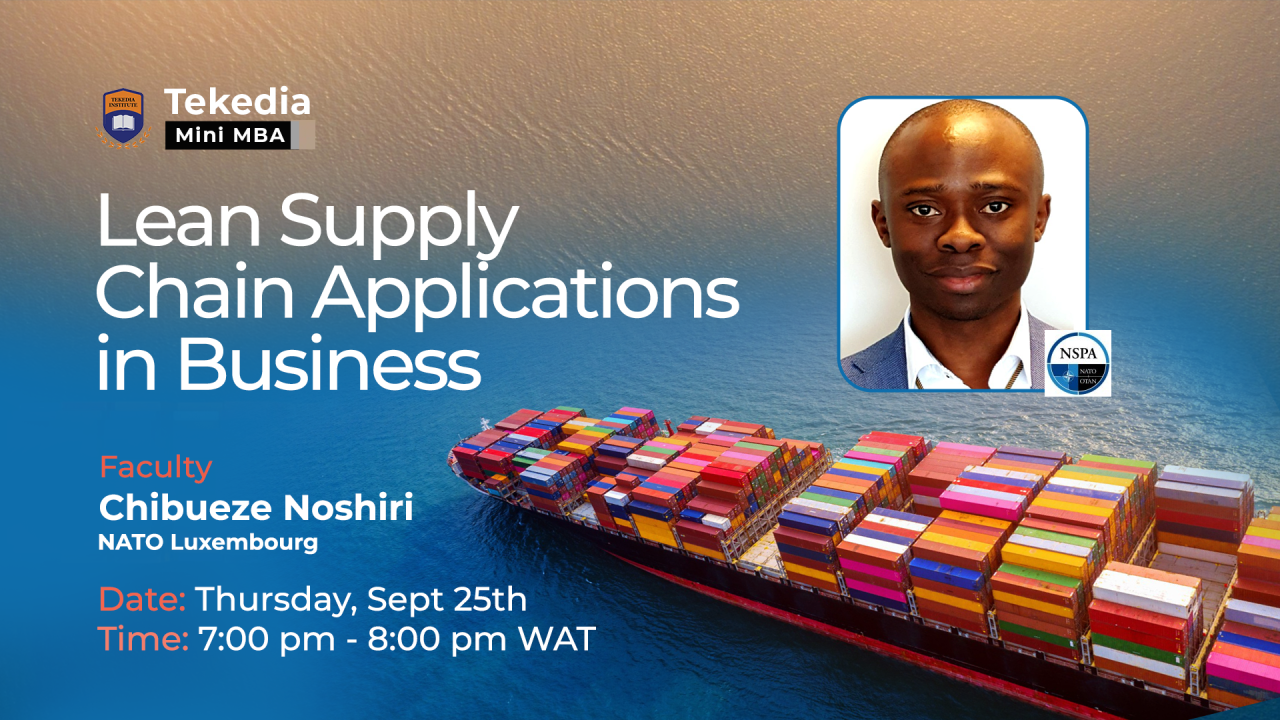
From NATO today, we will be learning from a zen-master of lean at Tekedia Mini-MBA.

Thur, Sept 25 | 7pm-8pm WAT | Lean Supply Chain Applications in Business – Chibueze Noshiri, NATO Luxembourg | Zoom link