DD
MM
YYYY

PAGES

DD
MM
YYYY

spot_img

PAGES

Home Blog Page 4498

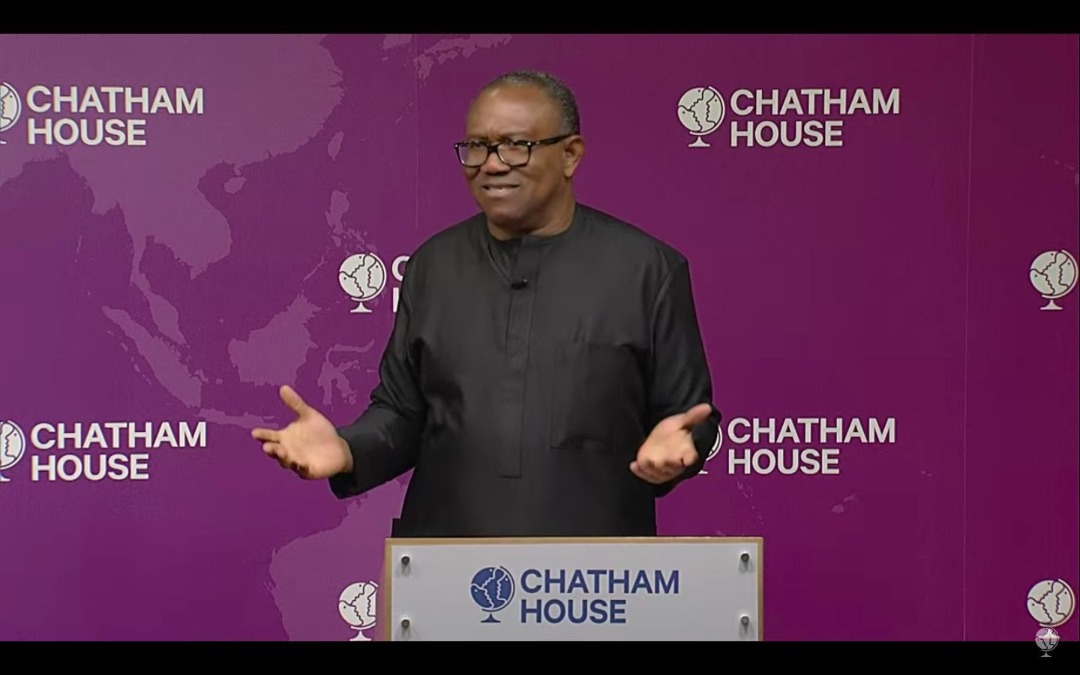
Peter Obi’s Speech At Chatham House UK (full text, video)

12

“In agreement to the primacy of gratitude among human virtues, please allow me to begin today with words of gratitude. I am most grateful to Chatham House, Dr. Alex Vines & his team for the global impact of their mission and commitment to engagement with Nation building in Nigeria. In providing this global platform to interrogate the vision of those seeking to lead Nigeria, at this time when clear existential threats as I will discuss shortly are pervasive across our dear country, this Chatham House event challenges us to new thinking.

We have alarming insecurity that has led to loss of many lives and properties, significant decline in food and economic output, immense trauma that has compromised the mental health of communities, and in some cases, irredentist pressures and disaffection with the Nigerian project The economy is in crisis with a troubling debt profile worsened by oil theft of proportion once hard to even imagine, two economic recessions in six years and a lamentable power sector that significantly constrains manufacturing and social life.

The Nigerian state is captive to an elite gang-up and a rentier political economy that has concentrated political power in the hands of those who came to power and influence mainly through their own contrivances and not through the affirmation of the people, and therefore, do not have the incentive to serve the people’s interest. Even after exploiting ethnic and religious cleavages and sentiments to ascend to political power, the very people on whose sentiments they grabbed power often become the primary victims of such political fraud that has rendered Nigeria a failing state with a worsening leadership crisis.

Consequently, Nigeria’s Democracy has been on the wane, evident in the Afrobarometer longitudinal tracking which reveals low voter turnout and apathy in the current Republic. But this seems to have turned around dramatically last year, allowing Independent National Electoral Commission (INEC) to register over 12 million new voters, with many more complaining they wished to register but were unable to make INEC deadlines.

What prompted this turn-around? The reasons for these very high stakes are lurking in facts of demographics, with our dominant population (the youths) frustrated and unhappy with the status quo and the diminished opportunities in Nigeria in an age of globalization when the Internet easily reveals to them the prosperous homes of those who live in better-led and governed countries.

How did we (Nigeria) plunge into such economic decline that we have overtaken India as home to the biggest pool of the absolute poor in the world? While the poverty rate in India is about 16%, that of Nigeria is about 63% with about 133 million Nigerians classified as multidimensionally poor!

This is unacceptable and needs to change! What Nigeria needs is a Great Escape as the 2015 Noble prize winner in Economics Angus Deaton of Princeton University elucidated, that what separates poor & rich is attributable to Health & Education. But what provides Quality Health and Educational Systems for a society? Committed and Focused Leadership that can Build and Sustain Public Wealth as I was told by Professor Donald Jacobs of The Kellogg School of Management.

In many ways, this is at the heart of my remarks today which are deeply rooted in my upbringing, particularly my mother’s counsel that I live a life of positive impact and manage both personal and public resources most prudently for sustainable/inclusive growth and development of the society.

It is the principle that guided my stewardship as Governor of Anambra State, Nigeria and led to our much-commended performance with some priced awards to show for it. Some of the awards were for outstanding accomplishment in key Millennium Development Goals (MDGs) now Sustainable Development Goals (SDGs). It is the same counsel and principle that is guiding and motivating me to offer to serve in a New Nigeria!

The answer lies in an understanding of Leadership, Institutions and Demographics. The good news is that demography is driving the change we are seeing in Africa with election after election in the last year in Africa, in which the establishment parties are being upturned by new or small parties. It is for this change that my vision of policy change and institutional development is rooted in the push for a broadened scope of SOCIAL MOBILITY AND FREEDOM for Nigerians, particularly our children and youth. Like Former British Prime Minister Harold McMillan said at the start of the Independence decade, a wind of change is blowing through Africa. Today a new wind of change sees the ballot box as being instrumental to changing of bad leadership.

Senator Yusuf Datti Baba-Ahmed, my running mate, and I are committed to a new politics that starts with the ethics of servant-leaders and anchored on the marriage of clean hearts and skilful hands. We know that unless we change our politics by changing our political leadership, we are stuck with this terrible state of underdevelopment and misery. We will patriotically reform our institutions particularly ones directly responsible for implementing Government policies to make them fit for purpose. It is not to be doubted at the global scene that Nigeria is blessed with some of the most entrepreneurial youths in the world, in science, in business, in art and entertainment.

We believe that what remains is to change the leadership class from predators to creators of value; from those whose wealth and power derive from the destitution of the nation and its peoples to those who have demonstrated the competence, character and capacity to invest in human development, create prosperity, and instill the right values and ethical conduct deserving of servant leaders. Nigeria today is at a critical juncture and the people, led by the youths brutalized by bad leadership, are awake and leading the movement to transform Nigerian politics and restart the engine of economic growth and social stability.

We count ourselves honoured to be trusted especially by the youths, to lead this democratic revolution and we deeply pledge to do so with sincerity, accountability and unquenchable love and desire for a better Nigeria. We are simply, the symbol of the Nigerian youths’ struggles to reverse the ugly trend that keeps driving them into social anomie, despair and rejection of their beloved country. We are determined to do everything that needs to be done to rescue and lead our beloved country to prosperity, freedom, security and peace. We will use merit to assemble competent Nigerians from all sections of Nigeria to form an effective Government of National Unity.

At the heart of my goal here today is to look at our Labour Party’s key policy planks and how they will drive up the quality of life of the average Nigerian, dramatically reduce poverty and return Nigeria to a place of strategic relevance in a world that needs a thriving and well governed Nigeria stabilizing the continent of Africa, making it a high value add for a planet imperilled by environmental challenges, terrorism and inequity.

I also plan here to speak on institutions and how the leadership we offer can facilitate the evolution of stronger institutions, with the rule of law a key anchor of Nation building in Nigeria. I have no doubt that the policy choices we favour, and the strong institutions Labour Party will facilitate, will move Nigeria from a country of rent seekers sharing Oil receipts and consuming conspicuously, to one that produces, based on vast factor endowments whose value chains can move us towards a high employment economy. We will turn our youth bulge to a demographic dividend, rather than today’s harvest of a time bomb of violence and insecurity from the uneducated, unemployed and marginalized.

This forms the first and most important thrust of my governance priorities without which the rest may not be achieved: “To secure Nigeria, end banditry and insurgency, and unite our dear nation to manage our diversity, such that no one is left behind”. The growing insecurity in Nigeria is not because the enemy is formidable, it is rather because of lack of focused leadership, ineffective security governance structure and poor coordination from the centre All these need to be addressed by first, projecting strong leadership signals that allow both state and non-state actors to be mobilized around a single vision.

Then, by pursuing a robust reform of the security governance structure with a strong coordinating mechanism that assures that all levels of government – federal, state, and local (with 3-level policing structure) are aligned with strong collaboration with partners from both the private sector and development groups to provide the required services and deliver results for every Nigerian. Once this is done, it is also important to have a single, clear, coherent, and consistent communication system to keep the government accountable, citizens engaged and involved in the development process.

It is important for institutions to be able to provide strong leadership, coordination capability, partner and engage collaboratively with all relevant stakeholders in an environment that mutually reinforces values. The second plank of my policy thrust is to “Shift emphasis from consumption to production by running a production-centered economy that is driven by an agrarian revolution and export-oriented industrialization”.

With about 70 million hectares of arable land, we will pursue an agricultural revolution through proper segmentation of Nigeria to activate and harness the factor endowments of different parts of the country for both rapid and mechanized agricultural development and as a pillar for Nigeria’s other sectoral development and industrialization. We will incentivize and invest in agro-cluster and industrial cluster development across our geo-resource zones to take advantage of agglomeration and scale effects particularly in North-West, North-East and North-Central regions of Nigeria. We will dredge both Rivers Niger and Benue, build dams and massively support the planting of economic trees across the country for local usage, poverty elimination, export and revenue generation.

A key task is to sequentially but decisively, dismantle the inefficient and anti-market distortionary structures restraining the Nigerian economy from creating the preconditions for a dynamic pro-market economy. We will employ entrepreneurial governance to dismantle impediments to free trade and ease of doing business and implement radical economic policies that will drastically reduce our debt service – a major drain on government revenue today Our Micro, Small and Medium Scale Enterprises (MSMEs) will be robustly supported. Further borrowing will be strictly for productive purposes.

While we will aggressively pursue the activation of all opportunities in the oil and gas value chain, we will use targeted incentive schemes that will be professionally administered to diversify our non-oil export portfolio with proper consideration and management of climate change risks and opportunities.

The third pillar of our governance priorities is to “Restructure the polity through effective legal and institutional reforms to entrench the rule of law, aggressively fight corruption, reduce cost of governance, and establish an honest and efficient civil service”. Reducing the cost of governance in Nigeria is an effective way to fight institutional corruption. In addition to reducing cost of governance and streamlining government operations for efficiency and effectiveness, we will ensure that reforms are pursued in a way that protects the livelihood of our hardworking and efficient civil servants. Critical to fighting corruption, we shall install a new budgeting system founded on the cardinal principles of public accountability, objective setting, and program implementation. This is against the extant budgetary principles of revenue mobilization, expenditure allocation, borrowing without emphasis on monitoring, evaluation, and feedback.

We will enforce the principle of performance auditing and institutionalize monitoring and evaluation process of the entire public service delivery as the primary means of actualizing our vision of a new Nigeria. This reform will institutionalize the personal involvement of the President in setting budgetary objectives of MDAs, and monitoring and evaluating the implementation process through the Office of Regulatory Review in the Office of the President.

Budget monitoring and evaluation capacity will be strengthened within the Presidency. We will embark on effective macro-economic and fiscal restructuring to quickly restore fiscal viability by discontinuing unaffordable subsidies which have left a black-hole in government finances. Fiscal and monetary policy will be properly coordinated, with each deploying conventional tools transparently instead of distorting markets to favour a few privileged persons.

For the avoidance of doubt, we will collaborate with the Central Bank of Nigeria for the transparent liberalization of the foreign exchange market and the dismantling of the opaque multiple exchange rate regime which effectively subsidizes a few privileged persons. We will also seek to boost the supply side, rather than continuing to concentrate exclusively on demand management of the foreign exchange market. When unaffordable subsidies are removed, some carefully calibrated transfers will be used to cushion any adverse impact on the economically weak. If the competitiveness of a sector is to be enhanced, then that will be done via the enactment of transparent and specially targeted fiscal and trade policies designed to stimulate investment and growth. Revenue shortfalls and leakages such as oil theft will be dealt with decisively by holding persons in positions of authority fully accountable.

The fourth plank of our governance priorities is to “Leapfrog Nigeria into the 4th Industrial Revolution through the application of scientific and technological innovations to create a digital economy.””


Great leaders become less wrong!

0

Avoid people who think they can never be wrong. Run away from people who think that acknowledging mistakes is weakness. If your boss is never wrong because he uses his power to make mistakes to look “correct”, it’s time for another move.

Authentic leaders change opinions based on new information. Bad leaders are lost in the past, never open to see a deep future. Great leaders become less wrong, not because they are smarter, but because they are very quick to quickly recognize errors and mistakes, and compensate for them.

The wise wrote the timeless “to err is human”. Yes, every human can make a mistake, but it takes only those who can recognize the mistakes, and change, to become Leaders. If your team does not make mistakes, you have a problem! But if your team makes mistakes, and cannot recognize, to recover from their errors, you have a lost #mission!

Comment on Feed

Comment 1: Awesomely digested and thanks for linking up with critical thinking with the subconscious. Likewise the inefficiency of every machine and machineries.

Comment 2: “To err is human”
Perfection is a wild goose.
Revision is the path to greatness.
May we never get to the point where our mission becomes a lost cause, Professor.?

Comment 3: Apt! It’s a shame that we miss this wisdom! Leadership is ineffective without the constant awareness that one can be wrong and that the strength of any leadership lies in its team!

What Recruiters Want from Job Applicants

0

I have been involved in some recruitment processes and I can see why most job applicants are unemployed even with bogus educational qualifications, with the best results and grades.

I am not a Human Resource manager or a professional recruiter but I manage a law office and sometimes we do seek to recruit new legal associates; NYSC associates; legal interns/ extern. I also serve as a retainer and secretary to some companies and most times I get involved in the recruitment process of those companies; when we advertise for roles or openings to be filled, on many occasions the things I see from job applicants do especially through their Curriculum Vitae make my body itch.

Let me remind you that when an employer is seeking a person to employ, the employer is looking for someone who is fit and capable for that role and can as well be loyal while on the job. They, therefore, need you to convince them that you are fit for the job and that you can do it and you will be loyal while at it. Your curriculum vitae (CV) containing your educational qualifications and past work experiences is just a means of convincing the prospective employer that you are fit and capable for the job; you have what it takes; you have done it before and you are capable of doing it again.

The first point of selling yourself to the recruiters or standing out from the numerous applicants applying for the same limited slot with you is for you to present your CV very well; a well-packaged and presented Cv goes a long way in getting your feet at the door of the company.  The importance of a well-drafted (in professional font size) Cv cannot be overemphasized in landing a job seeker the job. Also, a concise and brief cover letter of you telling the employer who you are and why you are fit for the role goes a long way as well.

Recruiters and human resource managers are busy people and they have numerous CVs to sort from, hence why they won’t think twice in discarding an applicant’s submission that the Cv was not properly drafted or presented. Your Cv is the first impression you make with your prospective employers and the wrong impression a bad Cv creates in the mind of recruiters is that if an applicant cannot present a proper Cv then his capability in executing tasks when employed will be in doubt.

As a matter of fact, there are not too many jobs or companies to provide employment for the teaming unemployed in Nigeria, hence when a role is being advertised may be what the company needs is just one or two people and you will have more than thirty persons applying for that role.  The only way you stand out from the rest of the applicants is by presenting and submitting an “eye-catching” Cv since it is through the Cv you will be making your first contact with prospective employers.

A company that has me as their retainer once tasked me with helping them get an in-house legal associate for the company. Immediately we sent word that such a company needed in-house counsel, we got about twenty applicants flooding my email box with their CVs in less than 24 hours.

The first thing I looked at was how the Cv was presented and how he or she is able to sell himself on the cover letter. I can tell you that most CVs I got were turn-off.  Some forwarded their CV without captioning it; When applying for a role or sending your Cv through email for a role, you are expected to add the role you are applying for with your name as the subject of the email so that your email won’t be mixed up with other emails. If you cannot present your Cv very well then it will be difficult for me to believe that you will be a fit for the role no matter how good your academic results are.

There are professional CV writers around, it will be helpful for you to pay them to package your Cv for you since it is what you will be using to create the first impression in the mind of prospective employers. Do not wait till when you are invited for a physical interview to wow the recruiters, without a good Cv you will not even get invited for an interview, so start wowing the recruiters with the CV.

On the final note; there is a clear difference between a Curriculum Vitae, a cover letter and an expression of interest.  Each of these should be on a different page of the document and should never lump up together as some job seekers do. There should never be an all-purpose or multi-purpose cover letter and expression of interest. A cover letter should be tailor-made specifically for a role you are applying for at a particular time.

Kenyan Fintech Startup Kwara Raises $3 Million Seed Extension

0
Fund, money cash dollar

Kenyan fintech startup that offers a secure, simple, and affordable digital banking platform for Savings and Credit Co-operative Society (SACCOs) and their members, Kwara, has raised a $3 million seed extension.

The new funding was led by existing investors such as DOB Equity, Globivest, and the founder of Kobalt music. Also, there were funds from new investors which were mainly African VCs such as One Day Yes and Base capital as well as fintech executives including Mikko Salovaara, CFO of Revolut.

Recall that the startup on the 12th of January announced its acquisition of IRNET Coop Kenya, a software company that is a subsidiary of the Kenya Union of Savings and credit Cooperatives (KUSCCO LTD).

With the acquisition, Kwara has now entered into an exclusive digital solutions partnership agreement with KUSSCO, which will see the startup offer its banking software solutions and mobile banking channels to help increase growth and profitability of SACCOs in Kenya.

Kwara CEO and Co-founder Cynthia Wandia recently disclosed that the deal came at the right time.

In her words,

We think we’ve barely scratched the surface in the Kenyan market. And so, we are just going to be really investing in products and services that deepen our relationship here.

“The rationale (of the deal) is clear, first it is an opportunity to generate leads and distribute our core product as fast, and to deepen our competitive moat.

“We’re entering an exclusive partnership, which also means no other tech company will be able to market with Kuscco. They are stacking their bets on us but we have been able to prove that we can do it as we continue to grow.”

Also speaking on its collaboration with Kwara, the Group managing director of Kuscco said, “this development marks a game changer in the management of credit unions going forward. The acquisition of IRNET and the KUSCCO-Kwara partnership will deliver to our 4,000+ member credit unions tested and proven, secure and efficient digital services as well as a modern neo-banking experience”.

This will see the entire IRNET team join forces with Kwara to ensure a seamless transition and to embed the entire Kuscco regional network of 16 branch offices and several hundred marketers and marketing expertise in Kwara.

Founded in 2018, Kwara provides secure, simple and affordable online and mobile banking for cooperative financial institutions and their members who are often excluded by traditional banks.

The fintech startup is on a mission to make building wealth together frictionless and ensure that financial institutions can meet their member’s financial needs instantly, helping them avoid expensive predatory alternatives.

Backed by Catalyst fund, Finparx, Google for startups, Kepple, and Bonum ventures, today Kwara serves over 27,000 members.

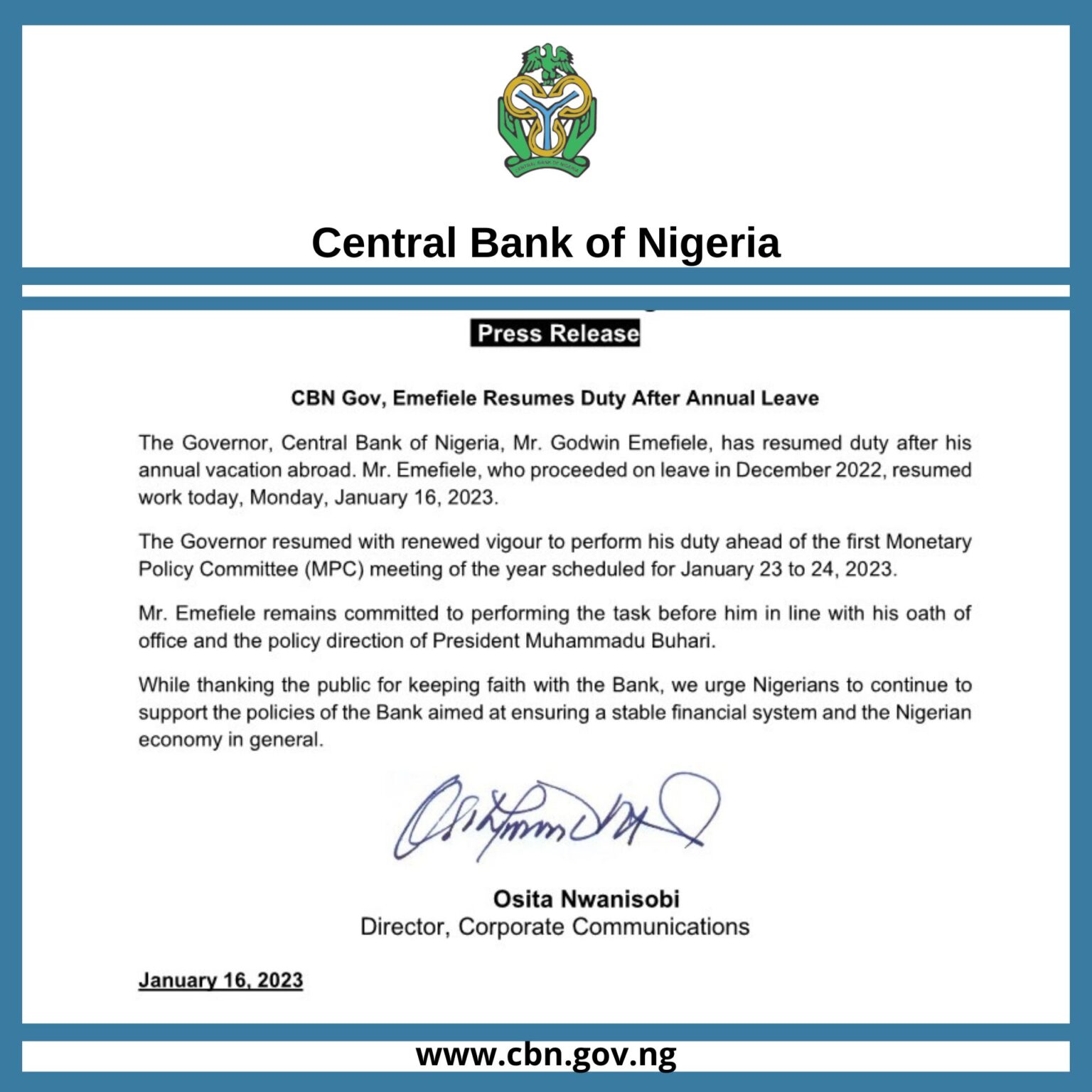
Update: Nigeria’s Central Bank Governor Resumes Duty

0

Update: This is an update


Original Article

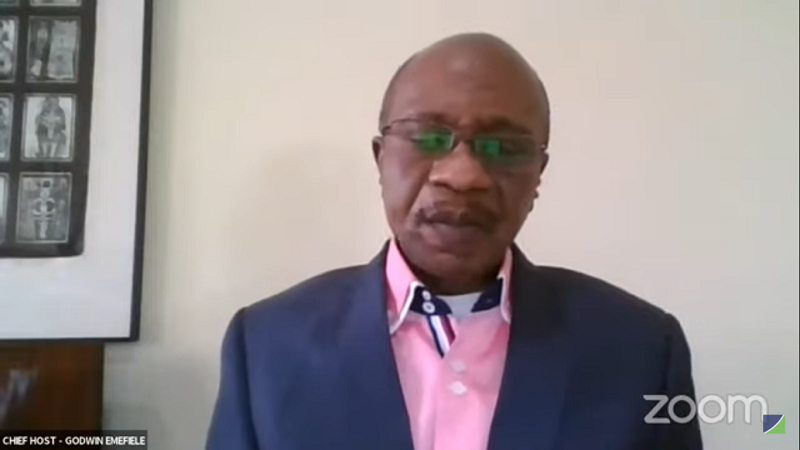
In December last year, an Abuja Federal High Court stopped the attempt by the Department of State Services (DSS), to effect the arrest of central bank governor, Godwin Emefiele.

The DSS had moved for Emefiele’s arrest based on allegations that he’s financing terrorism and that he’d committed other economic crimes, creating a cloud of controversy and a potential threat to Nigeria’s economy.

The move came along with allegations that the central bank governor masterminded the heist that saw N89 trillion stamp duty fund disappear from the government coffers. The allegations triggered a demonstration by a group of protesters who last week demanded the resignation of Emefiele.

Ever since those developments hit the news, the central bank governor has been notably scarce in the public. Emefiele was part of President Muhammadu’s entourage to the US-Africa Summit held in Washington in December, but failed to return to Nigeria after the event.

Although there are claims that his disappearance has nothing to do with DSS’ attempt to arrest him, that he’s on his annual leave, Emefiele is due to return to Nigeria to resume work as the head of the Central Bank of Nigeria (CBN). But that has not happened.

On December 24, People’s Gazette reported that the DSS had established a surveillance operation to arrest Emefiele on sight despite the High Court’s order, restraining them from arresting him.

“We have different teams of at least two each monitoring those places. We don’t know if they have more people deployed to even more places, but we did not see any signal from the DG’s office to suggest his involvement at this point,” a DSS source told Peoples Gazette.

Yesterday, the whereabouts of Emefiele was discussed on ChannelsTV’s Sunday Politics, which had rights activist, Femi Falana as a guest. The Senior Advocate of Nigeria (SAN) was generous with words when answering question on Emefiele’s whereabouts. Mr. Falana reechoed what several others have been saying.

“I can say without any fear of contradiction that Mr Godwin Emefiele is not in Nigeria; he hasn’t returned to the country because he has been declared wanted by the state security services,” he said.

But while the DSS has maintained that it is acting based on evidence, a section of Nigerians believe the move to arrest Emefiele is buoyed by the recent CBN policies – the redesign of the naira and the introduction of a new withdrawal limit. These, they believed, have irked state and non-state actors who were counting on the old rules to influence the outcome of the coming election through vote-buying.

In support of that belief, many said that the court had denied the DSS an ex parte order on Emefiele because the service failed to provide any evidence to back up its claims. Falana said if there was evidence, the DSS doesn’t need a court order to effect an arrest on any Nigerian who is not protected by immunity.

“If you have the evidence that he has committed the offence alleged, you don’t need a court order to arrest him and that is the law. And by the way, no court in Nigeria or anyway has the power to confer immunity on any citizen… If you are not one of the 74 people who are entitled to immunity in Nigeria; that is the President, the Vice President, the governors, and deputy governors, no other person can enjoy immunity,” he said.

However, while the burden of proof rests on the DSS, the CBN governor, who is seen to have over time created for himself an imbroglio reputation by indulging in illegalities, has not utter a word on the matter. Emefiele openly moved to run for president last year, and has over the last five years, printed more than N22 trillion in Ways and Means loan to the federal government. All in violation of existing laws, which consequently created an image of someone who is capable of committing serious crimes for the governor.

Read also: Emefiele: The Baffling Audacity of A Partisan Central Bank Governor

Against this backdrop, Nigerians are divided on what to believe as the DSS has also been caught several times overstepping its bounds working for vested interests.

However, Emefiele’s refusal to return to Nigeria has been given different interpretations. While many believe it is because he has a case to answer, others say he is trying to avoid being humiliated by a possible arrest given his position as the central bank governor.

BusinessDay quoted a well-connected government source as saying that “there is a deal that will allow the governor to return this week without arrest, but he will be presented with evidence of the allegations against him, and thereafter it is expected he will resign.”

On the other hand, Falana believed the DSS doesn’t have to wait for Emefiele’s return to file charges against him if he has committed a crime.

“So, you can’t say don’t arrest a citizen if there is reasonable suspicion that he has committed an offence. So, I expect the State Security Service to come out with the allegations, and if Mr Emefiele is not going to return to the country, file a charge in the Federal High Court so that he can get his lawyers, and prepare his defense,” he said.

Nigeria is a country where rule of law is not diligently followed. And based on the relationship between Buhari and Emefiele, which is largely believed to be hanging on quid pro quo, Nigerians appear not surprised by what is playing out. Emefiele has repeatedly said he has Buhari’s backing in major decisions he has made.