DD
MM
YYYY

PAGES

DD
MM
YYYY

spot_img

PAGES

Home Blog Page 4518

Tinubu Suspends EFCC Chairman, Abdulrasheed Bawa, Indefinitely

0

The Chairman of the Economic and Financial Crimes Commission (EFCC), AbdulRasheed Bawa, has been suspended indefinitely, according to a statement issued by the Director of Information at the Office of the Secretary to the Government of the Federation, Willie Bassey.

The statement disclosed that the suspension was approved by President Bola Tinubu to allow for a proper investigation into many of the “weighty” allegations surrounding his time in office.

“Mr. Bawa has been directed to immediately handover the affairs of his office to the Director, Operations in the Commission, who will oversee the affairs of the Office of the Chairman of the Commission pending the conclusion of the investigation,” the statement said.

With this, Bawa becomes the second head of an institution to be suspended under the approval of Tinubu, following the suspension of the Central Bank of Nigeria (CBN) governor Godwin Emefiele last Friday.

Like Emfiele, Bawa is currently in the custody of the Department of State Services (DSS). A statement signed by Peter Afunanya, DSS spokesperson, on Thursday, said that Bawa arrived a few hours ago at the secret service headquarters, Abuja on invitation.

Last month, the Coalition of Arewa Civil Society Organizations, a northern group, had asked for Bawa’s resignation following allegations of corruption and abuse of office leveled against him.

“The fourth executive chairman, Mr. Bawa, has been at the center of so many corruption allegations even before his appointment as the chairman, which was believed to be surrounded by so many controversies and mysteries,” the group’s chairman Adamu Aminu Musa said in a statement.

Former governor of Zamfara State, Bello Mattalle, also accused the former anti-graft head of corruption. The governor said Nigerians will only learn how corrupt Bawa is when he leaves office.

“He requested a bribe of $2 million from me and I have evidence of this. He knows the house we met, he invited me and told me the conditions. He told me governors were going to his office but I did not. If I don’t have evidence, I won’t say this,” he said.

However, Tinubu’s decision to suspend Emefiele and Bawa has stirred mixed reactions from Nigerians. While many believe that the president is making the right calls to sanitize the affected institutions, others believe that he is being vindictive – removing those he believed had opposed his presidential ambition to replace them with his loyalists.

Read the full statement below:

OFFICE OF THE SECRETARY TO THE GOVERNMENT OF THE FEDERATION

14th June, 2023

PRESS RELEASE
PRESIDENT BOLA AHMED TINUBU SUSPENDS BAWA INDEFINITELY FROM OFFICE AS CHAIRMAN ECONOMIC & FINANCIAL CRIMES COMMISSION

President Bola Ahmed Tinubu, GCFR, has approved the indefinite suspension from office of Mr. AbdulRasheed Bawa, CON, as the Chairman, Economic and Financial Crimes Commission (EFCC) to allow for proper investigation into his conduct while in office.

2. This follows weighty allegations of abuse of office leveled against him.

3. Mr Bawa has been directed to immediately handover the affairs of his office to the Director, Operations in the Commission, who will oversee the affairs of the Office of the Chairman of the Commission pending the conclusion of the investigation.

Willie Bassey
Director, Information

Could Gary Gensler be an unlikely saviour of Web 3?

0

Those who have been reading from me for some time will remember the phrase I coined

‘Web 3 is an end-to-end decentralized UX’

It’s one of the signature comments I regularly make on other people’s posts.

I usually have a narrative that goes something like:

‘It is a user condition. It is an occurrence. Something that ‘happens’..
I like the analogy of a simple circuit with a battery, two wires and a bulb. Web 3 analogy is the state of the bulb being lit.
The battery is not a Web 3 battery; The wires are not Web 3 wires. Wires and batteries can be used for many things.
In this way then, it is incorrect to use ‘Web 3’ as a prefix or adjective through which other things are defined. Web 3 can’t define anything. It is ephemeral in nature.
Web 3 fails to happen as a result of a point of centralization in the user journey. This is the equivalent of a break in the circuit.’
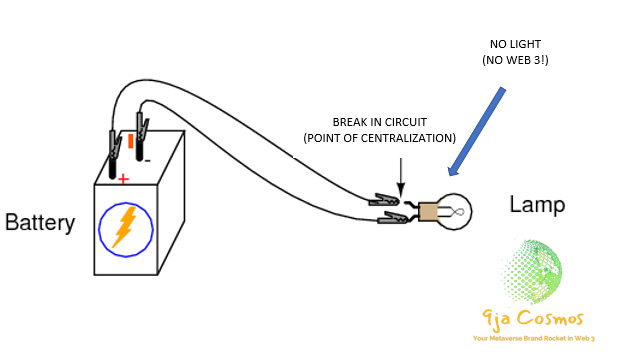
 

Examples of Web 3 obstruction/failure – use of (centralized) ICANN domain names, CEX’s for trading currencies, or storing keys/hashes off-chain in eth scaling solutions and protocol architectures.

When a UX exhibits Web 3 characteristics, the exclusion of certain undesirable phenomena are enforced:

Hacking

Regulatory Encroachment

Litigation and other hostile corporate actions

Fraud and Embezzlement.

Corporate Espionage.

The corollary of these is, should any of these phenomena successfully present themselves, then what has happened for the user, was NOT Web 3.

One of my close connections on LinkedIn recently said in response to a post that the SEC (under Gensler) was ‘chopping Web3 off at the knees’…

You see, the human body has a lot of parts that are actually made up of dead cells the moment they are born. This includes hair, finger nails, toe nails, and the outer layer of skin called the ‘epidermis’.

Nails and hair do not hurt when cut. The sensation felt by the touch of skin only happens because the epidermis itself is generally very thin, and the touch can impact on nerves in the physiology underneath.

While these ‘dead things’ provide the body with some functions with a minimal presence, they can cause huge problems in a human ecosystem when allowed to grow unchecked.

Out of control hair creates an environment to trap infection carrying detritus and provide a habitat for bugs and lice. Decaying epidermal detritus is kept in check with some moderate level of scrubbing while showering or bathing. Failure to do so can lead to skin cancers and other ailments. Unkept finger nails can harbour harmful bacteria, while toe nails in addition can grow inwards, causing painful conditions, which can ultimately result in a toe being lost to amputation.

Web 3 is no longer a young child, and at this stage is more like an elderly vagrant experiencing the ills of social exclusion.

Web 3 has a lot of problems with these ‘dead things’ growing unchecked.

It’s unfair to be saying ‘good old Gary’ has cut Web 3 off at the knees… at most he’s just providing a nails boutique, and also giving it a haircut.

This has been cutting out a lot of the out-of-control dead stuff, the things that are actually not Web 3.

The problem at the moment is that people are attaching ‘brands’ to things that do not enable Web 3. In fact, they are 100% brand and 0% Web 3.

In a recent post, Brian Naughton said: ‘We all enjoy hating on Gary Gensler… I suspect our vitriol is unproductive: My impression is that SEC staff are not just taking orders from the top. Instead, they are likely making a good-faith effort to protect investors by applying current law the best they can’

The way the SEC is going… all the CEXs that are dumping loads of tokens from their trade portfolios…. mostly ‘0x’ stuff.

Zhao though he was being clever trying to be a Robin Hood (pun not intended!) taking interest in the demise of FTX… it backfired on him and now he is enemy no. 1.

Now Wyatt is trying to be the darling of US political enquiries and regulation regimes making himself available for ‘free advice, and testimony’….

These are not communities you cosy up to, and it could easily end badly for him as well.

He will get away with it for a while due to the perception of being a ‘blue blood American’ but it will come a time when they all get bored with the Zhao thing, and they will be looking for someone new to get in the cross hairs.

Political animals need a constant stream of scape goats to create the noise that keeps them relevant and wins elections.

And any layer built on top of Eth is just ‘roadkill’ lying there, waiting for the political or regulatory scavenger to move in
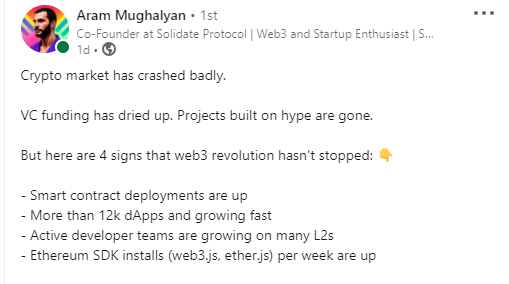
Aram’s post suggests optimism? But should it be thought of as that, really?

Folk are looking at what Gensler is doing, and they are saying OK… and they they just go back to what they were doing before, like as if nothing is happening…. more ‘fake’ Web3.

Its like living in California and thinking earthquakes only happen to ‘someone else’ or flash fires just happen to ‘someone else’ and the SEC is way more of a certainty than flash fires or earthquakes can ever be.

Now some folk from the ‘fake Web 3′ crew have gone and lobbied to have Republican politicians going after Genslers’ head. Rep. Warren Davidson, R-Ohio, and House Majority Whip Tom Emmer, R-Minnesota, introduced a bill

“U.S. capital markets must be protected from a tyrannical Chairman, including the current one,” Davidson said.

“That’s why I’m introducing legislation to fix the ongoing abuse of power and ensure protection that is in the best interest of the market for years to come,” he continued. “It’s time for real reform and to fire Gary Gensler as Chair of the SEC.”

Is this really required?

Gensler is showing us what the difference is between building on a strong foundation, and building on sands that can be washed away.

Instead of lamenting his actions, we should be doing two things…

  1. Thanking him for showing us the difference between sand and good bedrock
  2. Stop building on sand

We may need folk like Gensler around to stop fake Web 3, and to prevent ‘real’ Web 3 from needing serious chiropody to prevent it from losing toes, and that haircut literally costing an arm and a leg!

9ja Cosmos is here…

Get your .9jacom and .9javerse Web 3 domains  for $2 at:

.9jacom Domains

.9javerse Domains

All reference sites accessed 13-14/06/2023


foxnews.com/politics/house-republicans-introduce-bill-remove-sec-chair-gary-gensler

u.today/plot-to-remove-sec-chair-set-heres-how

linkedin.com/posts/arammughalyan_crypto-market-has-crashed-badly-vc-funding-activity-7073912219725430784-5jI2?

linkedin.com/newsletters/blockworks-daily-newsletter-6970764659159158784/

linkedin.com/feed/update/urn:li:activity:7072288123614871552?utm_source=share

Examining the Legal Framework Surrounding Online Poker in South Africa

0

The history of poker in South Africa is long and fascinating. The game was introduced in the country by early European settlers and has since built up a strong following amongst its citizens. Nevertheless, despite the game’s rich history in the nation, its legal status has been far from clear.

When the country first announced its initial gambling laws, most casino games, including poker, were considered illegal. However, a licensing system introduced in the 70s provided room for the legalization of certain games, and luckily, poker fell into the category. But then came online poker in the late 90s, the new technology that took the world by surprise, and while it took several years for online poker to gain traction in South Africa, it finally did in the early 2010s. Since then, the country has become one of the fastest-growing online poker hubs in Africa.

However, this growth has been heavily stunted by the very complicated regulations surrounding online poker in the country. Here, we’ll examine the legal framework surrounding online poker in South Africa and how the various regulations have shaped the industry. Read through to uncover the thrilling world of South African online poker.

History and Current Legal Status of Online Poker in South Africa

In 2004, the National Gambling Act was introduced in South Africa to replace the country’s outdated and inadequate gambling regulations. This was after the boom of online gambling and online poker in the country. According to The National Gambling Act 2004, all forms of online gambling were illegal, including online poker.

However, this Act did little or nothing to stop the fast-growing technology, and in a bid to cash in on the substantial annual revenue generated from online poker, the National Gambling Amendment Act of 2008 was published. With this Act, online casino games like poker would be legalized, and platforms would have to obtain a license from the government to operate.

Despite the multiple benefits of this Act, it was heavily confronted by anti-money laundering agencies and land-based casino operators who feared that the legalization of online poker would affect their revenue stream. After a prolonged legal battle, the Act was abandoned, but the industry continued to grow, albeit slowly.

In late August 2010, the North Gauteng High Court ruled a final judgment on the legality of online gambling in the country. According to the ruling, any form of online gambling was illegal, even if they were hosted on servers outside the country’s borders. Unlike other gambling regulations that targeted only site operators, the ruling confirmed that even players who played poker on these sites were in danger of the law. Guilty parties could face up to 10 years in prison or pay a hefty R10 million fine.

Online in Poker in South Africa, What You Must Know

Recently, there have been talks about reviewing the National Gambling Amendment Act of 2008 to give room for interactive gambling like online poker; however, no concrete conclusion has been reached.

Also, the 2010 court ruling did not explicitly specify the types of online gambling that were considered illegal.

In most countries, online poker rules are usually separated from other online gambling rules due to their nature. Operators and poker fans have managed to exploit this gray area. Currently, dozens of online poker sites offer services to players in South Africa, and so far, nobody has gotten into trouble with the government.

What the Future Holds for Online Poker in South Africa 

Online poker is fast growing around the world, especially in Africa. It’s now becoming increasingly difficult for countries to ignore the immense economic benefits of legalization, and soon, the South African government will have to sit and have that conversation.

Early this year, Geordin Hill-Lewis, a member of the South African Parliament, urged the government to take another look at the abandoned National Gambling Amendment of 2008. He later went on to introduce his Remote Gambling Act which is still being debated in Parliament today. This Act would revolutionize the online poker scene in South Africa and provide easier access to online poker and more revenue for the government.

The Bottom Line

Online Poker regulations in South Africa are a topic that has generated several debates in recent years. While many claim that the law prohibits all forms of online gambling, others argue that online poker wasn’t explicitly mentioned.

Nevertheless, the country doesn’t offer licenses to online poker sites, and players have to rely on offshore sites to play. So far, there have been no legal issues for players who play at offshore sites.

Fascinating numbers highlighting American games industry success

0

Already famed for its thriving movie and music industries, the United States is renowned for exporting entertainment, consumed by audiences around the whole globe. But over the last couple of decades, online technology has completely reshaped how people access pretty much everything, including video games.

Hardly surprising when considering how gaming has become phenomenally popular, this particular sector of the wider entertainment industry has now overtaken the others, even eclipsing the combined revenues of both movie and music sales internationally. What’s more, the spheres of influence between these entertainment mediums is merging, evolving to bring diverse new experiences for consumers.

Gaming is now big business, which leads us towards looking at some intriguing numbers, highlighting why gaming has become such an engaging pastime. And when digging for specific data, the discovery of certain statistics can provide some fascinating insights.

Games development creates thousands of jobs

Whenever we are busy enjoying the games we play, most of us may be blissfully ignorant of how much work goes into their production, along with the huge number of people involved. To put this into some numerical perspective, according to statistical information via IBIS World, the US video games industry reached 268,698 employees in early 2023.

During the five years evaluated between 2018 and 2023, the gaming industry has achieved 3.5% annualized growth on average, with further consistent increases in employment projected over the coming years. Producing video games has also become more profitable for companies, as the average business reports that revenue per employee has increased considerably.

Most interesting of all, data from studies has indicated that an average video games business has just one employee, which suggests that small and independent game studios are continuing to thrive. But whether small or large, the general consensus is that development studios are consistently expanding, always on the lookout for talented and creative people to build their games.

Online slots with massive progressive

When considering the growth of the games industry across America, the iGaming sector is one that is currently booming, largely thanks to states around the country legalizing access to popular online casinos. And while visitors to gaming sites have plenty of options to choose from, slots are by far the most played games in the digital realm.

Easily the most famous are the Mega Moolah and Mega Fortune slots, which offer players the chance to land huge progressive jackpots, based upon the latest guides from Legit Gambling Sites experts. They carefully review and rate the best online casino websites, focusing on the most honest and reputable operators, where the biggest choice of progressive slots can be found.

But what kind of jackpot prizes are up for grabs? Well, the Book of Atem progressive slot has reportedly paid out $18.4 million in 2023, while the Atlantean Treasures Mega Moolah slot has been hit for a jackpot spin worth $4.7 million. Looking at such incredible payout numbers, it’s easy to comprehend why players across the US are eager to try their luck, due to progressive slots regularly dishing out massive jackpots.

Mobile gaming continues to boom in 2023

Having already seen how video games employ thousands of people, and that some casino games can also turn players into millionaires, the diversity of platforms is also changing the way gamers interact with popular titles. No platform has grown faster than mobile, now that players can access their favorite games on the go, and from practically any location.

And right now this year, the most popular mobile game hails from a studio in California, and it has taken the US and the whole world by storm. Roblox was originally launched for Windows back in 2006, becoming available for iOS devices in 2012 and then Android platforms in 2014. Current data reports from Statista now show that Roblox tops the mobile gaming charts, generating more than $207 million between January and April of 2023.

Such revenues are a clear indication of the fandom surrounding Roblox, which boasts over 230 million registered players this year, including an average surpassing 20 million players daily. Recent data also shows that around 30% of the player base comes from the US and Canada, which is undoubtedly the single biggest portion overall.

Sustained growth predicted for the years ahead

Unlocking new opportunities for growth is essentially what drives video game publishers, which is entirely why the Morgan Stanley gaming outlook makes for interesting reading. The renowned financial institution has predicted entirely new levels of growth and advances, forecasting that 2023 will be a strong year for games industry, albeit with some important caveats.

While their analysis indicates that 2022 was quite sluggish, developers and publishers are bullish this year, which undoubtedly accounts for the boost in employment number associated with the games industry in the United States. Better productivity and increased efficiency are some of the reasons highlighted, accompanied by the perception of improvements in the overall quality of products being launched.

One of the key focal points for optimism is the next-gen console market, bringing a rush to launch new games for these powerfully optimized platforms, bringing an important boost for the triple-A developers and publishers. Given that one major console manufacturer has already sold roughly 37 million units this year alone, they will all need exciting new games to accompany them, fuelling instant demand.

The Invisible Layer Strategy, Design Thinking And Zero-Fee Banking

1

OPay, a payment company, began with a business strategy I have termed the Invisible Layer Strategy. Simply, the company started by subsidizing transportation services by making ORide (motorcycle ride hailing), OBus, OKeke, etc,  very affordable. It used that to acquire a  massive user base for its paytech unit. The plan was never to run those transportation units because their margins were small, and also scaling was an issue. But they provided one thing: they forced users to download the OPay app to get those free or discounted rides.

In this piece, I posited that even though OPay may be losing money in the transportation unit, it has a promise on the payment one under a Double Play Strategy which I have written extensively in Harvard. Simply, OPay will make money for the business even though ORide, OBus, etc may not.

One day, OPay hit one million users and that was the inflection point. One by one, it exited, and closed ORide, OBus, etc and then focused on the payment which was the original vision.  To evaluate this strategy, you have to consider what it would cost OPay to use advertising to onboard one million users in that sweet segment it has pursued (people who pay, withdraw, pay making it easier to capture value via fees).

What are you doing to acquire customers?

Design Thinking And Zero-Fee  Banking

When you pay that bill from your bank account, you pay a bank charge. But when you pay with one fintech’s app, connected to the same bank account, you do not pay any fee. How did that fintech execute that invisible layer strategy? I explain:

I will explain what OPay is doing at the technology layer within a well orchestrated design thinking framework. Consider the possibility that OPay has bank accounts in all banks in Nigeria. If a customer ( paying for DStv) pays through it, it will simply receive money from the customer to the specific corresponding bank account it maintains in the customer originating bank. At the same time, it will pay the merchant to the merchant’s bank account using its (OPay) funds in the same bank as the merchant’s. 

Because wallet-to-wallet transfer in Nigeria does not attract a fee, this two-sided intra-bank transaction (inflow and outflow) does not cost OPay and its customers any transaction fee.OPay, relying on bank APIs, automates this protocol. This is Option 1. There are other options on how to execute this including having a holding quasi-entity.

Indeed, this also makes its confirmation fast and seamless since no inter-bank settlement takes place at scale. The only drawback is that funds may not be efficiently utilized (not actively working for you) as you must have funds reserved for settlements. Needless to add that you have to be loaded (yes, have funds) to execute this playbook.

How can you save your customers money? No better growth strategy than that in Nigeria in this season of many fees and charges. Use design thinking and invent a new business playbook for that company.

Comment on Feed

Comment 1: I just saw this post after concluding a transaction with Opay. I don’t understand the intricacies of their business, but whatever it is, they should keep it up. My only regret is why I didn’t start using the app earlier, especially during the cash scarcity. Their transactions are swift, free and seamless.

My Response: They run a settlement fee system across all banks in Nigeria which means they have no connection to NIBBS. With that, they pay no fee.

Comment 2: Prof, isn’t it possible that Opay didn’t actually have Fintech in mind from the outset but simply began to focus on the sector after they’d found its huge potential?

Take Nokia for instance. Nokia was originally a paper mill when it was formed in the late 19th century but delved into phone manufacturing after 100 years. Same with Nintendo (which used to produce handmade playing cards) and Sharp which initially focused on producing belt buckles before becoming an electronics company!

My Response On Day 1 when OPay company launched ORide, the uniforms the riders wore did not have ORide, OBus, etc. Everything was branded OPay. If you saw their riders, everything was OPay. The app was OPay, not ORide, OBus. That was a clear indicator that right from Day 1, the destination was OPay