DD
MM
YYYY

PAGES

DD
MM
YYYY

spot_img

PAGES

Home Blog Page 4548

From First to Third Level Interest in 2022: How the Rest of the World Saw Africa and Africa Saw Herself

0

As Internet searches and behaviours are expected to cease at 12 a.m. around the world in 2022, our analyst examines public interest in Africa as a continent during the year, with a particular focus on the proposition that Internet users who searched using Google Search Engine chose “Africa” as a keyword towards understanding issues, challenges, and opportunities in Africa. In this piece, related search queries after using “Africa” are considered at first, second and third levels. The first level of interest represents the most frequently searched related queries to the keyword. The second and third level interests include the second and third most searched related queries.

Internet users from 166 countries, including African countries are considered for data sources. The countries are; Afghanistan, Albania, Algeria, Angola, Antigua and Barbuda, Argentina, Armenia, Australia, Austria, Azerbaijan, Bahamas, Bahrain, Bangladesh, Barbados, Belgium, Belize, Benin, Bermuda, Bhutan, Bolivia, Bosnia & Herzegovina, Botswana, Brazil, Brunei, Bulgaria, Burkina Faso, Burundi, Cambodia, Cameroon, Canada, Cape Verde, Central African Republic, Chad, Chile, Colombia, Comoros, Congo Brazzaville, Costa Rica, Cote d’Ivoire, Croatia, Cuba, Cyprus, Czechia, Denmark, Djibouti, Dominica, Dominican Republic, Ecuador, Egypt, El Salvador, Equatorial Guinea, Eritrea.

Estonia, Eswatini, Ethiopia, Finland, France, Gabon, Gambia, Georgia, Germany, Ghana, Greece, Guatemala, Guinea, Guinea-Bissau, Haiti, Honduras, Hungary, Iceland, India, Indonesia, Iran, Ireland, Iraq, Israel, Italy, Jamaica, Japan, Jordan, Kazakhstan, Kenya, Kosovo, Kuwait, Kyrgyzstan, Lebanon, Lesotho, Liberia, Libya, Lithuania, Luxembourg, Macao, Madagascar, Malawi, Malaysia, Maldives, Mali, Malta, Mauritania, Mauritius, Mexico, Moldova, Mongolia, Morocco, Mozambique, Myanmar, Namibia, Nepal, Netherlands, New Zealand, Nicaragua, Niger, Nigeria, Norway, Oman, Pakistan, Palestine, Panama, Papua New Guinea, Paraguay, Peru, Philippines, Poland, Portugal, Puerto Rico, Qatar, Romania, Russia, Rwanda, Saudi Arabia, Senegal, Serbia, Seychelles, Sierra Leone, Singapore, Slovakia, Slovenia, Somalia, South Africa, South Korea, South Sudan, Spain, Sri Lanka, St Lucia, Sudan, Sweden, Switzerland, Syria, Taiwan, Tanzania, Thailand, Togo, Trinidad & Tobago, Tunisia, Turkey, Uganda, Ukraine, United Arab Emirates, United Kingdom, United States of America, Uruguay, Uzbekistan, Venezuela, Vietnam, Zambia and Zimbabwe.

Our analyst discovered a “search interest divide” in which people in some countries did not search for additional topics. In other words, they only wanted information about Africa and ignored other needs and/or issues. There were, for example, no related search queries from Cape Verde, Central African Republic, Comoros, Eritrea, Guinea-Bissau and Niger. This also applies to the users in Afghanistan, Antigua and Barbuda, Armenia, Australia, Azerbaijan, Bahamas, Bahrain, Bangladesh, Barbados, Belgium, Belize, Bermuda, Burundi, Cape Verde, Central African Republic, Comoros, Eritrea, Guinea-Bissau, Haiti, Kosovo, Macao, Mauritania, Niger, Palestine, Seychelles, Syria and Ukraine who did not consider related search queries at second and third level interests.

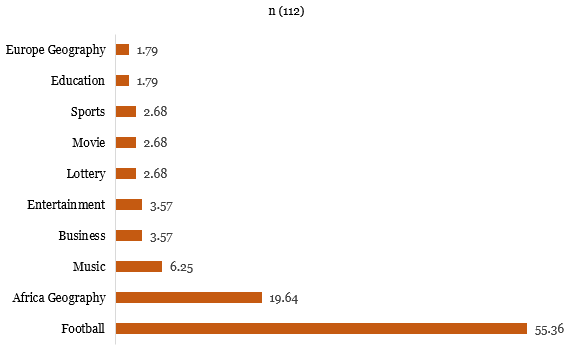
For the interest categories, a total of 428 related search queries from all the countries were found. For first and third level interest, over 37% and 32%, respectively, were discovered. The top ten related searches were examined further for analysis. Our analyst believes that the emerging search interest pattern indicates that the third level interests were used to address the needs that the first level could not satisfy (see Exhibit 1-3). Further investigation reveals that users were preoccupied with African football from first to third level. Knowing locations across the continent came next.

Observing Africa through the lens of South Africa is one of the analysis’s unexpected outcomes. In essence, our analyst discovered that users, particularly those from outside the continent, searched for South Africa as a related query to learn more about her (Africa). Further investigation of this result reveals that the lure that encouraged searching the nation as an additional topic was South African music with a focus on Mama Africa. The third place that business and music held at the second and third levels of interest was another surprising result.

Exhibit 1: Africa and the rest of the world’s first level interest

Source: Google Trends, 2022; Infoprations Analysis, 2022

Exhibit 2: Africa and the rest of the world’s second level interest
Source: Google Trends, 2022; Infoprations Analysis, 2022


Exhibit 3: Africa and the rest of the world’s third level interest

Source: Google Trends, 2022; Infoprations Analysis, 2022

Our analyst says it is not surprising that football was the most popular related search query throughout the year after looking at the newly revealed insights. Both the World Cup and the Africa Cup of Nations were held during the year. Despite this, all interested parties must examine the disparate positions occupied by business and education. An advocacy campaign on the best ways to use the tool for examining business opportunities and educational needs is necessary.

Google Reaches $20m Agreement with Indiana to Settle Privacy Lawsuit

0

Google has closed for the year with a $20 million agreement with Indiana to settle an antitrust lawsuit filed by the state. The tech giant was alleged to have engaged in deceptive location tracking practices, according to the state’s Attorney General Todd Rokita.

Google and other members of Big Tech have been in constant battle with both regulators and states over the use of private data.

Rokita said the separate lawsuit was filed against Google when negotiations between the company and a coalition of state attorneys general stalled. Those states had reached a $391.5 million settlement with the company in November.

The settlement is the last among many that the web search giant has recorded this year. The states began to probe Google after Associated Press reported in 2018 that the company continued to track people’s location data even after they opted out of such tracking by disabling a feature the company called location history.

Filing a separate lawsuit, Rokita said in his announcement on Thursday, has given Indiana about twice as much money as it would have under the deal with the 40 states in coalition.

“This settlement is another manifestation of our steadfast commitment to protect Hoosiers from Big Tech’s intrusive schemes,” Rokita said.

According to Indiana’s lawsuit, Google uses location data to build detailed user profiles and target ads. The suit also alleged that the company has deceived and misled users about its practices since at least 2014.

Rokita said he sued Google because even a limited amount of location data can expose a person’s identity and routines.

“Such data can be used to infer personal details such as political or religious affiliation, income, health status or participation in support groups as well as major life events such as marriage and the birth of children,” he said.

However, under the settlement agreement with Indiana, Google did not admit to any wrongdoing.

In January, Google received a €150 million fine from France’s data privacy watchdog, Commission Nationale de l’Informatique et des Libertés (CNIL), after it was found guilty of manipulating cookies to its advantage.

Fun Fact About the Year 2023

7

Do you know that the year 2023 is one of a kind of the calendar year whose counting  begins on a Sunday which is considered the first day of the week according to Christian, Jews and Islamic beliefs?

The last time this happened was six years ago in 2017 and another time we can expect to see this type of calendar year is in the next eleven years which is 2034.

In the last 56 years, this type of calendar year has occurred nine times as follows: 1967, 1978, 1984, 1989, 1995, 2006, 2012, 2017, and 2023.

The rotational movement of these special years has the following pattern: 11, 6 5, 6 (in years)

Based on above enumerated calendar years, there are two periods of 17 years each. Movement within each period alternate as 6, 5 and 6 years. However, movement from one period to another period takes eleven years.

For instance, from 1967, it took eleven years to move to a new period (1978-1995); from1995 it took another eleven years to move to a new period (2006-2023).

Since the next calendar year whose first day is a Sunday will be in another eleven years which is 2034, it could be said that 2023 marks the transition to a new period.

Combined Wealth of The World’s Top 500 Billionaires Fell by $1.4 Trillion in 2022

0

According to a Bloomberg report, a staggering sum of $1.4 trillion was wiped out from the wealth of the world’s top 500 richest people.

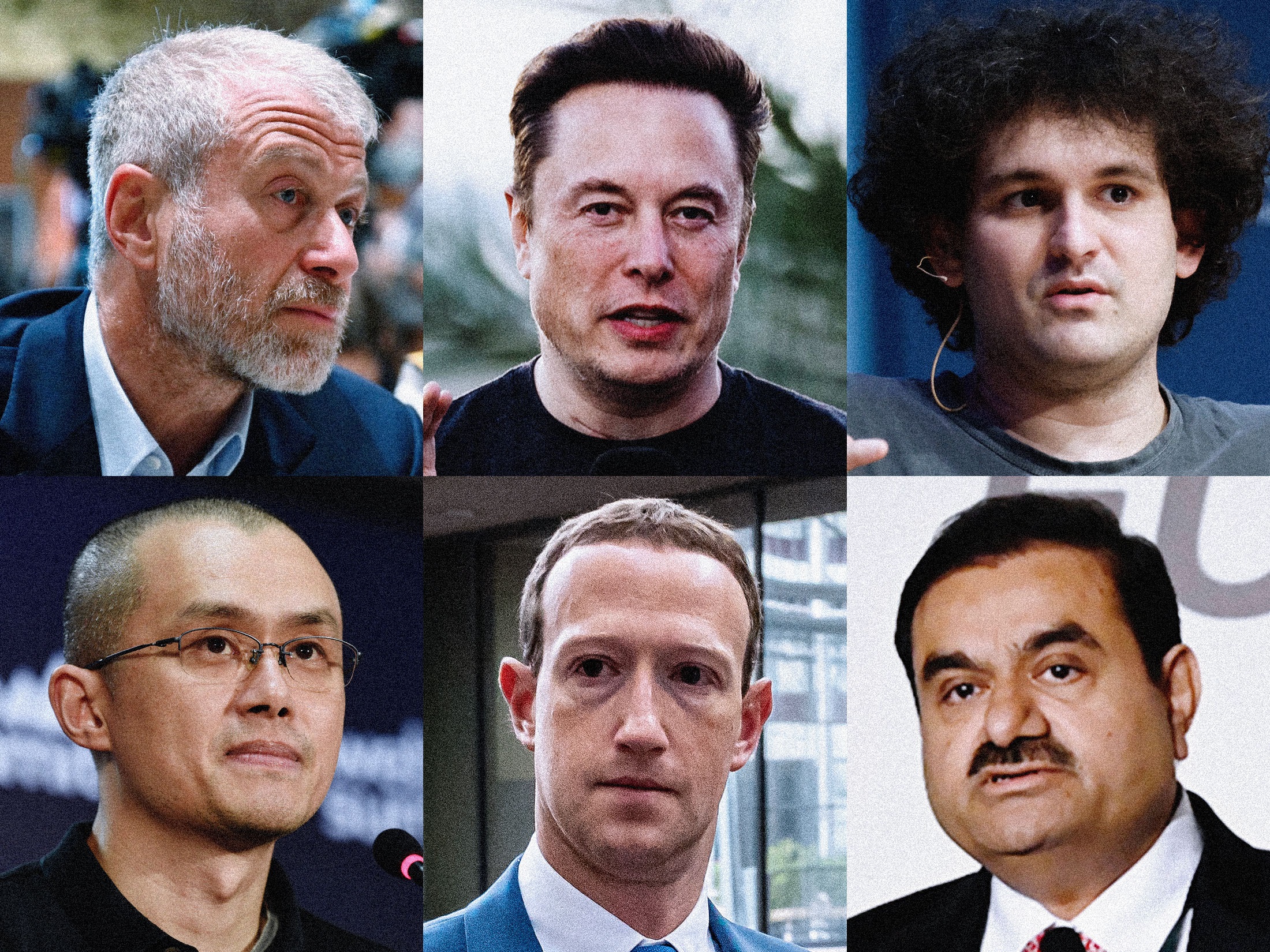
Amazon CEO Jeff Bezos, Tesla, and Twitter CEO Elon Musk, Meta CEO Mark Zuckerberg, and Binance CEO Chanpeng Zhao, cumulatively saw a whopping $392 billion drop from their net worth.

Globally, the world’s billionaires lost nearly $2 trillion combined in 2022, while billionaires in the United States lost $660 billion collectively.

In America’s billionaire list, Elon Musk lost the most, as his net worth dipped by about $115 billion this year according to Forbes.

Reports disclose that Musk has reportedly lost more than $130 billion from his net worth in 2022 as Tesla shares continue to fall, which his wealth is mostly tied to.

His net worth peaked at over $300 billion earlier this year, unfortunately, a 68% year-to-date decline in Tesla stock erased a huge chunk of that.

This saw him displaced from the number one position of the richest man in the world, overtaken by LVMH chairman and CEO Bernard Arnault.

Most of the losses accrued by these billionaires can be attributed to major macroeconomic events that happened in the year 2022, which also saw some shrewd investors lose their wealth.

Events such as the Russian-Ukraine war, high inflation, Federal Reserve’s interest-rate policy, the U.S. dollar’s strength, and hikes all affected the global economy as well as the stock market.

The uncertainty around each of them is creating challenges for investors, market experts, and investment strategists.

Meanwhile, despite the unfriendly economy of 2022, some investors made profit, which saw their fortune rise.

India’s billionaire and industrialist Gautam Adani, owner of the Adani Group, doubled his fortune in 2022 to $150 billion to become the richest man in India, and for a brief period, became the second richest person on the planet.

Also, several of the richest families in the world, such as the Kochs and the Mars family, saw an increase in their net worth this year. 

Ultra-wealthy tech founders led a wipeout in fortunes that spanned the globe, though secretive families and pro sports owners emerged relatively unscathed.

For the vast majority of the world’s wealthiest people, 2022 was a year to forget. It’s not just the money that was lost, though it was staggering — almost $1.4 trillion was wiped from the fortunes of the richest 500 alone, according to the Bloomberg Billionaires Index. Plenty of the pain, it turns out, was self-inflicted: The alleged fraud by onetime crypto wunderkind Sam Bankman-Fried; the devastating war waged by Russia on Ukraine that spurred crippling sanctions on its business titans; and, of course, the antics of Elon Musk, the new owner of Twitter who’s worth $138 billion less than he was on Jan. 1.

To Become an Effective Leader, Elevate your MISSION over your Ego

3

If you want to thrive as a leader, elevate your mission over whatever ego you may have. If that happens, you will look for talent anywhere they are, and also engage them in the right way. When Google says it does not care if you have a university degree or not, it is saying, I have no ego that requires me to display certificates in my HR department: I just want people that can get the job done!

Jesus would have hired lawyers, tax collectors, astrologers, etc as disciples. But He understood the importance of the mission, and went to largely fishermen, alloyed in the trade of persistence, perseverance and patience – critical attributes required for new missions. In the ancient Roman Empire, if you tell people on the street that you would hire fishermen for a big project, many would mock you. Some may recommend that you add some lawyers, doctors, and tax collectors if you want people to pay attention.

How many times has your ego pushed you to hire the wrong person? You want to introduce him as “He was the best student in his class”, “He made a first class”, “He studied in London”, “He is the son of Mr B”, etc. But deep inside you, he has no capacity to contribute to the mission.

Yes, ego has won over mission! And whenever that happens, visions die. Win over your #ego if you want that  #mission to thrive.

(Ndubuisi will be teaching on building effective teams in Tekedia Mini-MBA, starting Feb 6. Check here to attend )

Comment on Feed

Comment 1: It is possible for leaders to use their egos to drive organizations forward while also fostering a positive and collaborative mission, but it requires a careful balance.

On the one hand, having confidence and a strong sense of purpose can be essential for leadership and for inspiring and motivating others. A leader who is able to articulate a clear vision and convey a sense of purpose can help to rally their team and drive progress towards the organization’s goals.

At the same time, it is important for leaders to be aware of the potential negative effects of ego, and to try to keep their ego in check. This means being open to feedback and input from others, being willing to admit mistakes and learn from them, and being humble enough to recognize the contributions of others.

By striking this balance, leaders can use their ego to drive the organization forward while also fostering a positive and collaborative culture. This can help to build trust and cooperation among team members, which is essential for achieving success in any mission.

Comment 2: One of the key responsibilities of CEOs is to ensure that the organization has the right people in the right roles, and that includes the ability to hire and fire employees as needed. This requires a strong sense of leadership and decision-making skills, as well as the ability to keep ego in check.

Having the ability to hire and fire employees is a significant aspect of a CEO’s role, and it is important that they approach this responsibility with care and consideration. This means evaluating candidates based on their skills and fit with the organization, rather than external factors such as credentials or personal connections. It also means being willing to make difficult decisions when necessary, even if it means letting go of employees who are not performing well.

Ultimately, the ability to hire and fire effectively is a crucial part of a CEO’s role, and it requires a strong sense of leadership and a commitment to the mission of the organization. By keeping their ego in check and focusing on the needs of the organization, CEOs can make the best decisions for the team and drive the organization forward. Thanks Prof.

My Response:Good point. In this piece, I have bounded that “ego” within team building. Certainly, there is a positive ego where a CEO wants to accumulate more market share by doing things better. If I write this for a growth-focused class, the insights will modulate. My point here is ego on building teams: get the best guy irrespective of his or her background. All empires have done that: Pharaohs, Nebuchadnezzar, etc used slaves to lead. A modern version of ego-less team building is US where anybody can be anything