DD
MM
YYYY

PAGES

DD
MM
YYYY

spot_img

PAGES

Home Blog Page 460

Kenyan Remittance Startup Bonto Shuts Down Operations Eight Months After Securing CBK Licence

0

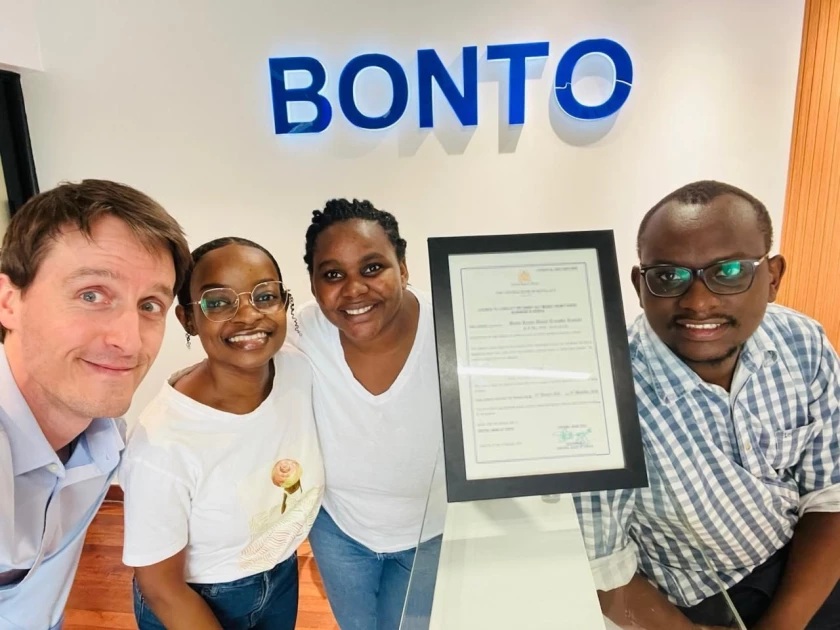
Bonto, a Nairobi-based remittance fintech startup, has officially ceased operations. It shut down two years after launching and less than eight months after receiving its licence from the Central Bank of Kenya (CBK).

Bonto founder and CEO Yoann Copreaux announced via a LinkedIn post, that the startup, which specialised in remittances and foreign exchange services, stopped processing transactions on August 15 and soon after requested the revocation of its licence. The CBK confirmed the revocation last week, marking the official end of Bonto’s short-lived journey.

According to Yoan Copreaux, the decision to close the startup came after a series of operational and market challenges that made the business unsustainable. He further noted that, FX margins collapsed, making the breakeven scale unrealistic. In addition, remittance fees remained low or virtually non-existent, while compliance requirements continued to rise, particularly affecting Money Remittance Providers (MRPs).

Unlike established MRPs that could rely on legacy clients, Bonto was essentially “building in the desert,” a far more challenging task. Efforts to sell the licence were also unsuccessful. Bonto reached out to over 50 fintech companies, signed multiple NDAs, and received five offers. However, none were viable when factoring in CBK approval timelines and the monthly financial losses the company would incur while waiting for a transfer.

“Closing was an emotionally tough decision, but ultimately it was the only rational path forward,” the CEO stated, emphasizing that continuing operations would have only deepened losses. Despite the setback, Bonto expressed deep gratitude to its stakeholders. The company thanked its clients and partners for their support and recognized the dedication of its team.

As part of the shutdown process, Bonto is offering its CBK-approved office space and a Canadian MSB licence to interested parties. The company’s founder acknowledged the personal toll of the closure but emphasized the importance of taking time to reset before embarking on the next venture.

Before the shutdown, Bonto was a Nairobi-based fintech startup specializing in foreign exchange (FX) services and money remittances, primarily targeting cross-border transfers to and from Kenya. Founded in 2022, it positioned itself as a tech provider in Kenya’s competitive remittance market, aiming to offer competitive FX rates and efficient transfer solutions for businesses and individuals.

The Nairobi-based remittance fintech startup, aimed to differentiate itself in Kenya’s competitive remittance market through innovative offerings focused on efficiency, transparency, and user-centric design.

These include;

1. Competitive FX Rate Platform

Bonto provided a digital platform offering real-time, competitive foreign exchange (FX) rates for cross-border transfers, particularly for USD-KES and other major currency pairs. The platform prioritized transparency, displaying live rates to help users avoid hidden fees common in traditional remittance services.

Unlike larger incumbents (e.g., Western Union or banks), Bonto’s lean, tech-driven model aimed to minimize overheads, passing savings to users through tighter spreads.

2. Low-Cost Remittance Model

Bonto targeted near-zero or significantly reduced fees for remittances, challenging the high costs of legacy providers. This was particularly appealing for small and medium-sized businesses (SMBs) and individuals sending frequent, smaller transfers. The company leveraged software to streamline operations, reducing the need for physical infrastructure, which allowed it to compete with giants like M-Pesa or WorldRemit on cost.

3. Focus on Digital-First Experience

Bonto offered a fully digital interface, likely accessible via a mobile app or web platform (bonto.africa), designed for seamless onboarding and transfers. This catered to Kenya’s tech-savvy population and diaspora communities. The platform emphasized user experience, with features like instant transfer confirmations and easy tracking, addressing pain points in traditional remittance processes.

4. Tailored Solutions for SMBs

Bonto positioned itself as a partner for small businesses engaged in cross-border trade, offering tools to manage FX risks and optimize international payments. This was a niche focus compared to competitors focusing on individual consumers. It aimed to support Kenya’s growing SME sector by providing affordable access to global payment networks.

5. Regulatory Compliance as a Strength

After securing its Money Remittance Provider (MRP) license from the Central Bank of Kenya in January 2025, Bonto marketed its compliance as a trust factor, ensuring secure and regulated transactions in a market wary of fraud. Its adherence to CBK’s stringent standards allowed it to build credibility, even as a small player.

While innovative, Bonto’s offerings faced headwinds in a saturated market. The low-fee model, while attractive, was unsustainable due to collapsing FX margins and rising compliance costs, as noted by CEO Yoann Copreaux.

Bonto’s innovations highlighted the potential for tech-driven remittance solutions in Kenya but also exposed the market’s structural barriers. The startup exit underscores broader challenges for Kenya’s fintech remittance space, while inflows grew, smaller firms face viability issues amid competition and costs.


Reeve Collins Launches STBL Stablecoin For Yield Generation as MetaMask Token Is Confirmed

0

Reeve Collins, co-founder of Tether (USDT) and its first CEO from 2013 to 2015, has launched a decentralized stablecoin protocol emphasizing yield generation for users.

The project, known as STBL, represents what Collins describes as “Stablecoin 2.0,” shifting value from issuers back to the community through transparency, productivity, and community governance. Unlike traditional stablecoins where yield often stays with issuers, STBL uses a three-token model backed by real-world assets (RWAs) like U.S. Treasuries, allowing users to retain and earn yield without lockups or staking.

The project’s Token Generation Event (TGE) for the governance token $STBL occurred on September 16, 2025, marking its official debut. It’s already live on BNB Chain, with listings on Binance Alpha, Kraken, and PancakeSwap. Mainnet rollout is planned for late 2025.

Collateralized by tokenized RWAs from partners like BlackRock’s BUIDL fund, Ondo, BENJI, and USDY. Over $500 million in institutional commitments, including $100 million from Franklin Templeton (with $1.6 trillion AUM), have been secured.

Yield Focus enters a $230+ billion stablecoin market where yield-bearing options (e.g., Ethena’s USDe at ~$4.5 billion market cap) are surging. STBL aims to make stablecoins “productive” by splitting principal and yield into separate streams, enhancing liquidity for DeFi, payments, and remittances.

How the Three-Token Model Works

STBL introduces a novel “yield-splitting” mechanism to address limitations in existing stablecoins (e.g., overcollateralized like DAI, reserve-backed like USDC/USDT, or algorithmic like FRAX). Users deposit RWAs to mint tokens, keeping yield accessible and programmable.

Stablecoin (spendable principal) | Pegged 1:1 to USD; backed by RWAs like T-bills; fully liquid for payments, trading, or DeFi without losing yield. Non-custodial and transparent on-chain.

Yield accrual captures passive yield (e.g., ~5% APY from Treasuries); tradeable, pledgeable, or reinvestable separately from principal. No staking required. Governance (community token) enables voting on protocol upgrades, interoperability, and staking for additional yields. Current market cap ~$200 million, seen as undervalued by early observers.

This model contrasts with older stablecoins by redirecting yield to users, fostering a “user-centric” ecosystem. Collins has emphasized in interviews that it creates “sustainable yield mechanisms” while maintaining stability.

Collins co-founded Tether in 2014 (initially as Realcoin), which grew from under $1 billion to $142 billion market cap, powering much of crypto’s trading volume. After leaving in 2015, he hinted at yield-bearing stablecoins to attract income-seeking investors.

Earlier in February 2025, he announced Pi Protocol (with tokens USP and USI) as a precursor focused on DeFi yield from bonds/RWAs, planned for Ethereum/Solana in H2 2025. STBL appears to be the realized evolution of that vision, co-founded with Avtar Sehra (Libre Finance) and backed by Wave Digital.

The project aligns with 2025 trends: tokenized Treasuries exploding in adoption, DeFi protocols unlocking liquidity while retaining yield, and stablecoins surpassing traditional payment networks in volume. Institutions like BlackRock are integrating it for compliant, on-chain exposure.

X discussions highlight its potential to “eat market share” due to institutional ties and Binance integration. Some predict quick listings and growth, though new launches can be volatile. It faces rivals like USDT, USDC, USDe, and Mountain Protocol’s USDM (offering ~5% yield). As a new entrant, peg stability and regulatory scrutiny (e.g., RWA compliance) will be key.

Phase 1 (TGE/listings) complete; Phase 2 adds governance; future phases include staking for extra yields and cross-chain interoperability.

The Confirmation of a MetaMask Token ($MASK) By Joseph Lubin Carries Several Implications For Users

Joseph Lubin, Ethereum co-founder and ConsenSys CEO, recently confirmed that a native token for MetaMask—likely ticker $MASK—is indeed coming “very soon,” potentially sooner than many expected.

This announcement has sparked widespread excitement in the crypto community, with speculation around airdrops for active users (e.g., those using swaps or bridges). In an interview on The Block’s “The Crypto Beat” podcast (aired September 18, 2025), Lubin stated:

The MASK token is coming—it may come sooner than you would expect right now.” He tied it directly to decentralizing aspects of the MetaMask platform, such as governance and features like swaps and Snaps.

No exact launch date was given, but the phrasing “very soon” aligns with the “sooner than expected” hint. Prediction markets like Polymarket now give strong odds (over 70%) for a 2025 release, with some betting on Q4.

The token aims to distribute control and ownership to the community, building on MetaMask’s role as the leading Ethereum wallet over 30 million monthly active users. It could enable voting on updates, fee sharing, or enhanced DeFi integrations.

While unconfirmed, early users (especially swap/bridge participants) are prime candidates. No official snapshots or claims yet—beware of scams. This fits ConsenSys’ push for Ethereum decentralization via tools like MetaMask, Infura, and Linea. It could boost ETH ecosystem activity amid rising “animal spirits” in the market.

The $MASK token is expected to enable decentralized governance, allowing users to vote on features, updates, or fee structures. This could shift MetaMask from a ConsenSys-controlled product to a community-driven protocol, aligning with Web3 ethos.

Token issuance may distribute economic incentives to users, incentivizing long-term engagement and loyalty. Anticipation of a potential airdrop based on wallet usage, swaps, or bridge transactions is already driving users to increase on-chain activity via MetaMask. This could spike transaction volumes on Ethereum and Layer 2 networks like Arbitrum or Linea.

The hype around $MASK has led to phishing attempts and fake token claims on X and other platforms. Users must stay vigilant, relying only on official MetaMask/ConsenSys channels. As the leading Ethereum wallet, a token could solidify MetaMask’s position against competitors like Coinbase Wallet or Phantom, especially by enhancing DeFi and NFT integrations.

Increased user engagement (swaps, bridging, etc.) could drive higher transaction fees and activity on Ethereum and its scaling solutions, benefiting validators and Layer 2 protocols. The token aligns with ConsenSys’ broader portfolio (Infura, Linea, Codefi), potentially creating a unified economic system that strengthens Ethereum’s infrastructure.

The announcement has fueled hype on X, with prediction markets showing 70%+ odds of a 2025 launch. This could draw speculative investment into Ethereum and related tokens. Depending on supply, utility, and airdrop mechanics, $MASK could command significant market interest, potentially mirroring successful token launches like $ENS or $UNI.

A high-profile launch could signal renewed “animal spirits” in the crypto market, especially if timed with a bullish cycle, boosting altcoin interest. The token could incentivize developers to build more Snaps custom plugins, enhancing MetaMask’s functionality (e.g., cross-chain support, advanced DeFi tools).

With $MASK enabling new features or rewards, DeFi protocols and NFT platforms integrated with MetaMask may see increased usage, fostering innovation. As a U.S.-based company (ConsenSys), the token launch may face regulatory hurdles, especially if classified as a security by the SEC. Compliance will be critical to avoid delays or restrictions.

The $MASK token could reshape MetaMask’s role in Web3, deepen Ethereum’s dominance, and spark market excitement, but its success hinges on execution, regulatory clarity, and community adoption. Stay tuned to official channels for updates.

SEC Pushes to Implement Trump’s Executive Order on Crypto in 401(k) Accounts

0

President Donald Trump signed Executive Order 14123, titled “Democratizing Access to Alternative Assets for 401(k) Investors,” directing federal agencies, including the Securities and Exchange Commission (SEC) and the Department of Labor, to revise regulations and guidance.

This aims to enable participant-directed defined-contribution retirement plans, such as 401(k)s, to include alternative assets like cryptocurrencies, private equity, and real estate. The order addresses restrictions under the Employee Retirement Income Security Act (ERISA) of 1974, which has limited such investments to protect savers, but proponents argue it democratizes access to higher-return opportunities typically available to wealthy or institutional investors.

As of September 23, 2025, the SEC faces mounting pressure to act swiftly. Labor Secretary Lori Chavez-DeRemer praised the order for promoting flexibility and eliminating “one-size-fits-all” approaches, signaling inter-agency coordination.

However, implementation isn’t immediate—fiduciaries must still ensure investments are “prudent” under ERISA, meaning employers and plan administrators will need to vet options carefully to avoid liability.

Critics, including Sen. Elizabeth Warren and economists like Gerald Epstein, warn of heightened risks: cryptocurrencies’ volatility, private equity’s high fees often 2% management plus 20% performance, and lack of transparency could jeopardize the $12 trillion in U.S. retirement savings.

Proponents, including firms like BlackRock and Vanguard, highlight potential diversification benefits for long-term investors with high risk tolerance. The SEC has not yet issued final rules, but industry groups are lobbying for expedited guidance, potentially by year-end.

US-UK Partnership Forms Crypto Task Force

The U.S. and UK announced the Transatlantic Taskforce for Markets of the Future, a joint initiative co-chaired by UK Chancellor Rachel Reeves and U.S. Treasury Secretary Scott Bessent.

This task force, operating through the existing UK-US Financial Regulatory Working Group, will deliver policy recommendations within 180 days on cryptocurrency regulation, digital asset oversight, and cross-border collaboration.

Focus areas include stablecoin alignment, tokenization of traditional assets, wholesale digital markets innovation, and anti-money laundering (AML) standards for crypto firms. The partnership stems from Trump’s recent UK state visit and reflects a shared push to position both nations as global crypto leaders amid renewed U.S. enthusiasm.

Coinbase, a key participant in the discussions, endorsed the effort, advocating for a “stablecoin corridor” and mutual recognition of regulatory regimes to boost innovation without stifling growth. UK trade groups like the Cryptoasset Business Council hailed it as a “vote of confidence,” noting the UK’s lag in adoption compared to the U.S.

This move could harmonize rules—e.g., UK’s planned 2026 crypto licensing with U.S. stablecoin frameworks—reducing barriers for firms like Coinbase operating transatlantic. However, challenges remain: balancing innovation with consumer protection, especially post-FTX scandals.

The task force seeks industry input, potentially accelerating global standards. These developments signal accelerating mainstream integration of crypto into finance, but with ongoing debates over risks versus rewards.

Over 90 million Americans with 401(k) plans could access cryptocurrencies, private equity, and real estate, potentially diversifying portfolios beyond traditional stocks and bonds. Alternative assets like Bitcoin have historically seen high returns (e.g., 60% annualized returns in some periods), appealing to younger, risk-tolerant investors.

SEC and Department of Labor guidance could clarify rules, encouraging employers to offer crypto options without fear of liability. This aligns with Trump’s deregulatory push, potentially streamlining approvals by late 2025.

Opening 401(k)s to crypto could drive billions into digital assets, boosting market liquidity and mainstream adoption. Firms like BlackRock and Coinbase could benefit from new investment products (e.g., Bitcoin ETFs).

Mass adoption could amplify market volatility, especially if retail investors panic-sell during downturns. Economic inequality may widen if high-risk assets disproportionately benefit wealthier, sophisticated investors.

Implications of US-UK Crypto Task Force

Harmonized rules (e.g., stablecoin frameworks, AML standards) could create a seamless transatlantic crypto market, reducing compliance costs for firms like Coinbase. A “stablecoin corridor” might enhance cross-border transactions, boosting efficiency.

Misaligned priorities (e.g., UK’s stricter licensing vs. U.S.’s lighter-touch approach) could delay consensus, prolonging uncertainty for businesses. Joint policy recommendations by March 2026 could position the US and UK as global crypto hubs, attracting investment and talent.

Tokenization of assets (e.g., real estate, bonds) could revolutionize financial markets, per Coinbase’s advocacy. Overregulation or slow implementation could push innovation to less-regulated jurisdictions like Singapore or Dubai, as warned by industry groups.

Robust AML and fraud protections could rebuild trust post-FTX, encouraging broader adoption. Clear rules might stabilize markets by reducing speculative excesses. Balancing innovation with protection is tricky—overly stringent rules could stifle growth, while lax ones risk consumer losses, especially for retail investors.

A US-UK crypto alliance could set global standards, countering influence from China’s digital yuan or other centralized systems. This aligns with Trump’s pro-crypto agenda to maintain U.S. financial dominance.

Both developments reflect a pro-crypto shift in Western policy, driven by Trump’s agenda and UK’s need to compete post-Brexit. They could accelerate mainstream crypto adoption but face hurdles in balancing innovation, risk, and consumer protection.

Best Cryptos For 2025: Why Digitap Crypto Visa Card Will Beat Ripple As Best Crypto

0

Cross-border payments and remittances have quietly emerged as one of crypto’s most impactful use cases. The market processes more than $150 trillion annually and is projected to rise above $250 trillion by 2027. For years, Ripple (XRP) was the poster child for blockchain in international transfers.

Ripple’s most loyal supporters argued it was just a matter of time before XRP would play a dominant role in helping banks and other financial institutions move money faster and cheaper. Money transfers remain reliant on SWIFT, the decades-old system for moving capital.

Ripple has not made meaningful progress in disrupting the money transfer industry. In fact, rival blockchains have seen better progress in scoring partnerships. For example, SWIFT is using Chainlink’s infrastructure to connect more than 11,500 of its member banks to public and private blockchains.

Enter Digitap ($TAP), a rising project blending the convenience of traditional banking with the power of crypto. Analysts are beginning to argue that Digitap, backed by a fully functioning and globally accepted Visa card, could outperform XRP to become the best crypto to invest in today.

Digitap is currently running the $TAP presale on its official website, where early buyers can view the current stage price, next stage price, percentage of tokens sold, and total dollar amount raised in real-time.

Ripple’s Small Wins Not Enough

Ripple is an early pioneer in merging crypto with cross-border transactions. By using XRP and the RippleNet network, banks can settle transactions in seconds rather than days. This is because XRP’s technology was designed specifically to avoid correspondent banking bottlenecks. This has made XRP popular for institutional use cases.

For example, Japan-based SBI Remit runs live corridors using XRP as a bridge currency to move money from Japan to accounts in the Philippines, Vietnam, and Indonesia. However, the deal was announced more than two years ago and hasn’t been followed up with a monster deal that would propel XRP way above $10.

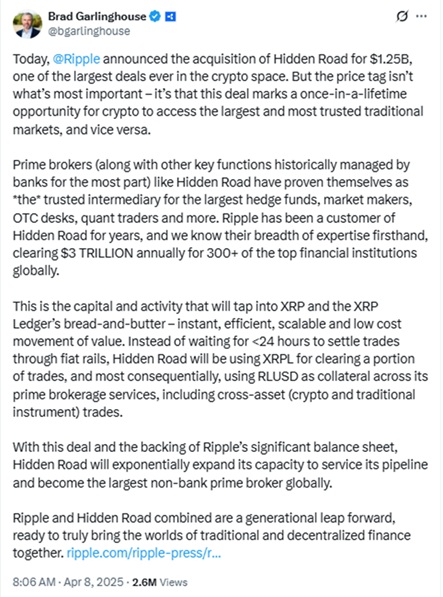
Still, Ripple investors have reason to remain optimistic that the coin has potential to inch higher. The U.S. Securities and Exchange Commission ended its multi-year legal spat with Ripple in March, in which it accused the company of selling unregistered securities. Approximately one month later, Ripple acquired Hidden Road for $1.25 billion as part of one of the largest M&A deals in the crypto space.

Source: @bgarlinghouse

XRP continues to trade around $3, roughly the same level it traded at a month ago. The token has attempted on several occasions to break above $3 but lacked any serious buying momentum to sustain a rally. Many smart-money and long-term XRP holders are now assuming the easy money in XRP has already been made and are asking what is a good crypto to invest in.

Digitap: The Visa Card Bridging Fiat and Crypto

Ripple has seen success at the institutional level and excels in bank-to-bank transfers. However, retail users have virtually no interaction with XRP in their daily lives. This is where Digitap’s proposition comes into play, as it targets the consumer market that Ripple continues to dream of serving.

Digitap brands itself as “the last money app you’ll ever need.” Sure, investors have every reason to be skeptical with early-stage crypto startups. But in Digitap’s case, it has a live product that is available to download on Apple and Google app stores.

Unlike Ripple, Digitap is a pure direct-to-consumer play: it provides a unified account and a Visa card that comes in both physical and virtual form. Users can spend cryptocurrencies or traditional fiat anywhere in the world where Visa is accepted. Balances are auto-converted at the point of sale, making the user experience as simple as tapping a phone for a payment or swiping a physical card in a machine.

Beyond the Visa card, the Digitap app operates as a multi-currency wallet and banking platform. Users can take advantage of features that include multi-currency IBAN accounts, instant currency exchange, offshore account options, and the ability to send money globally through blockchain transfers or a SEPA bank transfer.

Conclusion: Why Digitap Could Beat Ripple in 2025

Digitap’s core offering addresses usability, which is a key consideration for investors asking what is the best cryptocurrency to buy. Digitap addresses a real user problem, as managing multiple finance apps and dealing with high fees for cross-border transfers can be challenging. Digitap is driving early innovation, and its omni-bank model merges the roles of a bank, crypto exchange, and payment processor into one.

Users can download the Digitap app today, while Ripple does not offer a similar retail product. The convenience of Digitap’s solution, which includes spending crypto anywhere while earning cash-back rewards, can drive viral growth, especially among younger and tech-savvy consumers and the estimated 1.4 billion people worldwide who are unbanked.


Discover how Digitap is unifying cash and crypto by checking out their project here:

Presale https://presale.digitap.app

Social: https://linktr.ee/digitap.app

Africa’s Startup Scene: The Big Four Dominate Startup Funding as Fintech Leads The Charge

0

Africa’s startup ecosystem continues to flourish, and the latest data reveals a clear trend. According to a recent report by Africa: The Big Deal, the “Big Four” which comprises Nigeria, South Africa, Kenya, and Egypt, dominate the continent’s venture funding landscape.

Among the Top 100 most-funded startups in Africa, nearly four out of five are headquartered or have their main operations in these four countries. South Africa leads the pack with 23 ventures, followed closely by Nigeria with 22.

While South Africa takes the top spot in total numbers, Nigeria outshines in terms of high-performing ventures. Seven of the Top 20 startups are Nigerian, which include heavyweights such as Opay, Flutterwave, Moove, Interswitch, Moniepoint, PalmPay, and Andela.

Kenya and Egypt round out the Big Four with 17 ventures each, but their sectoral compositions differ. In South Africa, 15 of its 23 startups are fintech firms, such as TymeBank, Onafriq (formerly MFS Africa), Jumo, and Planet42. Nigeria and Egypt are more balanced, with fintech accounting for about half of their ventures.

Kenya, however, shows a unique profile — only two fintechs made the list: Pula and M-Kopa, the latter recently reclassified as fintech despite its origins in the energy sector.

Beyond the Big Four

While the Big Four dominate in terms of funding, other African nations are also making their mark. West African country Ghana, leads the second tier, boasting five startups which include mPharma, Fido, CarePoint, Zeepay, and PEG (now part of Bboxx following a 2022 acquisition).

Western Africa emerges as the most represented sub-region, with 31 startups, while Southern, Eastern, and Northern Africa are nearly tied. Payments giant Chipper Cash stands out as a cross-border case, with strong ties to both Ghana and Uganda, making its regional classification less straightforward.

Funding Insights: Fintech Leads, But Other Sectors Are Rising

As expected, fintech leads the charge in Africa’s startup funding scene, accounting for 42 of the Top 100 ventures. This sector has secured over $1 billion in 2025 so far, claiming 45-51% of total funding and nearly half of all $10M+ rounds. This is up from 28% in mid-2024 lows, fueled by payments, remittances, and credit innovations.

The sector’s appeal lies in solving Africa’s foundational financial gaps, 90% of transactions are still cash-based, yet mobile internet users are projected to hit 475 million by year-end. However, the narrative that “only fintechs can attract big money in Africa” doesn’t fully hold true. The list highlights a diverse startup landscape, with several other sectors showing strong representation.

Energy: Africa’s energy sector primarily cleantech and renewables has ballooned to 18-20% of 2025 funding ($950M+ so far, much via debt), outpacing logistics and rivaling fintech in growth velocity.

With 600 million off-grid residents and climate pledges like AfCFTA unlocking $5B in green trade, investors are betting on solar, efficient cookstoves, and pay-as-you-go models to bridge infrastructure gaps. A major category, with well-known names includes Sun King, d.light, and Burn driving innovation in clean and sustainable energy.

Transport & Logistics: Logistics sector snagged 10% of Q2 2025 funding driven by e-mobility policies. This sector features companies like Moove (Nigeria), Yassir (Algeria), and Swvl (Egypt).

AgriTech: The agritech sector has emerged as a resilient and high-impact area within the continent’s startup ecosystem, driven by the need to address food security, climate resilience, and productivity for smallholder farmers. Active startups include ventures such as Apollo Agriculture and ThriveAgric.

Retail & Commerce: Africa’s retail and e-commerce sector is transforming the continent’s $600 billion+ retail market, where informal trade dominates (90%+ of transactions). With over 50% mobile penetration and 600 million+ internet users projected by 2028, startups are digitizing supply chains, enabling B2B marketplaces, and integrating payments for SMEs, which account for 80% of retail activity. Players in this sector include MaxAB/Wasoko, TradeDepot, and Omnibiz.

HealthTech: Africa’s healthtech sector has emerged as a resilient and high-impact area, experiencing steady growth. Ventures in this category include LXE Hearing (formerly HearX), Pharma, and Cape Bio Pharms.

Outlook

The data above highlights both diversity and concentration. While the Big Four dominate in terms of numbers and funding, startups from smaller markets are increasingly making their presence felt.

Notably, while Fintech remains a driving force, other sectors from energy to logistics and healthtech are proving that Africa’s innovation story is broader than mobile payments and digital banking.