DD
MM
YYYY

PAGES

DD
MM
YYYY

spot_img

PAGES

Home Blog Page 461

Polymarket Files Form D With U.S. SEC For A Potential Token and Launch of Earning Markets

0

Polymarket, the leading blockchain-based prediction market platform, recently filed a regulatory document with the U.S. Securities and Exchange Commission (SEC) that has ignited widespread speculation about an upcoming native token launch.

The filing, dated around mid-September 2025, pertains to the company’s latest funding round and introduces a new category of financial instruments: “other warrants.” In the crypto industry, these warrants are often structured as rights to acquire tokens, a mechanism famously used by projects like dYdX prior to their token debuts.

Prior SEC filings from Polymarket’s parent company, Blockratize, only referenced traditional equity and warrants, making this addition a notable shift that signals potential preparations for tokenization. The filing coincides with Polymarket raising approximately $135 million in fresh capital, pushing discussions of a $10 billion valuation—up from $1 billion earlier in the year.

The rollout began in September 2025, aligning with the start of earnings season, and builds on Polymarket’s recent tie-up with Chainlink for 15-minute markets with near-instant settlements. This move marks Polymarket’s deeper push into regulated U.S. markets, following a favorable stance from the Commodity Futures Trading Commission (CFTC) and after earlier regulatory hurdles that led to a temporary U.S. user ban.

While Polymarket has not officially confirmed a token launch, industry observers interpret the warrants as a deliberate hint at token-linked incentives, which could reward users, enhance liquidity, or enable governance features. This move aligns with the platform’s aggressive expansion, including its recent CFTC approval to relaunch operations in the U.S. after a brief hiatus.

Polymarket, founded in 2020, has evolved from a decentralized Polygon-based platform using USDC for bets on events like elections to a compliant powerhouse, backed by investors like Polychain Capital, General Catalyst, Founders Fund, and even Vitalik Buterin. The prediction market sector is booming, with $216M raised across 11 deals in 2025 alone.

Social media buzz on X has amplified the rumors, with users and analysts drawing parallels to past token launches and debating the implications for prediction markets. For instance, posts highlight how a token could “supercharge adoption” but warn of regulatory hurdles from the SEC.

Launch of Earnings Markets

In parallel, Polymarket has launched new prediction markets focused on corporate earnings reports, marking a strategic pivot from its election-heavy origins to more recurring, TradFi-adjacent trading.

These markets allow users to bet on outcomes like whether a company’s earnings per share (EPS) will beat, meet, or miss analyst expectations, with probabilities updating in real-time during earnings cycles.

Near-instant settlement: Powered by Chainlink oracles for 15-minute resolutions on select events. Integration with platforms: Embedded directly into Stocktwits ticker pages for seamless access, where users see live odds alongside stock discussions.

Targets analysts, hedge funds, and retail traders hedging against earnings volatility, potentially driving year-round volume beyond sporadic events like elections. This rollout follows Polymarket’s U.S. relaunch and partnerships, positioning it to capture flows from traditional finance.

During the Q3 2025 earnings season, expect heightened activity around reports from tech giants like Apple or Tesla, with initial volumes already showing promise in beta tests. Overall, these developments suggest Polymarket is evolving from a crypto novelty into a hybrid finance tool.

A token launch could accelerate this, but it hinges on navigating U.S. regulations—watch for official announcements in the coming weeks.


Fox in Talks to Join Investor Group Bidding for TikTok U.S. Operations

0

Fox Corp. is in advanced discussions to join a consortium of investors preparing a bid for TikTok’s U.S. business, according to sources familiar with the negotiations.

The potential deal, first reported by Deadline, could mark a significant step in the reshaping of the social media landscape and place Rupert Murdoch’s media empire at the heart of one of Washington’s most politically charged corporate transactions.

President Donald Trump appeared to confirm speculation about the Murdochs’ role during an interview on Fox News’ The Sunday Briefing.

“A man named Lachlan is involved,” Trump said, referring to Fox CEO Lachlan Murdoch. “Rupert [Murdoch] is probably gonna be in the group, I think they’re going to be in the group.”

He added that other “really great people, very prominent people” — whom he called “American patriots” — were also poised to participate.

The investment would reportedly come from Fox directly, not as a personal stake by Lachlan Murdoch or through News Corp., the family’s other media holding. For Lachlan, the move would come shortly after consolidating control of the Murdoch empire following Rupert’s step back into the role of chairman emeritus.

The consortium may also include Oracle chairman Larry Ellison and Dell Technologies CEO Michael Dell, both of whom have long been rumored to be weighing involvement. Ellison’s role is particularly notable: as one of the world’s richest men, he is also the key backer of Skydance Media, which recently acquired Paramount and is considering a bid for Warner Bros. Discovery. If the deal goes forward, Fox would join Ellison in making TikTok the second major entertainment-adjacent power bloc to align with the platform.

White House press secretary Karoline Leavitt confirmed that, under the deal, the U.S. would assume control of TikTok’s algorithm, a centerpiece of the national security debate. Oracle, already providing cloud services to TikTok, would manage American user data. A new seven-member board, with six American appointees, would oversee TikTok U.S.

Beijing Offers Qualified Approval

The talks follow a Friday call between Trump and Chinese President Xi Jinping. Trump later hinted that Xi had given the green light for a deal, suggesting a rare moment of alignment between Washington and Beijing. A statement from China’s state-run news agency Xinhua underscored Beijing’s position: “The Chinese government respects the will of companies and is pleased to see companies conduct business negotiations on the basis of market rules and reach solutions that comply with Chinese laws and regulations and balance interests.”

The readout added a pointed reminder that Beijing expects Washington to “provide an open, fair, and non-discriminatory business environment for Chinese companies investing in the United States.”

A Long Battle Over TikTok’s Future

The maneuvering comes against the backdrop of years of tension over TikTok’s Chinese ownership by ByteDance. U.S. lawmakers and national security officials have repeatedly raised alarms over data privacy and influence operations on the app, which has more than 170 million American users.

In late President Joe Biden’s term, Congress passed and the Supreme Court upheld a law requiring ByteDance to sell TikTok’s U.S. operations or face a nationwide ban. Trump, after returning to office, declined to enforce the divestiture deadline and has instead issued four extensions to allow negotiations to progress. His latest remarks suggest he is eager to present the eventual deal as a victory for both national security and American business.

However, a successful stake in TikTok, for Fox, would represent a bold step beyond traditional media into the global short-video market, positioning it alongside tech titans in shaping the future of social entertainment. The deal is expected to deliver a high-profile resolution to one of Washington’s thorniest tech-national security battles — and allow him to frame the arrangement as a triumph of American enterprise over foreign influence.

Stanbic IBTC Half-Year Profit Soars 66% to N243.7 Billion on Stronger Interest Income

0

Stanbic IBTC Holdings Plc has reported a pretax profit of N243.7 billion for the half-year ended June 30, 2025, representing a 65.81% increase from N147 billion in the corresponding period of 2024.

The sharp rise was driven mainly by robust growth in interest income, which offset a mild dip in non-interest revenues.

The group’s interest income jumped 56.34% year-on-year to N384.7 billion. This was powered by N239.7 billion from loans and advances to customers, N131.2 billion from investment securities, and N13.7 billion from loans and advances to banks. At the same time, interest expenses fell slightly to N68.7 billion from N71.8 billion a year earlier, resulting in an 81.31% surge in net interest income to N316 billion.

Non-interest revenue, however, slipped to N117.9 billion compared with N129.1 billion in the prior period. Fees and commission income remained the bulk contributor at N123.6 billion, while other income—largely from property disposals—was down to N6.6 billion.

Altogether, Stanbic’s interest and non-interest income stood at N433.9 billion before impairments. After accounting for impairment charges of N11.1 billion, income came to N422.8 billion, reflecting a 52.70% increase year-on-year.

Operating costs reached N179 billion, largely driven by staff expenses and administrative overheads, leaving a pretax profit of N243.7 billion.

On the balance sheet, total assets climbed 17.51% to N8.12 trillion, while reserves increased to N686.7 billion from N522.6 billion a year earlier, underscoring the bank’s strengthened capital position.

Key Highlights (H1 2025 vs H1 2024):

  • Interest income: N384.7 billion, +56.34%
  • Net interest income: N316 billion, +81.31%
  • Net fees and commission revenue: N117.9 billion, -8.70%
  • Other income: N6.6 billion, -10.17%
  • Income after impairment charges: N422.8 billion, +52.70%
  • Profit before tax: N243.7 billion, +65.81%
  • Total assets: N8.1 trillion, +17.51%

Stanbic IBTC’s share price has rallied strongly in 2025, gaining 70.14% year-to-date, with the stock closing at N98.00 as of September 22, 2025.

Comparative Performance Across the Sector

Stanbic’s performance places it among the leaders of Nigeria’s banking sector, where several tier-one banks have also reported strong half-year results, albeit under similar macroeconomic headwinds.

Zenith Bank, for instance, reported a pretax profit of N505 billion for H1 2025, driven by a surge in interest income that mirrored the trend across the sector. Access Holdings also posted robust growth, with a pretax profit crossing N400 billion, supported by higher loan yields and investment income. GTCO recorded N367 billion pretax profit, also reflecting stronger interest earnings despite pressures on non-interest revenues.

While Stanbic’s N243.7 billion pretax profit is lower in absolute terms compared to its peers, the bank’s year-on-year growth rate of 65.81% stands out as one of the fastest among tier-one banks. The strong expansion in net interest income, which rose by 81.31%, demonstrates its ability to capitalize on higher interest rates more effectively than some rivals, even as non-interest income remained pressured.

Analysts note that this growth trajectory highlights Stanbic’s resilience in balancing its operations amid elevated funding costs, foreign exchange volatility, and inflationary pressures. With total assets rising to N8.12 trillion, Stanbic continues to consolidate its position among Nigeria’s largest financial institutions, though still behind peers like Access Holdings and Zenith Bank, which reported asset bases above N20 trillion.

U.S. Youth Unemployment Hits a Turning Point — and Jerome Powell, Top Economists, Believe It’s Not an AI Takeover

0

The sharp climb in joblessness among Americans under 25 has emerged as one of 2025’s defining economic flashpoints, Fortune reports, citing experts’ analyses.

For recent college graduates, the struggle to secure work has felt both isolating and disheartening. That anxiety gained unusual validation in recent weeks as central bankers and top economists began to acknowledge the reality: young workers face a uniquely American challenge.

Federal Reserve Chair Jerome Powell put it bluntly during his latest press conference following the Federal Open Market Committee.

“Kids coming out of college and younger people, minorities, are having a hard time finding jobs,” he said. He described today’s labor climate as a “low firing, low hiring environment,” where the overall “job finding rate is very, very low.”

In Powell’s telling, the market isn’t hemorrhaging jobs — it’s freezing young people out altogether.

AI Is Not the Main Villain

The conversation arrives amid public fascination with artificial intelligence. Deutsche Bank had already dubbed this past season “the summer AI turned ugly,” as studies warned of automation displacing entry-level roles. Yet Powell was skeptical. While acknowledging AI “may be part of the story,” he stressed it is “not the main thing driving” youth unemployment. He admitted there is “great uncertainty” around AI’s true impact but suggested that macroeconomic forces — slower growth, weak hiring, and restrictive immigration policies — are doing most of the damage.

Goldman Sachs and UBS economists soon echoed Powell. Goldman’s Pierfrancesco Mei argued that the real issue lies in the decline in job turnover.

“Finding a job takes longer in a low-turnover labor market,” he wrote, noting that “job reallocation,” the pace at which new jobs are created and old ones destroyed, has been declining since the late 1990s. Almost all job shifts now happen as “churn” between existing jobs. With churn well below pre-pandemic levels across states and industries, young workers bear the brunt. In 2019, an unemployed youth in a low-churn state needed 10 weeks to find work; now it takes 12 weeks on average.

UBS chief economist Paul Donovan offered a global comparison that makes the U.S. picture stand out even more starkly. In a note titled “The kids are alright?” he pointed out that European and Asian economies are reporting record lows in youth unemployment: young Euro area workers are thriving, the U.K. rate has been steadily falling, and participation by young Japanese workers is near all-time highs.

“It seems highly implausible that AI uniquely hurts the employment prospects of younger U.S. workers,” Donovan concluded. Instead, he said, the trend is “more convincingly” explained by a hiring freeze that blocks new entrants.

Data Underscore the Slide

The Bureau of Labor Statistics’ latest release makes the stakes clear. The youth unemployment rate hit 10.8% in July 2025, nearly a full percentage point higher than a year earlier. Between April and July, the number of unemployed young people swelled by about 690,000. The problem is broad-based, cutting across industries and states.

Why College Grads Are Hit the Hardest

History shows why new graduates may suffer most. Donovan noted that less-educated workers often escape the worst of such freezes because they typically enter the workforce earlier. High school dropouts, for example, can secure full-time work before downturns set in. With U.S. college enrollment in long-term decline, many young people are now turning to trades, where some earn six figures as entrepreneurs while peers with degrees struggle to get a foot in the door.

Stanford research adds a grim warning: graduates who entered the workforce during the Great Recession between 2007 and 2011 earned persistently less for 10–15 years compared to those who graduated during stronger job markets. Economists call these “scarring effects” — long-lasting damage to lifetime earnings, wealth accumulation, and even homeownership. With Powell already warning that minorities are finding it even harder to land jobs in 2025, the risk of widening inequality is real.

Powell left the door open on AI’s role. He mused that “companies or other institutions that have been hiring younger people right out of college are able to use AI more than they had in the past. That may be part of the story… Hard to say how big it is.” Yet the dominant narrative from both the Fed and Wall Street is that this is not primarily a story of robots replacing humans. It is a story of companies not hiring at all.

Policy and Market Implications

If the diagnosis is correct — that youth unemployment stems from a “no hire, no fire” freeze — the policy remedies differ sharply from those targeting automation. Economists suggest:

  • Incentives for firms to expand entry-level hiring and apprenticeships.
  • Targeted subsidies or tax breaks for employers who take on recent graduates.
  • Expanded vocational training and credentialing to make job seekers adaptable.
  • More accurate tracking of churn and hiring freezes across industries.

If unchecked, the current wave of unemployment could carve long-lasting scars into the economic futures of Gen Z workers, shaping wages, wealth, and opportunity for decades to come.

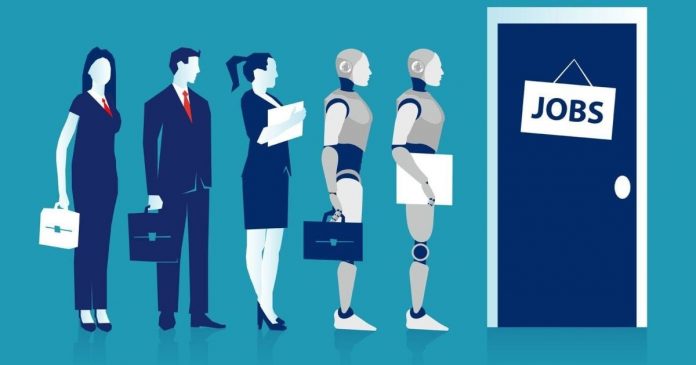
As AI Layoffs Hit Entry-Level Workers, Goodwill CEO Warns of “Flux of Unemployed” — Advocates Reskilling

0

Some tech leaders have been swift to dismiss predictions that artificial intelligence will spark widespread unemployment, while others believe the impact will be significant. Steve Preston, CEO of Goodwill—a U.S. nonprofit with more than 650 job centers— agrees with the latter, saying the shift is no longer hypothetical, according to Fortune.

He noted that it is already unfolding, with consequences most acutely felt by entry-level and low-wage workers.

Last year alone, over 2 million people sought help from Goodwill’s employment services. Now, Preston says the charity is preparing for a “flux of unemployed young people—as well as other people—from AI.” The 65-year-old, who previously served as the 14th U.S. Secretary of Housing and Urban Development, told Fortune that large organizations are already making “significant layoffs based on a move to AI.”

Call centers and sales teams are feeling the brunt of automation. “I don’t know that it’ll be catastrophic,” Preston explained, “but I do think we’re going to see a significant reduction in a number of jobs. I think it’s going to hit low wage workers especially hard.”

A Blow to Young Workers, Especially Non-Grads

Entry-level jobs, often seen as stepping stones for young workers fresh out of school, are shrinking. Preston notes that the labor market squeeze is particularly painful for Gen Z, especially those without college degrees.

“It’s much harder to find a job,” he said. “It’s really hitting college students right now in the marketplace. It’s really hitting young adults without college degrees.”

Research suggests young men are especially exposed to this wave of unemployment.

This reality contrasts with earlier arguments that skills-based hiring would make degrees less relevant.

“What I’m seeing is of the overall unemployment, people without college degrees have no jobs,” Preston stressed.

And while entry-level jobs once provided the foundations for career growth—mentorship, skill-building, and workplace familiarity—AI is eroding these opportunities. Without that training ground, even higher-level roles could be starved of fresh talent in the future.

U.S. vs. Global Workforce Shifts

The U.S. is not alone in this reckoning. In Europe, unions have warned that AI is hollowing out clerical and customer service jobs, leading governments in countries like France and Germany to expand reskilling subsidies. In Asia, call centers in the Philippines—a major global outsourcing hub—are under pressure, as generative AI begins to replicate tasks previously offshored to human workers.

In contrast, economies like India are attempting to balance the disruption by aggressively promoting “AI plus human” service models, where workers are retrained to supervise or complement automated systems rather than be replaced outright.

The comparative picture highlights the uneven pace of adaptation: while U.S. nonprofits like Goodwill brace for a surge in unemployment claims, other countries are embedding AI literacy and clean tech training directly into national policy.

Preston believes that the path forward lies in skills—both digital and practical. Goodwill has been working with employers to identify what will matter tomorrow.

“Digital skills are really critical,” he said, warning that being active on social media is not the same as mastering workplace technologies.

He pointed to tools like Microsoft Excel, Google Docs, and increasingly AI assistants like ChatGPT and Gemini as gateways to employability.

“People who are proficient in using AI tools are beginning to leapfrog other people going into the marketplace,” he said.

For those outside the corporate track, Preston says clean tech jobs—from solar panel installation to EV charging station maintenance—offer promising alternatives without requiring a college degree.

The warning extends beyond Gen Z. “If you are someone seeking a job in your 30s—or even 40s—and you haven’t acquired those skills, you’re pretty much locked out of a massive percentage of the jobs that are available,” he said.

However, Preston insists it is not too late. He recalls cases of people who went from homelessness to high-paying jobs at firms like Accenture and Google after completing intensive digital boot camps.

“When those people get those skills, we just see the doors busting open,” he added.