DD
MM
YYYY

PAGES

DD
MM
YYYY

spot_img

PAGES

Home Blog Page 4626

The Lawyer’s Call of Duty, Challenge of Leadership in Nigeria

0

Whenever you are going into a deal or negotiating a deal and the person on the other side asks you not to involve a lawyer or consult an expert claiming that if you involve lawyers or experts it will make things more complex, your basic instinct should tell you that you are about to be ripped off and cheated on. That is a red flag and you should abort the deal immediately or go against the advice and involve a lawyer or carry out a wide consultation.

By common sense, if a counter-negotiator gives you this advice you should know that there are facts that the person is trying to hide from you  and only wants to take advantage of your desperation or ignorance.

I have a client who is a popular Nigerian singer. He reached out to me some time ago, briefing me that a renowned United States-based Music label had expressed interest in acquiring his music catalog.

For those who might not know what a music catalog is: A music catalog is a collection of musical compositions and their copyrights; it is the collection of songs coming from the same owner and whoever owns the right to the music catalog holds the master and publishing rights of the songs. Unlike other asset classes, a music catalog is classified under intellectual property and not as real property and the owner or the maker of the music catalog owns it in perpetuity unless he sells or assigns it out to another person.

Back to the story, the United State based music label that expressed interest to purchase my client’s music catalog no doubt priced the catalog way too low than it is valued in the international market, and because they know he does not really know what it legally means to sell or assign his catalog out they advised him not to involve a lawyer that lawyers will only make the negotiations more complex.

No matter how much the person is offering you that may make you think that it is a great deal; in my years as a lawyer I have come to find out that if the other person wants to rip you off or take advantage of your ignorance he will advise you not to involve a lawyer or experts in that field. Do not proceed with such deals, place them on hold and do all the necessary due diligence consultation, the knowledge you gathered from the consultation will give you more negotiating power at the negotiation table.

Just like my client, once I got involved as his lawyer in the deal, we were able to up the price the music label initially offered for the catalog by over x50, and we were also able to negotiate down their right of ownership in the catalog from 100% to 50% right while my client will own the 50% rights in the catalog. We were also able to place a maximum number of years they are to own the catalog from perpetuity which they initially proposed to 10 years of ownership.

Generally, my client was able to get a deal that is 1000x better than the deal he would have signed if he had not involved a lawyer.

Moral lesson of the story; Learn to involve lawyers and consult experts in the field that the deal you are negotiating bothers on so you do not get yourself cheated or make a deal you will forever regret.

The Governors are the problems in Nigeria

Some days ago Governor Nyesome Wike of Rivers state in his usual manner took a swipe at some governors, exposing them that the governors of the Nigeria oil-producing states have been paid the 13 percent derivation funds by the federal government. 

Wike is quoted to have said in excitement; “Let me say it for the first time. So many people asked me: ‘where is he getting this money’? Let me say it. I want, through the Attorney-General of the Federation, to thank Mr President. Monies that were not paid to the Niger Delta states since 1999, the 13 percent deductions monies that were not paid, Mr President approved and paid all of us from the Niger Delta states.And for me, it would be unfair not to tell the public. It is not from FAAC money. It is the money that is supposed to be for Rivers, Delta, Akwa Ibom, Edo, and Bayelsa states”. (Quote Credit; Daily Trust). 

The 13 percent derivation fund comes from the federation revenue to oil-producing communities through the state governments as enshrined in section 162(2 ) of the constitution of the federal republic of Nigeria, 1999. 

It is more like other governors that received this payout swore an oath of gang secrecy with the intent to hush it and not let the public know about the fact that they have been paid so they won’t be held accountable for it and can squander it as they please but Governor Wike while thanking the president revealed to the public that the money that has been owed the oil producing state since 1999 has been paid by President Buhari, exposing his colleagues. We can only say God bless Wike for this act of patriotism.  

Some of the state governments that received these funds did not delay in releasing a public letter, denying the amount they got, while some from their body language and silence, it can be seen that they planned to deny having received the money in totality. 

Edo state government denied the amount they received from the government. The state government through Mr. Joseph Eboigbe, the Commissioner for budget and planning in a press conference stated categorically that the Edo State Government only received N2.1 billion in three tranches of N700 million out of N28 billion due the state.

But President Muhammad Buhari saves the day by clarifying and making it public through his Twitter page how much each Niger Delta state had been paid from the outstanding 13 percent derivation funds. The presidency stated that Edo state was paid N2.2 billion, unlike the state government’s claim that they have only received N2.1 billion. 

The discrepancies in the amount paid or received beg the question; who is lying and who is saying the truth between the Edo state and the presidency? Knowing how irredeemably corrupt some states are, my first guess will be that it is the state that is lying about the amount they received with the intention to “corner side” a whopping sum of N100 million. 

It was quite funny that most of the governors that received these funds never planned on making it public until Wike opened the can of worms. This is to show that Nigerian politicians will try everything possible to pilfer and avoid being held accountable by the public.


Congrats Tekedia Mini-MBA Learners for Today’s Graduation, #ready2lead [video]

0

Tekedia Mini-MBA edition 9 learners, congratulations again for completing our 12-week program today.  Now, you are #ready2lead.  Please reach out to Admin for your certificate.

If you missed the closing ceremony, please watch the video on click. At this graduation ceremony, my presentation was titled “Building Category-King Companies and Winning in Business”. Go and create that future, to predict it easily.

Tekedia Institute >> win the future.

Ford Motor Hits Goal of Becoming Second Best-Selling EV Automaker, Records Increased Sales

0
[#Beginning of Shooting Data Section] Nikon D800 2020/12/10 11:45:53.50 Time Zone and Date: UTC-5, DST:ON Lossless Compressed RAW (14-bit) Image Size: L (7360 x 4912), FX Lens: VR 70-200mm f/2.8G Artist: Eric Perry Photo Copyright: 322012 Focal Length: 75mm Exposure Mode: Aperture Priority Metering: Matrix Shutter Speed: 1s Aperture: f/14 Exposure Comp.: +1.3EV Exposure Tuning: ISO Sensitivity: ISO 100 Optimize Image: White Balance: Color Temp. (3140K), 0, 0 Focus Mode: Manual AF-Area Mode: Single AF Fine Tune: OFF VR: OFF Long Exposure NR: OFF High ISO NR: ON (Normal) Color Mode: Color Space: Adobe RGB Tone Comp.: Hue Adjustment: Saturation: Sharpening: Active D-Lighting: OFF Vignette Control: OFF Auto Distortion Control: OFF Picture Control: [SD] STANDARD Base: [SD] STANDARD Quick Adjust: 0 Sharpening: 3 Contrast: 0 Brightness: 0 Saturation: 0 Hue: 0 Filter Effects: Toning: Map Datum: Dust Removal: 2014/11/28 22:06:46 Image Comment: Eric Perry [#End of Shooting Data Section]

American automobile manufacturer Ford Motor hits the goal of becoming the second best-selling Electric vehicle in the U.S. after recording an increase in sales.

Ford narrowly surpassed Hyundai/Kai to claim the second position of EV manufacturers in the U.S. The company recorded a 7.4% rise in its shares from 5.7% a year ago.

It also reported sales of 53,752 all-electric vehicles in the U.S. through November 2022.

Speaking on the increase in demand for its Electric vehicles, Ford CEO Jim Farley said, “The demand is so much higher than we expected. It’s a really new experience for this big company, trying to be agile. We had to approach it very differently than we’ve done capacity planning.”

However, there are speculations that Ford was able to surpass South Korean company Hyundai after the automaker lost incentives that gave buyers of its EVs tax credits of up to $7,500 under the Biden administration’s Inflation Reduction Act.

Despite its rise to the second position of EV manufacturers in the U.S., several analysts have disclosed that the gap between Ford and Tesla which occupies the first position is wide.

Ford’s recent position is no doubt giving the company a feeling of ecstasy after it disclosed plans a year ago to become the world’s second-largest electric vehicle manufacturer in the world.

The company also disclosed plans to increase its production capacity of electric vehicles to 600,000 units by 2023.

Ford is clearly not resting on its oars despite smashing its goal, as it plans to top Tesla in EV sales by Mid-Decade. Ford estimates that it will build 2 million electric vehicles worldwide by 2026.

Tesla on the other hand still dominates the EV sector in the U.S with a 65 per cent market share of new EV sales.

However, a recent report from S&P Global reveals that Tesla’s market dominance in the US electric vehicle sector is gradually waning, down from 79 percent in 2020 and could drop below 20 percent by 2025.

Tesla’s waning dominance is due to a slow rollout of EVs in a more accessible price range below $50,000 where the company currently does not compete. As newer and more affordable options arrive Tesla’s share of the overall market is set to dive.

A research author John Murphy believes that Tesla will lose its dominant position in the EV market because it is not expanding its portfolio quickly enough to keep up with both legacy automakers and new startups that are ramping up their EV lineups.

The analyst says “Tesla CEO Elon Musk has had a vacuum for the last 10 years in which to operate where there hasn’t been much competition, but “that vacuum is now being filled in a massive way over the next four years by very good product.”

Few analysts have predicted that both Ford And GM Will Overtake Tesla By 2025. Will the prediction be successful, or will Tesla continue to dominate the EV sector? time will tell.

Nigeria to Incorporate Finance Ministry As An Investment Arm- Finance Minister

0

As oil-based revenue dwindles, the federal government of Nigeria has been counting on the non-oil sector to replenish the shortfalls. Though the revenue generated from the non-oil sector has significantly fallen short of what is required to meet government’s financial needs, it has been lauded by the finance minister Zainab Ahmed.

On Thursday, while presenting the finance ministry’s scorecard of 2015-2023, Ahmed disclosed that the non-oil sector accounted for 73 percent of the government’s revenue.

This received the minister’s applause as it underlines a major boost to President Muhammadu Buhari’s economic diversification policies.

While appreciating the progress of the non-oil sector, Ahmed revealed that as part of its economic diversification plan, the federal government is ready to establish the Ministry of Finance Incorporated as an investment arm of the federal government.

“If the government is going to be in any business, the Ministry of Finance Incorporated is the investor standing on behalf of the government.

“Ministry of Finance Incorporated used to sit as a department in the treasury, but now we have the President’s approval to turn it into a world-class investment company. The Ministry of Finance Incorporated currently has 130 corporate entities and it has various investments in these entities,” she said.

This follows a similar move by the government to incorporate the country’s national petroleum company, the Nigerian National Petroleum Corporation (NNPC), as factored in the Petroleum Industry Act (PIA).

According to Ahmed, latest data shows that the non-oil sector had been contributing 30-35 percent to federal government revenue, but the figure had appreciated to 73 percent.

The federal government revenue shortfalls have been masterminded by the significant drop in oil revenue, which is as a result of oil theft and oil installation vandalism. But the minister said that crude oil production had moved up to 1.3 million barrels per day (mbpd), from a low of 800,000 bpd.

The minister also spoke about other fiscal policies geared toward economic growth, which include laws designed to enhance the current tax regime.

“We’ve introduced the annual finance acts which are the main fiscal instrument we use to carry out fiscal policy programmes and to amend fiscal laws that have either been problematic for businesses or unfair to businesses, or bring in more revenue to government.

“We’ve been able to enhance it among several tax laws and improve tax administration efficiency. We’ve also been able to increase taxes. For instance, the VAT increased from 5 per cent to 7.5 per cent. We’ve been able to reduce taxes for small businesses,” she said.

Ethereum EVMs; Optimistic v. Zero-Knowledge Rollups

0

Before getting into the distinction between optimistic and zero-knowledge rollups, a refresher on what a rollup actually does will be helpful.

What Is the Purpose of Rollups?

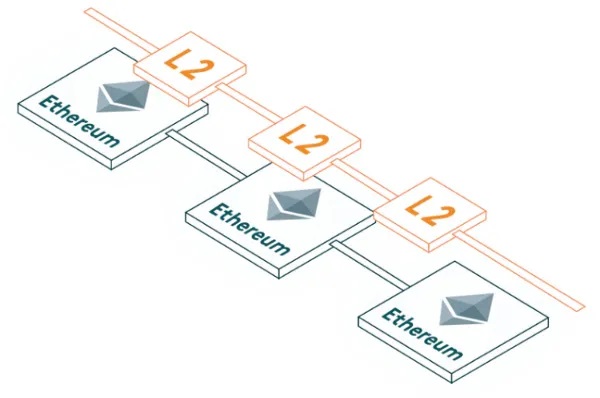
Rollups are considered off-chain (or Layer 2) scaling solutions because they execute transactions outside of the core Layer 1 blockchain on which they are built. If this sentence does not fully make sense, I recommend reading the beginning sections of my Previous publication on zkEVMs.

How does moving transactions off-chain increase scalability? Think of it like this?—?if every transaction on a blockchain network were executed and processed on the Layer 1, unless that network is capable of supporting high transaction speeds (i.e., the amount of time needed to fully confirm a transaction) and throughput (high transactions per second), bottlenecks will occur.

Rollups help by alleviating the processing burden of Layer 1s. Rollups process transactions “offline” from the main network, bundle (or “rollup”) these transactions into a single block, and then send that block back to the Layer 1 for final publishing. In effect, by processing thousands of transactions off-chain and only submitting a single transaction to the main network, rollups can greatly increase the scalability and throughput of an underlying Layer 1 blockchain.

Whereas the current Ethereum network can process about 30 transactions per second (TPS), rollups have the potential to increase throughput to hundreds or even thousands of TPS.

For purposes of this article, we will be limiting scope to rollups within the Ethereum ecosystem. With that context, it should also be noted that by publishing transactions on-chain, rollups inherit the security of the main Ethereum network. This structure is in contrast to some other off-chain scaling solutions like sidechains, which derive their security separately from Mainnet.

As a result, rollups are generally considered safer scaling solutions than sidechains and other alternatives like, for example, validiums which do not store transaction data on the main network.

Optimistic Rollups

Now to the first of the two main types of rollups. Optimistic rollups derive their name from the way in which they post transaction data on-chain. They post this data in an “optimistic” way?—?i.e., when posting, they assume all off-chain transactions are valid.

Taking a step back, consider for a moment what is actually occurring when rollups post off-chain transaction data back on-chain. When transactions are initially executed off-chain on a rollup, the Layer 1 has yet to finalize and recognize their occurrence.

However, when these transactions are posted on-chain, the main network must account for them and transition its “state” (i.e., its historical record of transactions, almost like a balance sheet at a single point in time) accordingly. The challenge becomes how to prevent potentially fraudulent transactions that have occurred off-chain from making their way on-chain through this posting process.

As noted above, when posting, optimistic rollups assume all off-chain transactions are valid. How can optimistic rollups do this while also ensuring fraudulent transactions do not make their way through? There is a fraud-proving scheme in place to help here.

After a rollup batch is submitted to the main network, there is a time window (called a challenge period, lasting roughly seven days) during which anyone can challenge the results of a rollup transaction by computing a fraud proof.

Without getting too into the details, if a fraud proof succeeds for a particular transaction, the rollup re-executes the batch that was previously submitted so that the invalid block/fraud is excluded the next time around. Alternatively, if the rollup batch remains unchallenged after the time window has expired, all transactions in a batch are deemed valid and accepted on the main network. Fraud proofs therefore facilitate what is known as “trustless finality”?—?as long as a transaction is valid, it is guaranteed to eventually be confirmed.

However, one risk is that this security model requires at least one honest node executing rollup transactions and submitting fraud proofs to challenge results. Otherwise, malicious operators would be able to post invalid blocks and potentially steal funds without challenge or oversight.

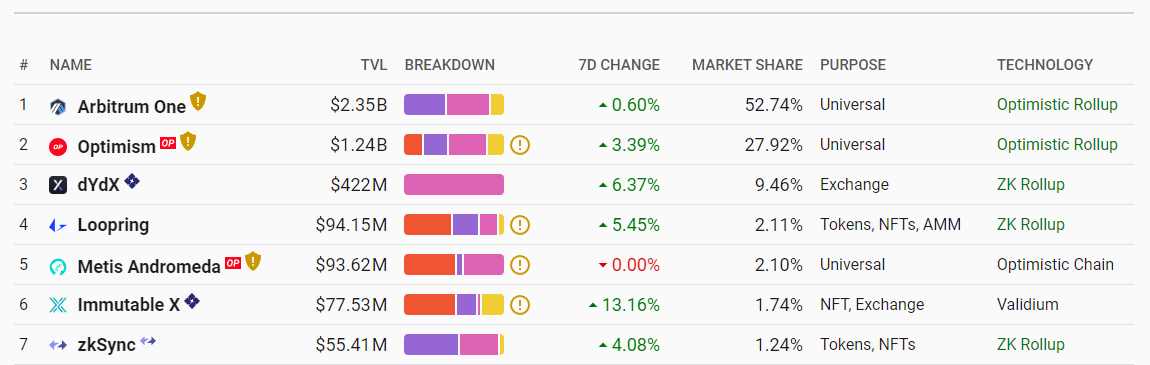
What are some examples of optimistic rollups out there? As of writing, Arbitrum One and Optimism are the largest in terms of total value locked (TVL) ($2.41bn and $1.44bn, respectively).

Zero-Knowledge (ZK) Rollups

At a high level, zero-knowledge (ZK) rollups are not all too different from optimistic rollups. Like optimistic rollups, transactions are executed off-chain and subsequently bundled into batches. However, instead of then posting all transaction data on-chain like optimistic rollups, ZK-rollups submit validity proofs to the main network in order to finalize.

Comparing Optimistic and Zero-Knowledge Rollups

There are a few main pros and cons that are worth noting when comparing optimistic and zero-knowledge rollups.

  • Transaction Finality. Since ZK-rollup transactions are finalized as soon as validity proofs are verified, unlike with optimistic rollups which require a challenge period (~seven days), there is no delay when moving funds from a ZK-rollup to the main network. Although this delay for optimistic rollups can potentially be mitigated for users by employing liquidity providers (who may deliver early payment in exchange for a fee), this delay is something to consider.
  • Security. If you may recall, to work successfully the security model of optimistic rollups requires at least one honest node to submit fraud proofs to challenge invalid state transitions. In contrast, ZK-rollups rely on trustless cryptographic mechanisms for security. By not having to rely on the honesty of other actors, ZK-rollups are generally considered more secure than optimistic rollups.
  • Overhead and Cost. ZK-rollups require specialized hardware to produce validity proofs (which may encourage centralized control), and the cost associated with computing and verifying these proofs can be substantial. These considerations are not as relevant in the optimistic rollup context.
  • EVM-Compatibility. Although not touched on previously, it is important to note that optimistic rollups (but not ZK-rollups) are generally EVM-compatible.
  • What EVM-compatibility actually means is a bit confusing. I like to think of it like this. The Ethereum blockchain, as essentially the world’s most popular network, has created a set of de facto global standards based on its early specifications, ranging from its programming language to its token standards. Since Ethereum is so popular, there are a myriad of tools and applications that target these Ethereum specifications. If other blockchains similarly build in accordance with these standards, they can then piggyback and take advantage of these other developer tools and keep up with the Ethereum ecosystem as it grows.
  • Blockchains that are not EVM-compatible (e.g., Solana) miss out on the above and create instead entirely new ecosystems. Although this may allow other blockchains to fundamentally change the Ethereum toolset and differentiate themselves in various ways, it makes it harder to attract developers who are used to the Ethereum standards. Given the complexity involved with zero-knowledge technology and proofs, we have not yet achieved EVM-compatibility for ZK-rollups (“ZK-EVMs”). Vitalik Buterin has even recently stated that Ethereum was not originally designed around ZK-friendliness, thus contributing to the delay in this regard. As a result, ZK-rollup developers have so far been unable to use zero-knowledge technology in an EVM setting, which has likely hindered development and the adoption of ZK-rollups to date. However, progress is being made. In July 2022 at the Ethereum Community Conference (EthCC), three separate projects (zkSync, Polygon Hermez, and Scroll) announced that they are striving to make ZK-EVMs a reality. Much progress is still to be made, but in the future the advantage that optimistic rollups have in terms of EVM-compatibility may subside.

In terms of total value locked (TVL), optimistic roll-ups are currently much more popular than ZK-rollups. This state of affairs may seem counterintuitive given that ZK-rollups appear to offer clear benefits in terms of transaction finality, security, and scalability.

However, if we consider how complicated zero-knowledge technology is to build and the fact that ZK-rollups are yet to be EVM-compatible, things start to make more sense. As technology improves and EVM-compatible ZK-rollups start being introduced, developers will likely begin to leverage the scalability and security guarantees of zero-knowledge proofs more which will help close the gap.