DD
MM
YYYY

PAGES

DD
MM
YYYY

spot_img

PAGES

Home Blog Page 464

Nigeria’s Job Market: Education, Public Sector Lead as ICT, Healthcare Grow

0

Nigeria’s labour market has recorded a significant concentration of employment opportunities in a few key sectors, while new signs of growth are emerging in digital and health-related industries. Fresh data from Hotnigeranjobs, a leading job listing platform covering the last two months, highlights how education, government and consulting dominate recruitment, yet it also points to promising momentum in information and communication technology, healthcare, and energy.

The education sector accounted for the single largest share of job listings, recording 4,315 openings during the two-month period. This means that more than one in every four jobs advertised came from teaching, training or related educational activities. The result is not surprising given the growing demand for teachers and trainers across schools, vocational institutions, and private academies. In addition to formal schooling, the expansion of digital learning and community training initiatives has created further opportunities. Analysts expect this trend to continue, although growth will be steady rather than explosive as schools respond to the pressures of enrolment and government budgets.

Government ministries and agencies followed closely with 3,293 advertised vacancies. These postings reflect the ongoing recruitment drives across public services and the expansion of administrative capacity in areas such as health, infrastructure, and regulatory oversight. While such recruitment tends to move in cycles linked to political decisions and budgetary allocations, the public sector remains one of the country’s largest and most stable employers. Stakeholders note that demand for skilled graduates in administration and project management continues to be strong.

Consulting, recruitment and human resource services ranked third with 2,187 vacancies. This industry plays a central role in Nigeria’s labour market as it supports other sectors in finding and managing talent. Its expansion is often a mirror of broader employment trends. When total job creation rises, consulting and recruitment firms tend to see increased activity. Current figures suggest that these firms are benefiting from high demand for placement services across both private and public organizations.

Banking and financial services contributed 1,525 jobs. While this remains a major employer, growth is relatively modest compared to technology and healthcare. The sector is stable but increasingly shaped by digital transformation as fintech companies expand and traditional banks upgrade their platforms. Analysts expect modest gains rather than dramatic increases in postings from this sector over the short term.

Healthcare and medical services recorded 1,178 advertised roles. This figure places the sector among the fastest growing, driven by rising investment in hospitals, clinics, and specialist care. Shortages of skilled health workers are also driving employers to expand their search. International organizations and donor-funded programs further reinforce recruitment demand. This combination means healthcare is one of the sectors expected to record a sharper increase in postings in the coming six months.

Information and communication technology services and software contributed 921 jobs. This figure may appear smaller than that of education or government, but the pace of growth is stronger. As businesses digitize operations and as fintech, cybersecurity, and artificial intelligence solutions gain traction, recruitment in ICT is forecast to expand by as much as 25 percent in an optimistic scenario. Training and capacity-building in digital skills are therefore critical priorities for government and private actors alike.

Manufacturing, production and fast-moving consumer goods accounted for 1,252 listings, while energy and power contributed 607. Both sectors are important for Nigeria’s economic diversification. Manufacturing is benefiting from consumer demand and regional trade initiatives, while energy recruitment is increasingly linked to renewable power projects and the need for technical experts in distribution. Stakeholders view both areas as strong mid-tier employers with potential for growth.

By contrast, oil and gas recorded 584 jobs. Although still important to Nigeria’s economy, its share of new job postings is modest compared to service-oriented industries. Future hiring will depend heavily on global energy prices and domestic investment decisions. Low-volume categories such as creative arts, sports, and professional bodies remain niche and are unlikely to contribute substantially to overall employment in the near term.

In the next six months, our forecasts suggest that education will continue to provide the largest number of jobs, though its growth will be gradual. Government hiring is likely to remain stable with slight increases tied to new budget cycles. Consulting and recruitment services will rise in line with overall labour activity. ICT and healthcare are expected to record the most rapid growth, with ICT driven by digital transformation and healthcare by workforce shortages and investment in infrastructure.

Our analyst notes that acquiring digital skills, health-related qualifications, or training expertise can open doors in the fastest-growing fields. Policymakers need to prioritize skills development in ICT, healthcare, and renewable energy while also maintaining support for education. Employers in slower-growth sectors such as oil and gas may face greater competition for skilled workers, while consulting firms will continue to shape hiring across industries. For investors and NGOs the opportunities lie in education technology, healthcare infrastructure and energy transition programs that create jobs as well as services.

Implications of SunPerp DEX and Deutsche Bank Bold Prediction on Bitcoin

0

SunPerp, a new perpetual decentralized exchange (perp DEX), officially launched on the Tron blockchain around September 19-21, 2025, marking the first native perp DEX in the Tron ecosystem.

Founded by Tron creator Justin Sun, the platform aims to fill a key gap in Tron’s derivatives trading infrastructure, leveraging the network’s dominance in USDT circulation the largest among blockchains to support high-volume perpetual futures trading.

Advertised as the “lowest trading fees in the market,” with Tron network fees reduced by up to 60%. Full refunds on gas fees for successful deposits, making onboarding cost-free.

Uses zero-knowledge proofs (ZK) for order data transmission to the Tron mainnet, allowing users to opt-in for position visibility. Millisecond executions, cross-chain liquidity aggregation, and an integrated auto-deleveraging (ADL) system to manage risk.

Upcoming points system, airdrops, and leaderboards to reward trading activity. During its public testing phase (pre-full launch), SunPerp attracted over 3,000 users without any marketing, signaling strong organic demand.

The platform is positioned to compete with leaders like Hyperliquid, dYdX, and GMX by emphasizing speed, low costs, and USDT-native trades. Tron-based wallets, bridges, and potential Layer-2 integrations are planned for scalability.

This launch intensifies the 2025 perp DEX race, where Q2 volumes hit $898 billion, driven by ecosystems like Tron and Binance entering the space.

Deutsche Bank Predicts Central Banks Will Buy and Hold Bitcoin by 2030

Deutsche Bank—a $1.05 trillion asset manager—forecasted that central banks could begin purchasing and holding Bitcoin (BTC) on their balance sheets by 2030, positioning it as a complementary reserve asset alongside gold.

The prediction stems from Bitcoin’s maturation as “digital gold,” with declining volatility (hitting multi-year lows in August 2025), deeper market liquidity, and clearer regulations in major jurisdictions. Reducing exposure to USD shocks which holds 57% of global reserves and hedging against inflation/geopolitical risks.

Like gold global reserves ~60,370 tons, Bitcoin’s fixed supply (21 million cap) and low correlation to traditional assets make it ideal for wealth preservation. 2025 saw gold demand surge (43% of central banks plan increases), while Bitcoin ETFs amassed $110B+ in AUM.

Examples include China’s $57B UST sell-off in 2024 and U.S. proposals for a Strategic Bitcoin Reserve. Adoption hinges on secure custody, contained volatility, and regulatory clarity; gold will retain primacy short-term.

The report echoes Deutsche’s March 2025 view of Bitcoin as “21st-century gold,” too vital to ignore. SunPerp’s launch as Tron’s first native perpetual futures DEX fills a critical gap in its DeFi ecosystem, potentially attracting traders and increasing on-chain activity.

Tron’s dominance in USDT circulation positions SunPerp to capture significant trading volume, especially for USDT-based pairs. Ultra-low fees and gas-free deposits could draw users from competing perp DEXs like Hyperliquid or dYdX, enhancing Tron’s reputation as a cost-effective blockchain.

Cross-chain liquidity aggregation and planned Layer-2 integrations could improve scalability, making Tron a stronger contender in the $898B perp DEX market. The use of zero-knowledge proofs for private order transmission sets a new standard for user control and security in DeFi, potentially inspiring other DEXs to adopt similar tech.

SunPerp’s entry escalates the 2025 perp DEX race, challenging established platforms like GMX and Binance-backed projects. This could lead to fee wars or innovation spikes across the sector.

Implications of Deutsche Bank’s Bitcoin Prediction for Central Banks by 2030

Central banks holding Bitcoin on balance sheets would signal unprecedented institutional legitimacy, potentially driving broader adoption by governments, corporates, and retail investors.

Sovereign demand could significantly boost Bitcoin’s price, building on its 2025 rally toward $124K. Historical parallels with gold suggest long-term appreciation but with higher volatility. Central banks diversifying away from USD toward Bitcoin and gold could weaken dollar hegemony, reshaping global finance dynamics.

Nations like China, already reducing UST holdings, might accelerate Bitcoin adoption to counter U.S. financial influence, escalating economic rivalries. Increased central bank participation could deepen Bitcoin’s market liquidity and reduce volatility, making it a more stable reserve asset.

However, initial purchases might spike short-term volatility. Widespread adoption would likely force clearer global regulations, balancing innovation with oversight. Jurisdictions lagging in crypto policy (e.g., EU, India) might face pressure to act.

Bitcoin’s fixed supply could appeal to central banks in high-inflation economies, offering a hedge akin to gold but with digital advantages. Sovereign adoption might shift public sentiment, reducing skepticism about crypto’s utility and encouraging retail investment, though risks of speculative bubbles remain.

Central banks would need robust custody solutions to mitigate hacking risks, a significant hurdle given Bitcoin’s decentralized nature. Deutsche Bank notes gold will remain the primary reserve asset short-term, limiting Bitcoin’s immediate impact. Adoption by 2030 depends on sustained volatility declines and regulatory clarity.

SunPerp’s launch could indirectly benefit from Bitcoin’s growing legitimacy, as a bullish BTC market driven by central bank interest might increase trading volumes on perp DEXs, including SunPerp.

If Bitcoin becomes a reserve asset, Tron’s USDT-heavy ecosystem might see increased BTC/USDT trading pairs on SunPerp, amplifying its role in DeFi.

Both developments face regulatory risks. SunPerp’s privacy features and Bitcoin’s sovereign adoption could trigger scrutiny, potentially harmonizing or clashing with global crypto policies.

Lagos Commissioner’s Flood Statement Draws Criticism Over Drainage, Urban Planning, and Enforcement

0

A statement by the Lagos State Commissioner for Environment and Water Resources, Tokunbo Wahab, on the flash floods that disrupted parts of the city on Tuesday, September 23, 2025, has triggered widespread debate on X (formerly Twitter). While Wahab expressed sympathy to affected residents and outlined the government’s interventions, many Lagosians used the opportunity to question urban planning practices, weak regulatory enforcement, and what they described as the repeated use of Lagos’ coastal location as an excuse.

Posting from his verified X account at 9:00 a.m. the following day, Wahab assured residents that the government remained committed to tackling flooding. He noted that Lagos, as a coastal city, is naturally vulnerable to flash floods during heavy rainfall, especially when combined with tidal lock. He highlighted technical challenges in areas such as Kusenla, where downstream water levels are higher than the drainage outlet and require pumping stations.

He also blamed environmental infractions, including construction on floodplains and refuse dumped into drains, particularly around the House on the Rock church. Wahab stressed that citizen cooperation was vital, insisting that illegal reclamations and obstructions without proper clearance would be removed. He ended his message with reassurance that the flooding had receded by Wednesday morning and that the Ministry would continue to strengthen flood management systems. The post, tagged #CleanerLagos, quickly went viral and had been viewed over 150,000 times by the afternoon.

The public response, however, reflected frustration more than sympathy. Several X users dismissed the explanation of Lagos as a coastal city as an overused narrative. They argued that decades of regulatory neglect had allowed indiscriminate building on floodplains, with both state and local authorities failing to enforce planning rules. Others pointed to global practices, noting that in developed countries residents are discouraged from concreting entire compounds without permits, since impermeable surfaces reduce infiltration, increase runoff, and worsen urban flooding.

A recurring theme in the replies was the need for consistent maintenance of drainage channels. One user remarked that ensuring drainages remain functional is hardly “rocket science,” suggesting that the impact and severity of flooding could be drastically reduced if existing infrastructure was properly managed. Another lamented that communities such as Gbetu Iwerekun in Ibeju Lekki have suffered without adequate drainage for more than 15 years, with no intervention from the Ministry despite repeated flooding. Similar complaints emerged from Abule Egba, where residents accused illegal construction of worsening erosion and appealed directly to the Commissioner to act.

The reactions also questioned the government’s framing of flooding as primarily a coastal issue. Many residents insisted that Lagos suffers just as much from urban flooding, pointing to the fact that large sections of the Island have been paved over with concrete, preventing rainwater from infiltrating the ground and forcing it onto the streets. This, they argued, would have caused flooding even if Lagos were not located on the coast.

Others recalled earlier promises that demolishing illegal structures on the Island would end flooding. They asked why floods persist despite those demolitions and wondered whether more buildings would be marked down in future. The pointed nature of these comments suggested a lingering distrust of government assurances, as residents demanded clearer long-term strategies rather than episodic interventions after each flood event.

The Commissioner’s message was intended to reassure, but the replies highlight a more complex reality. Lagosians  want measurable outcomes, stronger regulation, and accountability for communities long left vulnerable.

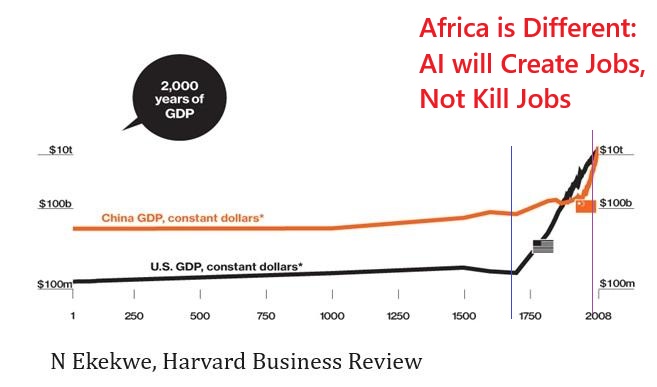
AI, Africa, and the Three Eras of Civilization, And Why AI Will Create Jobs, Not Kill Jobs in Africa

0

In many places across the world, the consensus is that artificial intelligence will displace workers, especially those at the entry levels of industries. The narrative is that AI will trigger disintermediation, eliminating jobs in massive numbers. But let me share a perspective: Africa will not be severely affected in this disruption. In fact, the continent may benefit in unique ways.

Years ago, I had divided modern civilization into three eras: the invention society, the innovation society, and the accelerated society. Those who have studied with us in Tekedia Mini-MBA know that framework well. In the invention era, brilliant minds created the pillars of modern knowledge in physics, chemistry, mathematics, and biology. But they did not commercialize those ideas into products and services.

The innovation society did what the inventors did not: they transformed those discoveries into products that shaped modern commerce and life. From the understanding of compounds, vaccines emerged; from electromagnetism, industries were born. Then came the accelerated society—our present moment—where technologies, powered by automation and AI, are compounding at breakneck speed. We are experiencing a Cambrian explosion of possibilities, and markets are being reshaped in unprecedented ways.

But these epochs have not been universal. They largely describe the realities of a few regions: Western Europe, the United States, China, and a handful of others. Sub-Saharan Africa has not fully crossed from invention to innovation. We remain largely in the era where ideas abound, but the systematic conversion into scalable products and services lags. And since AI can only disrupt jobs when innovation has created industries and employment structures to disrupt, Africa is shielded. The foundations required for AI-driven mass job losses are still thin across the continent.

Of course, this does not mean AI will have no impact in Africa. In banking, insurance, and telecoms, AI will certainly play roles. But let us be factual: how many people are employed in those sectors compared to agriculture, trade, and informal economies? The vast majority of Africans work in spaces where AI is not immediately applicable.

So, while the world panics about job losses, Africa must think differently: this is our window to leapfrog, to harness AI not as a destroyer of work but as a catalyst for creating new categories of industries, jobs, and opportunities for our people.

U.S. Eyes Equity Stake in Lithium Americas as Washington Extends Critical Minerals Strategy Beyond Borders

0

Lithium Americas stock surged nearly 80% on Wednesday after reports that the Trump administration is seeking an equity stake in the Canadian mining company, marking the latest step in Washington’s bid to secure direct ownership in the mineral supply chain critical to U.S. strategic interests.

According to a Trump administration official who spoke to CNBC, the White House is pursuing an equity stake as Lithium Americas renegotiates the terms of a $2.2 billion Department of Energy (DOE) loan for its Thacker Pass mine in northern Nevada. The development was first reported by Reuters.

The official said Lithium Americas had not met conditions for the first loan disbursement, prompting talks over new terms. The miner asked to delay part of its repayment into later years, and in response, the administration proposed a small equity stake to protect taxpayers.

“If we’re going to push out part of the repayment into later years, then the administration would like a very small stake of equity to create essentially a cash buffer and eliminate some risk on behalf of taxpayers,” the official said.

While no agreement has yet been finalized, the official described negotiations as positive. Because Lithium Americas is incorporated and domiciled in Canada, any stake would also likely require Ottawa’s approval, though the company trades on both the Toronto Stock Exchange and the NYSE.

A cross-border precedent

This would be the first U.S. government equity stake in a Canadian mining company. It follows a precedent set in July when the Department of Defense acquired a 15% equity stake in MP Materials, the Las Vegas-based rare earth miner. Shares of MP Materials have more than doubled since that deal was announced.

The Lithium Americas move signals Washington’s willingness to extend its mineral strategy beyond domestic borders to close allies, in sharp contrast to the MP Materials deal, which was strictly U.S.-based.

Thacker Pass and GM partnership

Thacker Pass, located in northern Nevada, is expected to become one of the largest sources of lithium in North America once operational. Lithium is a key material for electric vehicle (EV) batteries, making the project central to U.S. efforts to reduce reliance on Chinese supply chains.

Lithium Americas holds a 62% stake in Thacker Pass and operates the mine. General Motors holds the remaining 38% stake and has secured an offtake agreement for the lithium once production begins.

The Trump administration has stressed the need to protect domestic and allied mining ventures from Chinese dominance. Interior Secretary Doug Burgum revealed in April that the administration was weighing equity stakes as a tool to help miners compete with state-backed Chinese firms that control much of the global lithium refining and rare earth supply chain.

By pushing for equity instead of relying solely on loans or grants, Washington positions itself with both a financial buffer and a direct strategic interest in companies at the center of its industrial policy.

U.S. vs. China

The Lithium Americas deal highlights a growing divergence in how major powers secure critical minerals.

  • China’s playbook: Beijing has long relied on direct equity stakes in overseas mines across Africa and South America, often through state-backed giants. Chinese companies already hold significant positions in lithium projects in Chile, Argentina, and the Democratic Republic of Congo. This control of raw materials, coupled with China’s near-monopoly on refining capacity, has given Beijing a decisive edge in the EV and battery supply chain.
  • U.S. strategy: Washington is only now moving into direct ownership. The MP Materials deal and the proposed Lithium Americas stake represent a shift from subsidies and loans toward state equity participation, a model designed to mirror aspects of China’s approach but limited so far to North America.
  • Allied comparisons: The European Union is pursuing a different model through its Critical Raw Materials Act, which emphasizes subsidies and financing tools but stops short of direct ownership. Canada, meanwhile, has tightened restrictions on Chinese investment in its lithium sector, effectively steering companies toward partnerships with Western governments and firms.

The contrast underscores how the United States is adapting its policies to counter China’s longstanding dominance, while also testing how far allies like Canada are willing to allow Washington into their domestic mining sector.

If approved, the deal would mark a significant expansion of U.S. industrial strategy—beyond domestic firms like MP Materials to allied companies—and could pave the way for similar cross-border investments in the future.