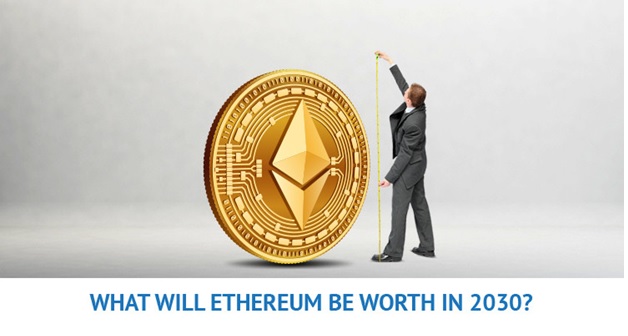
Crypto analysts believe that Ethereum value can actually reach six figures. For instance, according to Crypto Rating and based on the opinions of experts Dan Morehead and Nigel Green, Ethereum can actually reach a value of $100,000 by 2030. DigitalCoin, on the other hand, estimates that the highest value that Ethereum might have in this decade is $13,385.61, by 2030.
Since its release in 2015 Ethereum has experienced ups and downs, proving that it is a volatile cryptocurrency. Ethereum reached its record-high with a value of $4,891.70 on the 16th of November 2021. But what should we expect for the value of this decentralized platform by 2030?
Even though we can never correctly predict the future value of a cryptocurrency, it is generally estimated that Ethereum can steadily increase in value throughout the decade.
However, we must mention that the future price of Ethereum also depends on the rate at which other competing cryptocurrencies are growing too.
With the Ethereum asset currently priced at $3,775, Will the crypto asset be worth thousands of dollars in the coming years? Or will it be surpassed by other altcoins such as Binance Coin (BNB) which is already competing with the digital coin in the Decentralized Finance (DeFi) space?
>>>Buy Ethereum Now<<<
Ethereum: What Is It?

Ethereum (ETH) not only serves as digital currency but technology as well.
It is an open-source blockchain for conducting transactions. Normally referred to as DAPPS (Decentralized Digital Applications) or smart contracts, Ethereum’s blockchain technology would in the near future help in transforming industries in social media, e-commerce, education, healthcare, legal and telecommunications.
How Did Ethereum Become Bitcoin’s Best Competitor?
BTC and ETH are the top two most popular and largest cryptocurrencies by market capitalization. There are several “altcoins” which were developed after Satoshi Nakomoto’s blockchain innovation became a hit among investors and took the whole financial sector by storm, most of them failed.
ETH has come this far by putting several measures in place year in and year out which has seen the digital asset survive and have a fair share of the crypto market.
Ethereum has always played a secondary role to Bitcoin since the inception of blockchain technology but has been able to diversify its operations in the decentralized finance world by upgrading its platform from Ethereum 1.0 to the continuous development of Ethereum 2.0 which allows more altcoins as well as DeFi protocols to be created.
Diversification
Founder Vitalik Buterin and his team have been able to adhere to one of the major themes or central core of investing which is to diversify risks. Instead of thriving on Bitcoin’s model of making gains in the market through speculation, news in the media or shilling (when people who own a particular coin write insightful news articles about the asset in order to boost its demand and thereafter increase in price), Ethereum makes money from a number of ways such as cost of transaction.
Ethereum controls more than 94% of the Decentralized Finance (DeFi) space and as a result several developers and traders use its platform to lend, borrow and invest. Constant usage means more transaction fees and more money for the digital asset and its blockchain network.
Popularity and Fans (Developers and Traders)
Ethereum (ETH) like BTC thrives a lot on its popularity. Thriving on the fruits of this popularity, interest in the coin has gone through the roof which has seen the asset record a trading volume of $12bn in the last 24 hours as a time of writing this feature article.
This means that ETH has provided a gateway for other coins to be traded, unlike other altcoins which could not do much to command a great trading price for other tokens to survive.
Many novice investors are now starting to invest in crypto and their Point-of-Start is Ethereum. When more people purchase a product, there is an increase in demand and when there is more demand for a product than its available, automatically, supply goes down and the resultant effect is an increase in price and this is what ETH will be experiencing in 2023 and beyond.
There is no stock, commodity, metal or cryptocurrency which has gotten to its current trading price after its Initial Public and Coin Offerings without the support of fans (traders).
Fans first hear about an asset, then transition from being mere fans to skimmers of financial information of their favorite asset. After that, they become consumers of financial information of that asset. Then they experiment on brokerages, online trading through their DEMO ACCOUNTS which comes with unlimited funds. After gaining experience, they try trading with LIVE ACCOUNTS using a meager part of their savings. This helps them to gain knowledgeable insights about the movements of candlesticks as part of technical analysis combined with their personal research (fundamental analysis) and then move on to become investors of the assets.
Facebook (FB), Tesla (TSLA) and Bitcoin would not have survived without its fans. These fans moved on from being mere fans to become purchasers and holders of the asset for as long as their investment goals would take them. Ethereum’s fans believe “this blockchain technology will form the basis of the internet soon and will take the current Web 2.0 to a more advanced Web 3.0”.
Wrapping Bitcoin (BTC) On its Blockchain Network
As soon as you decide to check the price of ETH, the other asset which comes to mind for checkup is BTC. Many people trust BTC despite its volatility. Having Ethereum (ETH) wrap several BTCs on its blockchain network signals to numerous investors the authenticity, simplicity and openness of ETH to make its platform smart contract compatible. With this, it has made it extremely easy for users to create and unlock instruments such as loans and insurance.
An investment expert such as Blocktown Capital’s James Todaro is of the view that “Ethereum could be worth as much as $9,000 someday.” His views are based on fundamental analysis which sees the cryptocurrency making strong gains through its Decentralized Finance (DeFi) since Ethereum is the go-to-platform for several developers.
Ethereum could also be the second crypto to hit the $1 trillion market cap milestone since BTC has already surpassed that mark and this is good news for growth investors.
>>>Buy Ethereum Now<<<
Why Is Ethereum Important?
Ethereum’s $375bn market capitalization was not reached on mere speculation. Ethereum houses the largest ecosystems of applications in the cryptocurrency stratosphere. Evidently, more than half of the top-performing cryptocurrencies were built on its blockchain as ERC-tokens.
To summarize the importance of digital assets, 94% of the whole decentralized finance space is built on the blockchain. Many developers have been innovative enough to develop applications that help users borrow, lend and trade ERC-20 tokens without a bank or cryptocurrency exchange (middleman).
Cutting the middle man has turned out to be extremely lucrative as the annual interest rate of DeFi protocols on Ethereum can be anywhere from 3 to 10,000%. Such numbers have attracted huge investors with nearly 15 billion dollars of cryptocurrency introduced into the space of DeFi and the number is growing daily.
ETH token as part of its primary function is used to pay for the platform’s network fee which is called “gas”. The unit of measurement is called “gwei”. As demand for applications and tokens grow substantially, the result is an increasing demand for Ethereum (ETH). This is the main reason why several investors are of the belief that Ethereum may surpass Bitcoin to become the largest cryptocurrency in terms of price and market capitalization.
With Ethereum’s old platform (Ethereum 1.0), the network could handle around 15 to 30 transactions per second. Looking at the numbers in terms of trade volume, the network could not sustain its millions of users and the thousands of transactions which go on between them every second. With high network fees and too many users on the platform, Ethereum decided to upgrade its network from Ethereum 1.0 to Ethereum 2.0 and so far the results have contributed to the current rally we are seeing.
Continuous upgrades are being done daily to ensure it meets the needs of consumer demand which should see it stay in charge of DeFi for a long period of time. This will undoubtedly equate to huge gains in terms of a huge spike in price in 2023 and the decade ahead.
Will Ethereum Go Up With Ethereum 2.0?
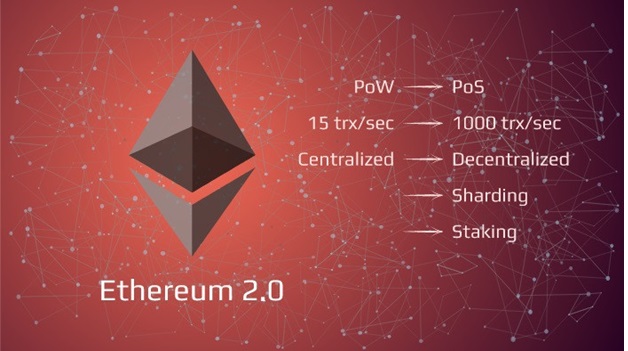
It must clearly be noted that Ethereum 2.0 went live on December 1, 2020 and this comprises major changes which could end the dominance of Bitcoin in the blockchain space.
Since the inception of Blockchain Technology, Bitcoin has led the discussion with regards to which coin will dominate the others for the first competitive decade (2015-2025). Satoshi Nakamoto’s handy work and the maximum supply of 21 million coins has made it possible for the digital asset to cross several milestones, $1,000 at the very least to $64,863.10 and still counting.
This may change in the next few years as the grandfather of crypto space has started to lose steam with regards to a lack of upgrades to its blockchain network. More importantly, Bitcoin faces diverse limitations and at the top of it all is a scalability issue.
The whole world at a point in time in 2017 and 2018 experienced several scalability issues with regards to business. There are many organizations which at the time were considering adopting blockchain.
According to a survey carried out by Deloitte in 2018, “obstacles have kept the value of blockchain more prospective than actual for most enterprises and have made commercial adoption difficult”. When comparing the transaction speeds of other technologies such as VISA and online payment systems such as PayPal and Skrill, Deloitte also found that “blockchain-based systems are comparatively slow when used as a means of processing transactions”.
This is a huge problem for businesses which are solely dependent on legacy transaction processing systems. Interoperability is a vital feature of technology and cross-chain compatibility could go a long way to enable the exchange of information and value between networks and provide solutions to the lack of traditional finance acceptance of cryptocurrencies.
Severe transfer delays and high fees have been associated with the Bitcoin network. Who can forget about the notorious “crypto kitties” app, which was developed by Dapper Labs (a studio in Canada) which allows players to breed, collect, purchase and sell virtual cats? Inasmuch as it brought leisure and recreation to Ethereum, it also congested the blockchain network which slowed transactions.
Abandoning Proof-of-Work (PoW) and Embracing Proof-of-Stake (PoS)
As soon as blockchain comes into mind, one of the prime areas we look at is security and scalability. This is the main reason why Ethereum is moving from its old platform (Ethereum 1.0 to Ethereum 2.0). When Ethereum first got into the game in 2013, it had to imitate a lot of the features of its predecessor BTC. Although Bitcoin’s blockchain initially made their operations successful, it also suffered the same limitations as its parent coin. This limitation is called Proof-of-Work. By adopting a Proof-of-Work system, ETH relied on a processing-power-intensive process to help with the validation and recording of transactions.
Additionally, in a Proof-of-Work system, participating computer nodes get into competition to help with the generation of cryptographic hashes which satisfy the level of complexity which the network seeks to determine. To prevent hacking, the complexity level is kept high enough which deters hackers or anonymous individuals from attacking the network since operating the required hardware will be too costly.
The major problem with Proof-of-Work has to do with its efficiency. As a result, Ethereum is constantly upgrading its blockchain to a proof-of-stake system which is more efficient.
According to Coinbase, staking is a process where holders of coins actively participate in transaction validation which is similar to mining on a proof-of-stake blockchain. Under such blockchain, holders of coins which meet a required minimum of a specific cryptocurrency can validate transactions. You had a general idea of “staking” which was related to gambling or sports betting but presently, you have an extensive understanding of “staking” under the umbrella of cryptos.
Under Ethereum’s 2.0 Point-of-Stake system, an algorithm chooses the node which records every transaction. Chances for selection are usually determined by the amount of digital currency which is held by the node owner. This decreases the complexity of the cryptographic work which leads to massive gains for the network. More importantly, as every node must take its digital asset to participate, it becomes difficult for hackers to attack the network since it would be extremely expensive.
The main differences are that Ethereum 2.0 employs a Proof-of-Stake (PoS) mechanism whereas Ethereum 1.0 uses a Proof-of-Work (PoW) mechanism.
The network in Ethereum 2.0 supports 100,000 transactions per second whereas the network in Ethereum 1.0 supports from 15 up to 30 transactions per second.
Additionally, most PoW networks have decreased network security because it has a small set of validators which makes it more centralized. But the new upgrade is secured because it is decentralized and requires a minimum of 16,384 validators.
Ethereum offers a platform which is going to serve as a house of the world’s finance. Considering the fact that thousands of people feel they do not have the freedom to do whatever they want with their hard-earned money without some form of control from traditional financial institutions, millions of people will be turning wholeheartedly to Decentralized Finance (DeFi).
Lastly, the new network comes with “Staking Rewards”. Depending on the amount of ETH staked on Ethereum 2.0, rewards range from 22% to 5% per year. You must by now be raising questions as to why the percentage is depreciating instead of appreciating. This is because the more ETH stake, the lower the returns annually. The model of the reward percentage is intended to strike a delicate balance between protecting the ETH cryptocurrency from experiencing too much inflation and incentivizing people to stake.
Ethereum has a great potential for growth in the financial markets and will hit several price milestones in the near future on the back of its own achievements with the protocols under its arsenal. As Co-Head of Global Fintech Lex Sokolin puts it “We are a stone’s throw away from the global financial industry running on a common software infrastructure” and Ethereum will be an integral part of this infrastructure all the way through.
Will Ethereum Go Up Like Bitcoin?
In total, there are 285 Decentralized Finance (DeFi) protocols which have been listed and it may come to the surprise of several traders that 214 of the projects are built on Ethereum’s blockchain network. This means that 94.6% of the whole DeFi space is run on Ethereum compared to the 25 DeFi protocols on Bitcoin (BTC) which is represented by 11.8%. Bitcoin (BTC) went up as a result of speculation on the market and buyers and selling trading digital coins and setting up new all-time prices as a result.
Ethereum (ETH) is the king of DeFi and has a range of products which are poised to offer strong competition to traditional financial institutions and are set for bull runs which will help boost Ethereum’s price in the process.
After closing the fund to new investors in late December 2020 which was based on administrative purposes, Grayscale has reopened its Grayscale Ethereum Trust to new investors after the bullish run of Ethereum and the whole crypto space. In the first week of February, the trust saw inflows which nearly totalled 100,000ETH. The Trust now manages close to $5 billion in Ethereum and this helped push the digital assets price in the third week of February.
According to Simon Peters, a cryptocurrency analyst on eToro brokerage, “Ethereum now finds itself in the spotlight after data showed withdrawals of Ethereum from exchanges is once again accelerating,” Peters further added that “It’s clear from the price that this diminishing supply is feeding through quickly to prices. With institutions expected to add further to their positions, we expect the price of Ethereum to push higher from here”.
His views are supported by THE INDEPENDENT whose correspondents on various from various markets reiterated that “This trend of investors moving ethereum to their own personal cold storage to hold for the long-term is forcing the value up even higher as more gains could be likely if there is a continuation of the dwindling supply”.
>>>Buy Ethereum Now<<<
What Will Ethereum Be Worth In 2025?
DigitalCoin predicts that by 2025, Ethereum could almost double its current value to $7,331.
The Economy Forecast Agency predicts a huge increase in Ethereum’s price. They believe Ethereum could reach $8,945 by January 2024, but after that, the price will start declining to end 2025 at $2,386.
Trading Beasts estimates very slow growth in Ethereum’s price, averaging around $3,649 by the end of 2024 and the beginning of 2025.
Cryptocurrency Price Prediction expects the price of Ethereum to go down to $2,842 by the end of December 2025.
Based on these predictions, we can assume that the value of Ethereum might still be below $30,000 halfway through the decade.
>>>Buy Ethereum Now<<<
Can Ethereum Reach $20,000?
Reaching $20,000 appears to be achievable for Ethereum ETH. It depends on the competitiveness of other cryptocurrencies, increased use of the Ethereum platform, full utilization of Ethereum 2.0, and the future value of the US dollar.
While the majority of credible predictions suggest that Ethereum may not reach $20,000 in this decade, it is likely that it can reach that amount in the next 20-30 years.
Coin Price Forecast, on the other hand, projects a rapid appreciation of Ethereum in the coming years, and the value of $20,286 might be reached no later than 2031.
Why Will Ethereum Succeed?
While the price of Ethereum may increase rapidly in the future, Ethereum, as a platform, is predicted to grow far larger than it is now.
As the first platform to offer decentralized services besides transactions, more businesses are becoming reliant on Ethereum because it’s quicker, safer, cheaper, and more easily accessed. As the number of dApps (decentralized apps) increases daily, it indicates that Ethereum is likely growing as well.
Furthermore, when the upgrade of Ethereum 2.0 is fully completed, both use of the Ethereum network and the value of Ether (ETH) might increase.
What makes Ethereum likely to succeed is its community which is one of the biggest communities in the crypto market. They actively engage in making the platform better.
Is Ethereum Eventually Going To Drop?
Every cryptocurrency undergoes highs and lows, so it is safe to assume that Ethereum might occasionally drop.
The future of Ethereum is also dependent on other competing cryptocurrencies known as ‘Ethereum Killers’. Some of these Ethereum killers are Polkadot, Cardano, Avalanche, etc.
However, it is not predicted by any of the credible prediction sites such as DigitalCoin, Trading Beasts, or The Economy Forecast Agency that Ethereum will drastically drop. Sure, Ethereum could enter a bear market, but it can eventually reach new highs in the long-term.
>>>Buy Ethereum Now<<<
Is Ethereum A Good Investment?
Generally speaking, Ethereum is a good investment, especially in the long run. With the number of services offered on the Ethereum platform continuously increasing, and with the imminent implementation of Ethereum 2.0, Ethereum has the potential to surpass people’s expectations. The future of Ethereum is looking very bright.
Ethereum might not be as stable as Bitcoin, but it is a safe investment when it comes to its security.
However, one should be careful when investing in Ethereum to distinguish it from Ethereum Classic, as they are two different cryptocurrencies.
Price Prediction Of Ethereum
Why should I buy Ethereum? What will Ethereum be worth in 2030? Many experts and in particular, Blocktown Capital’s James Todaro are of the view that “Ethereum could be worth as much as $100,000 someday.”
This notion is also shared by Managing Partner at Moonrock Capital and Co-Founder of Blockfyre Simon Dedic who also estimates Ethereum being worth $19,000 per coin in the not-so-distant future.
>>>Buy Ethereum Now<<<
What Will Ethereum Be Worth In 2030?
According to experts on Coin Switch, $50,000 will definitely be the trading price of Ethereum by 2030. On the same topic, market experts on Coin Price Forecast predict the period from 2028 to 2032 as the digital assets greatest run for growth investors who hold assets for a long time.
Statistically, they are of the belief that “there will be a 1040% increase in Ethereum’s price from 2023 to 2027 which will move its price from the current support level of $3,702 to a whopping $36,240”. After the five-year period, the next four-year period (2028-2032) will see the new all-time high of $36,240 rally to a new price milestone of $84,911. This prediction has created hot discussions in the crypto and the whole finance space as to which crypto currency (BTC and ETH) will be the first to hit the $100,000 mark. Only time will tell.
>>>Buy Ethereum Now<<<
Is Ethereum A Buy?
According to Deloitte, several business analysts expect blockchain technology to have an invaluable impact on businesses from diverse sectors globally. It is believed that when the technology fixes all of its problems, primarily scalability (transaction processing speed) and extensively adopts interoperable features, it has the potential to improve effectiveness and efficiency of organizations.
Additionally, it can also increase revenue through cost cutting and in the long term help with the creation of new business models, services and products.
Ethereum’s 2.0 networks come with new features Proof-of-Stake and Sharding which are to help deal with transaction speed and security issues. Aside from this, on 11th February, 2021, almost two months after official announcements were made, Ether futures went live on the Chicago Mercantile Exchange (CME) which is the largest derivative exchange in the world.
This helps traders of Ethereum futures the ability to use leverage to efficiently increase capital and the chance to profit from the future movements of the digital asset.
Ethereum’s price far and wide extends beyond making instant gains and considers several factors as to the number of Decentralized Finance projects which are already running on its platform as well as other potential projects which can satisfy an untapped market in the finance stratosphere.
With daily trading volumes crossing billions of dollars, ETH is a good buy and has the potential to surpass Bitcoin (BTC) in terms of price and market capitalization in the future.
>>>Buy Ethereum Now<<<