Ethereum and Bitcoin are both considered the leading cryptocurrencies and they may already be in your portfolio. But which one has the most potential going forward?
While crypto assets in general are not a safe investment, Bitcoin may have less risk than Ethereum because it has more demand and has a long track record. However Ethereum may have more potential growth over the long time.
Ethereum vs. Bitcoin: Which Is the Better Buy?
Is Ethereum better than Bitcoin? Ethereum has better technology and provides more uses than Bitcoin, however, Bitcoin has a lower supply and more liquid than ETH. Crypto investing is high risk, so before you invest in Bitcoin or Ethereum, make sure you’re willing to tolerate the high level of risk.
Ethereum and Bitcoin, two of the best cryptocurrencies, have been mainstays of many investors’ portfolios. Even the lay investor knows about them, which is why they’re perhaps the two Cryptocurrencies our trading-community friends and students most frequently ask us about.
Specifically, what they ask are: What is the main difference between Ethereum and Bitcoin? Is Ethereum a better investment than Bitcoin? Which is the best investment going forward? With that in mind, we thought it might be useful to break it down with the Ethereum vs. Bitcoin tale of the tape.
There are more than 21,000 cryptocurrencies in circulation, with a total market cap of $2.5 trillions. But despite the huge range of choice for investors, two coins dominate the market: Bitcoin and Ethereum.
>>>Buy Cryptos Now<<<
Virtual currencies are highly volatile. Your capital is at risk.
Ethereum vs. Bitcoin: Critical Differences Between The Two
Bitcoin is the biggest crypto on the block. Ethereum is in second place. But with a different market cap ETH won’t be stealing the top spot any time soon.
Early-stage investors in Bitcoin and Ethereum made huge profits and both coins are still popular choices for first-time speculators. But now that the initial gold rush is over, knowing what your investing in is more important than ever.
So is Ethereum a better investment than Bitcoin? Is it too late to invest in Bitcoin? Should you invest in Bitcoin and Ethereum at the same time?
And, perhaps most importantly, what is the difference between Bitcoin and Ethereum?
Find it out in our detailed Ethereum vs Bitcoin comparison guide.
What is Bitcoin?
Bitcoin is a decentralized digital currency that can be sent between users without a third-party intermediary. Bitcoin is not an application or technology. It is, quite literally, money in digital form. The very first transaction occurred in 2010 when a computer developer called Laszlo Hanyecz bought two Papa John pizzas for 10,000 Bitcoins. At the current valuation, those 10,000 Bitcoins are worth around $550million!
Bitcoin was created in 2008 by a person (or group of persons) using the pseudonym Satoshi Nakamoto. Satoshi wanted to create a ‘trustless’ currency that was 100% independent. In a sense, Bitcoin was an attempt to democratize money, and it’s no coincidence that the first coin came out in 2009, just a year after the credit crunch.
The 2008 financial crisis led to accusations that the banks had severely mismanaged people’s money, committed widespread fraud, and were then protected by governments. People felt disillusioned; many still do. Bitcoin offers an alternative form of finance that cannot be controlled or manipulated by a central power.
Unlike fiat currencies such as the pound or dollar, Bitcoin is not issued by a central bank. Instead, they’re created and released as a reward for a process called mining. Miners are the people who process the transactions on the blockchain, creating a permanent and 100% secure record of every Bitcoin transaction.
Think about miners as administrators or a decentralized authority that helps enforce the credibility of the Bitcoin network. Put simply, Bitcoin’s blockchain network is a system that ensures one coin always equals another coin, no matter where it’s sent or how many times.
Miners receive Bitcoin at a fixed, yet declining rate. This is because the Bitcoin algorithm was pre-programmed to limit the supply of coins to 21million. Around 18.6millin Bitcoins have been mined in the last ten years. But because mining becomes increasingly difficult after every new coin, experts think it will take another 120 years to dig up the remaining 2.4 million.
>>>Buy Bitcoin Now<<<
Virtual currencies are highly volatile. Your capital is at risk.
What is Ethereum?
Ethereum is more than just digital money. It’s also an open-source blockchain for conducting transactions, referred to as decentralized digital applications (dapps) or smart contracts.
Smart contracts are 100% secure, require no third-party intermediary, and can codify, decentralize, and trade just about anything. All of this requires power and energy. So to cover the cost, the Ethereum network creates tokens called Ether; this is the fuel that powers smart contracts. Ether is also the cryptocurrency that you can buy, sell, or trade.
A smart contract could be as simple as selling a second-hand bicycle or setting up a fundraising initiative without going through a crowdfunding site. Alternatively, smart contacts could facilitate complex financial agreements, including credit approvals, property purchases, insurance premiums, and much more. In other words, “smart contracts” could automate extremely complex transactions in a way that is fast, secure, and completely transparent. Agreements that now take days and weeks to finalize could happen in a matter of minutes, or maybe even instantaneously.
And this is only the tip of the iceberg. Ethereum’s secure blockchain technology could make online voting a real possibility, ushering in a new age of democratic engagement and representation. It could also revolutionize the healthcare and legal industries, logistics, telecommunications, streaming services, education, social media, and e-commerce.
Ethereum’s biggest fans think this blockchain technology will form the basis of an entirely new internet, or what experts are calling Web 3.0. In theory, the new web would be completely decentralized, giving users a chance to take back control of their information and create an organic online identity.
This user-centric approach would incentivise the creation of networks where people and companies develop products and services that benefit everyone. It would also put an end to some of the more problematic big-tech practices we see today, including data mining, censoring particular political views, and manipulating user experience to create more addictive platforms. To look at this another way, web 2.0 treats users as consumers or units; Web 3.0 would enable users to be individuals.
As you can see, much of Ethereum’s value comes from its future applications. But will all this potential turn into a reality? Well, many people certainly think so. Ethereum has received public backing from some major players in the financial and tech spheres.
The Enterprise Ethereum Alliance (EEA) is a global community of more than 140 blockchain leaders, adopters, innovators, developers, and businesses from around the globe. Some of its most prestigious members include investment giant JP Morgan, Santander Bank, and British Petroleum (BP), as well as tech-giants Microsoft and Intel. The EEA helps promote the benefits of blockchain technology. It’s also working on building business-ready versions of the Ethereum software.
>>>Buy Ethereum Now<<<
Virtual currencies are highly volatile. Your capital is at risk.
Ethereum vs. Bitcoin: What Is the Difference Between Both?
While Ethereum and Bitcoin share many similarities, they were designed for entirely different purposes. And understanding how (and why) they differ is something you’ll need to know before you can make a sound investment choice.
So here’s a breakdown of the main difference between Bitcoin and Ethereum and what they mean for you as an investor.
1. Supply
Ethereum is unlimited. The supply is continuous, although it will slow down as more coins are produced. Bitcoins are limited to 21million. Over time, this finite supply will increase demand, pushing up the value of each coin.
2. Use
Bitcoin is digital money that can be exchanged at any time. It’s also a digital asset with a store of value. That means it can be saved, retrieved, and traded at a later date. This is why many investors see Bitcoin as digital gold.
Ethereum is different. Its currency, Ether, is linked to smart contracts, and can only be traded after a set of predetermined conditions have been met.
For example, a Bitcoin transaction would look something like this: person X sends 10 BTC (Bitcoins) to person Y.
A smart contract could be written in this way: send 10 ETH (Ether) to person Y from person X if X’s balance is 10 ETH or more and the date is 01/01/2021.
Broadly speaking, Bitcoin is money, whereas Ether is a fuel that powers the Ethereum network. In fact, it’s often referred to as gas.
3. Speed
Ethereum can verify transactions (or blocks) within 20 seconds. It takes Bitcoin around 10 minutes to process each block.
4. Reputation
Bitcoin is over 10-years old. It’s the one cryptocurrency that most people have heard about. Bitcoin has an established reputation and is now accepted by major retailers, including Microsoft, Starbucks, and BMW. So if (or more likely when) crypto goes mainstream, Bitcoin has a strong chance of becoming the currency of choice.
5. Price
At the time of writing, Bitcoin is trading at around $48,000 per coin. Ethereum is hovering at the $3,789 mark. So for first-time investors with a more limited bankroll, Ethereum is probably more attractive option.
6. Technology
The Bitcoin and Ethereum blockchains are always being updated. But experts tend to agree that Ethereum technology is more advanced and robust. It’s faster and the transaction fees are cheaper than Bitcoin’s. Moreover, programmers are currently working on a major upgrade, known as Ethereum 2.0.
The new platform will simplify Ethereum’s blockchain, increase user security and transaction speed, and reduce barriers to entry, making the network accessible to anyone with a standard laptop. There’s no official release as of yet. But advanced testing is already underway, and programmers are optimistic that the platform will be fully operational by the end of 2020.
Adam Cochran is a crypto analyst and former marketing director of Dogecoin. He thinks a fully functional 2.0 platform will create a huge bull run on Ethereum. According to Cochran, this could send Etheruem’s price ‘to the moon.’ So if you’re thinking about taking a punt on Ethereum, now might be a good time.
>>>Buy Cryptos Now<<<
Virtual currencies are highly volatile. Your capital is at risk.
Is Ethereum A Better Investment Than Bitcoin?
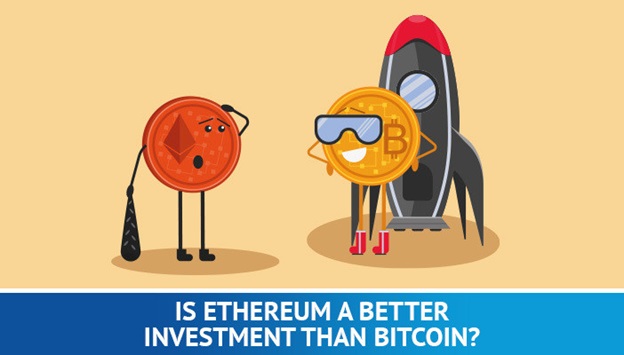
At the moment, it’s hard to say if Ethereum is a better buy than Bitcoin. Both have very different purposes. Whether one is better than the other largely depends on what you’re looking for, as well as a range of other personal factors. These include the size of your bankroll, whether you’re excited about short or long-term gains, and your aversion to risk.
Bitcoin is still the most dominant asset in the crypto space, and by quite a distance. It’s well established and was designed to gain value over time. Bitcoin might not promise big returns in the immediate future, but it’s the kind of investment that you’d still want in your portfolio in 10 or maybe 20 years.
For many investors, Ethereum’s real value is not tied to its scarcity or its current applications. Instead, Ethereum’s present (and future) value is intrinsically linked to its potential to revolutionize the digital space and the way we do business. Ethereum smart contracts could change everything from mortgage transfers to the way we create and consume online content. Moreover, the most exciting future applications of Ethereum will probably be the ones that we haven’t even thought of yet.
Investors who put their money into Ethereum do so in the hope that the technology will reach its full potential. And there are many indications that it could happen. As well as big-time backers like Microsoft and JP Morgan, many other investors are impressed by Ethereum’s technology.
When it comes right down to it, the ultimate debate between Bitcoin and Ethereum as investments comes down to an investor’s risk profile. Both are promised to perform well over the long time. Bitcoin is the more mainstream and stable of the two.
Gil Penchina is an American business manager and angel investor. He’s helped more than 100 tech start-ups get off the ground, including PayPal and LinkedIn. Here’s what he has to say about the Ethereum platform: “It’s clear to me now that Ethereum is the new currency of the Internet. It’s way ahead of where Paypal was in its day, and it’s much more exciting to its customers than Paypal ever was.”
Read More: Pros and Cons of Investing in Ethereum
>>>Buy Cryptos Now<<<
Virtual currencies are highly volatile. Your capital is at risk.
Tale of the Tape: Ethereum Vs. Bitcoin
Launch Year: Ethereum 2015, Bitcoin 2009
Available Coins: Ethereum 115M, Bitcoin 18.6M
52- Week Growth: Ethereum 450%, Bitcoin 140%
2-Years Growth: Ethereum 2850%, Bitcoin 70%
3-Years Growth: Ethereum 1950%, Bitcoin 140%
5-Years Growth: Ethereum 1103%, Bitcoin 6880%
Bitcoin VS Ethereum: a Genuine Power Struggle?
An issue that is increasingly coming to the fore – not just for cryptocurrency but for commerce in general – is that of sustainability. Leading voices from the world of business have recently drawn attention to the fact that the Bitcoin network consumes power at the same rate as a small country.
In fact, Cambridge’s Center for Alternative Finances estimates that a single Bitcoin transaction has the same carbon footprint as 680,000 Visa transactions or 51,210 hours worth of YouTube surfing, according to the site. Ethereum is no shrinking violet in this department, but its power consumption is still significantly smaller than that of Bitcoin.
The power consumption relates to the way each cryptocurrency is mined – with computer systems requiring huge amounts of power to be successful at unlocking their rewards.
The environmental concerns should not be dismissed by anyone looking to invest in Ethereum or Bitcoin either. As more and more countries legislate to reduce carbon emissions, this could well prove a key battleground for the crypto market and, if that turns out to be the case, then Bitcoin could already be on the back foot.
One of Ethereum’s major upgrades includes a shift to the proof of stake mechanism. This protocol sees validators on the network put up a stake as collateral. A bigger stake effectively means a validator gets proportionately more chances to solve the block equations required to verify transactions and unlock the ETH reward.
The shift to Proof of Stake is predicted to cut Ethereum’s energy consumption dramatically, as founder Vitalik Buterin states: “The PoW part is the one that’s consuming these huge amounts of electricity. The blockchain transactions themselves are not super computationally intensive.”
This shift will give Ethereum an advantage when it comes to environmental credentials, which could in turn see it being a far more viable network as the world moves towards lower carbon emissions.
>>>Buy Cryptos Now<<<
Virtual currencies are highly volatile. Your capital is at risk.
Bitcoin vs Ethereum: What the experts say
There is no shortage of Bitcoin supporters in the world of business and finance. Of course, this year, the biggest news has been Elon Musk’s firm Tesla acquiring $1.5 billion worth of BTC as part of its long-term investment strategy. However, Morgan Creek Digital’s Anthon Pompliano is also confident in Bitcoin, predicting that it will reach $100,000 by the end of 2022 and even going as far as to say that BTC could eventually hit $1 million per token – though he stopped short of giving a timeframe on this.
Similarly, Galaxy Digital investment guru Mike Novogratz is also bullish on BTC, also predicting it to hit the $100k mark before the year 2022 is out.
So what about Ethereum? Suffice to say, altcoin doesn’t quite have the high-profile backing that Bitcoin has, but there are still plenty of voices of support out there. Managing partner at Blocktown Capital, James Todaro, is overwhelmingly bullish on ETH, believing it will reach a staggering $9,000 before the end of 2022.
Mr Todaro’s prediction was echoed by Simon Dedic, the Co-founder of Blockyre, who also believes Ethereum has the potential to reach $9000. However, he did not speculate when this price point might be reached.
>>>Buy Cryptos Now<<<
Virtual currencies are highly volatile. Your capital is at risk.
Bitcoin vs Ethereum: Price History
Bitcoin
Bitcoin’s price movement has already become the stuff of legend. Initially trading at pennies, BTC reached parity with the US dollar in 2011. By 2013, the price of a single Bitcoin had reached an impressive $1,242 – yielding returns of hundreds of percentile points for those who had the foresight to invest in Bitcoin early on.
It’s fair to say the price trajectory of BTC hasn’t been a linear one – after reaching $19,783 in 2017 the bubble famously burst and saw prices tumble to $3,300 the following year. However, overall Bitcoin has increased in Value and by November 2020 it had regained the $20,000 price point.
This is where things started to get interesting. Heading into 2021, BTC has been on a record-breaking run, smashing through the $50k barrier in February. There was then a slight dip, before BTC was on the move again – this time going past $68,000 per token, amid continued interest from major corporations and institutional investors. Due to 2022 crypto sell off, the prices of major cryptocurrencies declined badly, at the time of writing the price of Bitcoin is trading around $19,000 per BTC.
Ethereum
Much like Bitcoin, Ethereum prices also remained unremarkable for the first couple of years of its existence. The first really notable movement came at the end of 2016 and into early 2017 when Ether hit the $10 mark.
Ethereum’s big price surge arrived in January 2018, when prices skyrocketed to almost $1,400, firmly establishing ETH as one of the top altcoins. However, this proved to be another bubble that burst and over the next few months prices tanked to around $85 per token. Ethereum then looked to be something of a damp squib for a while, as prices struggled against a barrier of $250 – meanwhile, Bitcoin seemed to be recovering well from its own downturn.
Fast forward to the winter of 2020 and Ethereum was well on the road to recovery, as the cryptocurrency market underwent a widespread upturn. Prices reached $741 by the end of December and continued to climb until they reached a record high of $4,812.72 in November 2021. Since then, Ethereum has experienced a dip in prices but at the time of writing was trading at an impressive $1450.
>>>Buy Cryptos Now<<<
Virtual currencies are highly volatile. Your capital is at risk.
Should I Invest in Ethereum or Bitcoin?
If you still can’t decide between investing in Ethereum or Bitcoin, then you don’t have to!.
As you’ve probably figured out, Ethereum was never intended to replace Bitcoin. So rather than seeing Bitcoin and Ethereum as direct competitors, it’s worth thinking about these technologies as complementary platforms with the potential to underpin very different aspects of a digitized financial economy. In other words, the future of crypto is not a winner takes all game; Bitcoin and Ethereum can both ‘win.’
Splitting your funds between different assets is called diversification. Diversification is a common practice for all types of investors, including billion-dollar hedge fund managers. It’s a way of minimizing risks, creating more opportunities for return, and safeguarding your assets from adverse market cycles.
How you diversify your portfolio is up to you. One option is to split the funds 50/50. But if you’re more excited by Bitcoin, you could go for a 70/30 split or vice versa if you think the future belongs to Ethereum.
If you are interested in buying both or one of the leading cryptos please read our best crypto exchanges today.
>>>Buy Cryptos Now<<<
Virtual currencies are highly volatile. Your capital is at risk.
Ethereum vs. Bitcoin Conclusion: Is Ethereum A Better Investment Than Bitcoin?
Ethereum has many benefits over Bitcoin. It’s more versatile, has better technology, and has far more real-world applications.
Compared to Bitcoin, Ether is also relatively cheap, making it much more accessible to investors with a smaller bankroll. At the current valuations, you could buy around 30 Ethereum for the price of a single Bitcoin. And given the technology’s potential and impressive list of backers, investing in Ethereum now is a chance to buy low and sell high in the future.
But Bitcoin is here to stay. And although it (probably) won’t revolutionize the digital space in the same way as Ethereum could, Bitcoin’s established ‘brand’ and increasing scarcity makes it an appealing proposition for more cautious investors with an eye on the long-term.
In the end, the final decision comes down to you. What kind of investor do you want to be? Which technology excites you more? And which is currently the most undervalued?
Figure out the answer to that question, you’ll definitely know if Ethereum is a better investment than Bitcoin!
In summary, both Ethereum and Bitcoin are considered as the best cryptocurrencies to invest in.
>>>Buy Cryptos Now<<<
Virtual currencies are highly volatile. Your capital is at risk.
FAQs
Will Ethereum pass Bitcoin?
According to experts, Ethereum’s future is optimistic and likely to increase in value as time goes on. Given time, Ether could pass Bitcoin.
Bitcoin vs Ethereum – which is better?
Ethereum has been dubbed by some as the Bitcoin killer and is certainly gaining traction however the following of Bitcoin is currently stronger. Both have their advantages so only time will tell if Ether is better than BTC.
Technically speaking, Ethereum has some advantages over its predecessor but at the time of writing the Bitcoin community seems a lot stronger – only time will tell which coin will win out.
>>>Buy Cryptos Now<<<
Virtual currencies are highly volatile. Your capital is at risk.
Like this:
Like Loading...