DD
MM
YYYY

PAGES

DD
MM
YYYY

spot_img

PAGES

Home Blog Page 4847

Nigeria’s NDLEA, will burning it solve the problem?

0

I was in the city of Nairobi, Kenya last month for a vacation and I visited the Nairobi National Park, a popular wildlife safari park where they conserve different species of wild animals.

My tour guild was thoughtful enough to lead me to the historical ground where the Kenyan government burnt over 105 tons of Ivory in April 2016 located somewhere inside the park 

Deep dive into the famous Kenya ivory burning history of 1989 and 2016: 

Due to its medical, ornamental, and economic value, the Asians and Europeans started buying elephant tusks in large quantities. There was a high demand for elephant tusks/ ivory around the world and those in need of it could pay any amount to lay their hands on it. 

Elephant tusk became a black diamond in Kenya and other neighboring East African countries where elephants are found. So hunters and poachers went gaga, hunting for elephants to get their tusks but an elephant must die before its tusks can be harvested. This led to a drastic reduction and massive death of elephants in Africa. 

Scouting for tusks is solely responsible for a significant decrease in the population of elephants in several parts of Africa, especially in East Africa. Between 1979 and 1989, the African elephant population decreased astronomically from 1.3 million to 600,000. This led to the first worldwide known ivory burning in 1989 in Kenya which motivated other countries to join in the protest against the harvesting of elephant tusks in their countries. 

After the 1989 burning of the elephant tusks, the harvesting of tusks dwindled, up until the early 2000s. The poachers and hunters got back fully at it and started killing elephants again and other wild lives to harvest their horns and tusks. 

As of 2014, according to a report by the  Wildlife Conservation Society, an estimated number of 96 African elephants are poached and killed every day to harvest their tusks. 

This became so terrible again, worse than the 1970s and 80s menace that the Kenyan government in conjunction with some NGOs working for the conservation and preservation of the wild lives had to take a drastic measure again to put a final end to elephant poaching. 

In April 2016, the Kenyan government gathered the tusks amounting to 105 tons confiscated from poachers and hipped it in one location and called both local and international media to witness it and stream the event live, and they set it all ablaze, tusks valued to worth millions of dollars on fire. It was a historical event. 

This burning and destruction of ivory as a technique employed by the Kenyan government and other conservation groups to end the illegal poaching of elephants to harvest their tusks and to suppress the illegal trading/exportation of ivory has so far worked as Kenya through it has recorded a huge success in protection and preservation of its wildlife since then till this day. 

Bringing this back home:
The NDLEA and by extension, the Nigerian government have come under public scrutiny and strong criticism for the act of burning cocaine seized from smugglers valued to have worth N194b the other day. Truth be told that it does not make economic sense to have it burnt, especially now that Nigeria is in a deep financial and economic crisis, but this goes to show the government’s strict policy against peddling and smuggling illicit drugs into the country.

Kenya adopted the same method in stopping elephant tusks harvesting and ivory trade and it worked for them, hence this method I am sure will work in Nigeria as well in eradicating the smuggling of illicit drugs into the country.

Let’s assume that the Nigerian government decided to sell those drugs in order to channel its proceeds into solving some financial problems, this will definitely cause a huge calamity as it will lead to the spreading of cocaine in every street and city in Nigeria in large quantities as even kids will be seen with it. The Nigerian government will thereby appear not to be serious with its fight against drug smuggling. 

Back to Kenya: Where the burnt took place is a historical sight in Kenya today, the remnants of the heap of ashes are still there for tourists to visit and see. It reminds everyone, both visitors and Kenyans of the government’s strict policy against elephant poaching for the harvesting and exportation of tusks.

So far, setting it ablaze works. 
Shell Makes It Clear As It Acquires Daystar, a Nigerian renewable energy provider

1
FILE PHOTO: A Shell logo is seen at a gas station in Buenos Aires, Argentina, March 12, 2018. REUTERS/Marcos Brindicci

This is one of the reasons why Tekedia Capital invested in TradeGrid: the path to energy companies of the future will be totally different from most things we do today. TradeGrid is built for today’s energy while primed for the energies of the future. Also, our members are currently investing in another downstream energy startup which we hope will provide the basic technology operating systems for energy systems of the future. Whether fossil fuel or energy from electrons, measurement and revenue assurance will remain critical (will share name after the cycle closes here).

Yes, Shell has bought Daystar: “Shell has made its first power sector acquisition in Africa with the purchase of a Nigerian renewable energy provider, as the oil major seeks to build out a green energy business that will eventually reduce its dependence on fossil fuels. Daystar Power, which operates in Nigeria, Ghana and three other countries across west Africa, provides solar power and battery solutions to business and industry across the region, including Nigerian Bottling Co, makers of Coca-Cola in the country.”

If Shell is buying solar tech companies, it is time for you to see energy differently.  Shell recently paid  $1.55bn for India’s Sprng Energy in April. This world is changing rapidly; rethink everything.

Peter Obi Leads in Premise Data Poll with 72% – Bloomberg

0

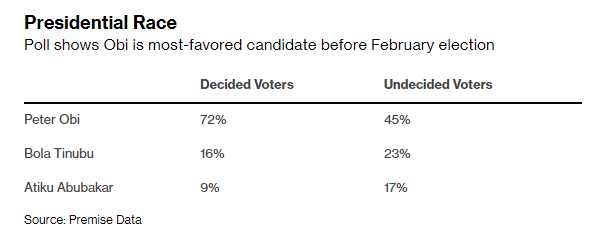
The Peter Obi universe would be excited over this one. In a Premise Data poll for Bloomberg, the Labour Party candidate picked 72% of the votes: “A clear majority of respondents said they intend to vote for Peter Obi, a former state governor, in elections scheduled for February. The results of the survey conducted for Bloomberg News by Premise Data Corp. were published on Wednesday as the official campaign to succeed President Muhammadu Buhari kicked off… Peter Obi scored 72% among those who have decided how to vote. Main party candidates much less favored in Premise Data poll”. 


A third-party candidate is the top choice to become the next president of Africa’s most populous country, according to a new opinion poll.

A clear majority of respondents said they intend to vote for Peter Obi, a former state governor, in elections scheduled for February. The results of the survey conducted for Bloomberg News by Premise Data Corp. were published on Wednesday as the official campaign to succeed President Muhammadu Buhari kicked off.

Of the 92% of participants who said they’ve decided how to vote, 72% named Obi as their first choice. Of those who are still unsure, 45% said the 61-year-old is their preferred candidate.

Presidential Race

Poll shows Obi is most-favored candidate before February election

Source: Premise Data

The San Francisco-headquartered data company surveyed 3,973 Nigerians from Sept. 5-20. Respondents to the app-based poll were selected from quotas developed by age, gender and location across the country’s six geopolitical zones. Results were then weighted against the original quotas to ensure national representation. About 44% of Nigerians own smartphones, according to the Alliance for Affordable Internet.

The candidates of the two parties that have ruled Nigeria since the restoration of democracy in 1999 fared less well. Bola Tinubu of the ruling All Progressives Congress garnered 16% of decided voters and 23% of those yet to make up their minds. Atiku Abubakar of the main opposition Peoples Democratic Party tallied 9% and 17% respectively.

The Lesson from Europe on Nord Stream “Gas Leakage”

0

Good People, can anyone explain why an “ordinary gas” leak is making European leaders unsettled? I mean in Nigeria, that happens all the time and the press does not even report it. In other words, it is not news!

In Sweden, the Defense Minister Peter Hultqvist was speaking in big grammar as though something big had happened. Indeed, it is a big deal when you understand that civilization is built on energy. If you lose energy security, you lose your future.

The European Commission President Ursula von der Leyen was blunt: “Any deliberate disruption of active European energy infrastructure is unacceptable and will lead to the strongest possible response.” That is how critical energy is. And they are mobilizing everything to make sure it does not repeat again.

Fellow Nigerians, everyone will know when Nigeria will move to the next level. And that will happen when we have a secure energy future. The urgency to get there is something we must look at in the current election season. Our office in Owerri uses the national grid as the second backup! In Sweden, the governor of the state would have called press conferences as though the world is failing. Respect good #leadership.

The European Union is “deeply concerned” about damage to the Nord Stream 1 and 2 pipelines that has resulted in leaks in the international waters of the Baltic Sea, calling it a “deliberate act.”

“All available information indicates those leaks are the result of a deliberate act,” the bloc’s foreign policy chief Josep Borrell said Wednesday, while promising to increase energy security efforts.

The bloc “will support any investigation aimed at getting full clarity on what happened and why and will take further steps to increase our resilience in energy security,” he said.

(This leak is assumed to be a sabotage)

Comment on Feed

Comment: This isn’t just a gas leak, it’s a suspected act of sabotage. It’s worth all the big Grammar and calls for investigation and action.

We all know what’s going on in Europe and everyone is wary. If this was indeed a deliberate act from an hostile country, why won’t they panic and work towards ensuring it doesn’t happen again ?

If Russia can silently blow up an undersea pipeline under Sweden’s nose, it can definitely do the same to Norway’s gas pipeline.

My Response: I pity the small Russia for blowing its own pipelines just as it is bombing nuclear power plant it controls. If sabotage is the standard, the whole force of Nigeria military would be in the creeks. More than 90% of leaks are due to “sabotages”. So, why are we not mad as the Europeans?

Building Agile Workforce in Companies – Tekedia Mini-MBA

0

Companies exist to fix frictions in markets. To do that, they must mobilize factors of production to create products and services. When you examine the whole constellation of that translation of organizing, combining and recombining those factors to make products, you see three things: people, processes and tools. The People are the heart of every firm. They are the central nervous system of any operating entity, making it possible for the neurons and synapses of markets to operate effectively. The wealth of firms is in the People of the firms.

Tomorrow, one of the finest minds in this industry of discovering, nurturing, and uplifting the human capital to execute business missions will be at Tekedia Mini-MBA. Ijeoma Anunibe, PHRi, SHRM-SCP, ACIPM is the Head of People at Shuttlers, an innovative transportation startup.

IJ will teach on  “Building Agile Workforce in Companies”. It would be an academic excursion from an industry leader with certifications in the critical domains of human resources management and administration.

Tekedia Institute >> the best teaches here.