DD
MM
YYYY

PAGES

DD
MM
YYYY

spot_img

PAGES

Home Blog Page 49

Uniswap Long-awaited Fee Switch Has Passed Overwhelmingly

0

The Uniswap governance vote to activate the long-awaited “fee switch” has passed overwhelmingly. The UNIfication proposal, jointly submitted by Uniswap Labs and the Uniswap Foundation, concluded voting on December 25, 2025 (Christmas Day), with near-unanimous approval.

Approximately 125 million UNI tokens voted in favor and only 742 against, 99.9% support. A portion of trading fees on Uniswap v2 and select v3 pools covering 80-95% of LP fees on Ethereum mainnet will now go to the protocol instead of entirely to liquidity providers (LPs). For v2 pools: Protocol fee of 0.05% (LPs receive 0.25% instead of 0.3%.

For v3 pools: Initially 1/4 for low-fee tiers (0.01%/0.05%) and 1/6 for higher tiers (0.30%/1%). Protocol fees will programmatically burn UNI tokens, creating deflationary pressure tied to trading volume. Additionally, a one-time retroactive burn of 100 million UNI from the treasury is scheduled.

Changes take effect after a ~2-day timelock, meaning activation around December 27, 2025. Uniswap Labs will remove fees from its interface/wallet/API, consolidate operations transitioning Foundation responsibilities, and establish a growth budget for protocol development.

This marks a major shift, linking UNI’s value more directly to protocol revenue after years of debate previously delayed due to regulatory concerns. Uniswap founder Hayden Adams called it a “turning point” for the protocol’s next decade.

The market reacted positively initially, with UNI surging during voting, though longer-term price impact depends on execution and volume. This aligns Uniswap with other DeFi protocols that capture value at the token level.

The UNIfication governance proposal has been executed following its passage and the ~2-day timelock. This introduces two distinct burn mechanisms for the UNI token, fundamentally shifting it from a pure governance token to one with deflationary economics tied to protocol usage.

100 million UNI tokens. Transferred from the Uniswap treasury and sent directly to a burn address permanently removed from circulation. This is a “retroactive” adjustment, approximating the amount of UNI that could have been burned if the protocol fee switch had been active since UNI’s launch in September 2020.

Its reduces total and circulating supply by ~16% from roughly 630 million to ~530 million UNI, depending on exact figures at execution. Protocol fees from trading activity are collected in an immutable on-chain contract called TokenJar one per chain, acting as a unified collector.

Fees can only be released from TokenJar by burning UNI in a separate contract called Firepit. This ensures that any withdrawal or use of accumulated fees requires permanent destruction of UNI tokens, creating direct deflationary pressure proportional to protocol volume.

Uniswap v2 pools on Ethereum mainnet: Protocol takes 0.05% LPs get 0.25% instead of 0.30%. Select Uniswap v3 pools high-volume ones covering 80-95% of LP fees on Ethereum mainnet: Protocol takes ~1/6 to 1/4 of LP fees e.g., 25% on 0.01%/0.05% tiers, ~16.7% on higher tiers.

Unichain sequencer fees: Net fees after L1 costs and 15% to Optimism are routed directly into the same burn mechanism. Future expansions via additional governance votes could include v4 pools, UniswapX, L2s/other chains, aggregator hooks, etc.

Burns occur when fees are “released” via governance-approved actions or automated mechanisms. Higher trading volume ? more fees accumulated ? more UNI burned over time. Estimated Scale: Based on recent volumes ~$2B daily, $600M+ annualized fees, the protocol portion could generate $100-130M+ annually for burns estimates vary by source and volume.

UNI supply decreases as Uniswap and Unichain usage grows, potentially increasing scarcity and value accrual for holders. No direct buybacks: Fees go to TokenJar first; burns are required to access them not automatic market buys. Future adjustments like expanding fee pools or new releasers require UNI holder votes.

This mechanism aligns UNI’s economics with protocol performance for the first time, addressing years of community debate. Long-term burn rate will depend on trading volume and future fee expansions.

Biblical Film David Topping Shows Independent Creators Could Strive Amid Heavy Funded Films

0

The animated biblical musical David from Angel Studios opened to an estimated $22 million domestically over its debut weekend of December 19–21, 2025, outperforming The SpongeBob Movie: which opened to about $16 million in the same frame.

This made David the top-grossing family-oriented animated movie of that weekend, beating SpongeBob by exactly $6 million as reported by multiple sources, including Angel Studios’ official announcement, Box Office Mojo, and outlets like Variety, Deadline, and Animation Magazine.

David finished #2 overall behind Avatar: Fire and Ash’s massive $88–89 million debut, while SpongeBob landed at #4. It also set records as the highest-opening faith-based animated film ever. Great win for an underdog story—literally.

The success of Angel Studios’ animated biblical musical David—opening to $22 million domestically and topping The SpongeBob Movie: Search for SquarePants ($16 million) as the #1 family/animated film of its debut weekend—carries several notable implications for the film industry, audiences, and cultural trends as of late December 2025.

Strong Demand for Faith-Based and Values-Driven Family Entertainment

David set records as the highest-opening faith-based animated film ever, surpassing Angel’s own The King of Kings, $19.4 million earlier in 2025 and classics like The Prince of Egypt.

This builds on Angel Studios’ track record like the Sound of Freedom, The Chosen, showing a reliable audience for uplifting, family-safe content—especially timed around holidays pre-Christmas here, pre-Easter for King of Kings.

Outlets note families seek alternatives to mainstream Hollywood fare perceived as increasingly explicit or morally ambiguous, with David’s themes of faith, courage, and traditional values resonating strongly.

With David and The King of Kings which grossed ~$61–80 million worldwide, Angel now claims two of the top 10 highest-grossing animated domestic releases of 2025. This marks their best theatrical opening ever around $22M > Sound of Freedom’s $19.6M and validates their crowd-funded, guild-driven model, 1.6M+ members greenlight projects.

It opens doors for more animated projects like the upcoming Animal Farm adaptation and positions Angel as a niche powerhouse challenging major studios in the family space. Search for SquarePants underperformed expectations despite strong reviews highest in franchise history and brand recognition, possibly due to franchise fatigue after 25+ years, oversaturation on streaming platforms like Paramount+, Netflix spin-offs, and direct competition from David for family audiences.

Many families opted for the wholesome biblical story over the absurdist comedy, highlighting a split in the family market: some prefer “safe” values-driven options during holidays.

Even against blockbuster competition, Avatar: Fire and Ash dominated with ~$88–89M, David secured #2 overall and proved grassroots marketing + targeted demographics can drive surprises. Potential for strong “legs” with extended run into the holiday season, similar to past faith hits, with staggered international releases starting soon.

It underscores polarization in entertainment: demand for “light-amplifying” stories is growing, potentially pressuring Hollywood to diversify beyond sequels and IP-heavy tentpoles, many film enthusiasts having to see light in faith based and family films which tends to have more run in the new year due to the current administration focusing on safety entertainment space for minors.

Overall, this is a clear win for independent, audience-funded faith content—proving there’s a substantial, underserved market hungry for family films that align with traditional/religious values, even in a crowded holiday corridor. If David holds well through Christmas and New Year’s, it could further accelerate this trend into 2026.

Deutsche Bank Forecasts S&P 500 to Reach 8,000 By EOY 2026

0

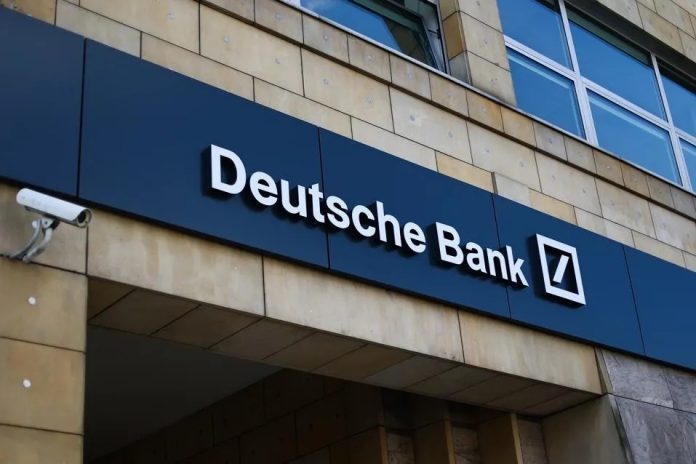
Deutsche Bank has forecasted the S&P 500 to reach 8,000 by the end of 2026 next year from the current date of December 27, 2025.

This projection, released in late November 2025, is the most bullish among major Wall Street firms at the time. It implies mid-teens percentage gains around 15-20%, depending on the exact starting point in late 2025, when the index was trading around 6,600-6,900.

Continued rapid investment and adoption of artificial intelligence (AI), driving corporate earnings growth and market sentiment. Robust S&P 500 earnings per share (EPS) growth to $320 in 2026 (a ~14% increase). Broadening of earnings strength beyond mega-cap tech stocks. Supportive factors like shareholder buybacks, capital inflows, and investor positioning.

Double-digit gains expected broadly. Deutsche Bank’s call stands out as particularly optimistic, betting on sustained AI-driven productivity gains and economic resilience despite potential risks like policy uncertainty or volatility. While forecasts vary, most strategists anticipate another positive year for U.S. stocks in 2026, though with potentially higher volatility than recent years.

Deutsche Bank’s heavy emphasis on artificial intelligence (AI) in its bullish S&P 500 forecast for 2026 (targeting 8,000) stems from the belief that AI is a transformative structural force driving sustained economic and corporate growth, rather than a short-lived hype cycle.

Strategists, led by chief U.S. equity strategist Binky Chadha, explicitly stated that “rapid AI investment and adoption will continue to dominate market sentiment” through 2026. This reflects confidence that investor enthusiasm for AI will persist, supporting elevated valuations and inflows into equities.

Productivity and Earnings Boost

AI is seen as a major driver of productivity gains across the economy, translating into robust corporate earnings growth. Deutsche Bank projects S&P 500 earnings per share (EPS) to reach $320 in 2026, a ~14% increase, with AI enabling stronger margins, efficiency, and revenue for companies adopting the technology.

Initial concentration in mega-cap tech, then broadening: The rally has been led by mega-cap tech giants like Nvidia, Microsoft, Alphabet due to massive AI-related capital expenditure (capex). However, the bank expects the benefits to broaden beyond Big Tech in 2026, with AI adoption spreading to other sectors, leading to wider earnings participation and reducing concentration risks.

Deutsche Bank views AI as a fundamental technological shift not just speculative, capable of reshaping industries and delivering meaningful productivity improvements for years. This supports their view of “mid-teens” market returns and elevated P/E multiples remaining justified.

While acknowledging high valuations in AI-related stocks, the bank argues that as long as AI capex remains strong and delivers real earnings, concerns about an “AI bubble” bursting are overdone. They draw parallels to past booms like dot-com era that lasted 3-5 years.

AI is the core growth engine in Deutsche Bank’s outlook, underpinning their most optimistic Wall Street target amid a resilient U.S. economy. This contrasts with more cautious views from firms worried about valuation contraction or economic polarization.

AI stocks will fly as the race for supremacy persists amid broader crypto weakness and privacy vs hack attributed to lack of advanced technologies sometimes meant to combat crypto-related scam and phishing which could be seen in the recent Trust wallet chrome extension breach which $7M was stolen by hackers, this shift underscores crypto’s high risk factors.

BTC Flashed Down to $24k on Binance’s BTC/USD1 Pair Due to Thin Liquidity During Christmas

0

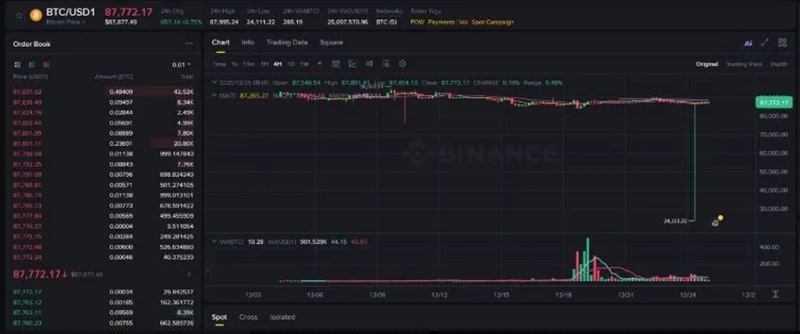
On Christmas Day, Bitcoin briefly flashed down to around $24,000–$24,111 on Binance’s BTC/USD1 spot trading pair.

This was a classic flash crash caused by extremely thin liquidity in that specific pair during holiday trading hours. USD1 is a relatively new stablecoin issued by World Liberty Financial backed by the Trump family, with much lower trading volume and order book depth compared to major pairs like BTC/USDT.

A large sell order or cascade of orders swept through the thin buy-side liquidity, causing a sharp downward wick on the chart. The price recovered almost instantly within seconds as arbitrage bots bought the dip and normalized it back to the global market price ~$87,000–$88,000.

This event was isolated to the BTC/USD1 pair and did not affect broader Bitcoin markets or major pairs e.g., BTC/USDT on Binance or other exchanges remained stable above $86,000. CoinDesk confirm It was due to low holiday volumes and order book mechanics.

No significant liquidations were triggered from this wick, as it didn’t impact leveraged futures pricing broadly. Similar incidents have occurred before on illiquid pairs.

Recent daily liquidations have been in the hundreds of millions at most, not billions from this flash wick, with no ongoing exploit or massive liquidation cascade. Flash crashes on illiquid pairs highlight risks in newer/low-volume markets, but this was not an exploit or systemic issue affecting BTC overall.

The flash wick to ~$24,000 was confined to Binance’s low-volume BTC/USD1 spot pair. Major pairs (e.g., BTC/USDT) remained stable above $86,000–$88,000. No significant liquidations occurred—unlike larger 2025 events (e.g., October’s $16–19B cascade).

CoinGlass data shows typical daily liquidations in the hundreds of millions, not billions tied to this. Arbitrage bots normalized the price in seconds. As of December 27, 2025, Bitcoin trades steadily around $87,400–$87,600, with no lingering sell-off.

Holiday Amplification: Thin liquidity during Christmas low trading volumes exaggerated the wick from a single large sell order or cascade. Newer/illiquid pairs like BTC/USD1 are prone to extreme volatility. A Binance 20% APY promo on USD1 deposits surged demand, draining order book depth and creating a premium—then a market sell order swept bids.

Stick to high-volume pairs (USDT/USDC) for execution. Use limit orders over market orders in thin markets to avoid slippage. Similar wicks happened before (e.g., December 10, 2025, on the same pair). Binance (via CZ) noted no involvement in trades and no index-linked liquidations.

Events like this may prompt better price protection mechanisms or warnings for new pairs to reduce “fat finger” errors and FUD. USD1 hit $3B+ market cap shortly after, showing strong adoption. Promotions and integrations like replacing BUSD collateral drive inflows, but expose growing pains in liquidity.

Ties to the Trump ecosystem amplify visibility—and conspiracy claims e.g., manipulation theories on X/Reddit. Most evidence points to organic liquidity issues, not coordinated dumps. Could fuel regulatory debates on stablecoin oversight.

Its reinforces need for deeper order books in emerging assets. As stablecoin market caps swell ($310B+ total), similar events may recur until infrastructure matures. Positive spin: Quick arb recovery shows market efficiency.

Overall, this was a non-event for Bitcoin’s fundamentals—more a reminder of microstructure risks in niche pairs than any systemic threat. Bitcoin remains resilient in a consolidating market post-2025 highs. Trade cautiously in illiquid environments.

Why Bitcoin is Likely to Outperform Gold and Silver in 2026

3

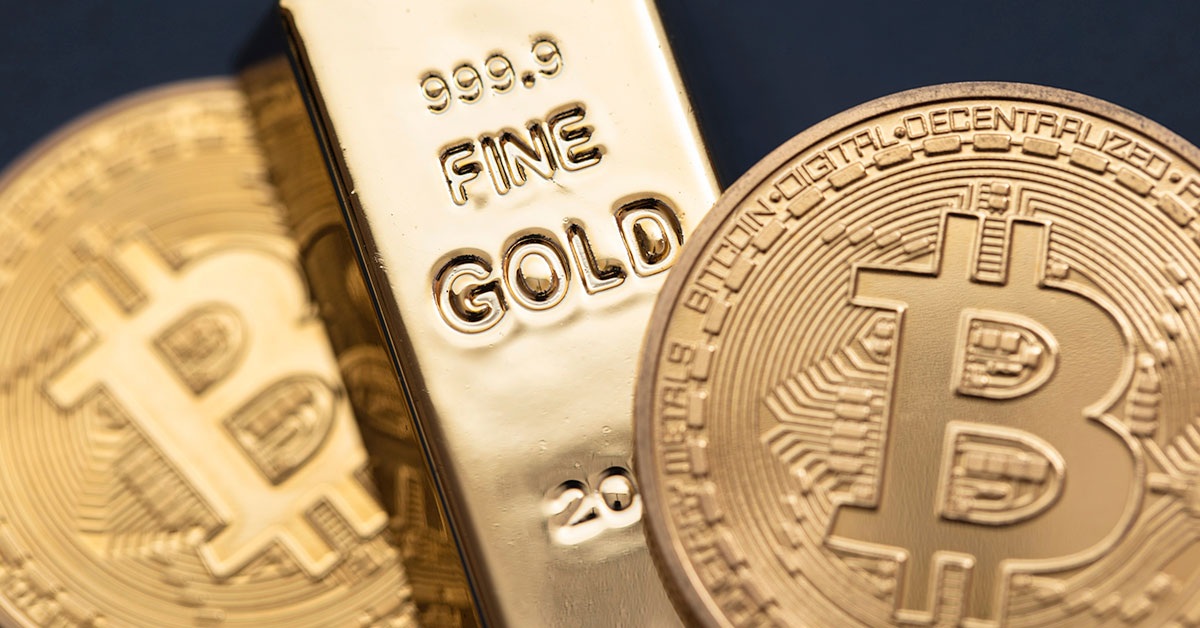
Bitcoin is likely to outperform both gold and silver in 2026 percentage returns. Bitcoin is trading around $87,000–$88,000 after a disappointing 2025 down ~7% YTD from earlier highs near $125,000 in October. This followed the April 2024 halving, but Q4 saw ETF outflows, options volatility, and risk-off sentiment.

Gold: Near record highs at ~$4,530–$4,540/oz, up ~70–74% YTD—its best year since 1979, driven by central bank buying, geopolitical tensions, and de-dollarization. Silver’s explosive rally to ~$75–$79/oz, up ~150–170% YTD, fueled by industrial demand due to solar, EVs, AI and safe-haven flows.

Precious metals have dominated 2025 performance, while Bitcoin has lagged. 2026  Analyst consensus points to strong rebound potential: Bullish targets: $150,000–$250,000 from Bernstein, Standard Chartered, Fundstrat, J.P. Morgan ~$170,000.

Moderate: $110,000–$160,000 average ~$135,000. Potential returns: +70% to +180% from ~$87,000 base case ~+100–150%. Post-halving bull phase— historical cycles show major gains 12–18 months after halving; current cycle peaked early but could extend, ETF/institutional inflows resumption, regulatory clarity, and risk-on recovery.

Gold continued upside but moderating gains: Targets: $4,500–$5,000 major banks average, up to $6,000. Potential returns: +0% to +30% from ~$4,530 base case ~+10–20%.

Central bank demand, lower rates, geopolitics—but already at extremes, overbought RSI, massive 2025 run. Silver rally is trong but likely less explosive after 2025’s surge: Targets: $56–$80 bank averages ~$60–70. Potential returns: -20% to +5% or up to +30% in bullish scenarios from ~$77.

Industrial demand persists, but parabolic 2025 gains suggest consolidation and pullback risk. Bitcoin typically delivers its strongest gains in the year following halving; 2020–2021 cycle: massive run post-2020 halving. 2025 was anomalous, early peak, then correction; 2026 aligns with the “extended bull” phase many analysts now expect.

BTC is down YTD while metals are at ATHs—Bitcoin has more room for catch-up growth. If macro improves like rate cuts, institutional flows, BTC; correlated to equities and tech rebounds sharply; metals may consolidate after outsized 2025 gains.

Recent data shows gold/silver pulling safe-haven flows while BTC underperforms short-term, but forecasts flip this for 2026. Persistent recession or tighter policy could favor metals as pure safe-havens. However, evidence from cycles, analyst targets, and supply/demand dynamics supports Bitcoin delivering superior percentage gains in 2026.

Key Drivers for Bitcoin Outperformance in 2026

Bitcoin’s potential to outperform gold and silver in percentage gains stems from its position in the post-halving cycle, combined with maturing institutional adoption and a likely shift in macro conditions.

The April 2024 halving reduced daily supply issuance by 50%, historically triggering major rallies 12–18 months later. While 2025 saw an early peak ~$126,000 in October followed by a correction to ~$87,000–$88,000, many analysts view this as an anomaly.

The traditional 4-year cycle is evolving into a longer, liquidity-driven pattern due to institutional involvement. Forecasts suggest the bull peak extends into 2026, with new all-time highs possible in H1.

Spot Bitcoin ETFs hold over $100B+ in assets. After 2025 outflows during risk-off periods, renewed inflows are expected as regulatory clarity improves, like bipartisan support for crypto legislation and macro stabilizes. Corporate treasuries and nation-state adoption add structural demand.

Bitcoin correlates with equities and tech. If Fed cuts rates further markets price ~2 in 2026 amid softening growth, risk assets rebound. Lower opportunity costs favor non-yielding assets like BTC over consolidated precious metals.

Only ~1.5M BTC left to mine by late 2026; mining difficulty up 25%. This creates tighter scarcity than gold/silver, whose supplies grow annually. Analyst consensus targets: $135,000–$250,000, Fundstrat $200K–$250K, J.P. Morgan ~$170K, Bernstein/Standard Chartered $150K–$170K.

From ~$87,500 current, this implies +50% to +180% returns base ~+100%. Precious metals dominated 2025, gold +70–74%, silver +150–170%, reaching extremes that suggest consolidation. Central bank buying, geopolitics, de-dollarization, lower rates. But after record highs (~$4,530/oz), overbought conditions (e.g., highest monthly RSI since 1980) point to moderation.

2026 targets: $4,600–$5,000 average according to RBC, Goldman Sachs ~$4,900–$5,000. Returns: +2% to +10% base, up to +20–30% bullish. Silver; Industrial boom (solar/EVs/AI, 95M oz deficit), safe-haven flows. Parabolic 2025 run ($77–$79/oz) risks pullback. Targets: $56–$80 averages ~$60–75, some outliers higher. Returns: -10% to +10% base, potential +20–35% if demand persists.

Metals benefit from persistent uncertainty but lack Bitcoin’s asymmetric upside from cycle extension and risk recovery. Capital rotation from overextended metals to Bitcoin as risk appetite returns, boosting BTC while capping metals.

Market Sentiment Shift — Validates Bitcoin as “digital gold” in growth phases, accelerating adoption. BTC leadership could lift alts/ETH, contrasting metals’ more isolated safe-haven role. Strong BTC gains signal improving liquidity/risk-on environment; metals consolidation suggests easing extreme fear.

Persistent recession, tighter policy, or renewed geopolitics could favor metals as pure safe-havens. Some forecasts warn of BTC correction to $60K–$75K early 2026 before rebound.

Overall, cycle dynamics, valuation reset; BTC down YTD vs. metals at ATHs, and analyst distribution support Bitcoin delivering superior percentage returns in 2026 ~+80–150% base vs. +10–20% for metals.