DD
MM
YYYY

PAGES

DD
MM
YYYY

spot_img

PAGES

Home Blog Page 49

XRP Spot ETFs See Strong Day 12 Inflows Amid Surging Institutional Demand

0

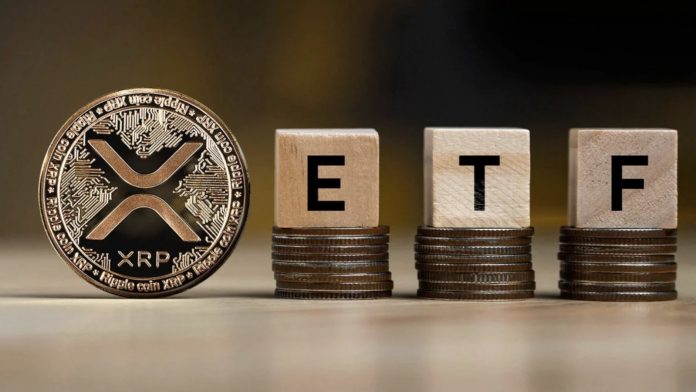
U.S. spot XRP exchange-traded funds (ETFs) recorded a robust net inflow of $67.74 million, elevating their cumulative net assets under management (AUM) to $844.99 million.

This marks the 12th consecutive day of positive inflows since the funds launched on November 13, 2025, positioning XRP ETFs as the fastest-growing major crypto asset vehicle in the market.

The milestone underscores accelerating institutional adoption of XRP, the native token of the Ripple network, even as it trades around $2.19—up nearly 10% in the past 24 hours.

The $67.74 million influx reflects sustained buying pressure from ETF clients, including major players like Vanguard, which recently listed XRP ETFs on its platform for broader access.

This builds on prior days’ momentum, with total inflows now approaching the $1 billion threshold. At least five spot XRP ETFs are active, including offerings from Grayscale (GXRP), Franklin Templeton (XRPZ), Bitwise, Canary Capital, and others.

Early launches saw strong debuts—e.g., Grayscale’s fund pulled in $67.36 million on day one, while Franklin Templeton’s attracted $62.59 million. Real-time trackers show over 339 million XRP tokens locked across these funds, equivalent to roughly 0.3% of the total circulating supply.

XRP’s price surge aligns with broader crypto optimism, including Bitcoin topping $92,000 and Ethereum at $3,073. However, on-chain data indicates 29% of XRP has left exchanges recently, signaling reduced selling pressure and potential for further upside.

Analysts note a bullish RSI divergence, hinting at a trend reversal despite prior volatility. This inflow streak highlights XRP’s maturation as a regulated investment option, outpacing many peers in growth rate. With ETFs now absorbing significant volumes like models suggest daily buys of 74.5 million XRP could drive prices to $600 under certain elasticity assumptions, it could catalyze a new bull cycle for the altcoin.

As the creator of XRP—the native cryptocurrency of the XRP Ledger (XRPL)—Ripple has been instrumental in shaping the regulatory, infrastructural, and market conditions that enabled these ETFs to launch in November 2025.

While Ripple does not directly issue or manage the ETFs which are handled by third-party asset managers like Grayscale, Franklin Templeton, and Bitwise, its efforts in legal advocacy, technological development, and ecosystem building have been pivotal in unlocking institutional access to XRP.

Ripple’s four-year legal battle with the U.S. Securities and Exchange Commission (SEC)—initiated in 2020 over allegations of unregistered securities sales—served as a critical proving ground for XRP’s non-security status. A landmark July 2023 court ruling affirmed that XRP sold on public exchanges is not a security, while institutional sales were deemed violations.

The SEC appealed but withdrew its challenge in March 2025, culminating in an August 2025 settlement that fully resolved the overhang. This clarity was the green light for spot ETF filings, as it aligned XRP with the regulatory framework that approved Bitcoin and Ethereum ETFs in 2024.

Without this resolution, issuers like Canary Capital and Bitwise could not have pursued “auto-effective S-1” filings under the SEC’s streamlined 2025 process. Ripple CEO Brad Garlinghouse has publicly hailed the outcome as a “win for the entire crypto industry,” emphasizing how it positions XRP as a utility token for payments rather than an investment contract.

The ledger’s consensus protocol enables near-instant transactions (3-5 seconds) at low costs, making it ideal for the high-volume creations and redemptions in ETF operations—where authorized participants exchange baskets of XRP for fund shares.

Ripple’s On-Demand Liquidity (ODL) solution, which uses XRP as a bridge asset for cross-border payments, further underscores its real-world utility, attracting banks and institutions that now view XRP ETFs as a regulated entry point.

Ripple’s recent innovations, like the XRPL lending protocol and integration with ISO 20022 standards, enhance this appeal. For instance, Abu Dhabi’s approval of Ripple’s RLUSD stablecoin for institutional use ties directly into ETF liquidity pools.

Garlinghouse has stressed XRP’s role as a “temporary settlement layer” in global finance, a narrative amplified on X where analysts link it to ETF-driven volume surges. Funds like Grayscale’s GXRP explicitly reference the “peer-to-peer Ripple Network” in their prospectuses, crediting it for XRP’s 13-year track record of reliability.

Ripple’s $500 million funding round in November 2025 at a $40 billion valuation—from firms like Citadel Securities—signals strong backing for scaling XRP’s role in tokenized assets and remittances, projected to capture 14% of SWIFT’s volumes.

While Ripple holds a significant portion of XRP about 40 billion in escrow, it does not directly sell to ETFs, avoiding past SEC scrutiny. Instead, it supports market makers and liquidity providers.

Ripple’s presence at events like Swell 2025, alongside White House officials, has sparked ETF buzz, with posts highlighting how these ties could drive $8 billion in inflows.

ETFs as a Ripple-Led Bull CatalystSince the November 13, 2025, launch of the first spot XRP ETF Canary’s XRPC, with $58 million in debut volume, Ripple’s ecosystem has seen explosive growth.

Total ETF AUM hit $844.99 million by December 3, outpacing early Bitcoin ETF inflows in relative terms. Analysts forecast a 65% XRP price rally to $3.60+ by year-end, driven by ETF demand reducing exchange supply 29% of XRP off exchanges recently.

Ripple’s positioning of XRP for $30 trillion in tokenized assets amplifies this, with ETFs funneling retail and institutional capital into its payments infrastructure. However, risks persist: XRP’s price remains volatile down 40% from its $3.65 July ATH, and competition from stablecoins like USDT challenges its dominance.

Ripple’s escrow releases 1 billion XRP monthly could pressure supply if not managed tightly. Ripple envisions XRP ETFs as a “regulated gateway” to its broader mission of modernizing $120 trillion in annual cross-border flows.

With more filings pending (e.g., 21Shares’ TOXR launching December 2), and futures ETFs like ProShares’ UXRP paving the way, Ripple’s role could evolve into deeper integrations, such as ETF-linked ODL pilots.

As Garlinghouse noted, “XRP connects the digital financial system”—a connectivity now supercharged by Wall Street. For investors, this convergence offers exposure to utility-driven growth, but always DYOR amid crypto’s inherent risks.


Crypto Rout Deepens Pressure on Leveraged Strategy ETFs as Regulators, Liquidity Risks, and Treasury Models Face Stress Test

0

Leveraged exchange-traded funds tied to Strategy Inc., the bitcoin-hoarding Nasdaq heavyweight that built its identity on turning corporate cash into cryptocurrency, are among the worst casualties of this year’s crypto market slump.

The downturn has exposed how fragile leveraged vehicles become when their underlying asset breaks down, and it is prompting renewed debate about whether corporate treasury strategies anchored to bitcoin can survive prolonged risk aversion.

The T-Rex 2X Long MSTR Daily Target ETF and the Defiance Daily Target 2x Long MSTR ETF, which both aim to deliver twice the daily return of Strategy shares, have lost nearly eighty-five percent of their value in 2025. The T-Rex 2X Inverse MSTR Daily Target ETF, meant to offer twice the inverse performance, has also suffered heavy damage, sliding forty-eight percent during the same period.

The simultaneous collapse of both long and inverse leveraged plays reveals the strain that extreme volatility places on daily-reset products, where slump-on-slump losses can compound rapidly and erode capital even when investors guess the direction correctly.

Strategy itself has tumbled more than forty percent this year, dragged down further after bitcoin fell below ninety thousand dollars. The cryptocurrency had reached a record of $126,223.18 in October before global risk aversion choked off the speculative rally and sent capital fleeing to safer assets. That reversal has hit Strategy harder than most because its identity—and valuation—has been treated by markets as a high-beta proxy for bitcoin.

Michael Saylor’s buy-and-hold bitcoin treasury model, which turned Strategy into the most aggressive corporate accumulator of crypto, has inspired dozens of imitators, though many of the companies that mirrored the approach have also posted outsized share-price declines this year. With bitcoin sliding and equity markets jittery, investors have been forced to reassess the idea that enterprise value can sustainably track crypto holdings through every cycle.

The company’s “mNAV” metric has become a key focus. CEO Phong Le said on the “What Bitcoin Did” podcast that Strategy may consider selling bitcoin if the ratio falls below one. Reuters calculations using LSEG data place the ratio near 1.1, giving the company some breathing room, but the comment unsettled investors who long believed Strategy would never sell under adverse conditions. Mike O’Rourke, chief market strategist at JonesTrading, said Le’s remarks undermined Strategy’s central marketing message of not selling despite volatility.

The change in tone comes against a harsh financial backdrop. On Monday, Strategy cut its full-year outlook to a range between a $6.3 billion profit and a $5.5 billion loss, far below its earlier estimate of $24 billion in net profit. That earlier figure, issued October 30, was based on an assumption that bitcoin would reach $150,000 by year-end. The company also disclosed a $1.44 billion reserve to cover dividends on preferred shares and interest on existing debt, highlighting how the tightening crypto environment is eroding financial flexibility.

Vincenzo Vedda, chief investment officer at DWS, said the strategy works only when bitcoin rises, adding that once prices fall, the options left to the company become very limited. The comment captures how sharply investor sentiment has turned: when bitcoin rises, Strategy is hailed as a visionary; when it falls, the business model appears exposed.

Short sellers have seized the moment, earning more than $2.5 billion betting against the stock this year, including around $156 million on Monday alone, according to Ortex. The stock has fallen more than seventy percent from its November 2024 peak and has more than halved since joining the Nasdaq 100 index.

Despite all this, analysts remain surprisingly optimistic. Of sixteen brokerages covering the stock, ten rate it a “buy,” four call it a “strong buy,” and two advise holding, according to LSEG data. The median price target of $485 implies a one-hundred-eighty-three percent gain over the next year.

Saylor delivered a keynote titled “The Undeniable Case for Bitcoin” at a Binance conference in Dubai on Wednesday, even as markets reassess what the case looks like in practice.

The broader market downturn has revived concerns about regulatory risk, especially as leveraged crypto-linked ETFs come under scrutiny. Regulators in the United States and Europe have spent the last two years debating whether daily-reset leveraged products tied to volatile assets belong in retail portfolios. Episodes like the current slump tend to sharpen those debates.

With leveraged Strategy ETFs suffering extreme losses and undergoing heavy intraday swings, questions are growing about liquidity resilience—particularly whether creation and redemption activity can keep up when market makers face widening spreads and underlying shares move unpredictably. These pressures do not imply imminent malfunction, but they do underscore how thin liquidity can become when sentiment evaporates, and leveraged structures amplify stress.

Corporate bitcoin strategies face similar questions. The downturn exposes how sensitive these models are to market pricing and how little room they leave for operational conservatism. If Strategy ultimately sells bitcoin to defend its mNAV threshold, it would mark a symbolic shift for a company long positioned as an immovable accumulator. Even the possibility of such a move signals that corporate treasury models built around bitcoin may evolve into more flexible or hedged counterparts—something that could reduce the mystique but potentially improve balance-sheet stability.

For now, the slump is a reminder that the bitcoin-as-treasury model works spectacularly in bull markets and brutally in downturns. The leveraged ETFs tied to Strategy show the same truth in more explosive form. Investors earn exponential upside when momentum is strong, yet when selling takes over, the losses arrive with equal force.

BNB’s Path to $1,400 Appears Clear, But Ozak AI Projection Shows 100x ROI Potential

0

BNB is once again capturing market attention as one of the most structurally strong large-cap tokens heading into the next crypto cycle. With deep liquidity, a massive global user base, and the expanding utility of the BNB Chain ecosystem, analysts increasingly believe BNB has a clear and achievable path toward the $1,400 region. Its long-term fundamentals, token burns, and exchange-driven demand provide a consistent base of support that many other altcoins cannot match.

Yet even with this compelling setup, analysts across multiple research desks agree that Ozak AI—a fast-rising AI-native token—offers far more explosive ROI potential. With early-stage affordability, real-time AI functionality, and accelerating presale demand, Ozak AI is emerging as one of the strongest high-growth contenders for 2025 and 2026.

BNB Shows Strong Structure as Demand Rebuilds

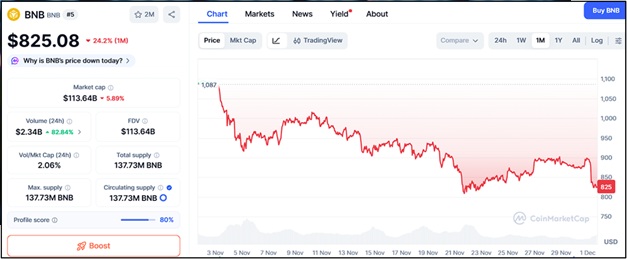
BNB, trading near $825, continues to maintain a healthy technical structure supported by strong accumulation zones at $802, $771, and $743, where long-term holders have repeatedly stepped in during corrections. These areas act as strong floors for BNB, reinforcing its reliability even during market volatility.

To trigger a broader upward expansion, BNB must break through resistance at $854, $892, and $930, each level representing a historically important point where momentum-driven rallies often begin. With stronger exchange activity, growing adoption across the BNB Chain ecosystem, and consistent burn mechanisms reducing supply, analysts project a long-term trajectory that could push BNB toward $1,400 in the upcoming cycle. However, as a large-cap asset, its ability to deliver extremely high multipliers is naturally limited.

Ozak AI Offers a Far Steeper ROI Curve Than Large-Cap Assets

While BNB’s growth outlook remains strong, Ozak AI (OZ) presents a vastly different opportunity—one centered on early-stage pricing and deep AI-native utility. Ozak AI is not simply a token; it is a high-performance intelligence layer that integrates real-time market prediction, cross-chain data processing, and automated decision-making into Web3 systems.

Its millisecond-speed AI prediction engines can analyze live market behaviors across multiple chains simultaneously, while its partnership with HIVE enables lightning-fast 30 ms trading signals used to identify actionable trends instantly. From traders to developers, the use cases for Ozak AI’s technology extend far beyond speculation, making it a functional tool in the world of automated crypto intelligence.

The ecosystem goes further with SINT-powered autonomous AI agents capable of interpreting voice commands, running automated trading strategies, analyzing on-chain data, and executing workflows across decentralized applications. This places Ozak AI squarely at the intersection of two of the fastest-growing global sectors: artificial intelligence and blockchain automation.

Because Ozak AI is still in the OZ presale phase, its multiplier potential is significantly higher than that of mature large caps like BNB.

Presale Acceleration Strengthens Ozak AI’s 100x Outlook

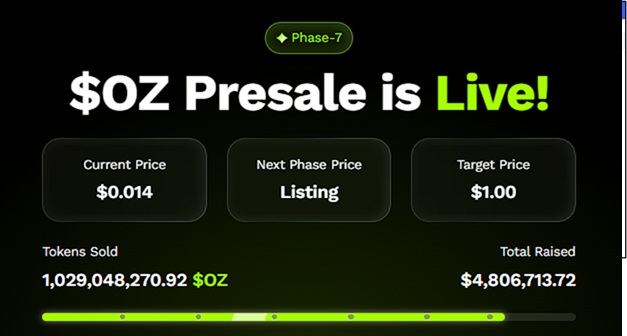
The strongest indicator of Ozak AI’s explosive potential is its rapidly growing presale performance. With over $4.8 million raised and more than 1 million tokens sold, the project’s early momentum mirrors the beginnings of past cycle giants that later delivered massive 50x–100x returns.

Investors are increasingly prioritizing AI-powered cryptocurrencies due to the rising demand for real-time automation and intelligence. Ozak AI’s early stage, combined with its high-utility infrastructure, positions it as one of the most promising new entries in the AI-crypto sector—and one of the few with genuine technological depth.

BNB Could Hit $1,400, but Ozak AI Holds the Real 100x Potential

BNB’s path toward $1,400 looks clearer than ever, backed by strong tokenomics, global adoption, and a supportive ecosystem. It remains one of the most stable and reliable large-cap assets for the upcoming market cycle.

But Ozak AI offers something far more powerful—a combination of early-stage affordability, deep AI-native functionality, and fast-growing presale momentum that analysts say could generate 50x–100x returns if adoption continues at its current pace. While BNB may deliver strong growth, Ozak AI stands out as the project with the steepest trajectory, making it the most compelling high-ROI opportunity heading into 2025 and 2026.

About Ozak AI

Ozak AI is a blockchain-based crypto project that provides a generation platform that specializes in predictive AI and superior information analytics for financial markets. Through machine learning algorithms and decentralized network technology, Ozak AI permits real-time, correct, and actionable insights to assist crypto enthusiasts and businesses in making the proper decision.


For more, visit:

Website: https://ozak.ai/

Telegram: https://t.me/OzakAGI

Twitter: https://x.com/ozakagi 

iPhone Shipments Forecast to Hit Record High in 2025, Fueled by China’s Demand for iPhone 17

0

Apple is projected to achieve a record year for iPhone shipments in 2025, driven by the phenomenal success of its latest models and a significant resurgence in its crucial China market, according to a highly bullish report released by research firm IDC on Tuesday.

This surge is not only expected to deliver a company record but also to catapult Apple past its greatest rival, Samsung, to claim the title of the world’s number-one smartphone vendor for the first time in 14 years.

IDC forecasts that Apple will ship a massive 247.4 million iPhones in 2025, representing a year-on-year increase of just over 6%. This figure comfortably surpasses the previous record of 236 million units sold in 2021, the year the iPhone 13 was released.

IDC Senior Research Director Nabila Popal attributed the growth to the new flagship line, stating, “thanks to the phenomenal success of its latest iPhone 17 series,” Apple is seeing accelerated performance globally.

The iPhone 17 and the China Comeback

The iPhone 17 series, launched in September, was viewed by investors as a critical product line for Apple, especially as the company simultaneously dealt with intense local competition in China and strategic questions regarding its Artificial Intelligence (AI) plans compared to fast-moving Android rivals. The latest device line has proved to be the key differentiator, especially in its largest market.

In a striking turnaround, IDC projects Apple’s shipments will jump by a significant 17% year-on-year in China during the fourth quarter (Q4). This massive demand, driven by the iPhone 17, has led the research firm to revise its outlook for the entire Chinese smartphone market from a previously projected 1% decline for the year to a positive 3% overall growth—a “phenomenal turnaround,” according to Popal. Apple’s success in China is particularly notable as local players like Huawei have been aggressively chipping away at its market share.

IDC anticipates that 2025 will be a record year not only in terms of unit shipments but also in value, forecasting that Apple’s total revenue for the period will exceed $261 billion, representing a 7.2% year-on-year growth. Shipments, a term used by analysts to refer to the number of devices sent by a vendor to its sales channels like stores or e-commerce partners, indicate the expected demand for a product, though they do not directly equate to end-user sales.

The IDC report reinforces a forecast made last week by Counterpoint Research, which indicates the monumental shift in market leadership.

Research Firm Apple (AAPL) Projected Shipments 2025 Samsung Projected Shipments 2025 Projected Market Share
IDC 247.4 million N/A N/A
Counterpoint 243 million 235 million Apple (19.4%) vs. Samsung (18.7%)

Counterpoint Research specifically projects Apple will ship approximately 243 million iPhones in 2025, marginally edging out Samsung, which is expected to ship 235 million smartphones. This would mark the first time since 2011 that Apple leads the global market in annual shipments.

The research firm attributes this shift to a key structural tailwind: the post-COVID replacement cycle hitting its inflection point, as millions of users who bought phones during the pandemic boom are now due for an upgrade, with Apple being the primary beneficiary.

Counterpoint also points to the 358 million second-hand iPhones sold between 2023 and mid-2025 as having created a huge installed base of users likely to transition to a new iPhone soon, effectively locking them into the iOS ecosystem.

While the near-term forecast is extremely bright, the reports highlight future potential headwinds for Apple. Bloomberg reported last month that Apple could delay the release of the base model of its next device, the iPhone 18, until 2027, which would break its regular cycle of releasing all its phones in the fall each year. IDC noted that this strategic shift could result in Apple’s shipments dropping by 4.2% in 2026.

Furthermore, IDC warns that the overall global smartphone market will decline by 0.9% in 2026 (a downward revision from a previously forecast growth) due to a combination of component shortages, particularly in memory chips, which is expected to constrain supply and raise prices.

This component shortage, however, is projected to affect low-to-mid range Android devices most significantly, as those buyers are more price-sensitive. Therefore, even in a shrinking market, Apple’s focus on the premium segment may allow it to maintain its revenue lead and market advantage.

Nigeria’s Business Confidence Climbs to 111.3 Points in October, Signaling Stronger Private-sector Optimism

0

Nigeria’s business climate gathered more momentum in October 2025, with the Business Confidence Index rising to 111.3 points from 107.9 in September, according to the latest NESG–Stanbic IBTC Business Confidence Monitor.

The new reading marks one of the strongest sentiment levels recorded this year and reinforces a growing sense of optimism across the private sector.

The BCM report shows that businesses are increasingly upbeat about current conditions, encouraged by easing inflation, a steadier exchange rate, and an improvement in overall macroeconomic stability. The upward movement also tracks a major year-on-year rebound from the 76.8 points recorded in October 2024, a period when operators were far more cautious about economic prospects.

The monitor noted that the domestic business environment “maintained its positive trajectory,” with the Current Business Performance Index holding firm in expansion territory. The warmth in sentiment reflects perceptions that the economy is adjusting to earlier shocks more effectively, allowing firms to plan with fewer disruptions.

A detailed sector review shows that all five major economic segments—Manufacturing, Trade, Agriculture, Services, and Non-Manufacturing—recorded expansion in October. Manufacturing and Trade delivered the most notable gains, rising by 8.8 points and 7.8 points respectively, to reach 111.3 and 115.4. Non-Manufacturing closed at 115.0, while Agriculture and Services posted 111.4 and 111.0.

Agriculture maintained its forward push, climbing from 107.3 points in September to 111.4 in October. Crop Production and Agro-Allied operations were the main drivers. Improved seed varieties, targeted government input programmes, and the softer inflation profile helped boost confidence among farmers and processors. Exchange-rate stability also eased pressure on operators who rely on imported inputs. Livestock and Forestry registered gains, though at a slower pace than the previous month.

Even with the improvement, Agriculture still faces barriers. Shortages of raw materials, recurring outbreaks of livestock diseases, and higher feed and input costs continue to squeeze producers. These pressures raise production costs and filter into market prices, limiting how far operators can push output without eroding margins.

Manufacturing posted one of its strongest recoveries this year. The sector’s index jumped to 111.3 points from 102.5 in September. Key segments such as Food, Beverage, and Tobacco, as well as Cement, recovered after slipping in the previous month. Businesses attributed the rebound to a more reliable power supply, improved access to finance, and better navigation of policy and regulatory hurdles.

Firms also reported that a more stable foreign exchange market helped them stabilize import planning and reduce the unpredictability that had weighed heavily on operations earlier in the year.

The Services sector maintained its modest growth path, rising to 111.0 points from 108.5 in September. The gains were backed by improvements across different service activities and a macroeconomic backdrop shaped by lower inflation and reduced currency volatility. However, Professional, Scientific and Technical Services, along with Other Services, recorded slower growth. The BCM noted that this exposes the fragility still lingering within the broader services industry, which remains sensitive to shifts in financing conditions and consumer spending power.

The report urged authorities to pursue economic reforms with greater urgency. It pointed to the need for infrastructure upgrades, security improvements, and expanded access to credit, warning that sustained momentum would require clearer policy coordination and firmer support for productive sectors.

The higher BCM reading carries broader implications. It shows that private-sector operators are beginning to rebuild confidence after years of unpredictable macroeconomic swings. The renewed optimism is tied to the pockets of stability that have emerged in recent months, from cooling inflation to a more predictable FX market. With all major sectors staying firmly in expansion mode, the recovery appears more evenly spread instead of being driven by isolated industries. Analysts often see broad-based expansion as a sign that underlying economic conditions are strengthening rather than masking weaknesses.

The BCM aligns with other indicators pointing to improved activity. For instance, the Composite Purchasing Managers’ Index rose to 56.4 in November from 55.4 in October, marking a stronger and more widespread increase in private-sector output. That rise reinforced the sense that the economy is gaining sturdier ground as the year progresses.

October’s BCM reading places Nigeria on a firmer footing heading into the final months of 2025. The challenge now lies in maintaining this momentum and ensuring that policy direction continues to support the conditions that have allowed confidence to rise across the country’s biggest economic sectors.