DD
MM
YYYY

PAGES

DD
MM
YYYY

spot_img

PAGES

Home Blog Page 4907

Court Declines to Hear Government’s Suit Seeking to Order ASUU Back to Work

0

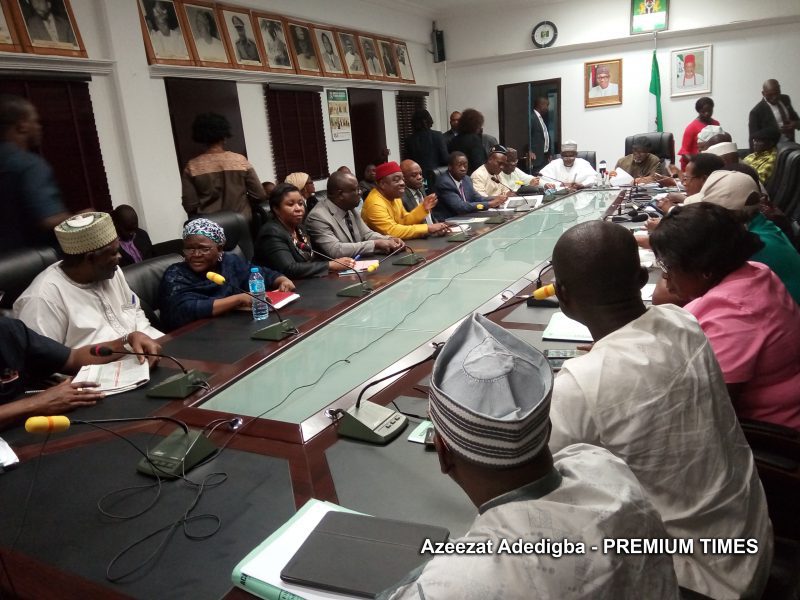
The attempt by the federal government of Nigeria, to force the Academic Staff Union of Universities (ASUU) back to work through court order, has failed after the National Industrial Court (NIC) sitting in Abuja, on Friday, declined to hear the application.

The presiding judge, Justice Polycarp Hamman, in his ruling, declined to hear the application on the basis of an objection raised by ASUU’s legal counsel, Femi Falana.

The federal government had last week, dragged ASUU to the NIC, praying the court to direct the striking academic union back to work to save Nigeria’s public universities from crippling.

At the resumed hearing of the application on Friday, FG’s lawyer, James Igwe prayed the court to hear the plaintiff’s interlocutory application for an injunction against ASUU, arguing that the matter is of great national interest involving millions of students who have been at home since February 14 when the strike began.

“Section 47 of the Trade Dispute Act gives your lordship the power to direct that no worker should continue to embark on strike pending when the applications are heard and determined”, he argued.

He urged the court to order the ASUU in the interim, to return to the classroom, pending the determination of the suit.

In response, Falana opposed the prayer, arguing that it would amount to determining the substantive suit. He said that the matter is already billed to be heard once again and thus, could not be entertained for the issuance of injunctive order.

In addition, Falana told the court that his clients are consulting with stakeholders, including members of the House of Representatives on September 20, in a bid to end the lingering strike action.

“We are going out of our way to ensure that this matter is resolved and we appeal to the claimant to corporate with us,” he said.

Based on this argument, Justice Hamman ruled in favor of the defendant, agreeing that the government’s application cannot be entertained at this point of the hearing.

The matter was consequently adjourned to Monday, September, 19 for a hearing.

ASUU has been on strike for over seven months now, crippling academic sessions in most public universities in Nigeria. The effects of the ongoing strike on the future of Nigerian students have been decried by stakeholders, parents and concerned citizens.

The union is demanding N1.12 trillion from the federal government to improve the welfare of its members as well as to improve the universities’ education standard that it said has long been out of date. In addition, ASUU is asking the government to allow it to use University Transparency and Accountability Solution (UTAS) against the government’s mandated Integrated Payroll and Personnel Information System (IPPIS) for salary payment.

The issues, which are part of the agreement that ASUU reached with the government in 2009, have held the universities to ransom as both parties are not willing to budge. The government says it has no money to fund ASUU’s request while the union sticks strongly with its demands.

At the receiving end of this controversy are students whose future is being jeopardized. The government is now counting on the court to force the resumption of public university education; a move many believe will not yield the needed result.


Appeal Court Upholds Texas’ Law Against Social Media “Censorship.”

0

Conservatives have got a reprieve on the controversial social media law enacted by the state of Texas last year. The U.S. Court of Appeals for the 5th Circuit on Friday ruled that social media companies removing posts based on a person’s political ideology is censorship.

The ruling came in contrast to the trial court’s judgment, which upheld the right of social media platforms to remove posts they deem wrong, and could impact the rights of tech companies to make policies pertaining to free speech in the future.

Per Washington Post, Friday’s opinion was written by Judge Andrew Stephen Oldham, who was nominated to the 5th Circuit by President Donald Trump. He was joined by Judge Edith Jones, a Reagan appointee. Judge Leslie H. Southwick, a George W. Bush appointee, concurred in part and dissenting in part.

What really separated the ruling of the trial court from the ruling of the Court of Appeal is how they interpreted the First Amendment.

The Washington Post, quoting the opinion, noted that Oldham wrote that while the First Amendment guarantees every person’s right to free speech, it doesn’t guarantee corporations the right to “muzzle speech.” In addition, he referenced the Texas law, which he wrote that it, “does not chill speech; if anything, it chills censorship.”

In the ruling, the court criticized the tech industry’s arguments against the law, saying that under the companies’ logic, “email providers, mobile phone companies, and banks could cancel the accounts of anyone who sends an email, makes a phone call, or spends money in support of a disfavored political party, candidate, or business.”

The 5th Circuit judges also agreed with Texas that social media companies are “common carriers,” like phone companies, that are subject to government regulations because they provide essential services.

For conservatives, who for long have claimed that their voice is being silenced under tech censorship backed by liberals, the ruling is a victory that may open the door for a potential similar interpretation of the First Amendment in other states.

Since the emergence of Donald Trump as the 45th US president in 2016, the issue of tech censorship has taken center stage in everyday discussion. It was amplified after Trump and some other members of the Republican Party were booted out of social media platforms following the Jan. 6 2021 after-election Capitol insurrection that sought to challenge Joe Biden’s win.

However, the issue will continue to remain controversial in the foreseeable future due to the contradicting views held by both conservatives and liberals. Many liberal-controlled states in the US hold claims that tech companies are making their platforms available for hate speech, cyberbullying violence and racial hatred. Thus, the states are enacting new laws to empower the companies to act decisively in curtailing the ills.

Washington Post noted that earlier this week, in response to criticism that tech platforms are enabling posts that glorify violence and hatred, California Gov. Gavin Newsom (D) signed a bill into law that forces large social networks to make public their policies for how posts are treated.

“If the Supreme Court doesn’t weigh in, it’s going to be increasingly difficult to operate a nationwide social media company because it could be navigating state rules that differ or even conflict,” Washington Post quoted Jeff Kosseff, a cybersecurity law professor at the United States Naval Academy as saying.

Tech organizations like Computer & Communications Industry Association (C&CIA) and NetChoice had earlier warned that the 5th Circuit’s decision runs counter to First Amendment and sets a precedent that could result in promoting harmful posts on social networks.

“Little could be more Orwellian than the government purporting to protect speech by dictating what businesses must say,” Washington Post quoted Matt Schruers, president of the C&CIA as saying. “The Texas law compels private enterprises to distribute dangerous content ranging from foreign propaganda to terrorist incitement, and places Americans at risk.”

The 5th Circuit’s ruling has triggered an array of reactions from the liberals, conservatives and the tech industry. While conservatives celebrate the decision, others have criticized it. Eric Goldman, a law professor at Santa Clara University, called it a “terrible opinion.”

The decision is surely going to end in a Supreme Court showdown. Carl Szabo, NetChoice vice president and general counsel, said. “We remain convinced that when the U.S. Supreme Court hears one of our cases, it will uphold the First Amendment rights of websites, platforms and apps,”

But in the Supreme Court, conservatives still have the majority.

Auctioning of traffic offenders’ vehicles is draconian

0

News: Tears flow as traffic offenders beg bidders at the Lagos auction!

The act of Lagos state traffic task force auctioning confiscated cars of traffic offenders is disheartening and should be abolished.

It should forever be abolished because, any law at all; be it state laws or federal laws enacted either by the federal or state lawmakers that do not align with the grund norm ie the constitution is null and void to the extent of its inconsistency. 

This law of the Lagos state that empowers the Lagos state government to confiscate vehicles of traffic offenders and auction them out without following the constitutional due process of fair hearing, as provided in s. 36 of the constitution is not just draconian but also a slap on the face of the constitution and such law must be thrown away.

No wonder St Augustine earlier said that “an unjust law is no law at all” and should never be obeyed or implemented. Because for punishment to exist in our laws it has to be more tolerable and not too harsh. 

The Lagos state government should review these traffic offense punishments in line with the gravity of the crime. In this instance, the appropriate punishment for the offense is the option of a fine or temporary seizure of the vehicle but never for the owner of the vehicle to forever forfeit the property. Punishment must be in the same gravity as the offense if not the law will be deemed a bad law. The act of auctioning those vehicles is gross, not in the same gravity as the offence and therefore a bad law. 

According to the positive theory of crime, harsh Punishment does not deter people from committing crimes rather it reinforces the commission of crimes, this is why sentenced criminals go to prison instead to feel remorse and turn a new leaf due to the harshness of the prison sentence they rather join gangs in prisons and become more hardened criminals, more hardened and brutal compared to how they were before they were sent to jail.

Punishments to criminals should be couched in a way that it positively influences the offenders and makes them turn a new leaf from the act and then integrates the offenders back into the society as fit and proper members of the society.

All of us must agree on one fact which is that traffic offenders should be punished so as to curb traffic offenses, especially in a state like Lagos but auctioning the vehicles is way too brutal. It is a bad law and such law was never made to be in complement with the constitution. Hence, any law that empowers the government to confiscate properties and auction them without following the constitutional due process of fair hearing, giving the offenders the right to be heard, offends the provisions of the constitution and such law is repugnant to natural justice, equity, and good conscience.

Between Berri Tiga and Carter Efe copyright (ownership) tussle: The position of the law.

0

Berri Tiga and Carter efe made a song together. According to the backstage story, Carter efe had the idea and conceived the concept for the song and shared the idea with Berri Tiga, then Berri Tiga wrote and recorded the song from the start to finish.

The idea/ concept for the song is to sing praises and adoration to Wizkid, hence they named the song “Machala”,  one of Wizkid’s numerous pet names. 

Carter efe gave the song a huge promotion and undeniably, due to the push he gave the song made the song “blow up” and topped music charts. That is where the fight started as to the rightful owner of the song and entitlement to the royalties that will accrue to each of them since the song is generating huge revenue on music platforms.

It is obvious that they had no prior contract or written agreement as to the ownership or entitlement to the song before the song was released. Carter Efe claimed that he is the real owner of the song since he was the one that conceived the idea of the song and he was also the one that promoted the song and made it “blow up”. He is not contesting the fact that he did not contribute to the writing and recording of the song. Writing and recording of the song were all done by Berri Tiga. 

Carter Efe’s claim of ownership to the song, therefore, revolves around the fact that the concept behind the song was his and he also made the song “blow up” due to his aggressive promotions. 

Issues like this are not foreign to the Nigerian music scene and they will keep happening unless artists learn how to make do with contracts before they collaborate on any project. The contract will set up the sharing formula of the royalties or revenues generated from the song and also clearly state the copyright ownership of each of the contributors in the project and the sharing formula of revenues that are generated from the project. 

This particular issue only came to public knowledge due to the fact that the song was (is) a huge success, hence the fight for ownership and royalties. 

The position of the law:
As a general rule,  the person who writes and records a song owns the copyright of that song in totality but if more than one person contributed to the writing and recording of the song, the persons involved are to be the co-owners or joint owners to the copyright of that song. In the absence of a written agreement as to the joint ownership of the song, it is presumed in law that the contributors will own the copyright equally.

To this effect, since it was Berri Tiga that wrote and recorded every component of the song, he is before the law the rightful owner of the song, and every copyright of the song belongs to him. 

All the royalties or revenues generated from the song should presumably go to him unless they made a contract that stated otherwise. 

It does not matter that the idea for the song belonged to Carter efe and Carter efe promoted the song, Carter efe is deemed to have rendered a service to Berri Tiga and Berri Tiga is to only pay him compensation for the services he (Carter Efe) rendered in the making of the song.

They can only claim joint ownership of the song and royalties or revenues shared between them if they both wrote and recorded the song and each person contributed a line or a verse to the making of the song.

The Little’s Advantage over Uber and Bolt in Kenya

4

The Kenyan government wants to cap the commission taxi drivers pay Uber, Bolt and other ride hailing companies to a maximum of 18%. In other words, for being in Uber and co’s networks, drivers permit these aggregators to keep a certain percentage of whatever they earn for serving customers. 

Uber charges a 25 percent commission per ride, which it says covers promotional price cuts to attract riders, operating costs, health insurance on the trip for the driver and the passenger, and support of safety button technology for passengers and drivers in jeopardy. Bolt and Little charge 20 percent and 15 percent respectively” – BD Kenya

That Little is a local Kenyan company. It does 15% which means it has room for the 18% cap. As expected, it supports this new regulation. Uber is not happy and is going to Court.

The key issue here is the business model: when Uber gives coupons to attract riders, it never comes out of the pockets of Uber. Rather, it comes from drivers since Uber charges higher commissions to make up for those giveaways.  But Little rarely offers giveaways.

This is where running a native business model provides positioning. In America, the best time to buy shirts is last week of any quarter as that is the time most stores mark down items to beat same-store numbers. They can lose $1 million but save $500 million in market cap by keeping Wall Street happy. Uber does that, but Kenya is not buying it.

Uber needs volume on rides, etc even if it makes no profit as most times, investors check mainly those metrics. That outcome is influencing what it is doing in Kenya. Otherwise,  it can freeze giveaways and take lesser commissions if giveaways are the reasons the commission is high.

Comment on Feed

Comment: Well some may say that what the government is proposing is fair but I don’t buy it. Uber was first to enter most markets, having options gives you choice. If the drivers under Uber wants to migrate to other car hailing service companies they can do that without government intervention. Putting a cap is unfair. Government should focus on ensuring free entry free exit to any sector but forcing everyone to use the same business model is going too far. If you want to win a commercial contest do your homework, stop looking for regulatory advantage it is just not fair.

My Response: I did not write it there but if you ask the Accountant General of Kenya, he will explain. This move is partly tax positioning. The percentage Uber keeps as revenue is globally taxed by US laws since Uber Kenya pays technology license to Uber US. That 25% may yield nothing for Kenya. after all the “engineering”. However, the local drivers’ 75% are under local tax. When you move the percentages, you keep more money in the local Treasury.

If Uber agrees to commit a certain percentage as tax to Kenya, I promise you that the cap will go. And the irony is possibly that Little which keeps just 15% may pay more local corporate tax than Uber which keeps 25% per equivalent ride.

Comment 1b: Uber Kenya will pay company tax to Kenya, what will be taxed globally in US is it’s global profit after tax from it’s various operations. If you think of it, all things being equal 25% will lead to a higher profit hence higher tax revenue. Uber’s global profitability hasn’t been impressive, I guess that’s why they won’t find this funny. As for paying technology license to US, Kenya can actually give it a number of years within which it should have a local alternative. My point remains that different companies have different comparative advantage. I am not a fan of government “one size fits all”. The driver’s under Uber can move as I have stated earlier. Putting a cap on commission looks like what a sector’s union should be arguing for not government mandating companies.

My Response: ” If you think of it, all things being equal 25% will lead to a higher profit hence higher tax revenue.” – Uber Kenya has to pay IP license to Uber Global. Out of that 25%, it may be paying close to 20% to Uber Global on IP licensing, leaving just 5% to be taxed, after profit in Kenya. But Little will be taxed on the profit of that 15%.

In Nigeria, NOTAP manages that and it is crazy – do not think because say Google Nigeria makes $2m in Nigeria that you would tax that $2m when the technology which powers making that $2m is hosted and created in California. Out of that $2m, an IP licensing is taken care, leaving about say $200k to be taxed locally after typical expenses. This is partly the reason why many Nigerian startups move their IPs to Delaware (USA). IP is wealth!