DD
MM
YYYY

PAGES

DD
MM
YYYY

spot_img

PAGES

Home Blog Page 4974

Why your Startup/Business needs a lawyer

0
Lawyers are important

When running a business or investing in a startup in a place like Nigeria where both the legal and political system is complex and filled with a lot of bureaucratic policies, you need to be extra careful and make sure you do everything by book in other not to encounter hitches that will ground your startup or budding business to a halt.

As a foreign investor funding a startup in Nigeria you definitely need a company lawyer that will lead you by hand and work you and the new business through the huddles of the never-ending Nigeria legal policies, statutes, and laws regulating the business and corporate world including the local government bye-laws of the area government where your startup is situate and also the state and federal laws regulating the industry you are in.

Even as an indigenous investor or startup owner in Nigeria, you surely need a lawyer especially if the startup is in fintech that is disrupting business lines and models that are heavily regulated by the regulatory authorities.

From the conception of the idea of the startup to the pre-contract and pre-incorporation to negotiation to incorporation and post incorporation to the contract stage to funding; you need a lawyer to vet and double check all these to make sure you don’t get burnt immediately or later in the future.

Some take home points on how a lawyer can help your startup and budding business, hence why your startup needs one.

From the conception of the idea of the business you are investing in, funding, or starting up, you need a lawyer to get the necessary registrations, certificates, and licenses that protect those ideas. Ideas are things of high value in the business world and it is classified as intellectual property hence why it is protected and guarded with jealousy. The lawyer would get necessary certificates that Protect your business’s technical know-how and ideas through trademarks, patent registrations, and copyright registrations. Intellectual Property Protection is key at the onset. Trademark, copyright, and Patent Registration should be done at the beginning of any business particularly if the startup is in the creative industry or in the industry where ideas are traded.

Therefore, if business ideas, trade secrets, and other intellectual properties are at the core of the business or the startup then you need a lawyer that will get the relevant registration that protects such properties of the intellect.

The lawyer will also help you protect the startup’s trade secrets by preparing appropriate confidentiality agreements and nondisclosure clauses between you the founder and the staff or employees of the company.
Some e-commerce store and fintech startup owners that float their businesses through websites do not even know that they can trademark their domain names as their startup intellectual property and they also do not know that websites can be registered as copyright, and every graphics, image, letters, color and every component of that site copyrighted as the intellectual property belonging to the company so as to legally protect it from copycats and intellectual property theft.

A startup lawyer can as well help you Incorporate and register the business/ company. According to Nigerian laws, a business or a startup which have not been duly incorporated with the corporate affairs commission will not yet be recognized as a statutory body or legal entity or be given the status of a legal entity. You as the founder will need a lawyer to help with the incorporation of the business and registering the business with the corporate affairs commission to make it a legal entity totally different from its owners.

The lawyer will know the right way to incorporate your startup. He can advise you by the nature or structure of your startup on how the business will rightly be incorporated either as a sole proprietorship, partnership (business name), or a Limited Liability Company (LLC/LTD).

I constantly run into business owners who by the nature and structure of their businesses the business ought to be incorporated as companies but was instead incorporated as business names and they end up spending extra money and wasting time to change the status of the business with the corporate affairs commission.

A competent startup lawyer can also help in registering the startup in foreign countries if the business is expanding to other jurisdictions and territories for operations.

Also, The startup lawyer will ensure that your business operations and activities are in compliance with laws, statutes, policies, and governmental procedures and regulations.  There are enormous statutes and policies regulating Nigeria’s corporate world and ignorance of any of it will not excuse you as a startup founder or business owner if you breach any of those laws and that is why you need a lawyer.
A startup lawyer will assist with identifying the specific regulation for your business and advice on compliance.

Some company owners operating in Nigeria do not know that they are expected to get a certificate called Special Control Unit against Money Laundering (SCUML). This is one of the strict requirements enforced by financial institutions and the EFCC against business owners and in some instances your bank account will be frozen if you have not obtained the certificate.  This is why you need a lawyer to advise you on how to comply with these requirements in order not to find yourself on a hot seat.

You need a lawyer as well to vet all correspondence and official documents coming in and going out of the confers of the company. The lawyer should review the proposed business plans, and contract bids, and review clauses and terms of the contract to make sure that the interest of the company is duly protected.

Also, your Lawyer will be able to draft the essential documents required to support your business’s digital presence or online marketing strategies if your business is carried out majorly in the digital world. For instance, you need a lawyer to draft up website terms and conditions, personal data collection and usage, etc.

Moreover, You as a founder need a lawyer to draft and specify the Shareholding of the founder(s) and draft the partnership agreement of the partners if the startup is a partnership.

Startup lawyers come up with the share structure of the founders and spell out the conditions for qualification. It is a known secret that founders/ investors have different agenda and different interests while funding or investing in a startup and each founder/ investor wants his individual interest to be fully protected. The Startup lawyer as a master in the craft can come up with agreements that will capture and protect the interests and sentiments of each investor and founder so as to avoid clashes that would warrant investors to pull out that could make the business park up.

Also, When many people form a company or establish a business, it’s best to understand and clearly specify the expectations of the founders and the assignment of each partner to avoid disagreements in the future. So a lawyer will draft the Founders agreement, shareholders agreement, specify the liabilities of partners, mode of partnership, types of partnership, what is expected of each partner,  dividends sharing formula and agreement,  percentage interest of every founder or partner, etc.

Most importantly, an incorporated startup/ business is deemed in law a separate legal entity hence, the startup is to be protected from the investors and even from the founder(s).

Also, as the founder of a startup, a lawyer will help in Protecting your personal assets from business liabilities. The lawyer will advise you on how best to protect your personal assets and the legal consequences of some contracts. You will want your business to be appropriately structured to protect your own personal, non-business assets.

A lawyer will also Advise you on approved advertisements and commercials formats in order not to run into trouble with the advertising regulating authorities. Some adverts are tagged offensive and prohibited to be projected to the public and any company which projects such adverts always get sanctioned and punished by the authorities and it does not matter if you are not aware that such adverts are prohibited. This is why you need a lawyer to guide you through so you don’t incur sanctions and punishments.

The lawyer will as well advise the company on the proper hire and fire policy which will be in compliance with labour act/laws and employment laws of Nigeria, draft company policies, draft rules and regulations, and handbook for staff and workers of the company.

If you are yet to hire or consult a lawyer for your startup or up-and-running business, you need to do that now to save your business from legal issues that will come up. To cap it up, Startup Lawyers do not only bring their legal expertise to the table but also their business experience having garnered enough experience from working with other startups.

Your startup(s), budding business, company do need some legal support and backup for them to scale up and expand.

Only 35% Of The Nigerian Population Have Access To Fintech

0

There is no disputing the fact that the development of the Fintech industry in Nigeria has significantly impacted the nation’s economy. Nigeria, which is home to over 200 fintechs, is among the continent’s fintech leaders with a lively crop of startups and a growing suite of digital offerings from mainstream banks.

Between 2014 and 2019, Nigeria’s Fintech sector raised more than $600 million in funding, attracting 25 percent ($122 million of the $491.6 million) raised by African tech startups in 2019.

In 2021, the Fintech sector raised about $800 million in 2021, which was 120% higher than what Fintechs raised in the last three years combined. The country has no doubt witnessed an increase in the penetration of smartphones among the youths, which has spurred the development of more Fintech services to increase financial inclusion and cashless payments.

Despite the significant increase of Fintechs in Nigeria, experts disclose that the sector only serves about 35 percent of the Nigerian population. Chief Product Officer, Mr. Brian Manuwike, recently disclosed that financial technology companies can only serve about 35 percent of the Nigerian population.

He further stated that the nation’s smartphone penetration is at 35 percent, suggesting that the market cap for financial technology companies is the same. Mr. Manuwike cited a lack of infrastructure as one of the major factors slowing down financial inclusion in Nigeria.

See what he said; “Access to digital payments drives the adoption of digital financial services. Once consumers use the service for the first time and have a good experience, they will always return to convenience. The problem with inclusion in Nigeria is not just a lack of infrastructure, but also a relatively low smartphone penetration.

“Currently, it is about 35 percent, which means that, at best, most Fintech products are capped at 35 percent of the population. These barriers continue to drive the economy’s reliance on cash, with 9/10 of transactions in Nigeria still settled in physical currency.

”Nigeria needs more investments in the offline infrastructure where consumers can access financial products/services with cash and without a smartphone. Offline distribution will drastically really drive financial inclusion”. 

Despite the low penetration of smartphone users in the country, it is estimated that smartphone and internet usage in Nigeria will continue to grow in the coming years, as the percentage of Smartphone users in the country continues to increase with each passing year.

However, this low smartphone penetration has made the people in Nigeria to still rely on cash transactions. Despite the fact that wallets and mobile money are the future of payments, there is a need for more investments in offline infrastructure where consumers can access goods/services and transact with cash without necessarily needing a smartphone.

A case study is the Safaricom M-PESA services where consumers can use the platform without the need for a smartphone. With zero data, customers can use the M-PESA service to send and receive money. It also provides them with ease of use and convenience.

With data and mobile phones sold at a high rate, which makes it difficult for those in rural areas and low-income earners to be financially included, it is therefore pertinent that Fintech Companies also roll out products that do not necessarily require the need for data or smartphones. Doing this will increase the percentage of people in the country that will be financially included.

With the entry of telecommunications firms into the Fintech sector, the likes of MTN and Airtel, it is a positive move for the Fintech ecosystem as it would ensure that players already in the space create new innovative offline products. Creating offline products will see a significant increase in the number of the Nigerian population that will have access to Fintech.

Kizz Daniel and the Washerman

0

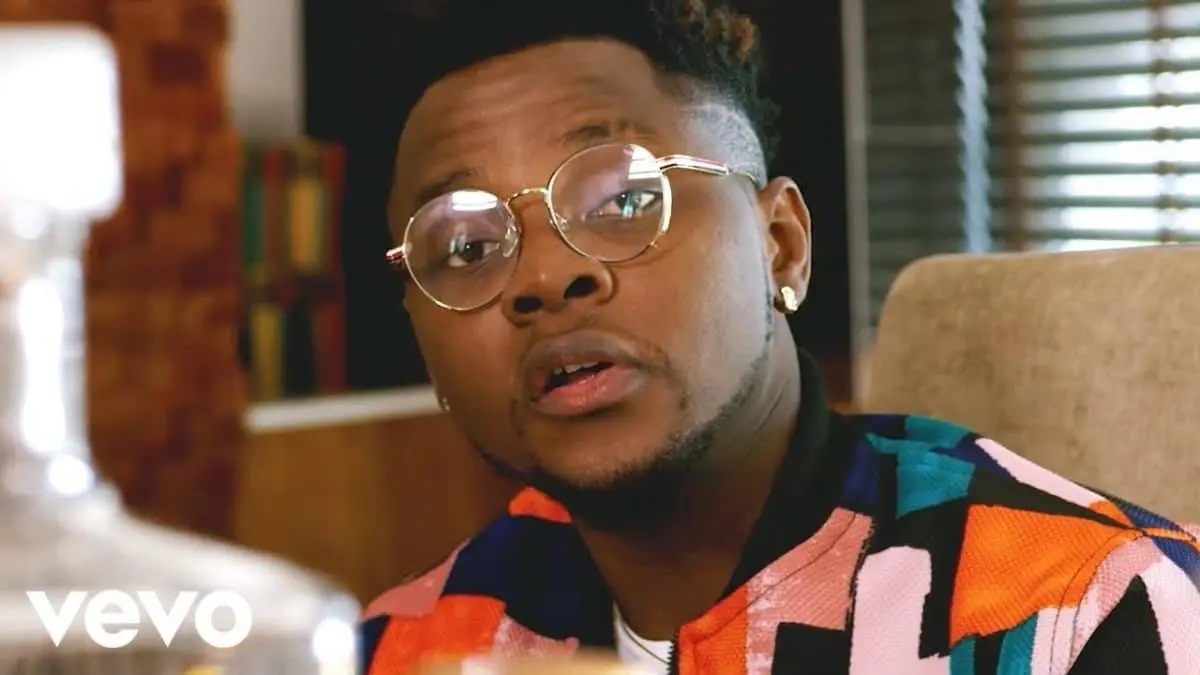
The superstar musician Oluwatobiloba Daniel Anidugbe popularly known as Kizz Daniel has been invited by the police and could be arrested or detained if he fails to honor the invitation of the police. 

He was invited on account of the seizure of a property (laundry truck) belonging to a dry cleaning company. According to the story, Kizz Daniel gave out his clothes to be dry cleaned by the laundry company and the Landry company damaged some of his expensive and quality clothes. He decided to seize their truck until they replace the clothes for him or pay him the money worth of the clothes which is said to be running into multiple six digits. The laundry company reported him to the police for this act. 

The act of Kizz Daniel seizing the property of his debtor/ offenders is referred to in law as self-help and resorting to self-help is always prohibited in a civilized society like Nigeria. Citizens are prohibited from taking the law into their hands, even if you are the singer of the famous hit song “Buga ”, you are expected to comfort yourself, be civil and follow the due course of law in addressing your grievances. 

A dry-cleaning company mishandling the clothes of the artist is a civil wrong and the police have no power over that and Kizz Daniel has no legal right or bases to resort to self-help; the corresponding reaction of Kizz Daniel seizing the property belonging to the dry-cleaning company now falls under the purview of criminal wrong and Kizz Daniel could be charged for theft or illegal seizure of property belonging to another. He could as well be charged with assault and battery and if he damaged the property of the dry cleaning company he could also be charged for damaging the property belonging to another. 

What the superstar singer should have done is to commence legal action against the laundry company in court and pray to the court to ask the laundry company to pay him back for the expensive clothes they damaged or replace the clothes and if Kizz Daniel makes a good case the court will grant him his prayers.

Self-help turns the society into a jungle; an animal kingdom where the strong feast on the weak and weaker animals are constantly harassed, killed, or chased around by the stronger ones. 

The Physics of Winning Commonwealth Games Gold on 4x100m Relay with New African Record

2

When the relay began, the commentators were all over England. As it picked up, Australia was also in the midst. About 5 seconds into the race, she picked Nigeria, quickly noting that the team was running a remarkable race. Tobi Amusan had given them an edge – a really brilliant start. But it must still be finished – and the last exchange of baton was crucial. Then, it happened – seamlessly and flawlessly. 

As that last baton exchanged hands, it was magical. In physics, you call that “momentum” because the last runner was put in a position to accelerate, overcoming her inertia at the highest speed possible. The commentators had quickly switched to Nigeria.

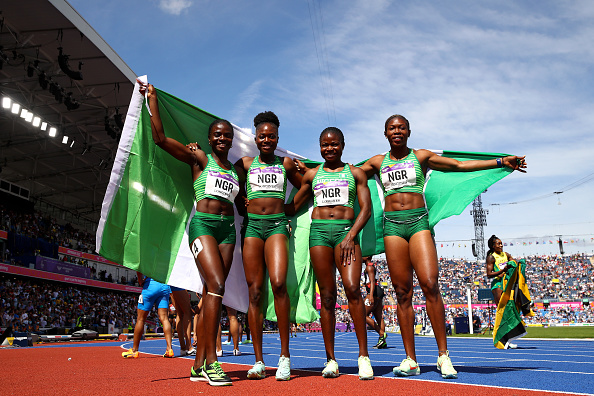
When it ended, Nigeria had won the 4x100m women’s relay final of the Commonwealth Games finishing ahead of England and Jamaica, respectively, and created a new African record. Commendations to Tobi Amusan, Favour Ofili, Rosemary Chukwuma and Grace Nwokocha.

Give the coach credit. The first leg of any 4x100m Relay  is the most difficult because you are starting from zero with huge inertia to overcome. Tobi, the queen of hurdles, is a master of changing speed since running hurdles requires running, jumping, and changing pace at the highest speed possible. She did it brilliantly.

Tobi handed over to Ofili and by that time, they were near the curve. Running the curve is very tricky as you have to bend at high speed. It was Chukwuma who ran the curve before giving it to the fastest woman in Nigeria now, Nwokocha. Darly Neita of England put in an effort but Nwokocha’s speed finalized the deal. That is always the case – the last leg is always about sprinting and the fastest person runs it.

I am so proud of these young women; you can be Amusan, Ofili, Chukwuma and Nwokocha and win the world. Have confidence and work hard.


You could see – I do like sports but I really have no talent in that space. I was always coming last or being in the wrong place in football games! With no way to improve the outcome, I switched to analyses. I called and analyzed runs, games, scores etc, telling the athletes and players how to improve!!! Lol. Nicknamed Sausa – the game caller, strategist and analyst; we grew with it. (Secondary school was one of the most fascinating moments in life; hope you had a great one.)

Why Nigeria’s Outstanding Performances in the Commonwealth Games Did Not Lead to Biggest Victories at the Olympics?

0

The Commonwealth Games and the Olympic Games are two renowned international athletic events where competitors often come from various nations and compete in a variety of disciplines. The Commonwealth Games are primarily intended for former subjects of the British Empire and those who want a political and socioeconomic alliance with the UK. Many African nations, including Nigeria, take part in the games every four years. The Olympic Games, which are similarly held every four and two years (during the summer and winter seasons), do not place restrictions on participation based on colonial ties. Instead, they are open to all nations in the world.

The first Commonwealth Games was held in 1930, and the Second World War forced the cancellation of two subsequent events. The games was referred to as the British Empire Games from 1930 to 1950. In 1954, it was renamed the British Empire and Commonwealth Games, and it ran until 1966. The British Commonwealth Games was the new name given to it in 1970. Up until the 1974 edition, the Games went by this name. Since 1978, the term “British” has never appeared in the nomenclature of the Games.

According to our analyst, the elimination of “British” was done with the purpose of making the Games not represent Britain’s colonial control over the participating countries, as well as to demonstrate the essence of viewing the Games as communal efforts of all nations. Nigeria has attended 15 of the 22 editions of the festival between 1950 and 2022. Nigeria skipped the Games in 1962 (Perth), 1978 (Edmonton), 1986 (Edinburgh), and 1998 due to various regional and global political schisms (Kuala Lumpur). Nigeria similarly skipped the 1976 Olympic Games in Montreal owing to a similar cause.

Exhibit 1: Nigeria’s Medal Performance at Both Games

Source: Commonwealth Games Foundation, 2022; Nigeria Olympic Committee, 2022; Infoprations Analysis, 2022

Manufacturing One Game for Success of the Other Game

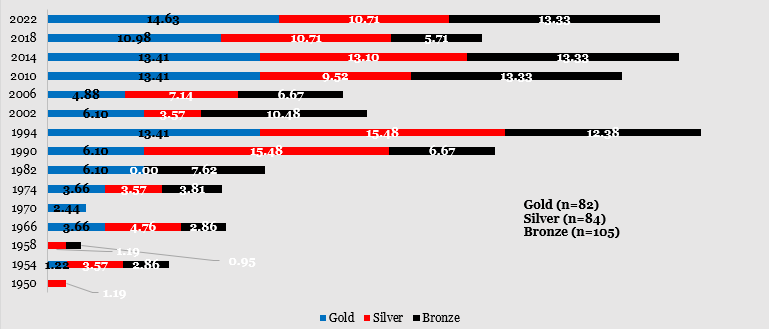
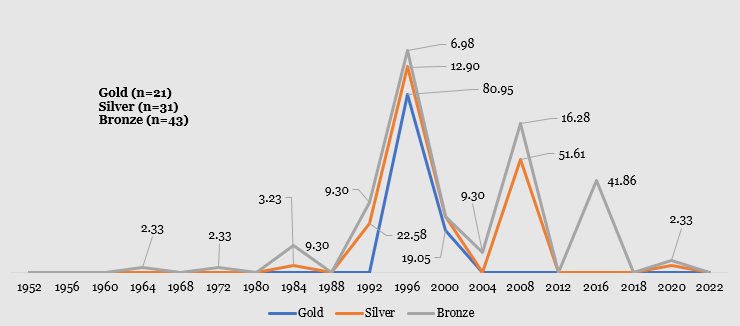
Nigeria competed in 11 Olympic Games before finally winning, but her second appearance (at the 1954 Commonwealth Games) resulted in her first gold medal (see Exhibit 2). Nigeria began winning gold at the Olympics in 1996, a year in which it won a sizable amount of gold medals. Nigeria made history by being the first African nation to ever win a football-related gold medal during the year. The country, however, was unable to maintain the momentum at the games in Sydney in 2000, Beijing in 2008, and Rio in 2016. She had one of its lowest performances in 2020, winning a small number of medals (see Exhibit 3).

As previously indicated, Nigeria earned a set number of medals across all medal categories at both games. Over the years, however, the country has performed better in the Commonwealth Games than in the Olympic Games (see Exhibit 1). In comparison to the Olympic Games, she has won more gold, silver, and bronze medals at the Commonwealth Games. Analysis of both games shows that Nigeria’s highest Olympic achievement was in 1996, and 2022 remains her year of great accomplishments in the Commonwealth games since 1950.

Exhibit 2: Nigeria’s Performance at Commonwealth Games 1950-2022

Source: Commonwealth Games Foundation, 2022; Infoprations Analysis, 2022

Exhibit 3: Nigeria’s Performance at Olympic between 1952 and 2022

Source: Nigeria Olympic Committee, 2022; Infoprations Analysis, 2022

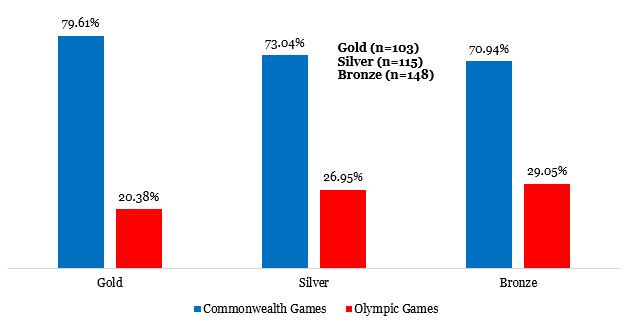
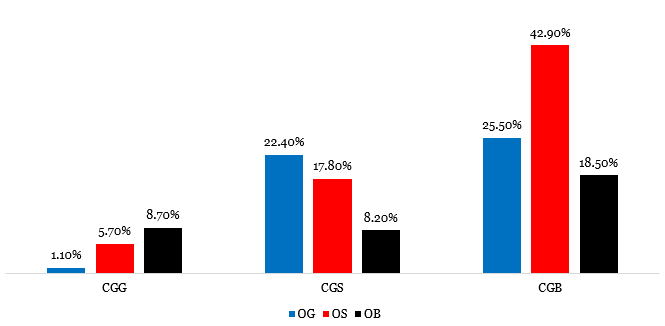
Bronze medals at the Commonwealth Games had a greater impact on the winning attitudes of athletes during previous Olympic editions than other medal categories, according to our analysis of the relationship between winning medals at the Commonwealth Games and achieving the same result during Olympic editions. Nigeria had a 42.90 percent greater chance of earning silver medals at previous Olympic competitions after winning bronze. Over a quarter of the gold medals won at the Olympic Games came from the bronze category. Analysis also reveals that Nigeria’s past Commonwealth Games silver medals helped the country achieve gold, silver, and bronze at the Olympics at a moderately high percentage (see Exhibit 4).

Exhibit 4: Percentage Contribution of Commonwealth Games Medals’ Winning to Olympic Medals’ Winning

Source: Commonwealth Games Foundation, 2022; Nigeria Olympic Committee, 2022; Infoprations Analysis, 2022

The Need for Exploring Sustainable Policy, Infrastructure and Incentives

The key insight is that leveraging the country’s performance at the Commonwealth Games might help her put up a strong show at the Olympics. Concerned stakeholders should take into account other potential elements that could have improved the performance throughout the previous five Commonwealth Games editions in addition to using medal exploits to determine this. Does this imply that athletes competing in athletics for the Commonwealth Games received greater instruction using top-notch resources and rewards than those who competed in past Olympic competitions?

The orientation and readiness of each involved stakeholder to make sport contribute to Nigeria’s growth and development would heavily influence the answers to this question. According to our analyst, using sport as a tool to achieve specific SDG goals and targets cannot be done with “mere paper policy” without taking tangible steps to translate stated goals and policy focus into physical activity. As a result, both the private sector and the Nigerian government, through the Ministry of Youth and Sports Development, need to step up and find creative ways to deal with the sector’s many problems.

There is a need to reexamine school sport activities, which created many excellent athletics who competed in the early editions of both games. Genuine infrastructure development investment must be undertaken, with an emphasis on creating a win-win situation. Sports coverage by media professionals must also be improved. The government’s sole focus on football is not assisting in the development of other sports across the country. Meanwhile, fixing these issues and/or challenges without proper financial and non-financial incentives for athletes would continue to facilitate citizenship change. As a result, it is critical that the Nigerian government consider developing special pay and remuneration packages for men and women in the sport sector.