DD
MM
YYYY

PAGES

DD
MM
YYYY

spot_img

PAGES

Home Blog Page 4979

Tekedia Institute Welcomes Be The Help Foundation

0

Join me to welcome a really fascinating non-profit in Nigeria to Tekedia Institute: Be The Help Foundation. Be The Help Foundation runs an agroforestry project  and offers  hands-on training centers for agroforestry and rural development.  The team will spend weeks at Tekedia Institute, and together we will co-learn on business systems and productivity elements. Tekedia Corporate Training helps companies optimize factors of production to become more efficient, and  thrive.

The best companies attend Tekedia Institute. With our 250 world-class faculty, we exceed the expectations of clients. That is why more companies choose our Institute . Learn more here 

Tekedia Institute offers virtual (online) corporate courses and workshops to startups, SMEs, NGOs, corporations and public sector entities. On engagement, we design, develop and deliver live corporate courses and workshops on many business domains (see below) using our Faculty.  We have served senior, middle and junior management cadres of companies besides general staff, including entry level employees in our  training program. We’re here to help you execute that business mission by deepening the capabilities of your manpower. Here are some attributes:

  • Custom and Consultative Training: Our training is consultative in structure and that means that we partner with you to gain a deep understanding of existing skills gaps in your organization as we design the curriculum. With those insights, we architect a roadmap, customizing and curating our courseware and programs to help achieve your strategic business objectives.
  • Project- and Case-Components: Our training includes business cases which are drawn from diverse sectors and geographies. Our faculty are leaders in leading local and global companies, and they ensure that our courseware is fresh, relevant and applicable to real business challenges.

Buhari Reverses the Approval of Seplat-ExxonMobil Deal Following NUPRC’s Objection

0

Shortly after the Nigerian Upstream Petroleum Regulatory Commission (NUPRC) nullified the approval of the Seplat-ExxonMobil deal by President Muhammadu Buhari, the president reversed his authorization.

Nigeria’s upstream petroleum regulator had said the president has no right to approve the transaction as it requires regulatory approval.

Presidential spokesperson, Garba Shehu, told Premium Times on Wednesday that the president has decided to support the position of the NUPRC in the deal.

According to him, previous confusion was because “various agencies involved in (the) decision had not coordinated well among themselves”.

When TheCable asked if there would be proper communication over the issue, he said “I have no statement to issue”.

The deal would have seen Seplat Energy Plc acquiring the entire share capital of Mobil Producing Nigeria Unlimited (MPNU), a local unit of ExxonMobil Corporation, for $1.3 billion.

The deal, which was consummated in February, became a subject of dispute on Monday after Buhari gave his approval.

The Nigerian National Petroleum Corporation (NNPC) had on July 6, obtained a court judgment to halt the deal. The NNPC’s prayer was for the court to declare that a conflict happened between the state-owned oil company and MPNU over the “interpretation of preemption rights under their Joint Operating Agreement (“JOA”) and order NNPC and MPNU to arbitration as required by the JOA.”

But Seplat Energy had argued that neither itself nor Seplat Energy Offshore Limited was a party in the lawsuit, and insisted the share purchase agreement remained valid.

In a corporate filing on Wednesday, Seplat Energy said it secured all the relevant approvals and followed due process in the acquisition of the assets.

“Seplat Energy has become aware of news and social media reports alleging impropriety in the process of securing ministerial consent to the acquisition of Mobil Producing Nigeria Unlimited by Seplat Energy Offshore Limited.

“Such reports are wholly untrue, and the company will pursue legal action against any parties involved in disseminating false information related to its business,” the statement reads.

It is not clear the next direction the deal will take since the presidential spokesperson didn’t provide further details in his statement. However, the NUPRC has maintained that the deal is subject to regulatory approval.

“As it were, the issue at stake is purely a regulatory matter and the Commission had earlier communicated the decline of Ministerial assent to ExxonMobil in this regard. As such the Commission further affirms that the status quo remains,” the regulatory body said.

TeamApt Raises $50m in Investment Round Backed by QED Investors

0

TeamApt, a Nigerian fintech startup that provides business payments and banking platforms, has secured a new investment round believed to be around $50 million.

The investment was led by QED Investors, a U.S. fintech-focused venture capital firm, and backed by existing investors such as Novastar Ventures, Lightrock and Bill.

Founded in 2015, TeamApt has grown to become one of the largest operators of financial services in Nigeria. The startup in a short while processes a $100 billion annualized run-rate transaction value via its products Moniepoint and Monnify.

Per TechCrunch, Moniepoint now serves 400,000 small and medium-sized businesses across Nigeria, allowing them to access various features to manage operations: working capital, business expansion loans and business management tools such as expense management (business payments cards), accounting and bookkeeping solutions and insurance.

TeamApt’s founder and CEO Eniolorunda said this new financing round would help the company to expand its credit offerings.

Presently, TeamApt’s lending portfolio is small. The company is thus seeking to expand its lending that has been operated from the balance sheet of its microfinance bank subsidiary due to its size. The portfolio expansion will see TeamApt sticking to its multiple lending partnerships plan. Per TechCrunch, this will include banks, development finance institutions and securitization structures, to access debt facilities.

QED made TeamApt its first investment in Africa having seen the company’s growth speed and potential. For four years, TeamApt bootstrapped before it raised a venture round in 2019, but the company has recorded 300% annual growth in revenue and market cap. TechCrunch reported, citing sources, that the company generated more than $100 million in annualized revenue last year.

“From our bootstrapping days, we built products where we can see positive unit economics from day one, which has continued to be reflected in our profitability,” Eniolorunda said in an email response to TechCrunch. “This has put us in the realm of the few attractive cash-flow-positive hyper-growth companies — even as we continue growing at triple digits year-on-year, while at the same time expanding our margins.”

QED is a notable investor in the payment industry, but has stayed away from Africa for reasons believed to involve the perceived minimal growth potential of the continent. However, in the past few years, Africa has risen to the top in payment services. Nigeria leads the pack with over $800 billion in digital transactions annualized in the first four months of this year.

The West African country is breeding fintech startups that are attracting millions of dollars in investment monthly, and some of them have already attained unicorn status. Seeing the wave of fortune blowing across the payment industry, QED is expected to bet more funds in the African market henceforth.

“I am proud to bring Africa to QED and QED to Africa. I could not think of a better way to enter the continent than with our investment in TeamApt,” said Gbenga Ajayi, QED Investors partner and head of Africa, in a statement. “Tosin and his team have steadily built an impressive payment and distribution network across Nigeria over the past five years. Their strong and positive unit economics, coupled with a deep customer focus, will enable them to continue to build out an even more expansive network.”

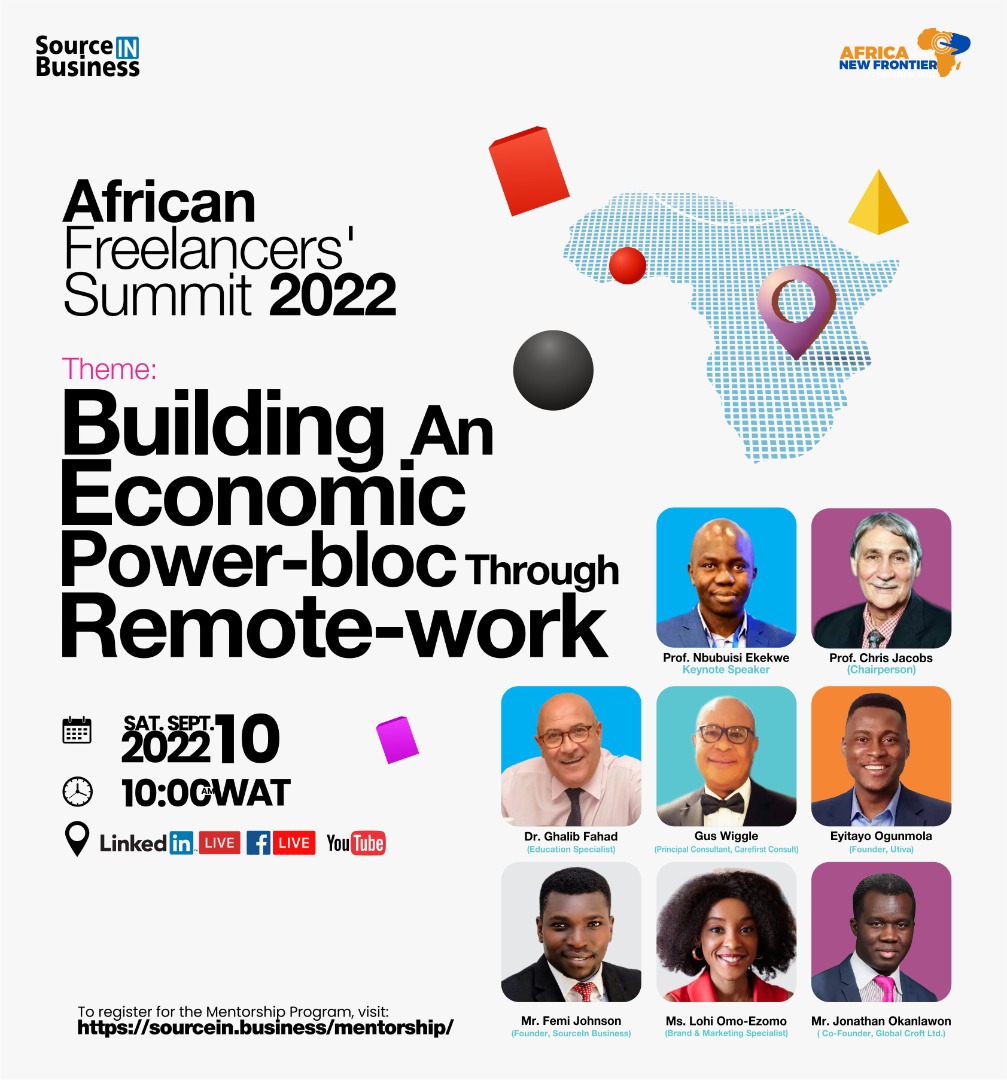
Ndubuisi Ekekwe To Keynote African Freelancers’ Summit 2022

0

In 1776, Adam Smith wrote his masterpiece – the Wealth of Nations. He followed up with other works, explaining productivity and the power of the “invisible hand”. Free market systems advance economies, by making products better, through healthy competitions. Indeed, the freedom of production and consumption, under market forces, accelerates innovation which improves societies.

Factors of production are the pillars upon which the market system operates. And in those factors, Labour remains extremely catalytic. The nature and the form of labour are evolving as a result of technology systems which continue to redesign the interdependent relationships that connect people, firms and nations.

In the industrial age economy, Labour was mainly in the meatspace (physical and atoms). Today, a new paradigm has emerged. Yes, Labour has added remote (digital and byte). Join me on Sept 10 2022 as I keynote African Freelancers’ Summit 2022.

You will understand the changes. Many young men and women are living in Lagos but they work in Estonia, America, Canada, etc daily.  As companies follow Adam Smith’s division of labour thesis, they are going remote, and Africa is positioned for that future. The LABOUR of the future would be unbounded and unconstrained by geography; plan for it. Two Saturdays ago, I keynoted 4 events on the same day, covering 3 continents. Is that not efficient? Adam Smith would have said “it is”.

H1 2022: Nigeria’s Banking Sector Leads, Attracts $1.47 Billion Foreign Inflows

1

Even though the banking sector in Nigeria continues to be grappled with macroeconomic pressures, such as rising inflation, fluctuating naira-to-dollar exchanges rates, and the likes, the Central Bank Of Nigeria, (CBN) disclosed that the sector recorded the highest amount of foreign inflow compared to other sectors of the Nigerian economy.

The banking sector attracted $1.47 billion as capital inflows in the H1 of 2022, an increase of 109.8%, compared to $698.2 million received in the second half of 2021 and 46.5% higher than the $1 billion inflows recorded in the corresponding period of 2021.

The banking sector accounted for 47.1% of the inflows in the Nigerian economy, followed by the manufacturing and financing sectors accounting for $457.7 million and $396.7 million respectively.

The banking sector in Nigeria is said to have settled for some major shifts in its operations this year, as last year, the Central bank of Nigeria (CBN), disclosed that the total assets of the banking industry grew by 20.97% from N53.17 trillion in April 2021 to N64.32 trillion in April 2022, which indicates that there is an N11.115 trillion increase within one year.

The banking industry in Nigeria despite some constraints has continued to grow significantly in recent years, owing to the exceptional performances of traditional banks in the country.

Some top-tier banks on the Nigerian exchange, generated a sum of N77.01 billion from electronic business in the first quarter of 2022, growing the top line by 11.7% compared to N68.92 billion recorded in the corresponding period of the previous year.

Also, the Fintech sector has also been attributed to have helped improve the growth in the banking sector, with a large percentage of inflows coming through Fintech startups either from international venture capitalist firms or Angel investors.

A report disclosed that Fintech firms raised a sum of $658.4 million in funding in H1 2022 across 23 deals. Other financial services firms recorded total deals worth $345.3 million.

Meanwhile, a total sum of $3.11 billion in capital was imported into the Nigerian economy as foreign inflows, between January and June this year, most of which were in form of foreign portfolio investments.Comparing the total inflows from the first half of last year, it grew by 11.8% when compared to the second half of 2021, where it declined by 20.7%.

Recall that the COVID-19 pandemic shook the economies of nations, which affected the capital inflows in Nigeria in the second half of 2020, as investors became wary about investing their money in Nigeria’s economy.

Despite this setback, there was a notably strong resilience in the second half of 2021, as inflows began to pick up, although weren’t compared to the success of inflows during the pre-pandemic era. In the first half of 2022, most of the inflows that came into the country came as foreign portfolio investment (FPI) at $1.71 billion in H1 2022, accounting for 55.2% of the total inflows recorded in the review period.

A major factor that has been attributed to the decline in Nigeria’s foreign inflows is the inability of foreign investors to repatriate their earnings from the economy as a result of FX scarcity.

Nigeria top-tier banks, UBA redeemed its $500 million 5-year Eurobond in June 2022, while Zenith Bank completed the redemption of its $500 million Eurobond in the previous month. This indication of the creditworthiness from the Nigerian banking industry, brought about the confidence of foreign investors to be willing to invest in the sector.