DD
MM
YYYY

PAGES

DD
MM
YYYY

spot_img

PAGES

Home Blog Page 4988

Four African Countries with Rapid Media Convergence for Audience Capturing

0

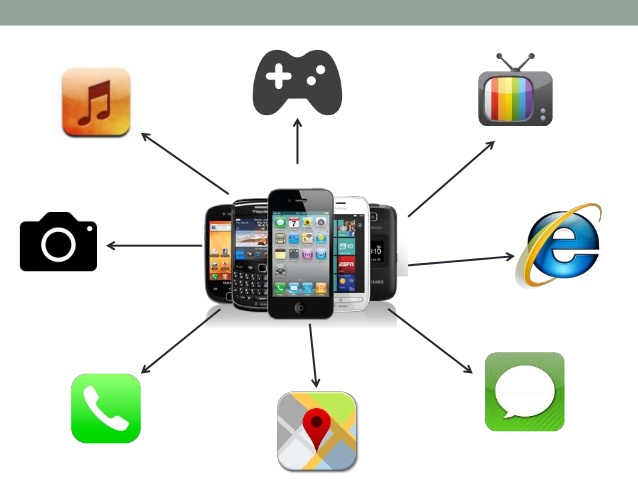
When information and communication technology experts sneeze and release new products, people and organizations must catch the ‘cold’ by incorporating the products into their value creation and capturing processes. Emerging technologies have continued to shape how media companies create and distribute value over time. The concept of carrying a radio box in order to listen to radio stations has been rendered obsolete by the introduction of various smart devices with radio capabilities.

The emergence of similar devices has effectively ended the era of viewing a television box as a “collective box” for viewers. Going to vendors’ stands in neighborhoods or waiting for them to deliver a copy of one’s favorite newspaper brand has completely changed because one only needs access to the Internet to read the content of various newspapers.

These scenarios can be found all over the world. Africa, also known as the emerging continent, is catching up in all aspects of integrating new media with traditional media systems. Media entrepreneurs and professionals from the continent’s east, west, north, and south are constantly innovating in terms of using emerging technologies for value creation and delivery.

In this piece, our analyst examines the media convergence patterns of 63 African media organizations. According to several independent research sources, these organizations have been the leading brands in South Africa, Nigeria, Kenya, and Egypt since 2019. The brands are Mail and Guardian, Time Live, News24, Daily Maverick, IOL, The South African, Citizen, The Punch, Premium Times, The Guardian, The Nation, ThisDay, Daily Trust, Leadership, The Star, The Standard, Nation, The East African, Egypt Today, Araham Online, Egypt Independent, NTA, Channels TV, TVC, Arise TV, ONTV, LTV, OGTV, Sound City TV, Kenya Broadcasting Corporation, Citizen TV, Family TV, NTV, South African Broadcasting Corporation, CNBC Africa, Ezekiel TV, Cape Town TV, Soweto TV, M-Net, MY TV, RSG, Metro FM, Radio 702, Umhlobo Wenene FM, Ukhozi FM, Lesedi FM, Radio Citizen, Classic 105, Radio Maisha, Kiss FM, Milele FM, Nile FM, Egyptian Radio, Robinson FM, Nogoum FM, Goal FM, Rehab FM, Wazobia FM, Nigeria Info, Raypower FM 100.5, Brila FM, FRCN FM and Freedom FM.

The majority of the top media outlets, from Egypt to Kenya, Nigeria, and South Africa, are combining social media with their current traditional or conventional methods of reaching audiences in their local areas and beyond. Our analyst found that the main reason media organizations use social networking sites like Facebook, Twitter, Instagram, and YouTube is to get around the limited radio and television frequencies that relevant local and international organizations have given them permission to use. Analyzed African traditional newspapers are also using the sites to expand their readership beyond their immediate area and increase their revenue from online advertising.

Despite their close use of social media, these organizations differ in how they display the platform icons (Facebook, Twitter, Instagram, and YouTube) on their websites. According to our data, many of them have the icons at the top of the home page, while others have them at the bottom. This has a number of implications for gaining an audience through social media. Our analyst notes that brands with icons at the top of the page have a better chance of attracting audience than those with icons at the bottom of the page. This is because online readers usually pay attention to the top of a website before considering the bottom.

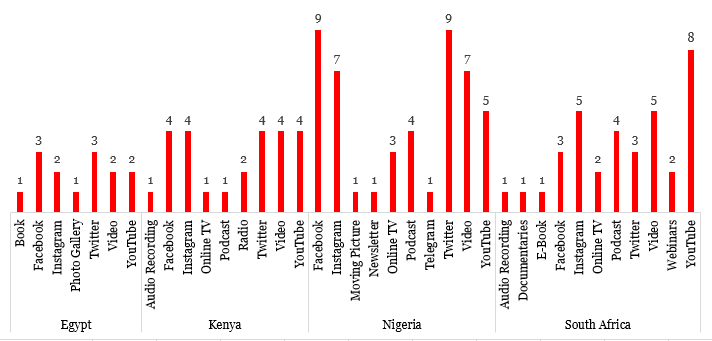
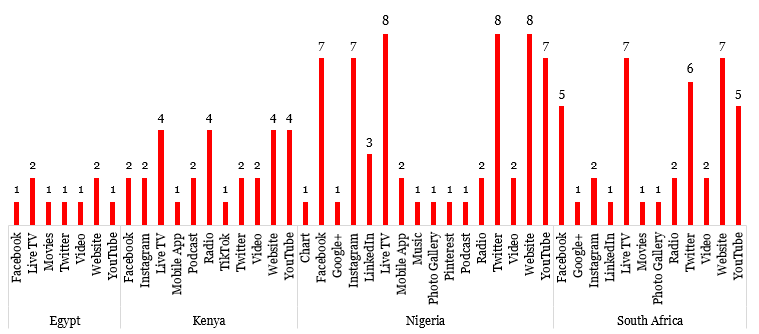
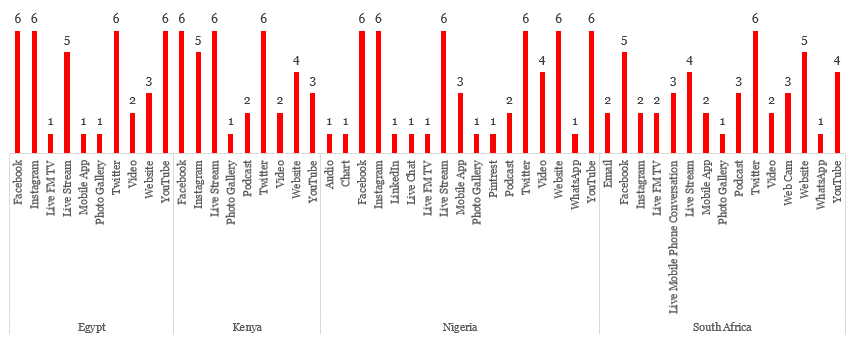
According to a country-by-country analysis, media brands in Nigeria, South Africa, and Kenya fare better in terms of incorporating many emerging technologies than those in Egypt (see Exhibit 1 to Exhibit 3). Egyptian brands, on the other hand, are better at integrating books and movies. The use of Live FM Television Channel on radio station websites is one of the most surprising insights from the selected brands’ convergence with new media. In this regard, one Egyptian radio station was successful in establishing a Live FM Television Channel on its website. This also applies to one Nigerian station and two South African stations. With the strategic placement of podcast and Live TV on websites, radio and television stations are embracing the duo.

Exhibit 1: Select African Countries and Categories of New Media Newspapers Are Converging With
Source: Media Organisations, 2022; Infoprations Analysis, 2022

Exhibit 2: Select African Countries and Categories of New Media Television Stations Are Converging With
Source: Media Organisations, 2022; Infoprations Analysis, 2022

Exhibit 3: Select African Countries and Categories of New Media Radio Stations Are Converging With
Source: Media Organisations, 2022; Infoprations Analysis, 2022

What Nigeria should learn from Kenya’s election

0

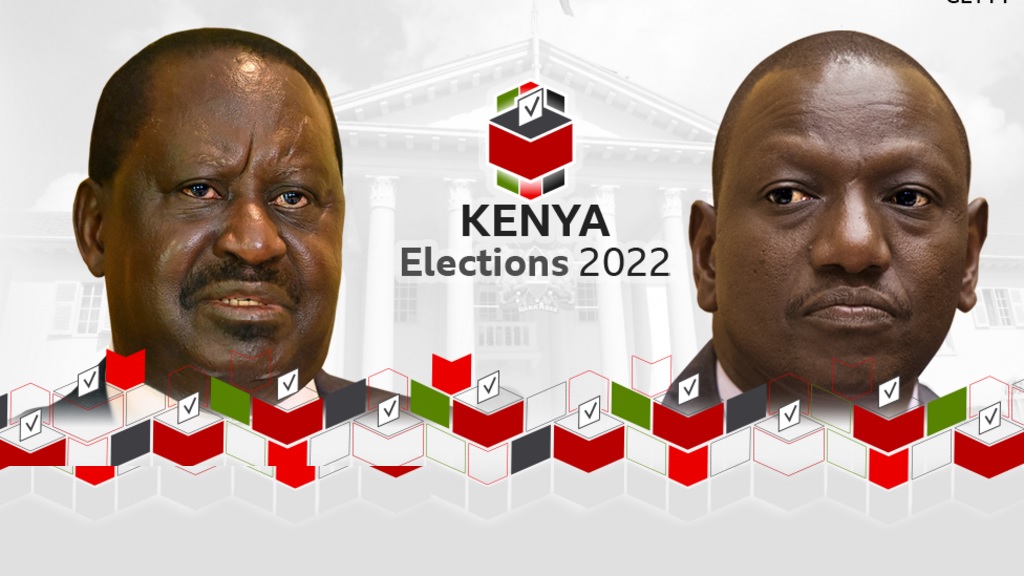
Tuesday, the 9th of August 2022 was a significant date in Kenyan political history. It was the day election for key positions was held all over Kenya.

Observers of the electoral process and the world at large are more interested in the outcome of the presidential election; who will be the 5th president of Kenya since the current president Mr. Uhuru Kenyatta has exhausted his term in office.

Since Kenya got its independence in the year 1963, it has had four presidents, starting from its first president Jomo Kenyatta (who happened to be the father of the current president). The late Jomo Kenyatta gave up power in 1978 to Kenya’s second President, Mr. Daniel Arap Moi. Moi was the longest serving Kenya president who served for 24 years. He was in power from the year 1978 till 2002 when he handed it over to Mr. Mwai Kibaki. Kibaki was in power till 2013 when he handed over to the current president Uhuru Kenyatta, who came in as the 4th president of Kenya.

Four contestants are struggling to get hold of the presidential seat and become the next number one citizen of Kenya; amongst them are the opposition leader, Mr. Raila Odinga, the current Deputy President Mr. Williams Ruto, Prof. George Wajackoyah and David Waihiga. Truth be told that the battle is more between Raila Odinga and Williams Ruto as they are the most popular candidates and the winner of the presidential election is more likely to be one of these two.

I was in Nairobi last weekend and I was amazed that on the eve of the election the city of Nairobi was peaceful and calm and everything seemed normal unlike Nigeria.

Aside from this, some other significant things caught my attention while I was in Nairobi during this election period and having keenly observed and followed the electoral process.  There are really some good electoral developments that Nigeria should at least learn and copy from Kenya and adopt for the upcoming Nigeria’s general election.

I was impressed to see that there is no politician or political figure in Kenya that is above the law. Honorable members of parliaments were arrested during the election for election violence and the police and other law enforcement agencies did not give them preferential treatment. In Kenya no matter who you are, once you are caught trying to destabilize the electoral process you will be arrested. For example, one candidate for parliament was arrested for fighting at a polling station and another parliamentary candidate was also arrested with 9 others for being in possession of machetes and other weapons at a voting center hours before the election was to kick off.

Secondly, Prisoners are allowed to vote in Kenya. That you are in prison will not rob you of your fundamental right to vote. There were polling centers and polling booths inside prisons for the sake of the inmate for them to exercise their franchise.

Also, Kenyans residing in other countries are allowed to vote too. Pooling centers were established in other countries so that Kenyan citizens dwelling in other countries other than Kenya can vote for candidates of their choice. There were voting centers in Canada, the USA, Germany, the UK, etc. That you do not reside in Kenya should not be the reason why your right to vote is taken from you.

Another significant thing I noticed in Kenya is that there is room for Independent candidacy in the Kenyan political system. Candidates must not contest under political parties, candidates do not have to have the backing or support of political parties for them to contest in an election or win elections. If you think you are popular enough to contest without the coverage or being a member of any political party you are free to do that.

Interestingly, some candidates who so far have lost the election or have seen that they are likely to lose the election have adopted the spirit of sportsmanship and they are willingly conceding defeat without recourse for unnecessary noise making, accusations and without even thinking of contesting the election results through judicial process or litigation.

Finally, there is no unnecessary pressure mounted on electoral authorities as they are given seven whole days to collate and announce the results of the election.

Generally, The election was fairly peaceful and so far free and fair. No violence or death is reported yet by the media to have occurred during the election.

Nigeria’s general election that is to be held a few months from now should at least learn and copy some few good points from Kenya’s that was just held.

Nigeria, The Only OPEC Member Which Missed Out on The Russia-Ukraine War Oil Windfall

0

In the wake of the Russia-Ukraine conflict that triggered oil windfall, petroleum exporting countries got an unanticipated opportunity to increase their revenue generation.

Oil prices rose as high as $130 per barrel, marking a significant shift from the market’s pandemic-induced turmoil. Though high oil prices posed a fresh global economic challenge, it presented a golden opportunity for some economies.

“The reality, though, is that the global crude and product system has suddenly become more complicated, less efficient and higher cost. This will be reflected in prices,” Simon Flowers, Chairman, Chief Analyst and author of The Edge, said.

For members of the Organization of Petroleum Exporting Countries (OPEC), a window opened for replenishment of what was lost to the pandemic. The organization generously increased oil output quota for its members as demand soared.

The once upon a time golden opportunity saw many members of OPEC, particularly in the MENA region, scooping billions of dollars in revenue, boosting their GDP.

Saudi Arabia led the pack with a whopping $1 billion per day revenue from oil export. The kingdom’s oil exports reached $30 billion in March, the highest in at least six years. The value of crude exports increased by 123% year on year, according to the kingdom’s statistics office.

Oman recorded a budget surplus of 784 million rials ($2 billion) in the first half of 2022, due to increase in oil output. Oman’s oil production rose to 1,037,000 barrels per day from 952,000 bpd in the same period in 2021.

Other MENA countries like Kuwait and Qatar also caught the wind of fortune. In other parts of Africa, there’s an uptick in both oil production and revenue. Angola overtook Nigeria as Africa’s largest oil producer.

While the oil windfall provided succor for OPEC members, Nigeria, Africa’s largest economy and the continent’s former largest oil producer, was left out.

“Nigeria is the only major oil exporter that hasn’t benefited from the windfall of higher global oil prices,” Dr Michael Olawale-Cole, President of Lagos Chamber of Commerce and Industry said.

The miss, which came with a brutal consequence of huge revenue loss, was masterminded by factors that the Nigerian government is still grappling with.

On Monday, the Minister of State for Petroleum Resources, Dr Timipre Sylva, decried the level of oil theft rocking the oil sector. He said Nigeria is losing 400,000 barrels per day to crude oil theft, which is capable of crashing the economy as it undermines the country’s earning capacity.

“It is a national emergency because the theft has grown wings and reached a very bad crescendo… And because of the height and orchestrated nature of the menace, Nigeria could not take the advantage of opportunities that abound in the gas production… This is because no investor would want to invest where there is incessant insecurity and vandalism of the infrastructure,” he said.

Nigeria has failed to meet up with its OPEC quota which has been increased to 1.8 million barrel per day (mbpd) due to the rise in crude oil demand globally. The country could only boast of 1.4 mbpd as of July 2022.

Besides this backdrop, Nigeria has no functioning refineries – thus, it imports refined petroleum products at the international market rate. The international market rate, which is unaffordable in Nigeria given the poverty rate in the country, has forced the government to pay billions of dollars in fuel subsidies.

In fact, the oil windfall was a curse rather than a blessing to Nigeria because it yielded budget deficits that the government has resorted to borrowing to upset. Nigeria’s oil benchmark for 2022 national budget was pegged at $62 per a barrel, which would have yielded budget surplus if not that the country is not refining its crude oil products. This means, Nigeria was losing more in revenue as soon as oil prices rose above $62.

Money Laundering and How It Is Being Fought by Financial Institutions

0
Fund, money cash dollar

Money laundering is the act of obscuring large amounts of money to be used for illicit purposes, like drug trafficking, illegal wildlife trade, or terrorist activities. While most people know that money launderers also make use of the banking system to execute their criminal misdeeds, few have an idea of how exactly they do so—much less how often it happens and how financial institutions are meant to respond to it.

The truth is, money laundering often goes undetected among unequipped financial institutions. If banks have neither the methods nor the technology to rightfully distinguish money laundering from legitimate customer transactions, it isn’t hard for the former to pass as the latter. It is also a testy time for those who do honest work in the financial industry, as many factors have driven criminals to become even smarter and more ruthless about their methods.

How exactly does money laundering happen, and how can banks use innovations like anti money laundering (AML) software to combat financial crime? Here’s a quick overview on modern money laundering schemes, as well as the approaches that financial institutions can use to counter them.

How Does Money Laundering Occur?

First, what both the general public and people in the financial sector need to know is that money laundering in real life does not always look like it does in the movies. To most people, money laundering elicits images of sketchy-looking agents who move conspicuous amounts of money in one-time bank transfers. But most global crime rings snub this approach in favor of something more effective: disguising illicit money transfers as legitimate and ordinary transactions done by innocent, respectable banking customers.

Criminals can “smurf” or break up large amounts into small bank deposits, all done by different people. They can also take illicit funds from bank accounts into other commodities such as precious metals or real estate properties, which make them easier to move across jurisdictions. Though diverse, these money laundering methods often have a key process at their core, which involves the following steps:

  • Covertly injecting the illicit funds into legitimate vehicles in the formal financial system;
  • Layering the transactions using tricks like bookkeeping treatments, and;
  • Withdrawing the funds so that they can be used for illicit purposes.

Sadly, many financial institutions only respond to money laundering when the criminals are already deep into their systems. Too many uphold a reactive AML program, in which staff only start looking into evidence of a crime when an illicit transaction has already happened. By that time, a bank risks ruining its reputation among its legitimate customers—sometimes, for good.

What Are the Best AML Solutions for Financial Institutions?

Effective counterattacks against money laundering and other forms of financial crime are largely pre-emptive, with emphasis on early and accurate detection and efficiency of available technological and human resources. Financial institutions will do well to implement this four-fold approach:

Pattern-Based Thinking in AML Detection

Good anti-financial crime practices can start with a bank’s know your customer (KYC) and customer due diligence (CDD) protocols. If these systems are improved, they can serve as powerful siphons of suspicious behavior and preclude money laundering activities.

When at their full potential, they may be able to identify instances of money laundering through webs or networks of customer behavior as opposed to individual customer transactions. Successfully detecting patterns that are emblematic of financial crime, instead of individual customer movements, can prevent further damage to the bank’s integrity and significantly hamper a criminal network’s operations.

Improvements in AML Data Analytics and Data Management

Small- and medium-sized banks are now increasingly at risk of being manipulated by money launderers and other financial criminals. In their case, data is the best defense. They should aim to invest in AML systems that can process, sort, and analyze huge swathes of data in time to track suspicious customer activity and put a stop to it before it’s too late.

AML teams can explore innovative and data-driven solutions like AML cloud databases, graph analytics, and custom-built AML scenarios. These will help financial companies craft an AML approach using a wider and more technically proficient perspective, which is sorely needed in the fight against smart and sophisticated financial criminals.

Increased Intelligence in AML Case Investigation and Reporting

Financial institutions should also branch into technologies like artificial intelligence (AI) and machine learning (ML) to increase their customer screening, transaction filtering, and case investigation capabilities. Using an AML platform that becomes more intelligent with transaction data over time will help banks concentrate their efforts on cases of concern and react to them at the right time.

Some banks may balk at the idea of using AI and ML for their anti-financial crime initiatives, but the technologies are neither as inaccessible nor as difficult to use as they used to be. A smooth integration experience will ensure that an AML team can properly incorporate these technologies into their screening, case investigation, and case reporting workflows.

Higher AML Compliance Rates

Contrary to what some financial institutions may believe, AML regulators are partners and not adversaries in the fight against money laundering and financial crime. Regulators hold financial institutions to a high enough standard for AML initiatives and motivate them to keep international crime rings at bay.

For that reason, banks should strive for better regulatory compliance for anti money laundering. A quicker and more organized AML reporting system, running on AML insight that boasts greater data richness and data integrity, will allow them to achieve this. This will earn them the trust of international AML regulators and keep them on top of regulatory requirements that will ultimately strengthen their institutions.

Final Words

Criminal networks perpetuate themselves by evolving their methods. The only way that financial institutions can win against them is to stay several steps ahead. If you are a stakeholder in your bank’s AML program, keep an eye out for new trends in financial crime—and utilize AML approaches that are pre-emptive, data-driven, and pattern-based.

Our production output is Knowledge and we distribute it amazingly; REGISTER today

0

“50 years ago, more than 80% of the value reflected on the balance sheets of Fortune 500 companies was physical stuff—plant, equipment, oil in the ground, inventory on the shelves. Today, more than 85% of the value on the balance sheets of Fortune 500 companies is “intangibles”—intellectual property, brand value, and a host of things more closely tied to human capital than to physical and financial capital. People are today’s value drivers.” – Fortune

At Tekedia Institute, we work  to advance the missions of firms by deepening the capabilities of the human capital through knowledge. We’re working with more Chief Learning Officers (CLO) as they architect and develop programs to ensure their firms have the skills for today and the future.

The Latin intellectuals wrote the “scientia potentia est” [knowledge is power]. Francis Bacon put it as “ipsa scientia potestas est” [knowledge itself is power]. Proverbs 24.5 wrote “..a man of knowledge increases strength…”.The Igbo Nation has “a man of knowledge dines with kings”.

I can extrapolate, when companies have knowledge, they win markets because only knowledge organizes all factors of production effectively.

At Tekedia Institute, our production output is Knowledge and we distribute it amazingly. Check out all our courses here