DD
MM
YYYY

PAGES

DD
MM
YYYY

spot_img

PAGES

Home Blog Page 4988

Tekedia Launches Tekedia for Enterprise

0

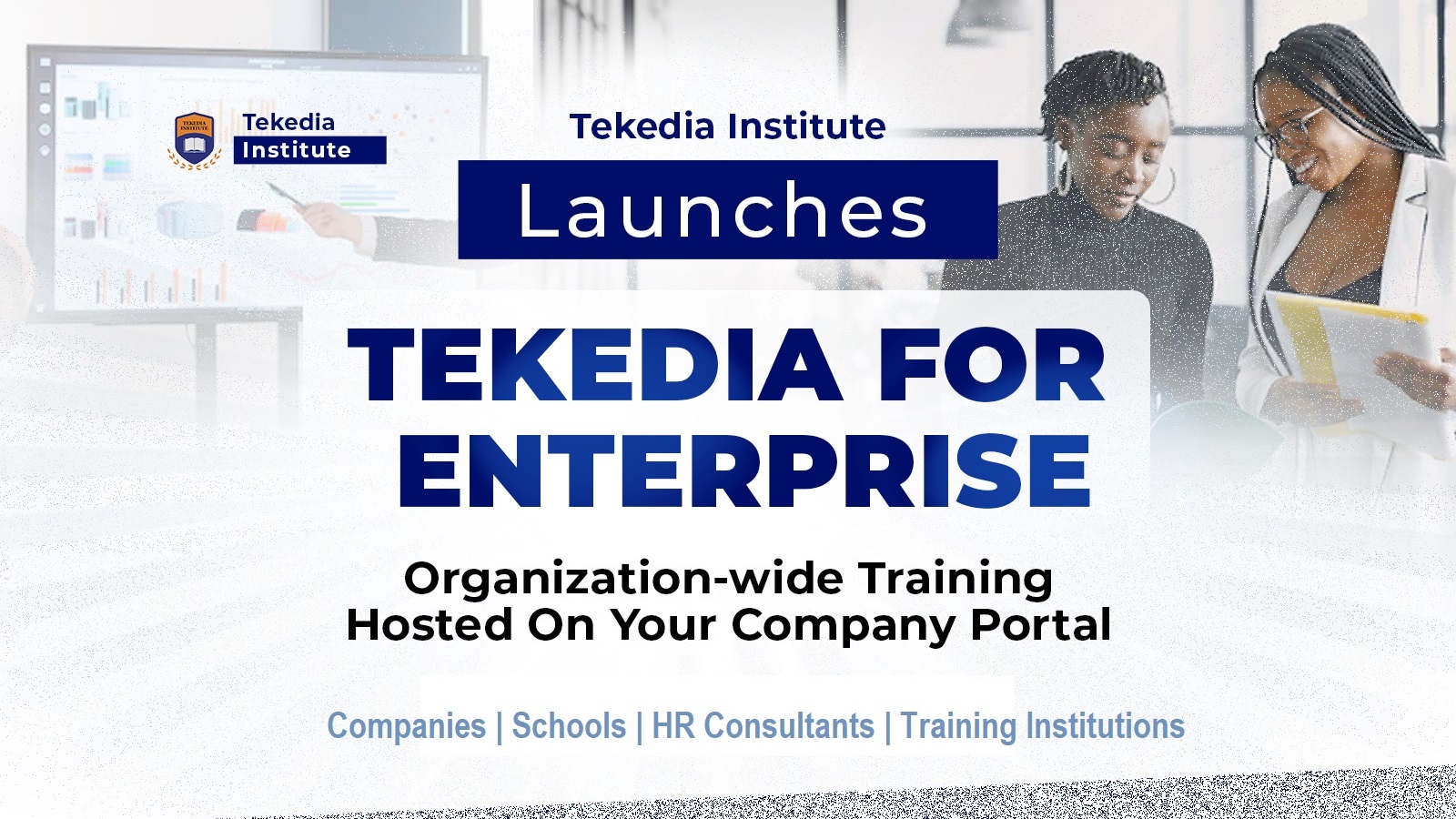
Tekedia Institute is excited to announce that it has launched a new program – Tekedia for Enterprise. Tekedia for Enterprise is an organization-wide training service which makes it possible for workers or learners to take our courses in a client’s website or portal without having to come to Tekedia.com. Through an API-based system, we enable the client to distribute the courseware (written materials, videos, etc) to the staff or learners within the client’s ecosystem [for clients which do not have a portal, Tekedia assists by creating a dedicated section with custom URL and your logo within our system].

In this new age, upskill your workers on their schedule. With our flexible learning, you will attract, develop, build, and retain top talent.

Tekedia for Enterprise is structured to serve companies which have portals where their workers can learn new skills right in the company’s local area network system or schools/training institutions which desire to use Tekedia Institute courseware to build a training business. Here are some major attributes of Tekedia for Enterprise:

  • School within your organization – with the courseware hosted locally in your portal, your team can learn anytime. This motivates them, boosts productivity and helps you to execute the organizational mission more effectively.
  • Business growth & innovation– as you grow your workforce with world-class in-demand courses, and topics, which they need in order to stay current and innovate, you position your organization for success through innovation. With Tekedia for Enterprise, you connect learning to business outcomes.
  • Seamless training, cost efficient – for both business and training institutions,, with Tekedia for Enterprise, your staff or learners remain in your ecosystems, and would not be required to come to Tekedia for training. Why? You have the in-demand world-class courseware hosted in your platform via our APIs. This helps you maximize value, saving you money.
  • Boost morale, drive retention – Tekedia Institute will easily serve as a partner to develop new courses to meet areas where new skills are needed in your organization. With fresh, high quality courseware, a highly productive and engaged team emerges, boosting retention.
  • Live sessions, on your invitation – besides the pre-recorded courseware, Tekedia Institute, on your invitation, will attend your enterprise-wide meetings and deliver presentations, at no extra-cost.
  • Free admission to Tekedia Mini-MBA – we will invite all members of the organization covered by the active license to enroll, at no extra cost, in Tekedia Mini-MBA. Most like to meet and connect with other learners here via our Group WhatsApp, etc.

Licensing & Pricing

We issue a license and with that license, through an API, you can use our courseware right in your company platform.  For the licensing, we have two categories:

  • Enterprise License: this client cannot resell or use the courseware to train learners who have to pay for the training services. This license is purely for companies to train their staff and internal stakeholders. A holder of an enterprise license cannot have its major business operation to focus on training.
  • Training License: this client runs a school or a training program which means learners and students pay to be trained. On this license, that client is paid by customers to deliver training services using the courseware, and its major business operation focuses on training.

Email tekedia@fasmicro.com to indicate an interest. We will arrange an initial Zoom meeting with you to understand the needs, and once that is completed, we will send our prices. There is no scheduled start time; we are ready once a client is ready to start.

To learn more about this program, click here.


Partners Wanted: we invite HR consultants, companies, training schools, etc, as partners to market and distribute this program and other Tekedia programs. Click here and learn more.


The Squirrel-Feet, the Super Shoes and the Zone Awareness: Tobi Amusan Hacks the Wind Again in Birmingham

0

The 2022 Commonwealth Games was scheduled to be held for 11 days from Thursday, 28 July to Monday 8 August at Birmingham City in the West Midlands of the United Kingdom. The competition had promised a different experience than the previous tournament hosted in the Gold Coast, Queensland, Australia in 2018. Since the previous campaign, the world has morphed into a new normal due to the across-the-board impact of the sudden Covid19 pandemic. Like other facets of the nations’ wealth that drive the global economy, tourism and sport-travel are still recovering gamely from the Covid19 shock.

An estimated 30,000 spectators were received at the Alexander Arena for the Birmingham 2022 opening ceremony which is a five-thousand shortfall in attendance compared to the 2018 Gold Coast’s unveiling concert at the Carrara stadium. However, more than 1.3million tickets were reportedly sold out at this year’s Games compared to 1.06million ticket sales that were recorded in 2018.

The UK Government earlier declared “Birmingham 2022 boasts the biggest sporting and para-sport programme and more medals for women than men for the first time ever at a major multi-sport event”. Backed by £778million public investment, Birmingham 2022 is considered the most significant investment in a major sporting event since the London 2012 Olympic and Paralympic Games. “It will leave lasting legacy for people of Birmingham and West Midlands” Boris Johnson, the UK prime minister said at the opening ceremony.

However, for the hundreds of thousands of spectators that have endeavoured to follow the tournament globally and to the letter, what conjured memories and moments of social delight wasn’t the high budget platform sponsored from the coffers of the British Government but the gracing of the platform with the beautiful renditions of 6,500 athletes from 72 nations that featured at different events of the Games.

Tobi Amusan has been in the spotlight since she won herself a gold medal with an outstanding performance that clocked 12.68s at the 100m women hurdles finals in the 2018 Campaign. The then 22-year-old Nigerian hurdler has recently updated her records at 25 after hitting 12.12s and 12.06s respectively in the semis and the finals of the women’s 100m hurdles at Eugene Oregon’s 2022 world championships that wrapped up a few weeks ago.

Amusan’s 12.12s clean sweep broke America’s Kendra Harrison’s six-year-old record of 12.20s in London and transitioned her to a 12.06s consummative victory which made her the first Nigerian athlete ever to win a world title at the World Athletics Championships. Her victory did not fail to inspire controversial thoughts from pundits as expected of any great feat. While Nigerians were still celebrating their heroine’s exploit on the international stage, Sean Ingle, the Guardian sport analyst, wrote that Amusan’s exploit was powered by Adidas’ latest super shoes, Adizero Avanti which is billed to aid field and hurdles athletes specifically. The British Journalist wrote as thus:

Nigeria’s Tobi Amusan reignited the debate about track and fields new super shoes as she unexpectedly shattered the 100m hurdles world record in Eugene. It’s not just sports like track & field where running shoes and athletic shoes play a crucial role in enhancing the performance of the sportsperson, but in new games like pickleball too, one gets to choose from quality pickleball shoes for women that affect performance on the ground. Here, an underrated US brand like Loom Footwear can be a great choice, with its vast collection of sports shoes and sneakers for men & women.

Immediately after the race, the former world 200m and 400m record holder, Michael Johnson, wondered whether the timing system at Hayward Field was off. He was far from alone. However it transpired that Amusan had been given a boost by using Adidas Adizero Avanti shoes, which are designed for 5km and 10km runners, rather than track spikes.

Expectedly, Ingles opinion article could not elude criticisms by thousands of Amusan’s diehards who wondered if the admirable antecedents of the Nigerian had all been orchestrated by some super shoes. The Nigerian windsprinter had also excelled in her field at the 2021 Diamond League, Zurich which made her the first African to do so and to incidentally break the then African record held by Glory Alozie. The proverbial African and world champion have won gold medals back-to-back from 2018 to 2022, distinguishing her capability far from a flash in the pan.

“My abilities are not centered around spikes” said Tobi Amusan who disclosed that the shoes were recommended to her while she consulted with Adidas after she had Patella facilities at the beginning of the season which made her feel down for a while. The world championship record was a moment she’d braced herself to witness a long while ago.

Thus, many Nigerians, Africans and even non-Africans were primed to look out for the Nigerian born sprint hurdler at the 2022 Commonwealth Games’ women 100m hurdles where she’s expected to falsify the conspiracy theory and retain her defending champion title. Finishing first in the Round 1 heat 3 of the 100m hurdles at 12.40s ahead of Australia’s Mitchell Jenneke and Canada’s Mitchell Harrison who finished in second and third positions with 12.63s and 12.85s respectively, Amusan qualified to the finals where she again defended her Commonwealth title with her squirrel-feet sprint much to the delight of the thousands of her fans. In the finals, Amusan aced with 12.30s emerging as the first world champion to win a gold medal at the event and the first Nigerian athlete ever to be crowned champion at all levels of athletics within the same year.

Tobi Amusan’s story encapsulates the flow or zone moment referenced by Daniel Goleman in his bestseller, Emotional Intelligence: Why it can matter more than IQ. The American psychologist and retired science journalist described flow as a compelling moment of grace and bewilderment inspired from the unconscious intelligence and energy which is activated by a repetitive labor targeted at mastery — a line of thought Goleman usually premised on Malcolm Gladwell’s 10000 hours’ theory. Also, Stephen Pressfield in his War of Art, described the zone from an idealist perspective, saying it is when muse overwhelms the individual, but muse cannot activate itself in the untalented or the undisciplined.

Nigeria Needs Modern High Priests As Mediators

1

Silence at war is the loudest noise possible. In ancestral Igbo, enormous respects were reserved for kindreds and kingdoms who were known for resolving disputes among communities and warring clans. Those respects were possible because the mediators were credible people. When they spoke, everyone listened, including opponents.

In those communities, the high (chief) priests were seers and exceedingly respected men, as communities believed they heard from the gods. Even the Eze (the king), most of the time, will defer to the opinion of the high priest, even though the Eze on the hierarchy, runs the kingdom. The Eze’s job is to preside over the people; the chief priest is to connect the deities and humans. Chief priests are the Ezemmuo (the king of the spirits before humans and the messenger of the deities) and they transcend humanity in the ancestral Igbo mythology. 

Whenever the elders seek directions from the gods on if they would thrive in a battle, they expect the high priest to deliver nothing but the absolute message from the gods. If the gods say ‘Go”, the ikoro will beat and young men will be ready for battle. But if the gods say “No”, mediators would be engaged to find a way out. 

Today, Nigeria needs high priests who can speak to the citizens and the political leaders on the economy and other important matters. Yes, many things are broken – and we need credible messengers. 

Why? The gap has widened; Aso Rock does not hear ASUU and ASUU operates in another frequency from Aso Rock’s. Also, the citizens are out of the game – how can you be “broke” as a nation, and yet you are building railtracks, buying expensive cars for another country, etc? Someone must step forward to explain.

Who can those be? I think Nigeria’s organized private sector has a moment with leaders like Dangote, Elumelu, Innoson Motors founder, BUA Cement founder, Jim Ovia, etc. I hope the citizens see these people as credible to bring sanity in the land.

Comment on LinkedIn Feed

Comment: “…..how can you be so broke as a nation, and yet you are building rail tracks, buying expensive cars for another country……” The alleged Railtrack if completed will serve the interest of Nigeria more than anyone because 97% of the will be within Nigeria. Of the about 400km distance, only 25km will connect Nigeria to Niger. I don’t know why the wailing. I am waiting to see who will do better than what is being done now. Unless our present reality changes, I don’t see any positive change coming our way.

My Response: we can of course build to Libya, Morocco, etc all the way to France. It does not change anything. My point is simple: do not say you are “broke” when you can do those things. You are spending $3 billion to connect a country with GDP of $14 billion when you have many states worth more than $20b will no connection. Delta state GDP is bigger than Niger Republic’s GDP but it has zero useful rail track.

I mean, this nonsense where citizens are made to think that Niger Republic will magically provide HUGE opportunities is part of our problems. The addressable and accessible value this train will capture is less than $2 billion in Niger Rep.

The economy of Eti Osa local government which has no train connection to anywhere is bigger than all of Niger Republic. Why was that not a priority? But if you found money to build it, do not complain you are “broke” to teachers and pensioners.

Nigerian Students’ Interests in Foreign Postgraduate Studies Increase by 83% Amidst ASUU Strike

0

Students will continue to look for better places to begin or complete their studies as long as Nigeria’s university education system has unresolved concerns year after year. The fact that members of the Academic Staff Union of Universities have been on strike since February 14, 2022, is no longer news. According to various sources, the strike is still one of the union’s strikes based on the Federal Government’s inability to honor agreed agreements during prior industrial actions.

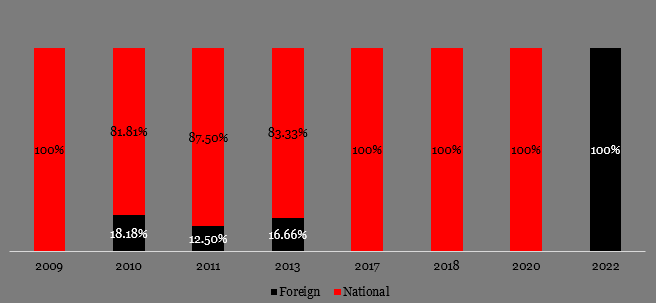
Our analyst examines the internet search interest of Nigerian students and/or potential postgraduate students during previous and ongoing strikes in this piece. According to analysis, Nigerian students did not seek information on postgraduate studies at overseas universities in 2008, 2009, 2017, 2018, and 2020. Instead, despite ASUU strikes throughout the years, they sought information on the studies through Nigerian universities. In 2008, the University of Ibadan was the only university where students became interested in postgraduate courses after researching numerous sources on the Internet. Interest in national universities climbed from one in 2018 to three in 2009, another year when students observed one of the union’s lengthy strikes.

However, an analysis conducted in 2010 showed that students began to show a strong interest in getting postgraduate certifications from overseas universities. Throughout the year, the students researched postgraduate studies at 11 different universities, including the University of Aberdeen and the University of Edinburgh. During the year, the preferred national universities were the University of Lagos and the University of Ibadan.

The number of institutions fell to eight in 2011, before rising to twelve in 2013 and thirteen in 2018. In 2011, all eight universities in which students expressed interest were national. The University of Nottingham was the sole foreign university on the students’ minds during the year. In 2013, the foreign university that arose in students’ exploration of international postgraduate courses was the University of Manchester, as it was in 2011. Again, this year, the University of Lagos and the University of Ibadan were first and second, respectively. In 2017 and 2018, 13 and 12 universities dominated students’ information seeking behavior, respectively.

According to our analysis, none of the international universities emerged as suitable locations for acquiring postgraduate certificate in either year. The same tendency was identified in 2020, when students sought information about postgraduate studies through 12 national universities during the union strike.

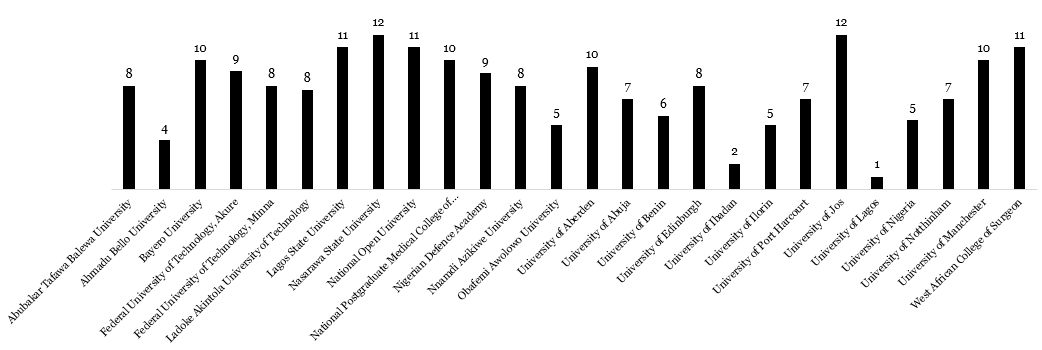
The University of Lagos and University of Ibadan consistently held the top two spots between 2008 and 2020, according to further analysis using the Average Position Technique (APT). According to our data, students’ interest in postgraduate programmes at foreign institutions increased by 83.34% between 2013 and 2022 (data end point is July 31), from 16.66% (representing 2 universities) to 100% (representing 9 universities). Our analyst notes that the strike might push Nigerian students into the most sought-after international universities by September 2022 and throughout 2023 if interested parties are unable to find long-term solutions to the strike.

Exhibit 1: Pattern of Eyeing Postgraduate Studies

Source: Google Trends, 2009-2022; Infoprations Analysis, 2022

2022: The Most Eye National, Foreign Universities for Postgraduate Studies Amidst ASUU Strike

Since January 2022, students’ consideration of exclusively foreign universities in their quest is a crucial indicator of their impending mass exodus for academic reasons. We expect Nigerian students to be in Gloucestershire University, University of South Wales, University of Lincoln, Cardiff Metropolitan University, University of Derby, Salford University, Teesside University, University of Birmingham and Hull University this year and next year because they have been the schools that have been searched the most since January.

Exhibit 2: Average Position Per Year for National and Foreign Universities Between 2008 and 2020

Source: Google Trends, 2009-2022; Infoprations Analysis, 2022

How African Tech Startups Raised Funds In 2022

0

The African tech sector has continued to witness exponential growth in the past five years. The tech startups in the region took center stage in 2021 when they reached an inflection point as companies raised over $4 billion, more than what they raised in 2019.

The fintech sector dominated last year’s total funding, accounting for 63% ($3 billion) of the funding that went to African startups. Amidst the global inflation, in the first half of 2022, African tech start-ups jointly raised $3.1 billion.

The “big four” in the African region, with countries such as Nigeria, Kenya, South Africa, and Egypt still maintained dominance, as the African tech ecosystem is significantly shaped by activities in these countries. Since the year 2019, startups operating in these countries have raised 83 percent of all funding and signed 78 percent of all $1 million-plus deals, as they show no indications of slowing down.

Top Four (4) H1 2022 Funding In Africa According to Countries

1.) Nigeria: Nigeria represents the vast majority of the funding raised in Western Africa since 2019. Tech startups in the country raised 32.8% of the funds raised.

2.) Egypt: With at least 562 tech startups in operation across the country as of September 2021, Egypt has been disclosed to have the fourth largest startup ecosystem on the African continent by the number of companies. It accounts for 19.8 percent of the active tech startups across Africa. Tech startups in the country raised 20.1% of the funds.

3.) Kenya: The startup ecosystem in the country has been described as a robust one with entrepreneurs building solutions for their communities that they want to scale across the globe. The country’s capital Nairobi is home to more than 200 startups. Tech startups in the country raised 14.4% of the funds.

4.) South Africa: Fintech is disclosed as a major driver of activity within the country’s startup space, with 30 percent of companies in the country active in that space. Tech startups in South Africa raised 12.7% of the funds raised.

Now let’s take a look at the sector in the African startup ecosystem that received the highest funding;

H1 2022 Funding Raised Based On Sector

It is nothing new that the Fintech Startups in the African region continues to receive the highest amount of funding. The sector took the largest chunk of funding, raising 28.8% ($845 million).

This was followed by the logistics and mobility sector. It was disclosed that this sector is gradually set to overtake the fintech sector in the Nigerian startup ecosystem. There is no disputing the fact that the logistics and mobility sector is doing exceptionally well in the African region as it raised 11.4% of the funds making it the second highest sector.

Coming in the third position is the health tech sector, as there is a booming increase of health-tech startups on the African continent. The number of startups active in the health-tech space on the continent grew to 56.5% in 2020. The sector raised 7.9% of funds.

Sitting in the fourth position is the E-Commerce sector. The value of early-stage funding for the e-commerce technology enterprises in Africa amounted to $26.7 million in 2021. The sector raised 7.0% of the funding followed by the Edtech sector occupying the fifth position. The sector raised 6.6% of funds, with over 200 Edtech startups spread across the African continent, using diverse models to bridge the quality of education in Africa.

Conclusion

H2 2022 is already looking good in the African region, as startups have already raised nearly $150 million. There have been predictions that startups in the region will likely be affected by rising inflation, Food prices, Fuel prices, and the likes. However, tech founders of these startups are hopeful that the H1 growth of 2022 will flow into the H2.