DD
MM
YYYY

PAGES

DD
MM
YYYY

spot_img

PAGES

Home Blog Page 4988

High Inflation: The Need For Employers To Operate A Flexible Payment System In The Workplace

0

With the inflation rate constantly spiking around the world, doubling in 37 of 44 advanced economies over the past two years, it has no doubt put a strain on so many businesses.

Showing no signs of stalling, food commodities, and the price of diesel/ petrol continue to skyrocket which has affected the standard of living for people across the globe. The high-inflation rate has made low-income households turn to loans and credit cards to be able to cope during this period.

The workplace hasn’t been exempted from the hit, as Its impact has also been felt there, which has resulted in the mass layoff of employees across the globe, over the inability of employers to meet up with their salaries.

Some employees have had their salaries slashed from the usual amount that they were being paid, as employers are now devising various strategies on how to cut costs and maximize profit to prevent their already dwindling revenue and income from further falling.

The rising cost of living is impacting the entire workforce and there is a need for employers to address this, as most employees have had their disposable income negatively affected which is taking a toll on their workplace input.

Looking at the fact that bills are increasing, coupled with the fact that a large percentage of employees still earn the same amount is a cause for concern. Few experts have urged employers to look for how they can assist their employees either through an increase in salary, incentives, or compensation package, etc.

Studies reveal that money issues affect employees’ productivity in the workplace. With the current high inflation rate ravaging global economies, there is no disputing the fact that most employees’ productivity will be affected.

Asides from the fact that offering employees compensation packages, incentives, increase in salary and the likes, is a good idea to limit the strain caused by the inflation on employees. However, I posited that employers should enable employees to get flexible access to salaries, moving away from the conventional system of month-end payment.

Flexible payment system is a new concept whereby employees are paid with an on-demand option. This means if the employee requires their pay early, they can demand it from the management, in order to fulfill their financial needs removing pressures.

This system of payment provides an on-demand solution to overcome financial difficulties without the need to ask for an advance from the employer which, in itself, is a daunting task.

I realized that a flexible salary payment system is one of the major ways employers can use to cushion the effect of inflation on their employers to enable them to have access to their salaries whenever they need it. It can be either weekly or twice in a month, depending on whichever model the employee chooses.

Often, workers find it challenging to meet everyday expenses or worry about not being able to meet them. Additional pressure stemming from inflation which has led to financial difficulties can cause mental health issues if the long-term strain on the finances of employees is not addressed.

With a flexible payment system, it provides them with a solution that does not result in additional borrowing and interest associated with borrowing. Few analysts have attributed a flexible payment system as not just a way to make employees work harder, but it can also effectively bring about organizational changes as it materializes in labor productivity.

Asides from adopting a flexible payment system in the workplace due to inflation, I am of the opinion that it should be fully adopted in every organization across the globe even when inflation subsidizes. The system has been proven to attract talent, improve productivity and also leads to staff retention.
Nigeria’s Largest Public Companies And Lessons from America – The Challenge of Lost Future

1

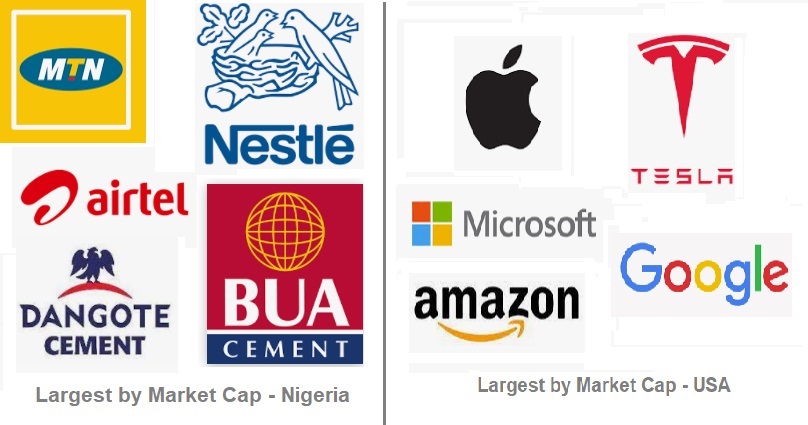
In 1917, the largest publicly traded company in the United States was US Steel. Fifty years later, in 1967, the largest recorded was IBM. Over those fifty years, American leading companies had transmuted from building and construction infrastructures to digital infrastructure companies. Before those, food companies were dominant.  Today, the largest US publicly traded companies are knowledge companies like Apple, Google and Microsoft. 

Simply, the US has moved from fundamental infrastructures  to creating wealth on numbers (yes, data) just as Greek philosophers had postulated many centuries ago.  I expect in 50 years for the leading companies to become firms where the knowledge creation is autonomous, with artificial intelligence, unbounded by pure human capabilities. In other words, dynamic numbers!

In Nigeria today, we are at the phase of that 1917 and 1967 as we are still building the constructing and core digital infrastructures with MTN, Nestle and  Dangote Cement leading the stock market. 

Looking deeper, the knowledge era has not arrived at scale in Nigeria. It will come, but it may take a few more decades looking at the unfolding paralysis ,since the companies which will anchor that future are not even Nigerian even though they do everything in Nigeria. Yes, they are legally Delaware (USA) companies with 100% of operations in Nigeria. That is Nigeria’s lost economic future, and will be more devastating than the impacts of dried crude oil wells.

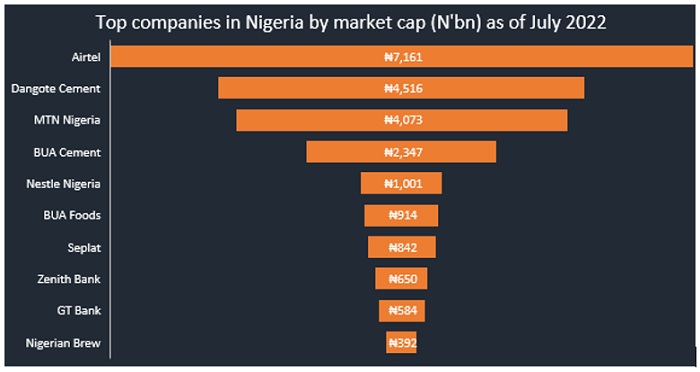
Top Nigerian companies by market capitalization, July 2022

This is the roll call, according to Nairametrics.

  • #1: Airtel Africa – N7.16 trillion
  • #2: Dangote Cement – N4.52 trillion
  • #3: MTN Nigeria – N4.07 trillion
  • #4: BUA Cement – N2.35 trillion
  • #5: Nestle Nigeria – N1.00 trillion
  • BUA Foods – N914.4 billion
  • Seplat Energy – N841.8 billion
  • Zenith Bank – N649.9 billion
  • GT Holdings – N584.2 billion
  • Nigerian Brew – N392.1 billion

Comment on LinkedIn Feed

Comment: Good point Ndubuisi Ekekwe, but part of the collateral damage is the high level of unemployment in the former manufacturing hubsof the USA that gave rise to the xenophobic followers of Trump.
Those manufacturing industries died in the USA and resurfaced in China, and LATAM countries. We must not allow the rise of knowledge industry kill off the manufacturing sector. That is what China is doing and reason for its consistent growth in the past 20years.
With the impact of the war between Russia and Ukraine, we now know that the knowledge industry means nothing without the agriculture and manufacturing industry. We must continue to champion the simultaneous growth of both industries.

My Response: Great point but knowledge companies do not mean lack of manufacturing. Tesla is a knowledge company. It sells tons of software licenses via vehicles (you cannot resell your Tesla with the licenses; the new owner has to re-license). Amazon is one of largest employers in America with 1.2M workers; it powers many small manufacturers across America. 

Your argument was made in the 1790s when farmers rejected the notion that tractors were good since they  would kill jobs. Foxconn, which makes things for Apple, is worth about $70B; Apple which depends on it, is worth $2.6 trillion. Many activists will prefer Foxconn which employs close to 1million people to Apple which employs say 40k directly but indirectly more than 5 million apps makers. I do think the activists are wrong!

Knowledge will run empires; Apple is a better company than Foxconn on all metrics. For you to thrive on knowledge, you have won the infrastructure as that is at the top of the pyramid.  The US does not have a  “high level of unemployment” to my knowledge; the problem today is that we have few people to employ. The complainers are troublemakers who find excuses to cause trouble.

Will China Invade Taiwan? For Semiconductors, Not Likely

0

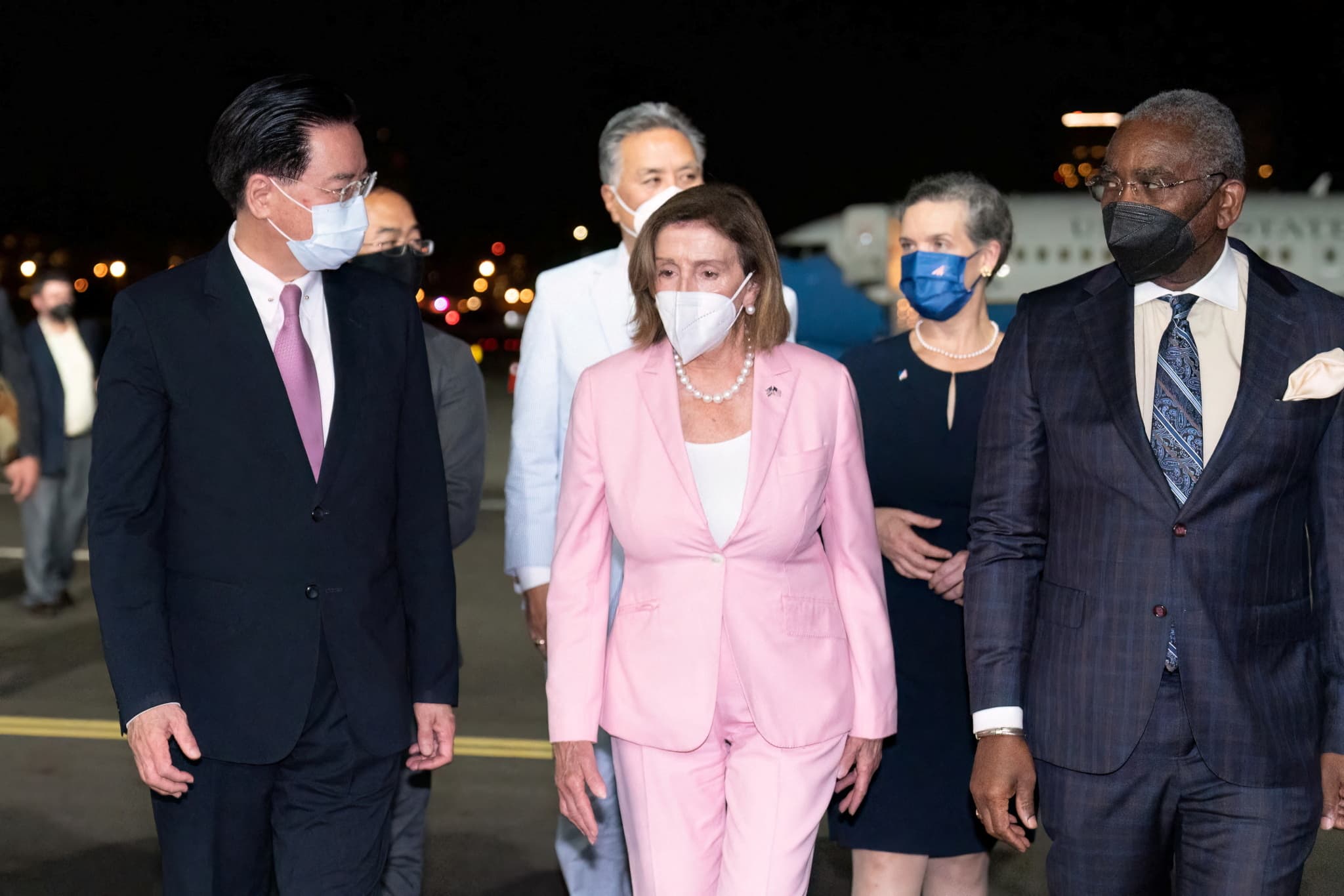
The US’ House Speaker Nancy Pelosi touched down in Taipei, Taiwan’s capital on Tuesday, on an official visit that has riled up the rivalry between Beijing and Washington.

Taiwan, a small island country in East Asia with a population of about 20 million people, has been a bone of contention between China and the United States. Taiwan’s located in the “first island chain”, an area that covers a list of US-friendly territories that are crucial to US foreign policy. It became a Chinese territory in 1945 by conquest, after Japan, who had ruled the island from 1895 surrendered during World War II.

Taiwan has been fighting to completely break away from China to freely practice a democratic government, while China is poised on keeping her under the control of its communist government.

Pelosi’s visit to Taiwan is significant because it portrays Washington’s defiance to China’s push to retain Taiwan. Beijing had, prior to her visit, warned that there will be serious consequences if Pelosi visits Taiwan.

“We are fully prepared for any eventuality. The People’s Liberation Army [PLA] will never sit by idly. China will take strong and resolute measures to safeguard its sovereignty and territorial integrity,” Chinese foreign ministry spokesperson Zhao Lijian had said.

China immediately embarked on military drills around Taiwan as soon as Pelosi touched down in Taipei, signaling a possible military conflict between the two countries. But earlier on Monday night, authorities in Mainland China had placed embargo on imports of some 100 Taiwanese food products, sparking concern that the conflict could yield both military and economic wars, which will be disastrous for both countries. Taiwan’s exports to the Mainland and Hong Kong topped $188 billion last year while China depends on Taiwan for some high value goods like semiconductors.

China’s President Xi Jinping has said “reunification” with Taiwan “must be fulfilled” – and he did not rule out military action as a means to achieve his aim. China has taken to threats to ward off US’ interference and possibly intimidate Taiwan to return.

But Taiwan has been defiant. The country’s perspective has been to uphold its relationship with the US.

Vincent Chao, former director of the Political Division, Taipei Economic and Cultural Representative Office in the United States, said Pelosi’s visit is welcomed as it follows an already established precedent of Newt Gingrich’s visit to Taiwan as Speaker in 1997.

“In that respect, Pelosi’s visit is not ground-breaking & nor should it be treated as such.” he said.

“If we allow Taiwan-US relations & established precedent to be rolled back due to PRC’s intimidation campaign, very soon all aspects of the relationship will come under challenge. This is consistent with past PRC practice of (give an inch & they’ll take a mile).

“So the buck has to stop here. We cannot give PRC leeway to chip away at the Taiwan-US relationship, or very soon we won’t have much of a relationship left. Showing weakness in the face of PRC resolve will almost certainly backfire, with longer, more serious consequences,” he added.

Apparently, Taiwan anticipates both economic and military response from China, but doesn’t think the Asian giant will launch an attack since it will hurt its economy. China’s economy depends a great deal on Taiwan Semiconductor Manufacturing Co. (TSMC) that the country currently accounts for about 10% of the company’s revenue.

In an interview with CNN’s Fareed Zakaria on Sunday, TSMC Chairman Mark Liu said that a Chinese invasion of Taiwan would render TSMC’s factories “non-operable” and create “great economic turmoil” on both sides of the Taiwan Strait.

Liu said there would be no winners if China were to invade Taiwan. While he admitted that he viewed the TSMC as more of a deterrent to war than a risk, he also acknowledged that the impact of a conflict would go well beyond semiconductors, and would bring about the “destruction of the world’s rules-based order” and “totally change” the geopolitical landscape.

Currently, China is in dire economic strains that were orchestrated by its crackdown on its tech industry, its troubled real estate sector, covid-induced lockdowns and logistics challenges. Thus, an economic or military fight with Taiwan, which is likely going to escalate involving possible retaliation from the US, will only compound China’s economic troubles.

For President Xi who is seeking a third term, caution means avoiding decisions that will further hurt China’s economy and in turn infuriate members of the Communist Party. Although in Mainland China, a throng is rising in demand for a strong military response from Beijing, it is a risk some analysts believe that China wouldn’t take for its own good.

Federal Government of Nigeria Disburses Over N66 Billion To 1.258 Million Nigerian MSMEs

0

The federal government of Nigeria recently disclosed the disbursement of over N66 billion to 1.258 million Nigerians under its Micro small and medium enterprises (MSMEs) survival fund and Guarantee off-take scheme.

This was disclosed by the Minister of State for Industry, Trade and Investment, Ambassador Mariam Katagum, at a town hall meeting of beneficiaries of the MSME survival fund and the guaranteed off-take scheme in Abuja.

The sole aim of the meeting was to highlight the scheme’s achievements in the country, as well as receive the feedback of beneficiaries. The minister further disclosed that the scheme from the federal government was initiated to stimulate the economy after the covid-19 lockdown, especially for small and medium-scale businesses and self-employed individuals previously gainfully employed.

Recall that the covid-19 pandemic that ravaged almost the entire globe, put a major strain on businesses, most especially small and medium enterprises. Businesses that could not withstand the pressure during the pandemic era were forced to shut down. Also, economies across the globe were thrown into jeopardy.

The scheme through the disbursement of the survival fund was implemented across five tracks in the country, which are; Payroll support scheme, Artisan and Transport scheme, Formalisation Support scheme, General MSME Grants scheme, and Guaranteed off-take scheme.

See what she said; “Under the payroll support scheme, the target was to augment the patrol obligations of MSMEs in the health, production, Education, Hospitality, and Food production sectors. In total, 490,408 employees received between N30,000 and N50,000 as three months’ salaries in the 36 States and the federal capital territory (FCT). 

“The artisan and transport scheme was designed to provide a one-off N30,000 grant to 333,000 beneficiaries. We currently have 398,260 self-employed individuals and MSMEs who have benefited across the 36 States and the FCT. Under this scheme, the off-take items were products such as face masks, hand sanitizers, and food items among others from micro and small businesses across the 36 states of the federation and the FCT.

These items were later handed over to the state governments and the FCT for onward distribution to schools, hospitals, NGOs, as well as other public and private institutions. Overall, the scheme has disbursed the sum of N66,000,020,000 directly to 1,258,183 beneficiaries, including those registered by Corporate Affairs Commission.’’

This is a commendable initiative from the federal  government as they introduced the MSME survival fund, which is part of the N2.3 trillion stimulus package of the Nigeria economic sustainability plan to help businesses overcome the challenges posed by the covid-19 pandemic.

The scheme is expected to save at least 1.3 million jobs across the country and specifically impact over 35,000 individuals per state. MSME has been described as the backbone of any nation’s economy.

According to the National Bureau of Statistics, Small and Medium enterprises account for 96% of businesses, and 84% of employment creation in Nigeria. With a total number of around 17.4 million, they account for 90% of the manufacturing sector.

These statistics aforementioned just show the impact small and medium-scale businesses have on the advancement of Nigeria’s economy.

They are notably the highest employer of labor, creating income for unemployed youths, which catalyzes income generation, job creation, and poverty alleviation. The government has no doubt offered support to the MSMEs in Nigeria, unfortunately, a large percentage of them are still operating at a low capacity, as these businesses are still faced with a myriad of problems.

Analysts and Ministers have disclosed that despite the efforts from the government to support MSMEs, they cannot do it alone. They revealed that the business community also has an integral role to play.

With a close look at developed nations around the world, there is no disputing the fact that these nations are developed due to the immense contributions from the MSMEs as a result of significant support from the government.

In Nigeria, the efforts of the government in supporting MSMEs notwithstanding needs more facilitators if it would catch up with its counterparts in other developed and developing countries.

FBS: One of the Best Online Brokers in Nigeria

8

The COVID-19 pandemic has altered the lives of millions of people around the world. Staff layoffs, business closures and the realization that the world will no longer be the same have forced people to think about new sources of income. Thus, trading is becoming an increasingly popular activity. This trend can be observed worldwide on a global scale, including in Nigeria.

However, in order to safely and effectively engage in trading, you need a reliable broker. For example, FBS Forex broker.

Who is FBS

FBS is an international company that has not only won the trust of traders around the world, but has also received numerous international awards, including Best Forex Broker, Best Copy Trading Application, Best Mobile Trading Platform, Best Forex Broker LatAm, Best Forex Broker Asia and many more. Another interesting fact is that FBS is an official Leicester City Principal Club partner.

The company was founded in 2009 and has since expanded into more than 150 countries. The head office is located in Limassol, Cyprus. FBS is trusted by over 23M traders and more than 410,000 partners worldwide, including Nigeria.

FBS Markets Inc activities are regulated by IFSC, license number IFSC/000102/310. Since the IFSC not only licenses companies, but also makes sure that they adhere to all the necessary rules for providing financial services, you can be sure that your funds are safe.

Why trade with FBS

In addition to being a licensed and experienced company, FBS provides a wide range of services for traders and meets all the requirements of modern financial markets.

Here are the main benefits of FBS in Nigeria that every trader will enjoy:

  • Convenient trading tools
  • Deposits and withdrawals via any system in any currency
  • Deposit bonus for trading
  • Multilingual customer support 24/7

FBS features: trading instruments and account types

With FBS, Nigerian traders have access to all the main trading instruments:

  • Forex — major, minor and exotic currency pairs are available for trading;
  • Metals — gold, silver, platinum and palladium;
  • Indices — various most famous indices, including NASDAQ 100, Nikkei 225, S&P 500, and more
  • Energies — natural gas and crude oil (Brent and WTI);
  • Stocks — shares of the world’s largest companies, such as Tesla or Google;
  • Crypto — round-the-clock trading of more than 100 currency pairs.

Depending on your preferences and interests, you can open different types of FBS accounts.

Standard account

This is the most common type of account among traders.

  • No commission
  • Minimum deposit of $100
  • Floating spread from 0.5 pips
  • Leverage up to 1:3000

Cent account

The most convenient account for beginners.

  • No commission
  • Minimum deposit of $1
  • Floating spread from 1 pip
  • Leverage up to 1:1000

Micro account

An account with a special feature — fixed spread.

  • No commission
  • Minimum deposit of $5
  • Fixed spread of 3 pips
  • Leverage up to 1:3000

Zero Spread account

Here the name speaks for itself.

  • Commission from $20 per lot
  • Minimum deposit of $500
  • Zero spread
  • Leverage up to 1:3000

ECN account

An ECN account allows you to trade without intermediaries.

  • Commission of $6
  • Minimum deposit of $1000
  • Very low spreads
  • Leverage up to 1:500

Crypto account

Trade over 100 cryptocurrencies with the FBS crypto account.

  • Commission of 0.05%
  • Minimum deposit of $1
  • Floating spread from 1 pip
  • Fixed 1:5 leverage

Special offers for Nigerian traders

A special feature is available for traders of the Muslim faith in Nigeria — the Islamic Swap Free Account. This means that traders on Cent and Standard accounts get no swaps or interest charges on overnight positions.

In addition, all Nigerian traders have access to Fix Rate special offer — deposits and withdrawals at a fixed exchange rate.

Trading platforms

With FBS, traders in Nigeria can download the following platforms to any device directly from the official website:

MetaTrader 4

  • Available on Windows, Mac, Android and iOS
  • 50 technical indicators and charting tools
  • Create, buy, and use Expert Advisors and scripts
  • All types of Forex trading orders
  • Implement strategies of any complexity

MetaTrader 5

  • Available on Windows, Mac, Android and iOS
  • 38 technical indicators
  • More functions to create technical indicators, trading robots and utility apps
  • 6 types of pending orders
  • Economic Calendar

FBS Trader: mobile trading platform

  • FBS’s own platform
  • All the trading instruments available in one app
  • Real-time statistics
  • Simple interface
  • Instant deposits and withdrawals via your preferred payment methods in your preferred currency
  • Customer support 24/7

And for users of the FBS Trader application there are valuable bonuses:

  • Quick Start bonus. If you sign up for a Quick Start Bonus account after you install the app and register, you will receive a free $100 bonus to start mobile trading.
  • Activate Cashback Bonus in the app and get up to 20% for each order.
  • Mobile trading library. An immense selection of training materials is available in the FBS Trader app and will be useful to both novice traders and experienced professionals.

FBS Loyalty Program

The FBS Loyalty Program is an opportunity for traders in Nigeria to earn valuable prizes for every trade. Making a trade, you can earn not only money, but also status points. Then you earn new levels, which will allow you to get prizes of different values. The more points, the higher the level, the more valuable the prizes.

Overall, FBS is a great broker for those who want to start this business in Nigeria. It offers favorable conditions, comfortable and efficient trading platforms, many bonuses, and most importantly, a caring attitude towards its clients.