DD
MM
YYYY

PAGES

DD
MM
YYYY

spot_img

PAGES

Home Blog Page 499

Musk Tightens Grip on Tesla With $1bn Share Purchase, but 25% Control Still Elusive

0

Elon Musk has opened his wallet again, this time pouring $1 billion into Tesla shares, though the move barely shifts the needle toward his long-stated goal of tightening control over the electric vehicle maker.

A regulatory filing released Monday revealed Musk bought about 2.6 million shares on Friday, lifting his total holding to roughly 413 million shares. That raised his ownership stake only slightly, from 12.7% to 12.8%. The incremental increase, which underscores the scale of Tesla’s $1.2 trillion market value, marked Musk’s first open-market buy since 2020 and signals renewed confidence in Tesla’s trajectory. The new purchase Yet in percentage terms, the gain was small. The $1 billion outlay increased his stake by just 0.08%.

To reach the 25% threshold he has publicly demanded — a level he said would give him enough sway to be “influential” while still leaving room for him to be “overturned” — Musk would need to more than double his current holding. That means acquiring an additional 12.2% of Tesla, a stake worth upward of $150 billion at current prices.

Even Musk, with a net worth of $419 billion according to the Bloomberg Billionaires Index, would face steep hurdles. His wealth is largely tied up in Tesla stock itself and illiquid stakes in his private ventures, including SpaceX and artificial intelligence startup xAI. Freeing up cash on that scale would be extraordinarily difficult. And that’s before considering the market effect: any large-scale, open-market buying spree would likely push Tesla’s share price even higher, inflating the bill.

Legal Clouds Over His Compensation Shares

Musk’s calculations are further complicated by unresolved disputes over his 2018 compensation plan. That package awarded him 304 million stock options — shares that would substantially boost his influence if unlocked. But earlier this year, a Delaware court voided the deal, ruling that Tesla’s board failed to exercise independence in approving it.

The 304 million disputed shares were not included in the latest filing. Nor were the 96 million restricted shares Musk was granted in August, which remain tied up in conditions. Business Insider, which first broke down the filing, excluded both tranches in calculating his effective stake.

The legal fight over those shares hangs over Tesla’s governance as its board now pushes a fresh $1 trillion compensation proposal for Musk. That deal, tied to ambitious operational milestones like boosting Tesla’s valuation eightfold to $8.5 trillion and deploying a million robotaxis, could catapult him toward the ownership levels he craves without the need for open-market purchases.

Confidence or Power Play?

For now, Musk’s $1 billion purchase could be read two ways. On one hand, it fits with his January 2024 declaration that he wants 25% voting control or else would prefer to “build products outside of Tesla.” The buy-in could be part of a long-term strategy to claw toward that threshold.

On the other hand, it may be less about power and more about signaling. With Tesla navigating slowing EV demand and intensifying competition, Musk may be using his own capital to reassure investors of his conviction in the company’s future.

Either way, this was his first open-market buy in four years, making it a significant gesture. Whether more follow could provide critical clues about whether Musk intends to chip away gradually at Tesla’s ownership structure — or whether he is simply flexing confidence in a company he insists is only getting started.

What Comes Next?

Looking ahead, analysts say Musk’s path to 25% control could play out in several ways.

Gradual accumulation: If Musk continues buying shares on the open market, each additional billion-dollar purchase would barely move the needle. To realistically double his stake through this method would take years and vast amounts of liquid cash — something even Musk may struggle to free up without offloading parts of SpaceX or other ventures.

Board-driven compensation: The more plausible route lies in Tesla’s proposed $1 trillion compensation package. If shareholders approve it and Musk meets the ambitious milestones, he could secure enough new stock to elevate his voting power toward the 25% mark without draining his personal fortune. But the deal faces legal and governance scrutiny, especially given the court’s rejection of his earlier package.

Status quo: Musk may choose to hold steady, using symbolic stock buys like this one to demonstrate confidence while focusing his real energy on steering Tesla toward growth targets that justify his influence. In this case, the 25% goal could remain aspirational rather than operational.

However, Musk’s latest move has given him little in terms of numbers — but it has reignited speculation about how far he will go to cement his hold over Tesla and whether the next chapter will be written in the courtroom, the boardroom, or the stock market.

Welcome to the 18th Edition of Tekedia Mini-MBA

0

Good People, it is with great pleasure that we welcome a new group of global citizens to the 18th edition of Tekedia Mini-MBA. A diverse cohort of innovators, entrepreneurs, and professionals has joined us. Welcome to the #BestSchool.

We do not just teach at Tekedia Institute; we ignite the spark of possibility. We challenge the status quo, and we provide the tools to build a better world, one idea, one company, and one market at a time. For the next twelve weeks, your classroom will be the global marketplace.

I urge you to be curious, and to collaborate. Your network is your net worth, and the relationships you forge here will be invaluable for your career. This is your time to learn, to grow, and to transform. The economy is waiting for your ideas, your leadership, and your courage. Welcome to the Tekedia Mini-MBA; let the learning begin.

Registration continues here https://school.tekedia.com/course/mmba18/

Bitcoin Pulls Back as Crypto Market Cools After Volatile Weekend as Fed Decision Looms

7

After a bullish weekend, the cryptocurrency market is showing signs of slowing down as profit-taking and cautious trading take hold.

Major digital assets rallied strongly last week, but momentum has faded with traders eyeing macroeconomic developments and the upcoming Federal Reserve policy decision.

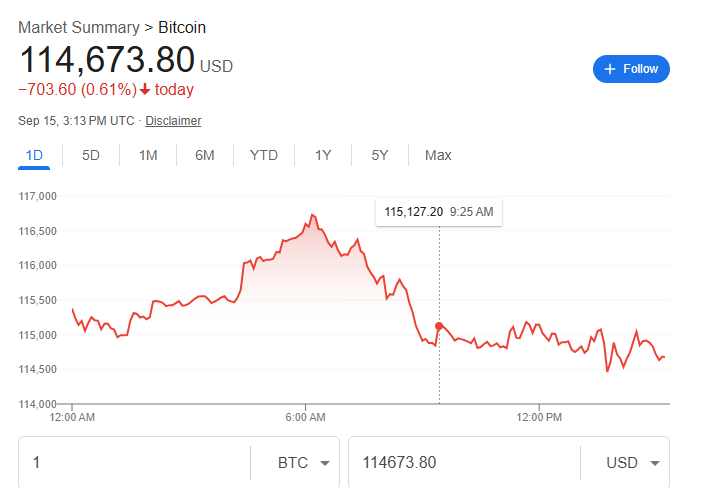
Bitcoin pulled back to $114,478, retracing from last week’s high of $116,718. Over the past seven days, BTC has traded in a tight range between $110,870 and $116,705, with $115,000 acting as a key pivot point.

Despite the recent dip, Bitcoin remains up 8% over the past two weeks, according to CoinGecko. It has also gained 5% in the last week and sits 93.7% higher year-over-year, though it’s slightly down 1.1% over the past 30 days. BTC’s current market capitalization stands at $2.32 trillion.

Key Technical Levels

Bitcoin remains locked in a tug-of-war between bullish and bearish forces, with whales gradually cashing out while retail traders cheer every move above $120,000. Analyst Michaël van de Poppe highlighted the $117.5 – $118K zone as Bitcoin’s final hurdle before a potential breakout toward a new all-time high (ATH).

“Breaking through this level could send BTC toward $123,000,” he noted, adding that the upcoming Fed rate cut could intensify volatility. Should BTC fail to break resistance, immediate support sits at $114,800, followed by $112,000 and deeper at $103,000.

Also, analyst Rekt Capital emphasized Bitcoin’s weekly close above $114,000, calling it a positive signal: “A successful reclaim of $114K as support would not only enable upside but also confirm a likely end to the corrective phase.”

Charts shared by Rekt Capital highlight a repeating pattern since 2023, where former resistance levels turned into support zones before the price continued higher. The current structure mirrors those earlier setups, with a successful retest of $114,000 potentially opening the path to $130,000.

The market remains in a neutral-to-distribution range, with no clear signs of renewed accumulation among long-term holders.

This suggests that while the price has held firm, supply dynamics remain cautious. Traders are watching closely to see if stronger inflows shift the balance toward accumulation.

Macro Catalyst: Fed Rate Cut in Focus

The Federal Open Market Committee (FOMC) decision on Wednesday is expected to bring a 25 basis point rate cut, with futures markets assigning a 94% probability. Historically, lower interest rates have boosted risk assets like Bitcoin.

A dovish tone from Fed Chair Jerome Powell could push BTC toward $120,000, while a hawkish surprise or unexpected policy moves might drive volatility and test key support levels.

Data from CryptoQuant shows a growing trend of Bitcoin moving off exchanges and into long-term storage. This suggests strong accumulation by conviction-driven holders, tightening market liquidity, and potentially providing a bullish underpinning for prices.

Market Outlook

The broader crypto market faces a pivotal week. A clear and favorable Fed decision could restore investor confidence, stabilize prices, and spark a rebound across Bitcoin, Ethereum, and other top coins.

Bitcoin’s ability to hold above $114,000 and break through $118,000 resistance will determine whether this consolidation period transforms into a renewed bull run or a deeper correction. 

On the flip side, unexpected policy moves or aggressive profit-taking could heighten volatility, dragging BTC and altcoins lower and testing major support zones.

Hyperliquid & Polkadot Shine While BullZilla Presale Steals the Spotlight: Top Cryptos to Invest in This Week

0

Crypto investors are watching the markets closely this week as new narratives emerge around trending meme coins and innovative networks. Among the many projects vying for attention, BullZilla stands out with its rapidly accelerating presale, offering investors a unique window of opportunity. While Hyperliquid and Polkadot remain significant players in the broader blockchain ecosystem, BullZilla’s early momentum is reshaping expectations for meme coin potential in 2025.

With stages that update every 48 hours or when funding hits $100,000, the Bull Zilla presale has become a focal point for those hunting the next big 1000x return. At the same time, Hyperliquid is advancing decentralized trading infrastructure, and Polkadot continues to strengthen its cross-chain interoperability, proving that the crypto landscape remains diverse and dynamic.

BullZilla: Explosive Presale Momentum

BullZilla ($BZIL) is in the spotlight for good reason. The BullZilla Presale is already creating a wave of excitement thanks to its structured approach: each stage lasts just 48 hours or ends early if $100,000 is raised. This built-in scarcity drives urgency and rewards those who participate early. Analysts are calling BullZilla one of the top cryptos to invest in this week, with its community growth and meme-driven narrative pointing toward serious upside potential.

The project combines classic meme-coin energy with a clear tokenomics plan, drawing comparisons to early-stage successes like Shiba Inu. For investors seeking trending meme coins 2025, BullZilla’s strategy, complete with rapid stage progression and a cinematic brand identity, sets it apart as a contender for massive gains once it lists.

BullZilla Presale Information

Metric Details
Current Stage 2D (Dead Wallets Don’t Lie)
Phase 4
Current Price $0.00005241
Presale Tally Over $360,000 Raised
Token Holders Over 1200
Tokens Sold 23.4 Billion


How to Buy BullZilla

Investors eager to join the BullZilla ($BZIL) Presale can participate directly through the official website. The process typically involves:

  1. Connecting a Wallet (such as MetaMask or Trust Wallet).
  2. Selecting the Payment Option (ETH)
  3. Purchasing BullZilla Tokens at the current presale price.
  4. Claiming Tokens once the presale stage concludes.

Hyperliquid: Pioneering Decentralized Trading

Hyperliquid focuses on bringing high-performance decentralized trading to crypto markets. Its core strength lies in delivering exchange-level speed and reliability while maintaining on-chain transparency. This has attracted a growing community of traders looking for alternatives to centralized exchanges.

Although Hyperliquid is not running a presale like BullZilla, its development roadmap and user adoption highlight its long-term potential. For investors diversifying beyond meme coins, Hyperliquid provides exposure to the DeFi sector’s ongoing evolution.

Polkadot: Interoperability Powerhouse

Polkadot remains a cornerstone of multi-chain connectivity, enabling different blockchains to securely share data. This foundational technology has kept it relevant through multiple market cycles. Developers continue to build parachain projects that leverage Polkadot’s scalable architecture.

For investors, Polkadot offers a more established and infrastructure-oriented opportunity compared to fast-moving meme coins. It complements high-growth plays like BullZilla by adding balance to a crypto portfolio.

Why BullZilla Leads the Pack

Despite the strong fundamentals of Hyperliquid and Polkadot, the BullZilla Presale captures the most immediate excitement. Its rapidly increasing funding rounds and built-in scarcity create a unique short-term window for those looking to participate before major price milestones. Early backers are positioning themselves for what could be one of the most talked-about meme coin launches of 2025.

For anyone seeking the top cryptos to invest in this week, BullZilla stands out as the only active presale among these three projects offering not just narrative appeal but a tangible path to early-stage ROI potential.

Conclusion

Hyperliquid and Polkadot provide solid, longer-term blockchain plays, but the current market buzz belongs to BullZilla. Its fast-moving presale, meme-coin energy, and clear stage-based growth plan position it as one of the trending meme coins 2025. Investors looking to capture early gains should keep BullZilla at the top of their watchlist while maintaining exposure to established networks like Hyperliquid and Polkadot for stability and diversification.


For More Information: 

BZIL Official Website

Join BZIL Telegram Channel

Follow BZIL on X  (Formerly Twitter)

FAQs

Why is BullZilla considered a top crypto to invest in this week?

BullZilla’s presale stages advance every 48 hours or once $100,000 is raised, creating scarcity and early ROI potential.

Is Hyperliquid a meme coin like BullZilla?

No. Hyperliquid is a decentralized trading platform focused on high-performance DeFi infrastructure.

What makes Polkadot attractive to investors?

Polkadot enables cross-chain interoperability, supporting a wide range of projects and providing long-term ecosystem value.

Summary

BullZilla’s explosive presale momentum makes it one of the top cryptos to invest in this week, while Hyperliquid and Polkadot offer steady, infrastructure-driven opportunities. Combining these projects in a portfolio can balance the high-growth potential of meme coins with the stability of established blockchain ecosystems.

Disclaimer

This content is for informational purposes only and does not constitute financial advice. Cryptocurrency investments are volatile and risky. Always conduct independent research and consult a licensed financial advisor before investing.

Microsoft Reaches Agreement with EU to Separate Teams from Office Suites

0

Microsoft has agreed to formally separate its Teams messaging and videoconferencing service from its Office productivity suites in Europe, ending a years-long antitrust probe in Brussels and signaling a significant shift in how regulators address the bundling practices of U.S. tech giants.

The European Commission approved the commitments on Friday, saying the settlement would help prevent business practices that limit competition in workplace software. Under the agreement, Microsoft will now sell Office 365 and Microsoft 365 without Teams at a reduced price in Europe, and customers with long-term licenses will be able to switch to these unbundled versions.

The case stems from a 2020 complaint filed by Slack Technologies, now owned by Salesforce, which alleged that tying Teams to Office gave Microsoft an unfair advantage in the fast-growing corporate collaboration market. Brussels launched a full investigation, raising concerns that the software giant was repeating the same exclusionary tactics that had defined its earlier confrontations with EU regulators.

Microsoft had already begun offering unbundled versions of Office 365 during the inquiry, but critics argued those steps were insufficient. After reviewing Microsoft’s updated commitments, the Commission required the company to expand the price gap between suites with Teams and those without by 50 percent, ranging from €1 to €8 per user, depending on the package. These changes will remain in place for at least seven years.

In addition, Microsoft pledged to publish technical documentation enabling greater interoperability between rival messaging services and Office applications, a requirement that will last for a decade. The company will also allow European customers to export Teams messaging data to competitors and ensure marketing materials clearly state that comparable Office versions are available without Teams. Crucially, these measures will be implemented globally, not just in the EU.

By settling, Microsoft avoids potentially steep penalties. Under EU law, fines for antitrust violations can reach up to 10 percent of a company’s worldwide annual revenue.

Microsoft has faced such sanctions before: in the early 2000s, it was fined €497 million for tying Windows Media Player to its operating system, followed by additional billion-euro fines for failing to comply with remedies. Later, a “browser choice” case over Internet Explorer again cost Microsoft hundreds of millions. These bruising encounters cemented the Commission’s reputation for aggressive enforcement — and have perhaps taught Brussels that fines alone often failed to meaningfully change market dynamics.

This time, regulators opted for a different strategy: binding structural commitments designed to promote competition over the long term. The EU appears to seek not just to punish past behavior but to shape the rules of the digital workplace for the future by embedding data portability, interoperability, and transparent pricing into the settlement.

The settlement comes amid heightened transatlantic friction over Big Tech regulation. Just last week, the European Commission fined Google $3.5 billion for anticompetitive adtech practices — a move that drew sharp criticism from President Donald Trump, who threatened retaliatory tariffs on European exports.

However, the commitments provide an opening for rivals such as Slack and Zoom to compete more effectively without being crowded out by Microsoft’s distribution power. For Microsoft, the settlement closes a politically sensitive standoff in Europe while preserving its global productivity empire. It is also believed to reflect a more mature regulatory approach for Brussels, born from two decades of hard-fought battles with Microsoft itself.