DD
MM
YYYY

PAGES

DD
MM
YYYY

spot_img

PAGES

Home Blog Page 5

Geely, Tesla Lead China’s Car Market as EVs Reshape the Industry

0

China’s fiercely competitive car market is increasingly being defined by electric vehicles, with domestic brands taking a larger share of consumer demand and even established global automakers struggling to maintain their positions.

Geely’s Xingyuan Takes the Top Spot

Industry data compiled by Autohome shows that Geely’s Xingyuan electric hatchback was the best-selling car model in China during the six months through July, highlighting how quickly affordable electric vehicles have moved into the mainstream.

Nearly 197,500 Xingyuan vehicles were sold during the period. Priced at just under 100,000 yuan ($14,820), the model combines one of the market’s fastest-growing powertrains with a price point aimed at mass-market consumers.

Geely has emerged as one of the strongest challengers to BYD, China’s dominant electric vehicle manufacturer. The Hangzhou-based automaker ranked second in overall vehicle sales in China in 2025 and has maintained a broader portfolio spanning gasoline-powered vehicles, mass-market EVs, and premium electric models sold under its Zeekr brand.

The success of the Xingyuan weighs heavily because it shows that China’s EV competition is no longer concentrated only in expensive, technology-heavy models. Affordable electric cars are increasingly becoming the products driving sales volumes.

Tesla’s Model Y Holds Second Place

Tesla remains one of the few foreign manufacturers capable of competing near the top of China’s increasingly electrified market. Its Model Y ranked second among the country’s most popular models, with more than 180,000 units sold during the period.

The Model Y is considerably more expensive than Geely’s Xingyuan, with prices ranging from 263,500 yuan to 313,500 yuan. Yet it outsold models from fast-growing Chinese technology and EV companies, including Li Auto’s i6 SUV and Xiaomi’s SU7 sedan.

Tesla’s performance also demonstrates that brand recognition and product positioning remain important even as Chinese automakers expand their technological and pricing advantages.

BYD Places Three Models in the Top 10

The EV company’s position is more complicated.

Three BYD models appeared among China’s 10 best-selling vehicles during the period, giving the company the strongest representation of any automaker. However, its highest-ranked model, the Yuan UP SUV, placed only fifth with nearly 97,700 units sold.

The Ti 7, sold under BYD’s off-road brand, ranked sixth, while the Sealion 06 SUV also made the top 10.

The rankings come as BYD faces signs of weaker demand. The company reported that passenger vehicle sales fell by more than 10% in the first half of the year, underscoring the intensity of competition in a market where manufacturers are competing aggressively on price, technology and model variety.

The figures also show that being China’s largest EV manufacturer does not guarantee that individual models will dominate the country’s sales rankings. Consumer demand is becoming increasingly fragmented across a growing number of domestic brands.

Volkswagen is the Sole Traditional Foreign Brand

Foreign automakers, meanwhile, are finding it increasingly difficult to break into the top tier.

Volkswagen was the only traditional foreign automaker to appear in the top 10. Its gasoline-powered Lavida ranked ninth, squeezed between Leapmotor’s A10 electric SUV and Geely’s gasoline-powered Boyue L SUV.

The result highlights the widening gap between China’s rapidly expanding domestic EV industry and foreign automakers that still rely heavily on conventional gasoline-powered models.

The shift is visible in China’s broader sales data.

New energy vehicles, a category that includes battery-electric and hybrid vehicles, accounted for 65.1% of new passenger-car sales in July, up sharply from 54% a year earlier, according to data released by the China Passenger Car Association.

That means electric and hybrid vehicles now account for nearly two-thirds of China’s new passenger-car market, giving manufacturers that can compete effectively in the segment a substantial advantage.

The transition is occurring even as the overall passenger-car market contracts. Passenger-car sales fell 20.3% in the year through July, while new-energy vehicle sales declined 12.5% over the same period.

That combination is important. EV penetration is rising not simply because the overall market is expanding, but because consumers are increasingly choosing new-energy vehicles within a weaker market.

The competitive pressure is consequently moving beyond the traditional question of whether EVs can replace gasoline-powered cars. Chinese manufacturers are now competing against one another for market share in a segment that has become the center of the country’s automobile industry.

Price is one of the most powerful weapons. Models such as Geely’s Xingyuan show how Chinese automakers are bringing EVs to a much broader consumer base, while companies such as BYD, Xiaomi, Li Auto and Leapmotor continue to expand their model ranges.

Technology is another battleground. Chinese automakers have been incorporating advanced driver-assistance systems, connected-car functions and software features into vehicles across different price categories. That has made competition less dependent on traditional advantages such as engine technology and manufacturing scale.

For foreign automakers, the challenge is therefore becoming structural. Volkswagen’s appearance in the top 10 provides evidence that established brands can still generate significant demand, but the limited representation of traditional foreign manufacturers shows how difficult it has become to compete at scale without a strong electric-vehicle portfolio.

China is also becoming an increasingly important test of the global automotive industry’s future. The country’s consumers are adopting electric and hybrid vehicles at a faster pace, while domestic manufacturers are using their home market to develop products, reduce costs and build scale.

The leading brands emerging from this competition are not necessarily those with the largest overall portfolios. They are the companies able to combine competitive pricing, rapid product development, software capabilities and manufacturing scale.

Geely’s Xingyuan taking the top spot, Tesla retaining second place, and BYD placing three models in the top 10 show that the market is being reshaped. The bigger story is that the center of gravity is moving decisively toward new-energy vehicles, while the space available to automakers that fail to keep pace with that transition is becoming increasingly narrow.

Aave and Cardano Cool Off, but Experts Say BlockDAG at $0.002 Could Deliver Massive 1000x Upside!

0

Recent updates around every Cardano price prediction involve difficult news today: Grayscale cancelled its plans for a Cardano ETF, breaking months of institutional hopes. Meanwhile, the Aave current price sits close to $89, showing decent stability on the surface while the network quietly shuts down six low-activity blockchain setups. Neither coin shows strong growth potential.

BlockDAG (BDAG) presents a much stronger opportunity today. Investors hunting for tokens that deliver 5000x returns usually learn that projects with heavy team holdings rarely succeed long-term. BlockDAG fixed this issue by removing insider tokens, setting aside $100 million in launch liquidity, and launching at a low stage 1 price that fits perfectly on any serious top crypto to buy list.

Inside the BlockDAG Presale: How Zero Team Allocation Drives 1000x Projections

Look at the basic math behind token distribution: team tokens often get dumped on everyday investors later on. BlockDAG decided to give insiders zero tokens. The stage 1 cost sits at $0.002 with a planned $0.10 launch target, giving early buyers a built-in 50x advantage instead of rewarding team members who exit early.

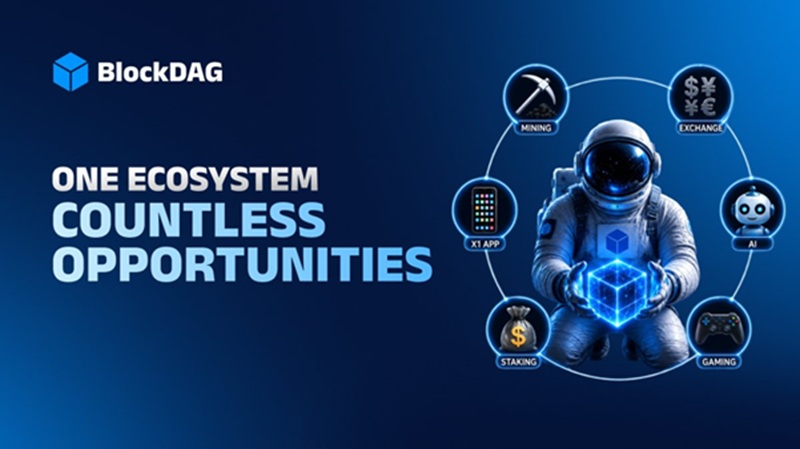
This price setup connects directly to working products today. The Super App allows people to mine BDAG through the X1 Miner, earn staking payouts, and spend funds using debit cards, while the BlockDAGX platform prepares to offer fast trades with deep market liquidity.

BlockDAG also backs its project using $100 million in liquidity, ensuring the $0.10 target price rests on firm ground rather than temporary marketing hype. This structured setup earns a prime place on every real top crypto to buy list rather than short-lived promotional projects.

What sets BlockDAG apart is its built-in 50x launch gap, zero team distribution, and functional crypto products. This solid design keeps serious investors returning to it on every top crypto to buy list available today. These strong core factors explain why market analysts view this project as a top candidate for 1000x returns this year.

Cardano Price Prediction: Grayscale Cancels ETF Plans as ADA Slides Downward

Building a positive Cardano price prediction has become far more challenging lately. Grayscale officially stopped its Cardano ETF project, removing a key institutional growth factor right after ADA became eligible for spot funds on August 9. The coin trades around $0.1824 today, down 2% over 24 hours and losing 4% this past week as news spread.

Cardano maintains several clear advantages, including widespread token distribution, a top-five position among Layer 1 networks by trading volume, and a 10% gain before this update hit. However, any realistic Cardano price prediction must consider that the asset remains down over 70% this year while searching for fresh upward momentum.

Aave Current Price Stalls Near $89

The Aave current price sits near $89.41 right now, up 3% over the last day but down 2% compared to last week. Grayscale gave the network support by allocating almost 20% to its DeFi fund, and Standard Chartered suggested a distant $200 target by 2030. However, the project lead wants to close six inactive chain deployments, affecting nearly $98 million in deposited funds.

This cleanup keeps the system organized, but it does not drive explosive price growth. With circulating tokens near the 16 million cap, the Aave current price lacks room for huge supply movements, making it a stable project that is unlikely to yield massive returns for new investors.

Why the BlockDAG Presale Setup Beats ADA and Aave

Every current Cardano price prediction must adjust for the recent Grayscale exit, while Aave’s current price levels show a project focusing on network cleanup instead of rapid expansion. Both projects feature established teams and real tech, but neither offers massive near-term growth.

BlockDAG offers a clearer path forward. Zero team tokens prevent sudden insider sell-offs, $100 million in planned liquidity backs the $0.10 launch reference, and a functional product ecosystem provides real utility today. Starting with a clear stage 1 entry and a built-in 50x setup makes it a top choice for any top crypto to buy list right now.

Presale: https://purchase.blockdag.network

Website: https://blockdag.network

Telegram: https://t.me/blockDAGnetworkOfficial

Discord: https://discord.gg/Q7BxghMVyu

BlockDAG Captures Global Crypto Attention: Is This the Best New Crypto Presale of 2026?

0

As of mid-August 2026, the total cryptocurrency market cap hovers near $2.2 trillion during a period of noticeable market stagnation. Bitcoin continues to trade between $63,000 and $65,000, struggling against strong resistance due to sluggish US employment figures and an unusually tight connection to the S&P 500. Additionally, US spot Bitcoin ETFs recently experienced $145 million in net outflows, while Ethereum steadily drifts between $1,870 and $1,900.

To top it off, the US Senate delayed its CLARITY Act vote until September. Despite this widespread macro fatigue, one specific project continues to dominate discussions across Telegram, crypto Twitter, and major presale communities: BlockDAG. Investors everywhere are debating whether BlockDAG truly represents the best new crypto presale of 2026 or simply a temporary viral trend.

Understanding the Massive Interest Behind the Project

The surge in attention becomes completely clear once enthusiasts examine BlockDAG’s underlying architecture. Instead of relying solely on Proof-of-Work or Proof-of-Stake, the engineering team designed a hybrid PoW-DAG framework. This network combines the time-tested security of Bitcoin’s Proof-of-Work mechanism with a Directed Acyclic Graph layout that handles numerous transaction lanes at the same time rather than sequentially.

This structural innovation explains why analysts frequently highlight BlockDAG as the best new crypto presale in current industry discussions. Standard blockchains usually force developers to choose between speed and security. BlockDAG eliminates this compromise entirely by validating parallel transactions without generating orphan blocks. As a result, the ecosystem achieves 7,000 transactions per second alongside swift 2-second settlement times. Powered by the GhostDAG consensus algorithm, the network also maintains complete compatibility with the Ethereum Virtual Machine, enabling developers to deploy existing smart contracts effortlessly.

Groundbreaking Technology Meets Proven Traction

Unlike typical early-stage projects that rely purely on prospective concepts, BlockDAG presents tangible proof right now. This clear execution separates the project from competitors claiming to be the best new crypto presale on the market. The BlockDAG Casino is already fully operational and has attracted over 13,000 registered players.

While many presales expect early backers to fund unproven ideas, BlockDAG offers a live gaming ecosystem, an active hybrid PoW-DAG network operating at scale, and a rapidly expanding user base before completing its initial fundraising phase.

Examining the Strategic Structure of the Presale

BlockDAG currently offers Stage 1 tokens at $0.002 each, marking the lowest price across its scheduled 25-stage presale. Incremental price increases will occur at every stage, culminating in a final presale price of $0.05 in Stage 25. Following the conclusion of the presale, the team aims to list the coin at an intended reference price of $0.10. While this listing price represents an ambitious target rather than a guaranteed outcome, it features strong support through $100 million in planned launch liquidity backed by presale funds and internal reserves.

This attractive combination of low entry costs, clear stage progression, and robust liquidity backing clarifies why market participants regularly recommend this project as the best new crypto presale to evaluate in August.

Final Thoughts!

Determining whether BlockDAG stands as the best new crypto presale ultimately depends on individual priorities. Investors who value deep technological innovation will appreciate how the hybrid PoW-DAG model disrupts typical Layer-1 clones. Similarly, those who prioritize working utility will value a project that already serves 13,000 active platform users.

Naturally, presale investments still carry inherent market volatility, and the $0.10 listing goal serves as a target rather than a promise. BlockDAG transparently acknowledges these market realities.

Nevertheless, in an uncertain environment where Bitcoin remains restricted and regulatory decisions like the CLARITY Act face delays, BlockDAG continues to build incredible momentum. By combining real tech, active revenue, vibrant community interest, and an unbeatable Stage 1 price point, BlockDAG firmly secures its position as the most talked-about crypto opportunity of the year.

Presale: https://purchase.blockdag.network

Website: https://blockdag.network

Telegram: https://t.me/blockDAGnetworkOfficial

Discord: https://discord.gg/Q7BxghMVyu

BlockDAG Presale (BDAG) Opens a 50x Path from $500 Toward $25,000 While XRP & SOL Face Heavy Losses

0

Two major crypto names are facing a tough period. XRP is trading near $1, close to its 52-week bottom after losing around 68% over the past year. Solana has seen a similar decline, falling more than half from a year ago and remaining nearly 74% below its all-time high despite a recent small bounce. For holders who entered at higher levels, these charts remain difficult to watch.

This setting is bringing more focus to early presales. When large established coins move sideways or continue lower, attention can shift toward projects still in their presale stage, where pricing has not yet been shaped by years of market cycles. BlockDAG (BDAG) is gaining interest for its structured presale, which gives early participants a clear price path before open-market trading begins.

XRP Price Remains Close to Its 52-Week Bottom

XRP remains a well-known crypto asset, supported by the XRP Ledger and its focus on fast, low-cost cross-border settlement. Institutional interest continues, with banks and asset managers reporting XRP exposure through ETFs, while the network keeps closing millions of ledgers successfully. However, its market performance paints a weaker picture. XRP trades near $1, close to its 52-week low, after losing about 68% of its value over the past year.

Ongoing regulatory uncertainty surrounding pending legislation has kept market sentiment careful, while interest in XRP’s earlier growth story has weakened. Those looking for short-term price gains have seen limited results over the past year, even though the underlying network continues processing settlement activity as designed.

SOL Activity Grows While Its Price Remains Weak

Solana presents a similar case, although its network activity remains strong. Stablecoin supply on Solana has increased about elevenfold in three years to nearly $17 billion, while new DeFi products such as Jupiter’s Lend v2 continue launching. Spot Solana ETFs have also attracted more than a billion dollars from major issuers, while some corporate treasuries have begun operating validator nodes to support SOL holdings.

Despite this activity, SOL remains nearly 74% below its all-time high and more than 50% lower over the past year. It is trading between $72 and $90, with ETF outflows limiting a stronger breakout. Solana remains strong across many network measures, but its price has continued to struggle.

BlockDAG Presale Opens With a Potential 50x Setup

Against these conditions, the BlockDAG presale (BDAG) takes a different approach. Stage 1 begins at $0.002, with 25 stages planned toward a final presale price of $0.05, followed by a $0.10 launch price. At $0.002, $500 would purchase 250,000 BDAG, which would equal $25,000 if BDAG reaches $0.10.

BlockDAG is also entering the market with an active ecosystem. Its blockchain is already operational and processing network activity instead of remaining at the whitepaper stage. BlockDAG Casino is live, giving users a working place to play, transact, and use BDAG rather than waiting for a future product.

Mining hardware is being delivered to participants, creating direct network participation beyond presale purchases. As more miners arrive, they contribute to network security and activity. The BlockDAGX exchange is also planned to add trading and liquidity, creating another utility layer for BDAG once listing begins.

Longer term, a Super App is being developed to combine wallets, mining, trading, swaps, spending, payments, and rewards in one simple platform. This gives the project a broader utility plan than many presale-stage coins currently offer.

Final Say

For those seeking early-stage upside, established assets trading near $1 and $76 respectively have less room for percentage growth than a project still entering Stage 1 of a 25-stage presale. That is where the BlockDAG presale (BDAG) stands out: a $0.002 entry price, a defined path toward $0.10, and an active ecosystem already delivering products. With $100M in planned launch liquidity, BDAG enters its next stage with a setup worth watching closely.

Explore BlockDAG Now:

Presale: https://purchase.blockdag.network

Website: https://blockdag.network

Telegram: https://t.me/blockDAGnetworkOfficial

Discord: https://discord.gg/Q7BxghMVyu


Quantinuum, Oracle Partner to Bring Quantum Computing to Oracle Cloud

0

Quantinuum and Oracle are joining forces to bring quantum computing to Oracle’s cloud infrastructure, giving businesses and researchers access to quantum processing alongside artificial intelligence and high-performance computing as the technology industry moves closer to commercializing quantum systems.

The companies announced a multi-year partnership on Tuesday but did not disclose financial terms or provide a firm date for deployment.

Under the agreement, customers of Oracle Cloud Infrastructure will gain access to Quantinuum’s Helios quantum computer through Oracle’s planned quantum service. The integration will allow users to combine quantum computing with Oracle’s graphics processing and high-performance computing resources within the same cloud environment.

The partnership represents an effort to move quantum computing beyond isolated research systems and into enterprise computing environments where quantum processors can work alongside conventional computing infrastructure.

Helios, which Quantinuum commercially launched in November, is expected to operate on-site within an Oracle AI data center in the United States. The companies said it will integrate with existing OCI services and operate under the same governance framework used by Oracle cloud customers.

The arrangement could be significant for enterprises seeking to experiment with quantum computing without building or maintaining dedicated quantum infrastructure. By incorporating quantum capabilities into OCI, Oracle intends to provide developers with access to quantum resources through an environment that already supports conventional computing and AI workloads.

“Together, Quantinuum and Oracle plan to explore how hybrid quantum-AI infrastructure could address some of the most computationally intensive challenges facing enterprises and broaden access for universities and research institutions advancing scientific discovery and education,” the companies said in a joint statement.

The focus on hybrid computing reflects the current state of quantum technology. Quantum computers are not expected to replace conventional processors or GPUs for most workloads. Instead, researchers and technology companies are pursuing systems in which quantum processors handle specific computational problems while classical computers perform other parts of an application.

Quantinuum CEO Rajeeb Hazra said the partnership is designed around that model.

“We believe the next phase of enterprise computing will be shaped by bringing quantum, AI and high-performance computing together,” Hazra said, adding that the collaboration would create “a unique deeply integrated environment for hybrid workloads.”

Oracle plans to preview its quantum service in the coming months. The service is expected to combine Quantinuum’s development stack with open-source hybrid programming frameworks, allowing developers to build and test applications that distribute workloads between quantum and classical computing systems.

The partnership comes as technology companies increasingly seek practical applications for quantum computing after years of investment in developing the underlying hardware.

Quantum computers use quantum-mechanical effects to process information in ways that differ from conventional computers. Their potential applications include complex optimization, materials science, drug discovery, financial modeling and cryptography. However, the technology remains at an early stage, with companies still working to improve reliability, scalability, and the number of useful computations that quantum systems can perform.

Cloud access has consequently become an important part of the industry’s commercialization strategy. Rather than requiring customers to purchase quantum machines, cloud platforms can provide remote access to quantum processors while integrating them with existing development and computing tools.

Oracle’s involvement also denotes the growing relationship between quantum computing and AI infrastructure. The same enterprises investing in AI now require high-performance computing resources, large data-processing capabilities, and specialized hardware. Integrating quantum processors into those environments could allow researchers to test whether quantum systems can provide advantages for specific workloads.

The financial terms of the Quantinuum-Oracle agreement were not disclosed, and the companies did not announce when customers would receive access to Helios through OCI.

However, the partnership expands Oracle’s cloud offering into an emerging computing category and gives its customers another specialized processing option alongside CPUs, GPUs and high-performance computing systems. For Quantinuum, integration with one of the world’s major cloud platforms could broaden access to its quantum technology and provide a path toward wider enterprise adoption.

Analysts believe the immediate commercial impact is likely to depend on whether developers can identify workloads where quantum processors deliver measurable advantages over increasingly powerful classical systems.