DD
MM
YYYY

PAGES

DD
MM
YYYY

spot_img

PAGES

Home Blog Page 5005

Get More Value on Your Money with Mintyn, A Tekedia Capital Portfolio Startup

0

Good People, Tekedia Capital portfolio neobank startup, Mintyn | Online Banking, achieved a major milestone today. The banks of the future must do more to thrive – and Minityn is doing just that. Mintyn’s playbook to make sure that your money delivers more value if banked with Mintyn than any bank in Nigeria is working.

You want to buy rice and you have N5,000. If you buy that rice alone from your account with other banks in Nigeria, it could give you 100 cups*. But if you are banking with Mintyn, through Mintyn Trade in its app, you can post “I want to buy rice and I live in Ikeja”. Within minutes, Mintyn will share that message. Other people who want to buy rice indicate interest.

Mintyn will then pool the funds and buy that rice in bulk – and then use its logistics systems to share the rice. But the time everything is done, your N5,000 could give you 200 cups*. Is that not smart banking? We have doubled value for you? You see why Nigerians like Mintyn!

Mintyn Trade serves estates, churches, mosques, companies, etc where many people can be served together to reduce the marginal cost of logistics. I commend the team for exceptional operation; they’re growing the numbers. Mintyn is available in all locations in Nigeria here mintyn.com

A Snapshot of Nigeria’s Expenditure Performance for the 2021 Fiscal Year and Projections for 2022

0
Finance Minister, Nigeria

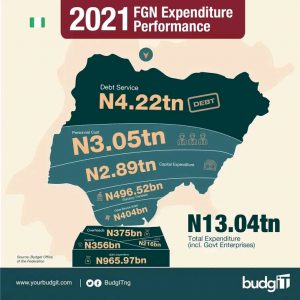
The Budget Office of the Federation recently reported that a total expenditure of N13.04trn was made at the 2021 fiscal year ended as against N13.08trn that had earlier been proposed at the beginning of the fiscal year. The Budget Office of the Federation provides budget functions, implements budget and fiscal policies of the Federal Government of Nigeria.

According to the 2021 Federal Government of Nigeria’s expenditure performance as reported by the Budget Office of the Federation, N4.22trn were spent on debt servicing, that is about 32 percent and largest fraction of the total expenditure for the year. This is followed by personnel cost at N3.05trn and Capital expenditure at N2.89trn. The remaining N2.88trn was distributed among statutory transfers, overhead, pensions, other operating expenses, other service expenses etc.

The 2021 expenses recorded 20 percent increase from the 2020 expenditure which was put at N10.81trn. The Federal Government of Nigeria had earlier proposed N11.9trn for the 2021 fiscal year to absorb the macroeconomic and domestic economic realities observed in the 2020Q2. The budget later increased to N13.08trn in the beginning of the fiscal year and N14.57trn after a supplementary budget of N982.7bn was included and approved on 26 July 2021.

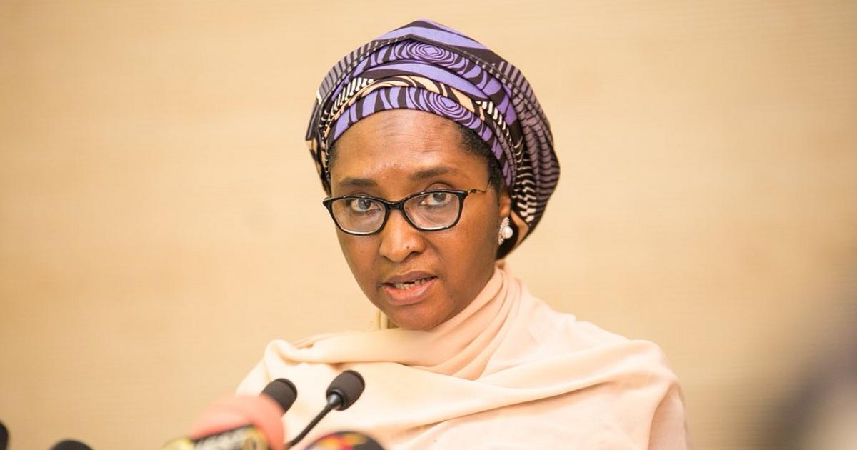
Discussing the proposed 2021 budget, Zainab Ahmed, Nigeria’s Minister of  Finance, Budget and National Planning was reported to have made the following remarks:

  1. With the current global economic conditions, key parameters and other macroeconomic projections driving the medium term revenue and expenditure, frameworks have been revised in line with emerging realities.

  2. The Crude oil price benchmark in 2021 would be revised from $28 per barrel in 2020 to $40 per barrel while crude oil production capacity would be reviewed from 1.8million barrels per day to 1.86million barrels per day.

  3. The exchange rate of the Naira would be left unchanged at N360 to a dollar during the year with inflation rate expected to drop from 14.15 percent in 2020 to 11.95 percent in 2021.

  4. The non-oil GDP was projected to grow from N131.16trn to 132.6trn; oil GDP from 88.69trn to 101trn; national GDP from 139trn to 142.19trn and Nominal consumption to rise from N117.9trn to 118.89trn with GDP growth rate projected to improve from a negative 4.2 percent to positive 3 percent.

As at November 2021, the FGN’s total revenue was N5.51trn, about 30 percent shortfall from the projected N7.89trn. Oil price reached $79.31 per barrel against the $40 benchmarked, while oil production was put at 1.56million barrels as against 1.86million barrels earlier planned for. Also, Naira exchanged at N410.15 for a dollar as against N360 to a dollar budgeted and inflation rate was put at 15.4 percent vs 11.95percent that was also earlier budgeted for. However, the GDP growth rate hit 4.03 percent as against 3.0 percent earlier expected. This was a significant win recorded for the year.

For the 2022 fiscal year, the FGN’s total expenditure was projected at N17.13trn which is 18 percent higher than the 2021 budget. Of this, the recurrent non-debt spending was put at N6.91trn, capital expenses at 5.96trn and Debt servicing at 3.61trn. Oil production is projected to increase to 1.88million barrels per day and oil price to hit $62 per barrel. Also, Naira exchange rate is expected to maintain N410.15 to a dollar and inflation rate is expected to climb down to 13 percent. Furthermore, Nominal consumption was to increase to 119.28trn and Nominal GDP to increase to 184.38trn and GDP growth rate expected to hit 4.20percent .

According to the Budget office of the Federation, the 2022 budget which was prepared using zero-based budgeting approach based on the policies/strategies contained in the 2022-2024 Medium Term Expenditure Framework (MTEF) and Fiscal Strategyy Paper (FSP) seeks to continue the reflationary policies of the 2020 and 2021 budgets.

Currently, the Naira has further decreased in value against the dollar, exchanging at N418 to a dollar at the official market and around N700 to a dollar at the unofficial market. As of June, inflation rate climbed up to 18.86 percent months-on-month increase. Furthermore, the cost of servicing debt surpassed the Federal Government’s retained revenue by N310 billion in the first four months of 2022, according to the minister of finance Zainab Ahmed.

While the Government’s institutions including the pro-Government individuals have continued to attribute the current economic recession of the country to several factors ranging from increasing demand for dollar, massive exodus of people from the country to other countries, the hideous activities of the cryptomarket, and the Russian-Ukrainian war, critics have not failed to decry the current unproductive state of the country influenced by the increasing culture of borrowing and waste in the Government which has shot the country’s public debt portfolio up above N41trn, thereby creating a huge debt to revenue disparity.

Sanusi Lamido, former Central Bank of Nigeria Governor and former Emir of Kano is a strong critic of the Nigerian Government and advocate of economic-driven policies. Sanusi Lamido was reported to have said Nigeria’s bankruptcy is masterminded by its inability to cash in on the oil windfall orchestrated by the Russian-Ukrainian war. The former CBN Governor believe Nigeria is sitting on a keg of gunpowder, noting it is the only oil-producing country that is grieving at the moment when oil prices have gone up as a result of the war.

One Acre Fund Announces Nigeria Graduate Internship Opportunities

0

To our community members here who are looking for a graduate internship, consider this one. One Acre Fund  is an international trade and development organization. It “supplies smallholder farmers with the financing and training they need to grow more food and earn more money. Instead of giving handouts, we invest in farmers to generate a permanent gain in farm income. We supply a complete service bundle of seeds and fertilizer, financing, training, and market facilitation— and we deliver these services within walking distance of more than 1 million rural farmers we serve.”

Apply and if accepted by One Acre Fund Nigeria, you will also spend time at Tekedia Institute as part of your development, courtesy of funding by One Acre Fund Nigeria.

One Acre Fund Nigeria is looking to place a cohort of paid interns for a four-month period. Interns will work on impactful projects, receive mentorship from organizational leaders and provide support to One Acre Fund’s operations. Interns will be given substantial work assignments and asked to produce high-quality deliverables.

Interns are valued members of the One Acre Fund family and we are looking for the best of the best. We ask all staff to take a “Farmers First” attitude and approach their work with humility. Specific projects may change with the needs of the organisation.

ELIGIBILITY REQUIREMENTS: For this cohort, we will require the following;
  1. Strong quantitative background [Minimum of an undergraduate degree in Mathematics, Statistics, Accounting, Economics, Finance, Engineering or a related course]
  2. Top grades [First Class/Second Class Upper degrees for Bachelors, Distinction or Upper Credit for HND]
  3. Internship will be based in Minna. Candidates should be willing to reside in Minna, Niger State.
Based on performance, interns who successfully complete the program will have the opportunity to transition into full time roles within the organisation.
Click here to view the job description: https://drive.google.com/file/d/1F3KhEZEUnobyH46HSNU0OJab5k6PsBRi/view?usp=sharing

America Cooks for Donald Trump As FBI Raids Home

1

In Ovim community in Abia State Nigeria, during Nkwo days when elders gather to discuss the affairs of the community, there is always one unmistaken statement that follows all libations: “aka ojoo gara na-nnu agwo gbakwaya” [literally, any bad hand that enters into the warren, may the snake bite him]. Simply, the elders are saying anyone who wants to commit evil to find success, may he/she meet obstacles and destructions. They do not stop there.

When a person causes trouble, the Ojengwa (women who act like police and enforce local ordinance) will go out to issue warnings. If the person does not change, they call the youth to warn his parents. If the parents cannot help, the person will then be excommunicated. That excommunication means taking the person to Nkwo – the highest deity in Ovim – and asking Nkwo that this person does not belong anymore. Any person who goes through that is basically done for life – totally worthless. Most after that experience will never return to Ovim; they are lost forever.

Every parent will tell his or her child, do not allow this community to cook for you because you cannot finish eating their food. Why this traditional vibe? America is cooking for former US President Donald Trump:

The FBI executed a search warrant Monday at Donald Trump’s Mar-a-Lago resort in Palm Beach, Florida, as part of an investigation into the handling of presidential documents, including classified documents, that may have been brought there, three people familiar with the situation told CNN.

The former President confirmed that FBI agents were at Mar-a-Lago and said “they even broke into my safe.” He was at Trump Tower in New York when the search warrant was executed in Florida, a person familiar told CNN.

“My beautiful home, Mar-A-Lago in Palm Beach, Florida, is currently under siege, raided, and occupied by a large group of FBI agents,” Trump said in a statement Monday evening.”

This is unprecedented for a former US President. They could have subpoenaed the document. But for them to use raids, the implication is that a judge had to be convinced that a crime was possibly committed for him or her to approve the warrant.

People, great societies work that way: when one person cooks for a village, be assured that the village can finish your meal. But the issue is making sure the village does not cook for you because you have no chance. Trump cannot afford for America to cook for him because he has no chance.

LCCI Asks Buhari to Tackle Rising Debt by Increasing Revenue

0

As Nigeria’s public debt compounds, stakeholders of the economy are expressing concern over its future impact on the country’s economic wellbeing.

The public debt, which if added to the N20 trillion Ways and Means from the Central Bank of Nigeria, will amount to more than N61 trillion, is increasingly eclipsing the country’s revenue.

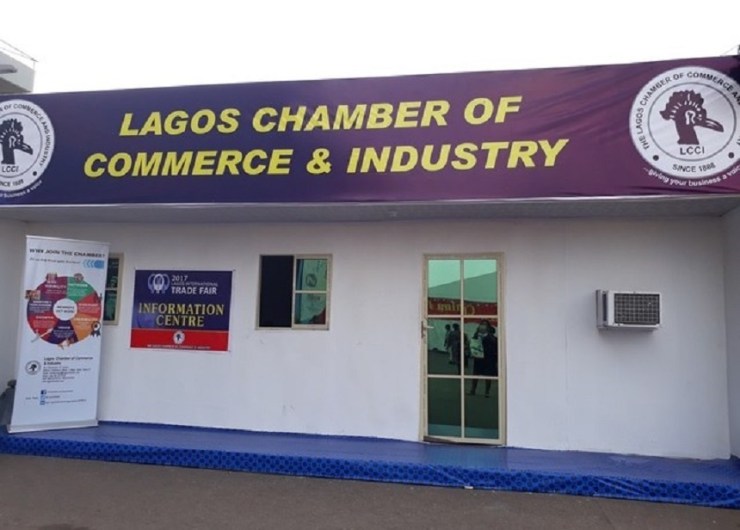
On Monday, the Lagos Chamber of Commerce and Industry (LCCI) called on President Muhammadu Buhari’s administration to adopt measures to increase the country’s revenue and borrow from cheaper sources to cushion Nigeria’s debt portfolio, NAN reports.

The call was made by the LCCI president Michael Olawale-Cole. He said the advice became necessary because the country’s rising debt stock was becoming increasingly problematic due to dwindling revenue and the unsustainable burden of subsidy payments.

He added that most recent statistics on the regime’s revenues showed poor performance and mounting government costs, making it evident that Nigeria was going through a debt crisis.

He noted that aggregate expenditure for 2022 was estimated at N17.32 trillion; at the end of April, a revenue of N5.77 trillion was expected, but only N1.63 trillion was realized as the regime’s retained revenue.

Mr Olawale-Cole further mentioned that within the same period, the government’s actual spending stood at N4.72 trillion; N1.94 trillion on debt servicing, and N1.26 trillion on personnel costs, leaving only N773.63 billion for capital expenditure.

He further said the country’s total public debt stock rose from N39.56 trillion in December 2021 to N41.60 trillion by the end of the second quarter of 2022, as revealed by the Debt Management Office (DMO).

He warned that the borrowings were significantly increasing, and Nigeria was struggling to service these debts due to revenue mobilisation challenges and an increased fuel subsidy burden.

These developments, the LCCI president said, were disturbing, seeing that debt servicing alone was higher than actual retained revenue in the first four months of this year.

“There are already concerns that most, if not all, of the assumptions in the Medium-Term Expenditure Framework (MTEF) 2023-2025 will be missed as we continue to experience unprecedented levels of disruptions to supply chains and agricultural production, the LCCI chief added.

He explained that the 2022 budget assumptions had already fallen short in terms of inflation, exchange rate, and GDP growth rate.

“And all of these assumptions have become inadequate. Nigeria’s debt-to-GDP ratio now stands at 23.27 per cent, as against 22.43 per cent on December 31, 2021. On the path of caution, we urge the federal government to discontinue this unsustainable pattern,” stressed the LCCI president.

The industrialist acknowledged that the level of insecurity in the country had prompted increased spending on defence and security and that worsening insecurity in the country had battered investors’ confidence and affected foreign exchange inflows into Nigeria.

He further stressed that with the high component of Eurobonds as part of external debt, the current weakening of the naira signified an exchange rate risk likely to put pressure on inflation and its attendant consequences.

“Nigeria is the only major oil exporter that hasn’t benefited from the windfall of higher global oil prices. The International Monetary Fund (IMF) has warned that debt servicing may gulp 100 per cent of the federal government’s revenue by 2026 if the government fails to implement adequate measures to improve revenue generation,” Mr Olawale-Cole stated.

According to him, in the face of rising debt servicing costs accompanied by a dwindling revenue, the provision of critical infrastructure and amenities like healthcare services, education, power, roads, and security will be hard hit as funding shrinks.

Mr Olawale-Cole also stated that recently, the DMO listed N250 billion Sukuk on the Nigerian Exchange Limited (NGX) as an alternative financing source to bridge the infrastructure gap in the country.

He said the issuance and subsequent listing of the Sovereign Sukuk on the NGX platform aligned with the LCCI’s persistent call for cheaper government financing away from debts by leveraging innovative and cost-effective revenue sources.

“The chamber has consistently advised the government to borrow from cheaper sources and consider deficit financing from equity instead of the expensive debts borrowed and used for recurrent expenditures. The commercialisation model proposed for NNPC Limited is the right direction to go,” he explained.

The LCCI boss added, “Once this plan succeeds next year, it should be replicated with other national corporate assets scattered across the country. Nigeria must manage its debt burden to avoid further pressure on revenue.”

Mr Olawale-Cole further said it was also imperative that more spending was needed in supporting productive infrastructure instead of spending borrowed money on subsidizing consumption.

“Government must rethink its sourcing of debts and spending of borrowed funds,” warned the LCCI president.