DD
MM
YYYY

PAGES

DD
MM
YYYY

spot_img

PAGES

Home Blog Page 502

CBO Chief Says Trump’s Tariffs Fuel Inflation, but Long-Term Deficit Gains Projected

0

Congressional Budget Office (CBO) Director Phillip Swagel said Monday that President Donald Trump’s tariffs have likely pushed inflation higher than CBO analysts had initially expected, adding a new layer of complexity to the debate over their economic impact.

Speaking on CNBC’s Squawk Box, Swagel explained that while Wall Street analysts have been bracing for tariff-driven price hikes for months without seeing them clearly reflected in consumer markets, CBO data suggests otherwise.

“Our analysis shows the economy has weakened since January, and normally that should be exerting downward pressure on inflation,” Swagel said. “Instead, we’re seeing upward pressure from tariffs.”

Despite near-term inflationary pressures, Swagel highlighted the CBO’s long-term assessment, which points to a surprising fiscal benefit. According to him, the tariffs are expected to reduce the U.S. budget deficit by $4 trillion over the next decade by generating new revenue for federal accounts.

“So $3.3 trillion of revenue and then $700 billion of averted debt costs,” he said. “That would be a big reversal in terms of the deficit.”

Still, the future of Trump’s tariffs remains uncertain. The Supreme Court is scheduled to hear oral arguments in early November, after the Trump administration appealed lower court rulings that found the president had exceeded his authority in imposing the levies.

Swagel described the outcome of that case as “one of the key uncertainties in the economy.” However, he pointed to the CBO’s latest September report, which suggests that the cloud of uncertainty will fade over time.

“The effects of policy uncertainty dissipate over time and disappear by the end of 2027, returning investment to what it would have been without the uncertainty in trade policy,” the report stated.

The debate over Trump’s tariffs evokes memories of earlier U.S. trade battles, but the current round differs sharply from his first wave of duties between 2018 and 2020. Then, Trump’s administration launched a tariff offensive aimed primarily at China, imposing levies on more than $360 billion worth of Chinese imports. Beijing responded with retaliatory tariffs on U.S. agricultural exports, forcing Washington into a costly subsidy program to bail out American farmers. At the same time, the EU hit back against U.S. steel and aluminum tariffs by slapping duties on iconic American products such as bourbon, motorcycles, and Levi’s jeans.

That earlier round of tariffs centered on specific trade grievances—such as China’s alleged intellectual property theft, state subsidies to strategic industries, and what Trump described as “unfair” auto tariffs from Europe. The disputes culminated in a “phase one” U.S.-China trade deal in 2020, but many duties remained in place, continuing to distort supply chains even as global markets sought relief from escalating tensions.

By contrast, the current tariffs extend well beyond targeted trade fights. They function as a broad revenue-generating mechanism designed not only to pressure foreign competitors but also to pour money into U.S. government coffers. That is the context in which the CBO’s $4 trillion deficit reduction projection stands out: unlike the earlier wave of tariffs, which raised questions about consumer costs and farmer bailouts, today’s tariff structure is being justified partly as a fiscal stabilizer in an era of mounting federal debt.

The legal backdrop is also different. In 2018–2020, most challenges came from affected industries and trade partners through the World Trade Organization, resulting in drawn-out arbitration. Now, the fight is moving into the U.S. judicial system itself, with the Supreme Court poised to rule on whether Trump overstepped his authority—a decision that could redefine presidential control over trade policy for decades to come.

Together, these contrasts highlight why today’s tariffs are viewed both as an inflationary headwind and a fiscal lifeline, a duality that separates them from Trump’s first wave of duties that were primarily about geopolitical leverage and industrial retaliation.
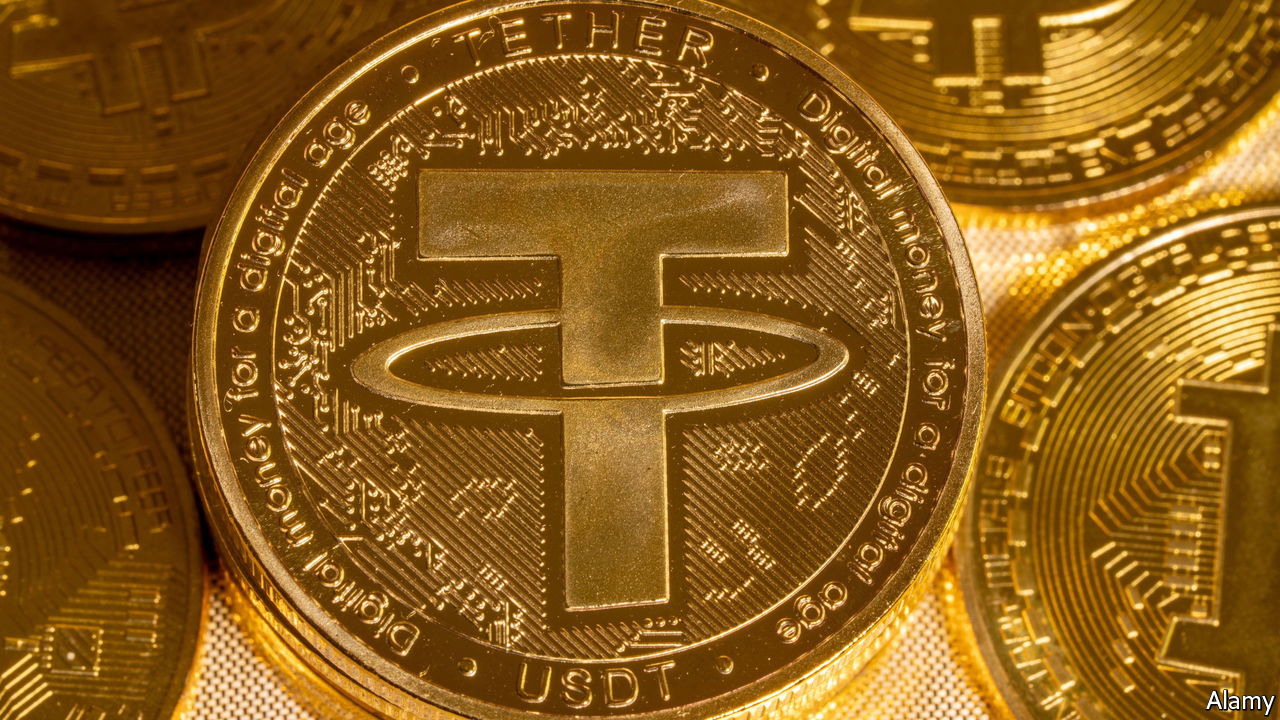

A Look At Tether’s Announcement of USAT Stablecoin and Bo Hines’ Appointment

0

Tether, the issuer of the world’s largest stablecoin USDT, officially unveiled USAT stylized as USAT as a U.S.-regulated, dollar-backed stablecoin designed specifically for the American market.

This marks a significant expansion for Tether into the U.S., leveraging recent regulatory developments like the GENIUS Act, which establishes federal standards for stablecoin issuers. At the same time, Tether announced the appointment of Bo Hines, a former White House crypto advisor, as the future CEO of its new U.S. entity, Tether USAT.

USAT is positioned as a compliant alternative to USDT, targeting U.S. businesses, institutions, and users who need a domestically regulated digital dollar. It will be backed by transparent reserves, primarily U.S. Treasuries, and aims to support use cases like remittances, global payments, and online checkouts.

Unlike USDT, which operates globally and has faced past scrutiny over reserves, USAT emphasizes U.S. oversight from the outset to build trust and interoperability. The token will be issued by Anchorage Digital, a federally chartered crypto bank, with reserves managed by Cantor Fitzgerald.

Both partners will hold stakes in the U.S. entity and share revenue from reserve assets (e.g., interest from Treasuries). Tether’s proprietary platform, Hadron, will handle tokenization. Tether plans to roll out USAT by the end of 2025, with headquarters in Charlotte, North Carolina—Hines’ home state.

This keeps Tether’s international operations including USDT based in El Salvador. Tether CEO Paolo Ardoino highlighted USAT as a way to reinforce U.S. dollar dominance in the digital economy, noting that Tether already holds billions in U.S. Treasuries.

Bo Hines, a former Republican congressional candidate and key figure in U.S. crypto policy, served as Executive Director of the White House Presidential Council of Advisors for Digital Assets often called the White House Crypto Council under President Trump.

He led efforts on a major 166-page digital assets report and contributed to the GENIUS Act’s passage. Hines resigned in August 2025 and joined Tether initially as a strategic advisor before being elevated to CEO of Tether USAT.

His background bridges policy and industry, helping Tether navigate U.S. regulations amid past controversies like CFTC fines over reserve transparency. This announcement positions Tether to compete more directly with rivals like Circle’s USDC in the U.S., potentially capturing institutional demand while addressing long-standing regulatory concerns.

USAT’s alignment with the GENIUS Act and U.S. oversight addresses a key pain point for U.S. institutions wary of non-regulated stablecoins like Tether’s USDT. Unlike USDT, which has faced scrutiny over reserve transparency, USAT’s transparent backing by U.S. Treasuries and domestic regulation could attract banks, fintechs, and enterprises hesitant to adopt USDT.

Circle’s USDC has dominated the U.S. regulated stablecoin space with its compliance-first approach. USAT’s entry, backed by Tether’s massive $133 billion market cap and $13 billion in 2024 profits, threatens USDC’s ~$37 billion market share by offering a similar regulated alternative with potentially lower fees or broader global reach due to Tether’s established network.

Smaller stablecoins like PYUSD (PayPal) and Paxos’ tokens may struggle against USAT’s scale and Tether’s brand recognition, especially if USAT integrates seamlessly with Tether’s global infrastructure (e.g., Hadron platform).

Tether’s USDT holds over 60% of the global stablecoin market, with deep liquidity across exchanges, DeFi platforms, and cross-border payments. USAT can leverage this ecosystem, offering interoperability with USDT for international use cases, which could appeal to businesses needing both U.S.-compliant and global solutions.

While USDC is strong in the U.S., its global adoption lags behind USDT in regions like Asia and Latin America. USAT could bridge this gap, allowing U.S. firms to tap Tether’s global reach while staying compliant domestically, potentially outmaneuvering USDC in hybrid use cases.

Bo Hines’ experience as a White House crypto advisor and his role in shaping the GENIUS Act give Tether an insider edge in navigating U.S. regulations. This could accelerate USAT’s adoption by U.S. policymakers and institutions, positioning it as a “patriotic” stablecoin aligned with the Trump administration’s push for dollar dominance.

USAT’s focus on use cases like remittances, payments, and online checkouts directly challenges USDC and PYUSD, which target similar applications. Tether’s plan to headquarter USAT in Charlotte, North Carolina, may also foster regional partnerships, boosting adoption in the U.S. Southeast.

If USAT gains traction, it could pressure non-U.S. stablecoin issuers (e.g., Binance or new entrants) to seek similar regulatory approvals, raising the bar for compliance globally and potentially consolidating the market around a few dominant players.

By combining U.S. compliance with Tether’s global infrastructure, USAT could capture significant market share, particularly among institutions and cross-border businesses. However, it must overcome Tether’s historical baggage and execute flawlessly under regulatory scrutiny to outpace established players like Circle.

The competition will likely drive innovation, lower fees, and accelerate stablecoin adoption, reshaping the U.S. digital payments landscape by late 2025 and beyond. On X, discussions highlight excitement about increased legitimacy for stablecoins, though some users note the irony of Tether—long criticized for offshore ooperation.

Tether reported $13 billion in profits for 2024 largely from Treasury yields and expects similar results in 2025, underscoring its financial strength to back this pivot.

Tesla Shares Surge 80% This Year, Erases 2025 Loses as Musk Buys $1Billion Shares

0

Tesla’s stock is soaring back in 2025 after a rough start to the year. Shares of the electric vehicle (EV) giant have surged 80%, completely erasing earlier losses.

The dramatic rebound comes after Tesla’s board gave Elon Musk a chance to become the world’s first trillionaire, Musk then made a bold show of confidence by purchasing $1 billion worth of Tesla stock, sending a strong signal to investors about the company’s future.

This move has reignited bullish sentiment on Wall Street and sparked renewed optimism around Tesla’s growth prospects in the EV and AI-driven energy sectors.

The news lifted shares of Tesla (TSLA) 7% at the market open Monday. While it didn’t sustain those early gains, it did finish the day up nearly 4%. That was enough to wipe out the remaining losses for Tesla shares for the year, which at one point were down 42% from the end of 2024.

Commenting on the company’s growth tracjectory,

Dan Ives, tech analyst with Wedbush Securities and one of the bigger fans of Tesla on Wall Street said, “It’s a huge vote of confidence from Musk and the bulls love seeing this. It sends a positive signal after a very tumultuous year for Musk and Tesla shareholders.”

Recall that as Musk became active in running the Trump administration’s Department of Government Efficiency, the company started facing backlash from those who opposed Trump and his agenda. His EV company Tesla posted its largest sales drops in history in the first and second quarter, and profits plunged along with it.

Beyond the political backlash that impacted sales, the company also faced faced increased competition from the EV offerings of other automakers, particularly in China.

Displeased with the company’s downward trajectory, Tesla’s board, in its proxy statement spoke of the importance of keeping Musk focused on Tesla going forward.

They pointed out his involvement as CEO of several other companies, including rocket company SpaceX and artificial intelligence company xAI, which owns the social media platform X, which demands his attention. In addition to his many business interests, Musk remains active in politics, despite his falling out with Trump. He has announced plans to form a third political party, but details remain murky.

To ensure full commitment, Musk has consistently demanded a bigger stake and increased voting power at Tesla, having said previously that he would prefer to build AI and Robotuce products outside of Tesla if he cannot get 25% voting power. The board wants Musk focused on four things: cars, Tesla’s full self-driving software, robo-taxis, and AI-trained robots.

The recent package “represents a critical next step to keep Musk as CEO at least until 2030,” wrote Wedbush analyst Dan Ives in a report Friday. “Tesla is heading into one of the most important stages of its growth cycle with the autonomous and robotics future now on the doorstep.”

Musk Monday’s stock purchase brought an additional 2.6 million Tesla shares into his portfolio. But it barely increased his stake in the company, his holdings of Tesla shares rose by less than 1%.

This turnaround comes after a turbulent first half of the year, where Tesla grappled with intensifying competition from Chinese rivals like BYD and a broader slowdown in global EV sales. Analysts had initially forecasted a challenging 2025, with earnings projections dipping nearly 30% due to margin pressures and supply-chain disruptions, as noted in reports from Yahoo Finance.

Yet, the company’s focus on innovation, particularly in full self-driving technology and the Optimus robot project, has reignited investor enthusiasm.

Tesla’s third-quarter delivery volumes are expected to exceed forecasts, potentially marking a “bottom out and rebound” as suggested in analysis from LongPort. The company’s energy storage business also hit record highs, deploying over 11 GWh in the prior quarter, bolstering revenue diversification away from pure auto sales.

Future Outlook

Tesla’s 2025 recovery underscores its ability to navigate volatility through innovation, but sustaining this momentum will require executing on ambitious projects like unsupervised autonomy and next-gen vehicles.

As shares approach break-even for the year, industry insiders are watching closely for signs of whether this rally marks a new era or a temporary surge.

Shiba Inu Enthusiasts Expect 20x, But Ozak AI’s AI Advantage Positions It for 100x Upside

0

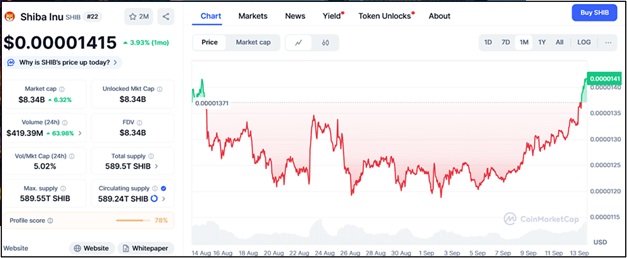
Shiba Inu (SHIB), trading at $0.00001410, continues to energize its huge community with forecasts of as much as a 20× rally, supported via a manner of resistance at $0.00001500, $0.00001650, and $0.00001800 and aid at $0.00001350, $0.00001280, and $0.00001200. Yet at the same time as SHIB prospers on meme-driven hype, traders are more and more attracted to Ozak AI (OZ)—a presale project priced at just $0.01 that has already raised over $3 million—with its AI-powered blockchain vision and formidable 100× ROI potential positioning it as one of the most thrilling boom memories of 2025.

Shiba Inu’s Meme Power in 2025

Shiba Inu (SHIB), trading at $0.00001410, remains one of the most recognized meme coins in the crypto market. Its big network, ecosystem expansion through Shibarium, and cultural presence have kept it applicable years after its initial hype cycle. Analysts advocate SHIB may want to rally up to 20× in the next bull run if meme coin enthusiasm returns in full pressure, placing it near to all-time highs and rewarding long-term holders who’ve caught on to the project.

From a price movement perspective, SHIB faces resistance first at $0.00001500, a stage that has time and again capped upward momentum. Beyond that, a more potent barrier sits round $0.00001650, with a prime test at $0.00001800; that would signal the start of a broader rally. On the downside, SHIB unearths a manual near $0.00001350, with support at $0.00001280 and $0.00001200. These are tiers that bulls will need to defend to prevent further declines. These resistance and assist stages can be important in shaping SHIB’s near-term trajectory.

The 20× Forecast for SHIB

If Shiba Inu reaches its full bullish potential, a 20× run would take it far above current levels, creating strong returns for early believers and new retail entrants. This growth potential highlights SHIB’s continued ability to spark FOMO when retail activity and meme-driven speculation surge. However, while such gains are impressive, meme coins like SHIB often face volatility and lack the innovation-driven foundation of emerging projects built around utility and technology.

Ozak AI’s 100× Presale Buzz

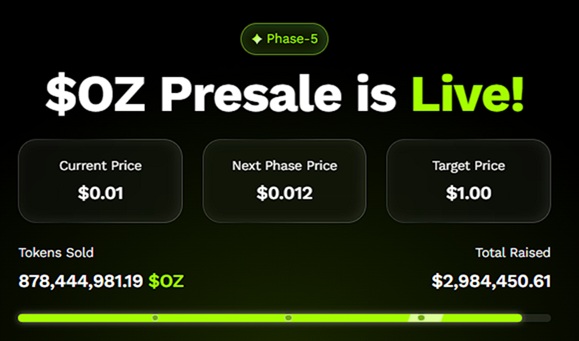
In contrast, Ozak AI (OZ) is attracting massive attention in its presale by combining artificial intelligence and blockchain, two of the fastest-growing industries in the world. Currently priced at just $0.01 per token in Stage 5, Ozak AI has already raised more than $3 million, signaling strong investor demand. Analysts believe OZ could surge to $1 or beyond once listed, offering early buyers 100× upside. Compared to SHIB’s 20× potential, Ozak AI’s forecast looks far more explosive, making it one of the most compelling opportunities of 2025.

Why Ozak AI Stands Out

What makes Ozak AI different is its utility-focused roadmap. Instead of relying solely on community-driven hype, OZ is designed to embed AI capabilities into decentralized systems, creating smarter, more efficient blockchain applications. This innovation-driven model not only makes Ozak AI more resilient than meme coins but also positions it as a project with long-term relevance. The fact that both retail investors and whales are accumulating during the OZ presale adds further confidence in its potential trajectory.

Shiba Inu at $0.00001410 continues to spark optimism with 20× predictions, supported by resistance at $0.00001500, $0.00001650, and $0.00001800 and support at $0.00001350, $0.00001280, and $0.00001200 shaping its short-term path. Yet while SHIB relies on meme-driven hype cycles, Ozak AI’s $0.01 presale entry and $3 million raised position it as a groundbreaking project with 100× ROI potential. For investors, Shiba Inu offers solid upside within the meme sector, but Ozak AI clearly delivers a far bigger opportunity for exponential growth in 2025.

About Ozak AI

Ozak AI is a blockchain-based crypto project that provides an innovative platform that focuses on predictive AI and advanced data analytics for financial markets. Through machine learning algorithms and decentralized community technologies, Ozak AI enables real-time, accurate, and actionable insights to help crypto lovers and corporations make the perfect choices.

For more, visit

Website: https://ozak.ai/

Telegram: https://t.me/OzakAGI

Twitter: https://x.com/ozakagi

Top Online Gambling Platforms 2025: Spartans, Stake.com, FanDuel, Roobet, & More

0

Online gambling in 2025 is being reshaped by fresh ideas, bold updates, and a focus on fairness that breaks away from the past. Among the many names driving change, Spartans CASHRAKE™ stands out for its system that gives back to players, while Stake.com pushes the crypto-first model. FanDuel, Roobet, BetMGM, LeoVegas, and DraftKings also bring their own shifts, making this list of top online gambling platforms one that shows the key changes shaping how people play today.

1. Spartans CASHRAKE™: Building Fairness into Every Bet

Spartans Games has launched something no other site has tried before: value on each bet. The CASHRAKE™ setup is not a promo or short deal. It is part of the system, giving rakeback on all wagers and cashback on every loss.

Unlike many platforms where rewards are hidden in fine print or limited to VIP players, CASHRAKE™ works for all. This changes how users view risk. For the first time, the house gives back on every turn. This new balance between platform and player makes Spartans one of the top online gambling platforms in 2025, and sets it apart from the rest.

2. Stake.com: Crypto-first gambling made simple

Stake.com set itself apart by cutting out fiat. Its crypto-only rule gave players fast deposits and instant withdrawals worldwide. Where other casinos waited, Stake built its name as a digital-first platform.

This move brought in users who already worked with BTC, ETH, and USDT, removing banks from the process. While it does not use a system like CASHRAKE™, its crypto-only path has helped Stake.com become one of the top online gambling platforms for digital-native players.

3. FanDuel and DraftKings Shift Sports Betting Culture

FanDuel and DraftKings turned US legalization into more than a rule change; they made it cultural. By joining with major leagues and weaving sports betting into everyday sports viewing, they reshaped public acceptance.

These names became part of game day, not just apps. Their edge lies in presence and legitimacy. Still, reward setups stay regional and follow old models, limiting reach outside North America. Both remain among the top online gambling platforms but have yet to expand global rewards.

4. Roobet Connects Gambling with Esports

Roobet found its path by embracing esports fully. Where others hesitated, it leaned into a generation driven more by streaming and online contests than by standard sports.

Its markets for games like League of Legends and Counter-Strike shifted what users expect from a sportsbook. Though short on classic betting choices, Roobet still reshaped who joins gambling. Its role among the top online gambling platforms shows how esports can redefine reach.

5. BetMGM Builds a Complete Mobile World

BetMGM moved beyond a single app, creating a full mobile ecosystem. It focused on slots, live casino, and sports betting in one clean setup, with push alerts, geofencing, and live odds making play easier anywhere.

Its link between real-world casinos and mobile loyalty gave users seamless moves across channels. Yet, while its structure is strong, promos stay region-bound, and payout speeds lag behind crypto sites. Still, its design earns it a place in the top online gambling platforms list.

6. LeoVegas Shapes Mobile Play Early

LeoVegas stood out early by making mobile-first design its core long before it became standard. Smooth touch, vertical design, and fast-loading play set the mark that later brands followed.

This early vision fueled the mobile gambling surge. Yet, despite its strength, LeoVegas has not matched the scale or disruptive depth of newer rivals. Still, as one of the top online gambling platforms, its role in shaping mobile UX remains clear.

7. DraftKings Expands Through Its Own Tech

DraftKings invested in building its own systems, from odds engines to user paths and data security. Owning its stack lets it release new tools faster and manage behavior with more control.

While others use white-label setups, DraftKings keeps tech in-house, giving it long-term strength. Still, its reward model does not match the instant, universal reach of CASHRAKE™. Yet its role among the top online gambling platforms stays firm as it grows its tech edge.

Wrapping Up the Change

Online gambling in 2025 is marked by fierce growth, as platforms chase new ways to blend tech, access, and experience. Spartans CASHRAKE™ stands apart, not by adding more games or sports, but by shifting value itself.

By giving back on every action, win or lose, it creates a fresh model of trust. The design is not tied to chance or tiers but instead to fairness and clarity. In doing so, Spartans defines a new path while others refine the edges. Among the top online gambling platforms, it does not just compete but rewrites the rules for the future.