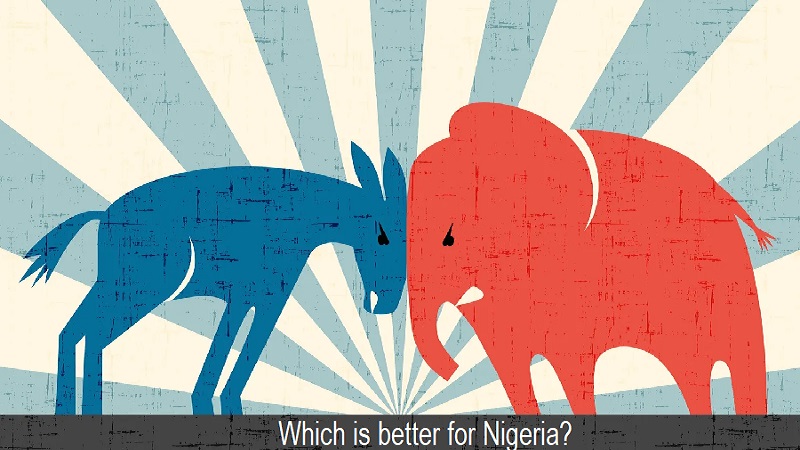
Community Member: In America, they have two major political parties and using these parties, they have done well over the decades. Which one do you think favors Nigeria, ideologically and policy-wise?
My Response: First, a disclosure, I am a registered Democrat which means I am in the same party as Joe Biden and Obama but I do not vote on party lines; I vote based on the candidates. There is no comparison between politics in US and what we have in Nigeria. In US, you can know a republican or a democrat from his or her policies or ideologies.
For example, while most Republicans are pro-life, their counterparts, Democrats, are pro-choice. In Nigeria, our politics is nothing but a group of humans since there are no core differences between say APC, LP and PDP members. In short, more than 50% of leading members of APC used to be in PDP. So, at the foundational level, there is no core difference! And that also means that party-level voting makes no sense as there is nothing special one party can offer the other party cannot provide, unlike in America where a pro-life candidate will surely struggle in Boston, a democratic city.
With that noted, Nigeria will be in a better position if we do what democratic cities do. In America, more than 70% of the top-50 ranked universities are in democratic cities. Also, more than 80% of the largest cities are in democratic cities. In the last 50 years, more than 80% of new Fortune 500 companies have been created by democratic cities. Even when you have great universities in Republican-run states, the likelihood that the highest ranked university is in an island of a democratic city in that state is high (Austin hosts the highest ranked university in Texas, and Austin is a democratic city; the same applies in Georgia where Georgia Tech based in Atlanta, a democratic city, hosts the highest ranked university in that state). Democratic cities file most patents per capita.
What makes democratic cities outperform on many fronts? They actually believe in investing in the future and building community infrastructures. They build infrastructures, invest in the citizens and provide paths for those citizens who need help. Over the years, they have outperformed, contributing more in making America greater.
Yet, what happens there means nothing in Nigeria as there is no basis for comparison. Nigeria does not have political parties when it comes to ideas and policies, we have the assemblies of people and nothing but that. That is the reason why someone can win in PDP in Anambra State for Senate, and next four years win via APC, and another four years, return back to PDP. That cannot happen in America because that person’s ideologies would have made it impossible!
But note this: what makes America great is not by chance.
State and non-state actors advocated for meaningful political and electoral changes after the 2015 general elections, taking into account the many concerns and difficulties that defined local and national elections in Nigeria between 1999 and 2015. The interested stakeholders engineered and carried out a number of initiatives between 2015 and 2021. Nigerians have a number of laws, from the national parliament to the executive branch of government, that were intended to strengthen political and electoral processes in advance of different state governorship elections scheduled before the general elections in 2023 as well as the year’s elections.
However, our analyst notes that the Electoral Act’s sections and guidelines, as well as the electoral body’s template for managing political campaign activities, remain paper tigers given the actions taken by political parties, candidates, and their supporters prior to and during the governorship elections that were held ahead of the general elections. This stance is supported by the evidence that political figures and the people who support them have engaged in flagrantly illegal conduct.
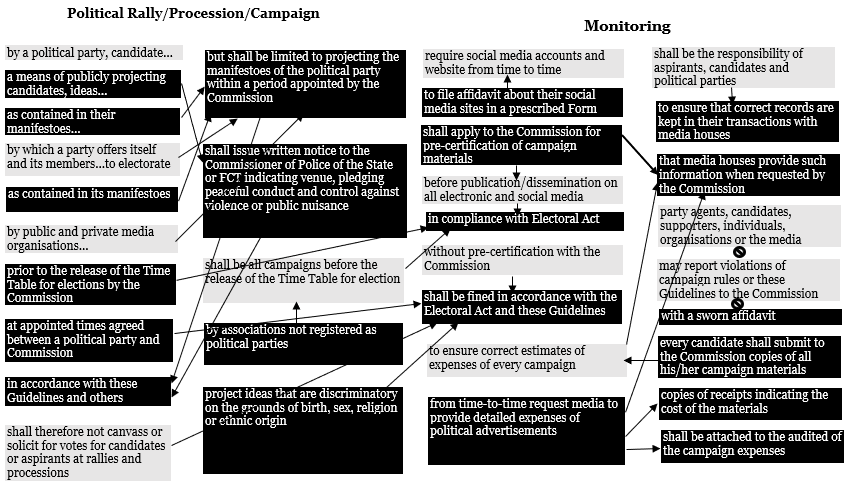
Both the Act and the Guidelines, as expected, provide goals and means for addressing flaws and issues identified with the past elections. For example, analysis shows a close link between the goals and means developed for campaign activities/types and the electoral commission’s monitoring of such activities/types (see Exhibit 1, where Goals are in grey boxes and Means are in black boxes).
Analysis reveals that the value of goals and means in campaign activities/types in the INEC’s Campaign Guidelines exceeded 70%. This implies that the goals and means in the two primary components of campaign rules for political parties, candidates, and their followers are mutually exhaustive and interrelated. Further analysis reveals that 54.8% of campaign monitoring concepts or guides in the electoral body’s guidelines were expressly pulled from campaign offences indicated in the 2022 Electoral Act, while 8.1% were drawn from campaign rules in the same Act.
Exhibit 1: Interconnectivity of Appropriateness and Sufficiency of Goals and Means of Ensuring Better Election Campaign in INEC’s Campaign Guideline
Source: Independent National Electoral Commission, 2019; Positive Agenda Nigeria, 2022
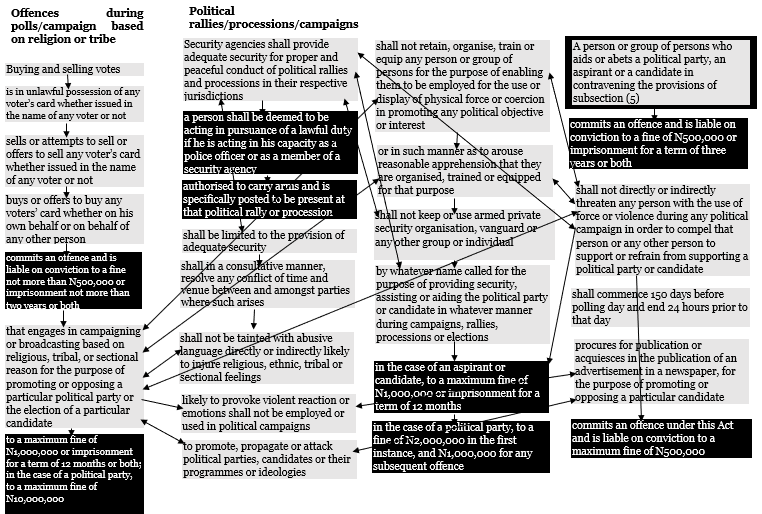
Exhibit 2: Interconnectivity of Appropriateness and Sufficiency of Goals and Means of Ensuring Better Election Campaign in Electoral Act 2022
Source: National Assembly, 2022; Positive Agenda Nigeria, 2022
From the Electoral Act to the INEC’s Campaign Guideline, it has been established that political parties, candidates, and supporters should not begin campaign activities before to the specified time (see Exhibit 1 and 2). Sections and procedures for developing messages about candidates and political parties and communicating them across communication channels without causing division in the country are also included in the legal and policy documents.
However, our observational analysis of political parties, candidates, and supporters of the main parties for the 2023 presidential election shows that actors are breaching Section 97 subsection 1, which criminalizes religious or tribal campaigning. According to the section, “A candidate, person or association that engages in campaigning or broadcasting based on religious, tribal, or sectional reason for the purpose of promoting or opposing a particular political party or the election of a particular candidate, commits an offence under this Act and is liable on conviction.” Paragraph a-b further specifies punishment for the violators. It states that: “(a) to a maximum fine of N1,000,000 or imprisonment for a term of 12 months or both; and (b) in the case of a political party, to a maximum fine of N10,000,000.”
In order to forward their agendas ahead of the general elections, parties, candidates, and supporters have largely turned to religion. Actors have attacked the personalities and beliefs of presidential candidates in both social and conventional media. Although it wasn’t the main factor in the Osun 2022 election, the governorship candidates’ personalities were disparaged. However, criticizing the leading opposition candidate (Senator Ademola Adeleke) due to his alleged lack of education was against the law and the campaign standards set forth by the electoral commission.
Our analyst notes that the campaign atmosphere would be hostile for the general elections in 2023 because this appeared during the most recent governorship election without any sanctions or prosecutions being brought against those responsible. Parties, candidates, and their followers would widely disseminate false and deceptive information that might incite physical violence throughout the nation. The ways to achieve the precise objectives indicated for controlling and sustaining the campaign environment on virtual platforms and in physical locations must therefore be reviewed by the concerned parties. Where the means are obviously inadequate, they should be reformulated in order to achieve mutual benefit.
The Russia-Ukraine war has forced the US and its allies to seek alternatives to their energy supply. The war which started in February, created a global energy crisis that shot gas and other commodities’ prices up, stoking inflation across countries.
The global economic crisis was triggered by a series of US-led sanctions leveled against Russia in the wake of its invasion of Ukraine. The Kremlin’s attempt at retaliation, which has been largely tied to cutting off oil supply to many countries, has triggered a massive push for alternatives, particularly in Europe.
Thus, the European Union (EU) delegation to Nigeria and ECOWAS said on Friday that it would replace the gas from Russia with Nigeria gas.
The EU’s decision to seek out Nigeria as an alternative supplier of gas was disclosed by the Deputy Director-General Department for (Energy), European Commission in Brussels, Matthew Baldwin, at a news conference on Friday in Abuja.
NAN reports that Baldwin will be meeting with top government officials in Nigeria and private sector players, including key stakeholders in the country’s energy sector.
The European Union has stood by the United States against Russia as it pounds Ukraine. Being their sole supplier of energy, the Kremlin has threatened to sever its energy supply – and the threat is becoming very imminent.
The EU’s executive body had urged member states to slash their gas consumption by 15% to avoid an energy crisis in case Russia cuts off supply this winter. But its primary goal is to see that the bloc is weaned off its dependence on Russia energy.
“In summary, I am on a mission from Europe to try to deliver Liquefied Natural Gas (LNG) today in the context of NLG partnership tomorrow with Nigeria.
“Europe is in a tight spot in relations to gas, following the Russian invasion of Ukraine and the instability in our gas market and the threat of cutting off supply altogether.
“So, we have launched the energy platform task force and the primary goal is to reach out to our reliable partners such as Nigeria to replace the gas from Russia with gas from reliable partners,” Baldwin said.
He had earlier this week disclosed that the EU has launched a gas demand reduction plan and is looking to reduce demand of gas by 15% to manage the demand aspect of the equation.
“To be clear, we need to manage the supply side and that’s why we want to expand what is currently at 14% shares of our total LNG import from Nigeria and we want it to go up.
“Our gas percentage was 60 per cent but now we want to go,” he said.
He added that Nigerian products had extraordinary potentials and that was why the EU wanted to expand the short term delivery.
The Deputy Director-General said that the EU hopes to kickstart the partnership by the end of August this year, which would create a long term partnership with Nigeria.
The report quoted Samuela Isopi, the EU delegation to Nigeria and ECOWAS, as saying that the bloc was doing its part in contributing to the energy sector by collaborating with Nigeria.
She said the EU’s current contribution stands at 400 million euros, and remains Nigeria’s biggest trading partner accounting for over 20% of Nigerian trade with the world.
The energy partnership is expected to increase EU-Nigeria trade volume which stood at 28.7 billion euros in 2021, with a trade balance of 6.4 billion euros in favor of Nigeria.
However, while the partnership bears a huge economic potential, Nigeria’s ability to live up to EU’s potential energy demand is under serious question.
Nigeria’s oil output has been spiraling downwards even in the wake of the oil windfall orchestrated by the Ukraine crisis.
Nigeria’s oil production has been losing its place in the Organization of Petroleum Exporting Countries (OPEC)’s ranking. It dropped Year-on-Year, YoY, by 14.3% to 1.4 million barrels per day, mbpd in the first half (January – June) 2022, from 1.6 mbpd in the corresponding period of 2021, according to the Oil Production Status Report of the Nigerian Upstream Petroleum Regulatory Commission, NUPRC.
The oil output also dropped Month-on-Month, MoM, by 23% to 1.3 mbpd in June 2022, from 1.7 mbpd, recorded in the preceding month, May 2022.
Against this backdrop, Nigeria has been failing to meet its OPEC’s quota of 1.826 mbpd.
If you are the coach, what would be the next call? Replace the substitute or abort the substitution, assuming he is not the 3rd substitute in the game? Not sure, though, the rule of the game allows voiding that substitution since it has been completed. In other words, this is one substitution wasted!
How prepared are you for that #change management in that company? The next change can destroy your competitiveness if you do not prepare well. In football, you get reserves to warm up so that change brings positive energy and movement.
Following volatility in the cryptocurrency fortunes (with an overall downwards trend), there have been a lot of fallout in the general DeFi sector , and in decentralized ‘everything’.
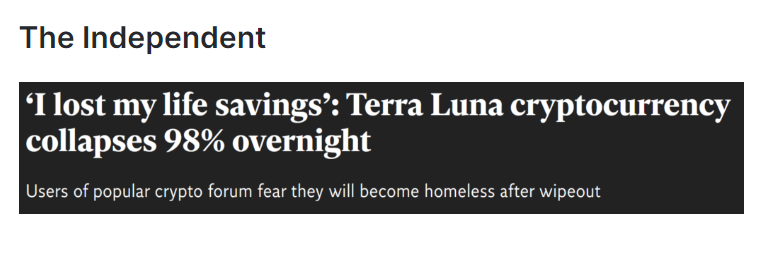
We have had the collapse of the stablecoin – LUNA. We have seen the demise of Celsius, the insolvency of the 3 Arrows Hedge Fund, the operational contraction of CoinFLEX over a position taken by Roger Ver, and subsequent huge row with CoinFLEX CEO Mark Lamb
We’ve had layoffs in different segments of the Decentralized/Web 3/Crypto industry across the board, key case in point: OpenSea.
Side accusations of weak regulation began as some speculation on root causes was seen as ‘Singapore Based’… but Ravi Menon, managing director of the Monetary Authority of Singapore (MAS), said troubled crypto firms reported by the media as being based in Singapore are not fully regulated in the country.
Menon focused in particular on crypto hedge fund Three Arrows Capital and Singapore-registered companies TerraForm Labs and Vauld during a press briefing for the presentation of the central bank’s annual report.
“In reality, these so-called “Singapore-based” crypto firms have little to do with crypto-related regulation in Singapore,” Menon said.
We hark back to a time, before the CBN ban when Nigeria was the second biggest trader of cryptocurrency by volume in the world. What is different now?
We have to ask ourselves what does this all mean, for the world as a whole, for Africa, and indeed for Nigeria.
BEAR MARKET
We had the COVID pandemic. For sure it damaged production. It damaged hospitality and entertainment businesses. It damaged logistics and supply chain activity – by air, sea and road.
Did it damage business in the blockchain and decentralized space? Not really… why?
If anything, the pandemic fueled the growth of the decentralized space and metaverse.
Those already professionally involved have workload that lends itself well to working remotely. They too, as well as the unconnected global public had limited recreational options and that also meant limited ways of spending income. Travel and social restrictions meant people had to find things to occupy themselves while mostly confined to home, and investing or otherwise participating in the virtual world was an outlet.
Then came something very different – The Russia-Ukraine war. With it has come global crises on both food and energy supplies.
On the Barrons Investment Advisor site, Phillip Toews of Toews Asset Management has heralded a ‘Bear Market’. He has many Subject Matter Experts keeping his opinion company.
The question is… are there parts of the decentralized and blockchain world that are depression (bear market) tolerant?
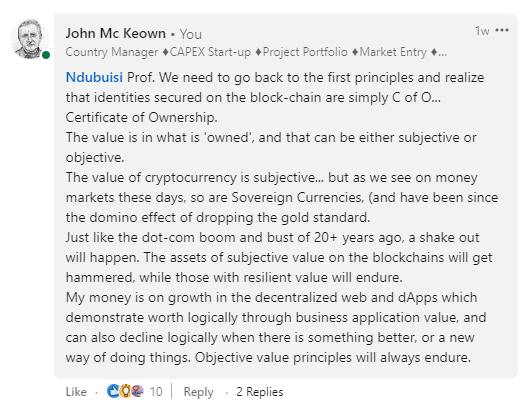
This is a response I gave Prof Ndubuisi Ekekwe on LinkedIn when he reported on the Celsius debacle:
The fall out from the Russia-Ukraine war is not limited to the participants, it is global. Energy deficits are crippling manufacturing, lack of electric power are causing some to fry in 45 degree heat, while some in colder climbs may experience frost bite in a harsh winter for lack of heating. All around the world, there are whole regions, including Africa that are either already or will experience additional food shortages on top of prevailing challenges. It is hard to contemplate the lofty benefits of an intangible world of blockchain and metaverse when the very immediate concern is an empty stomach.
This war has forced a value reset.
ENDURING VALUE ON THE BLOCKCHAIN
Unfortunately, there is no sure quick way to make easy money, and humankind seems to never learn this no matter how often burnt. Many of the types of blockchain assets have subjective value. This means it is very difficult to empirically prove the presence of value, or the absence of it. This is particularly true of cryptocurrency and digital artwork, and they will struggle to stand up in a bear market.
However, there is the potential for assets with enduring value to be secured on a blockchain. Ultimately a blockchain is simply a decentralized virtual entity on which assets can be secured through the issuing of a long string of alpha numeric characters which acts as a C of O (Certificate of Ownership).
It doesn’t define what the asset is, or what class it belongs to, except that blockchains lend themselves better to securing virtual rather than real world assets.
The place where enduring value starts is always at the core. At its most fundamental level, that is at the coding of smart contracts, the development of dApps (decentralized applications) and the growth of the Decentralized Web (Web3).
A CONTRACTION
There will always be a speculating mentality which will get hit by Bear Markets when they come. They started on cryptocurrency. The market became depressed because of steps on sanctions, limitations and laws of individual states.
Then they moved on to hype up digital artwork of notional value, such as Cryptopunks and BAYC (Bored Ape Yacht Club). These create fluctuations in the demand for the products and services that support how blockchains work, and how blockchain assets get marketed and sold.
However, as speculative assets and their supporters take a hammering, there is a core of services and products at the back end that continue to be in demand. The bear market isn’t entirely a bad thing, because it forces entrepreneurs to refocus on how to create and secure more enduring value on blockchains, building more resilient products and services. This will then build back capacity.
I am not saying cryptocurrency and certain types of digital artwork won’t bounce back. I am simply saying in the long game, their fortunes are not crucial to the decentralized and Web 3 world being successful.
WHERE WEB3 IS NOW
Recall my previous article on Web3 in March (just before I took assignment in a remote part of Imo State Nigeria for some months without reliable internet!)
In it, I did an analysis of the various Web 3 domain providers, and on balance, argued that ‘Unstoppable Domains’ was probably the market leader.
Every new technology must reach it’s apex timely, and until it does, the need that drives the evolution continues to get served by the establishment. The ‘establishment’ is currently ‘Web 2’ – the domains administered by ICANN and country registrars (known as gTLDs and ccTLDS).
And so, leaders of the new Web3, can only become apparent from visibility on Web 2 – at least for now!
As I visit ‘Unstoppable Domains’ after my hiatus since March, nothing useful has changed in four months. Browser adoption is key, and we are still in the same place with only Opera and Brave supporting Web 3 (decentralized) domains natively. Nobody (apart from recluse enthusiasts) has time to be downloading plug-ins to enable the most popular browser – Chrome, to get access to what is currently a very limited and obscure collection of content compared to what is available on Web2.
The other thing is search engines. There are a few obscure search engines for Web3, like ‘Bitsearch’ https://bitsear.ch/ , but none of the mainstream search engines operating on Web2, Google, Bing, or even Duckduckgo show any signs of becoming Web3 compliant.
Then there is services growth – talking about Social Media, in a discussion with Josh Gordon (twitter @justwavyj) Matthew Gould, Unstoppable Domains CEO (twitter @matthewegould) conceded:
‘New Social Networks are going to have a really hard time… because they are going up against Facebook and Twitter, who have a huge networking effect… there are some… ‘Aave’ (Social Media platform on Web3)… you can do some interesting things there… but again, they are going up against these huge, locked in monopoly networks, with these private algorithms, and it’s extremely hard to compete… I’m hoping we can build the tools in ‘crypto’ to make these things more open… but it is uphill… it’s an uphill struggle!’
I also notice they have dropped their live support from the site, and this was a major advantage when selling services based on unfamiliar technology. However, nobody else is doing any better.
CURIOUS RELATIONSHIPS AROUND UNSTOPPABLE DOMAINS.
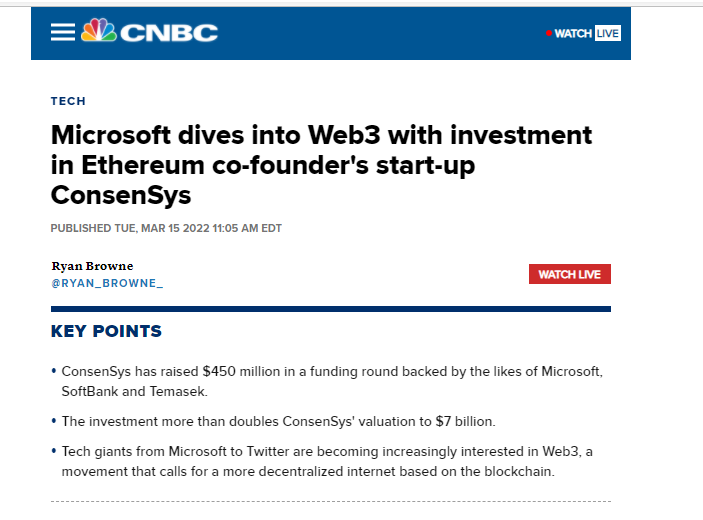
There are a couple of things about UD, that are a bit curious. As we can see, earlier this year, Microsoft took on a huge chunk of ConsenSys, a company started by Ethereum Founder Joseph Lubin
In my March post, I referenced Moxie Marlinspike, creator of signal who cited the illusory nature of ‘decentralization’ in crypto and Web3 – ‘Blockchain application programming interfaces are mainly controlled by Alchemy and Infura, while cryptocurrency exchange traffic is primarily dominated by Binance, Coinbase, MetaMask and Opensea.’
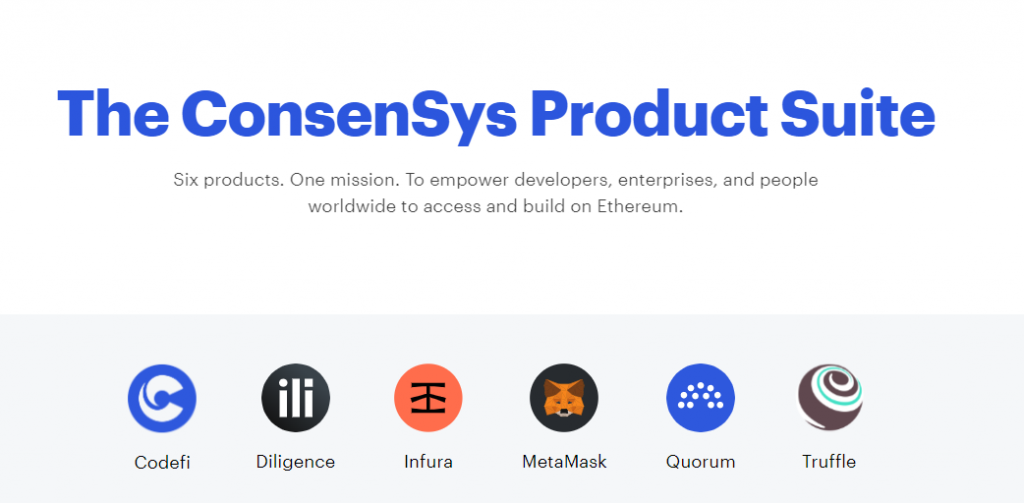
And when we look at the Consensys product suite….
We see two of the ‘suspects’ here. While UD provides compatibility with Alchemy, support engagement is definitely leaning towards Infura, and if you want support to assist you directly with minting your domain, MetaMask is the preferred wallet to help you with, unless you are insisting on something different.
There is other plurality with Polygon, the sidechain on Ethereum, but it could be all innocent and just down with the familiarity of support officers with specific solutions, so I will just stop short, labelling it ‘curious’ and no more.
I’m on the fence about Microsoft involvement. On the one hand it smacks of big business muscling in on the so called democratized decentralized community, but in other ways its like the old oil majors renaming themselves ending ‘Energy’ instead of ‘Oil’ and opening up business units focusing on wind farms and solar. There is this level of comfort seeing the behemoths of the Web2 era jumping in. It gives some reassurance that my effort in developing knowledge and skills is worth it.
But one of the ‘killer’ selling points of UD’s domains being minted to the polygon blockchain is one payment, never ever having to pay renewal fees as with Web2 domains…
The benefit of that cannot be realized until regular browsers, especially chrome, and search engines like google, can manipulate Web3 content on the polygon chain.
Google have built a team devoted to developing in house Web3 expertise, and they have some programs running which sponsors young people to learn about the decentralized web, but they haven’t jumped into any major acquisitions yet. With Microsoft out of the blocks, they may be hesitant to make their browser and search engine Web3 compliant until their own position has a commanding lead to benefit from them.
Expect Amazon, Apple and Twitter to be watching keenly, and with close to a billion dollars extra liquidity from the Bitcoin sale, who knows what Elon Musk might do!
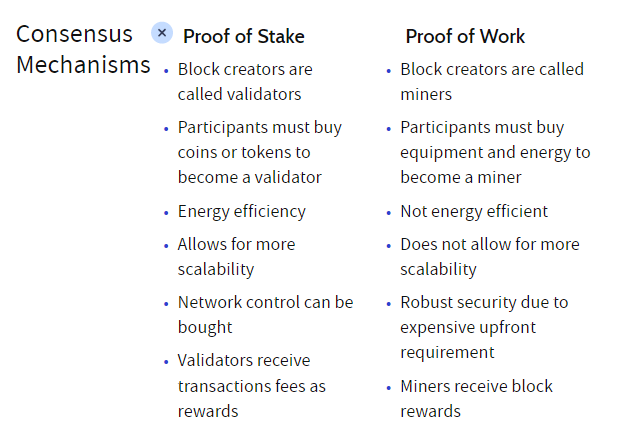
Ethereum, which is the root chain for Web 3 domains currently operates the PoW consensus which costs ‘gassing fees’. Polygon describes itself as an ‘Ethereum scaling platform’. This is what allows Unstoppable domains to offer Web 3 domains at a one off price. Native .eth domains and handshake domains have no cost benefit over traditional web 2 domains as the gassing fees force annual renewal charges.
A STORY
The year is 1994. I am in London, in Earls Court, at the Annual Computer and ICT Exhibition. There are about three hundred exhibitors stands. Most of the visitors are just curious enthusiasts looking for a techie day out. There is only a small hardcore of serious buyers. Public internet is being spoken about as a concept, but I didn’t know anyone that had it. Corporate Intranets are only in government and big institutions.
CD roms are only just appearing. Almost everything is still 3.5” floppies and everything is an ugly beige. No laptops yet. No smartphones. The masses are milling around the Microsoft or the Intel stands. AMD is also getting some attention. There is a smaller number interested in the less popular processors such as Cyrix and Thompson. Some interest in the Corel and Open Office stands. Majority of visitors are only after promo freebies… mugs, pens, mouse mats, whatever.
The stingiest of enthusiasts are just picking up corporate promo floppies en-masse. These are made with the format lug absent, but taking a small drill bit and drilling through the corner of the disk where the lug should be, restores the re-write function.
I got advance promo versions of IBM PC DOS and Solaris for x86.
In a small corner, and a humble stand, I found this group of thoroughly miserable exhibitors which everyone was passing by. They wanted to start this company, and were looking for investors, and they were talking about this thing called ‘dot-com’. I listened and took a floppy.
The next year, they were back in US and met their objective. The company was called Verisign.
Over the next five years, the ‘dot.com’ boom and bust came and went.
Right now, the more I think about Web3 and the potential for dApps, it is like I am being transported through some time warp tunnel and being placed in that small corner, right in front of that humble stand. The eerie ether like atmosphere is causing mucus from my nose, and the air is so thick and tangible it feels like I can reach out and carve it with a knife. It is so surreal.
MY TAKE ON WHERE THE YOUTH OF NIGERIA, INDEED AFRICA, AND OTHER COUNTRIES WITHOUT HARD CURRENCIES SHOULD FOCUS
The global fallout from the Russia-Ukraine war is not necessarily a bad thing for Web3 and the potential for dApps, It’s slowed down where big business is focusing, and that buys young entrepreneurs and coding consultants some more time to upskill, strategize and prepare. Forget quick speculative turn-around with little mental effort. Be prepared to ‘break’ your brain. This is about onboarding enduring value.
Don’t entertain ‘fluffy’ vague ideas about describing yourself as a ‘Web 3 Community Manager’. These only exist where some of the Web3 pioneers (like Unstoppable Domains) have HQ presence. While the job can be done remotely, at minimum you will need 24/7 reliable access to fairly modern computer with a large VDU and a reliable, corporate strength internet connection. Unless you are moonlighting from the Project Engineering Department of MTN, that isn’t going to happen!
A lot of technical skills are needed for this job, as a ‘Web 3 Community Manager’ would typically be in charge of a team of live support officers guiding a customer community through problems such as minting a Web 3 domain to a blockchain, or sorting out the technical intricacies of a cross bridge transfer, moving a domain from one blockchain to another. A ‘Web 3 Community Manager’ will usually have the challenges escalated that the regular support officers couldn’t fix, and they will have to produce the goods live, and in the moment. Thinking the job is just about soft skills is an illusion.
I see profiles on LinkedIn with people describing themselves as a ‘Web 3 Community Manager’ when what they are is someone who is an enthusiast, has built their own little ‘LinkedIn Nation’ around them, and is engaging with like minds. This is all very commendable but the title doesn’t fit. Some are at best freelance technical journalists on the topic, but it is very difficult to monetize that in countries such as Nigeria.
I will invite you to go online and look at the very first automobiles ever made. You will find they look like a rich persons horse carriage, with the horses missing at the front, and some odd looking machine contraption linked to the wheels.
Humankind has often pioneered new inventions not with the tools best for the job, but with the prevailing tools best suited to what this new invention is intended to replace. Visualization is great in theory, but ideal tools are ‘ideally’ crafted, when the product it is to be brought to bear on… the application is an existing reality.
So it was with blockchain, and initial efforts were coded from languages that already existed, and were created with other things in mind… C++, Javascript, probably the newest of them was Python.
Now we have new languages and tools which have been purpose built with crypto, Web 3, (the decentralized web) and blockchain in mind. Solidity, Rust, Vyper, tools like the Moralis SDK (Software Development Kit).
My suggestion is to explore opportunities to upskill to some of these languages and technologies while there is still time. Build enduring value within yourself. The market is not there in Nigeria yet. There are no UD paying customer communities, but they will develop over time. But there are service gaps in developed markets for these services right now. These services can be sold globally until a home market is available.
Most mainstream Nigerian banks now offer domiciliary accounts in several currencies, such as Dollars, Euros or Pounds. Or you can take a look at KlaDot, from Tekedia Institute’s sister company, Tekedia Capital.
Don’t be swayed by speculation illusions. Build your future proofing for these new opportunities before big business gets the chance to come, cut, and run.




 In my March post, I referenced Moxie Marlinspike, creator of signal who cited the illusory nature of ‘decentralization’ in crypto and Web3 – ‘Blockchain application programming interfaces are mainly controlled by Alchemy and Infura, while cryptocurrency exchange traffic is primarily dominated by Binance, Coinbase, MetaMask and Opensea.’