DD
MM
YYYY

PAGES

DD
MM
YYYY

spot_img

PAGES

Home Blog Page 5069

IPMAN Approves N180 Per Liter Fuel Price, Setting Nigerians Up for Further Economic Hardship

1

As the ripple effects of Russia-Ukraine war cut through economies, exposing many to inflation as the cost of living rockets, Nigeria, Africa’s largest economy that has helplessly watched the economic spikes take a toll on its people, is about to see its situation exacerbated.

On Monday, the Independent Petroleum Marketers Association of Nigeria (IPMAN) asked marketers across the country to begin dispensing petrol at N180 per liter and above, as it’s no longer possible to sell at the government’s approved price of N165 per liter.

“The chairman and executives, in conjunction with some senior members of our unit, organised a press conference today, 20th June 2022, at IPMAN HOUSE Ejigbo Lagos, where we explained our predicament with the current price of PMS at the private depot.

“We explained that with the current price, there is no way we can sell less than N180 per litre. On this note, members are hereby advised to sell at a sustainable price within their environment.

“Just make sure that the price is on your pump. Kindly contact the secretariat should you have any authority challenging your operations,” IPMAN spokesman Akeem Balogun said in a statement to Peoples Gazette.

Recently, there has been an uptick in queues at petrol stations, signaling imminent scarcity of petroleum products once again.

Earlier, petrol distributors and the Nigerian Association of Road Transport Owners (NARTO), had cried out to the federal government, asking for permission to increase freight rate as the price of diesel, which has risen as much as N800 per liter, is making their business unsustainable.

In response to their outcry, President Buhari, last week, approved the upward review in freight rate for transporters. This was disclosed by the Nigerian Midstream and Downstream Petroleum Regulatory Authority (NMDPRA).

“The review was necessitated by the upswing in the global price of petroleum products especially automotive gas oil (diesel) and its implication on the cost of transporting premium motor spirit (PMS) nationwide,” NMDPRA said, adding that the transporters’ freight rate has been reviewed to reflect current market realities.

Nigeria is facing a serious challenge in its downstream sector that has been compounded by rising oil prices.  Fuel subsidy, which is gulping nearly 30% of Nigeria’s 2022 budget, has put the government in a difficult situation. The government has repeatedly failed to remove the subsidy due to opposition from the Nigerian Labour Congress and civil rights groups, who fear that its removal would deteriorate the already bad economic situation of the country.

However, without a choice, the government is succumbing to the harsh realities of the oil market.  With crude oil selling above $100, Nigeria needs to double its $62 budget’s oil benchmark to sustain the subsidy payment and keep pump price at the N165 per liter cap, which it has been borrowing to maintain.

The Finance Minister said Nigeria will need further N4 trillion if the subsidy is to be maintained in the next six months. But selling fuel at N180 per liter means Nigerians will experience a new height of economic hardship. For a country where businesses depend mainly on power generators for electricity, the already high cost of goods services is expected to see further spike. This will push inflation, which is currently at above 17%, further up.

Time for Engineering at Fasmicro Nigeria

0

We’re the Africa’s premium technology company and the zen-master of field programmable gate arrays on Intel Corporation technologies. We know Intel FPGA technology and have access to critical documents and design kits as a Certified Technology Partner.  We’re Fasmicro Nigeria, Africa’s only “INTEL FPGA Training Partner”.

(Clients: team would have sent you info. I will be training on the newest technologies which Intel has unveiled. We want you to upgrade your products and technologies. We’re here to serve you and very proud of our engineering heritage; thank you for your partnership. It’s electronics – and it is a way of life for us.)

Legal Methods for Debt Recovery in Nigeria

0

In the Nigerian Business environment as well as any other jurisdiction, no factor is usually as important as the level of access to Credit facilities which are a means for getting businesses running as well as a means of plugging gaps in individual finances.

In the same length, no issue bothers those in the business of rendering Credit services more than the issue of recovering its receivables, specifically debts owed by their customers, which has led to the creation of a sub-industry on its own – the Debt Recovery sub-sector.

With the coming of Fintech, the problem of recovering debt hasn’t gone away but has instead taken a digital form, with debtors sometimes playing the system to take several loans on the basis of either inaccurate or concealed unfavorable information that would ordinarily disqualify the borrowers from getting a loan. This has led to many Digital lenders, some of them less than transparent themselves, turning into Digital loan sharks and using Debt Recovery methods that would qualify as some of the most deeply upsetting forms of Cyber-bullying.

This article aims to enlighten Digital lenders, be they Digital Banks, Digital Financial Institutions or Moneylending companies, on the full extent of Debt Recovery as a concept and some of the legitimate methods for Debt Recovery under Nigerian law.

For starters, Debt Recovery is simply the process of securing payment from borrowers, be they individuals, businesses or companies, for Monetary debts owed to other companies or individuals which were not paid as at the time and in a manner agreed between the borrowers and lenders.

This will then lead us to some of the permissible methods of Debt Recovery under Nigerian law which are as follows:-

1. A Conditional Bill of Sale :- This is a document that grants to the lender from the borrower a conditional title to a piece of moveable property (or chattel) legally owned by the borrower or his guarantor as a security for the loan. Conditional Bills of Sale are enforceable debt instruments that grant speedy collateral security for lenders and are to be registered with the Bill of Sale Registry under the Directorate of  Commercial Law of the Ministry of Justice in places like Lagos State.

By requiring that this document be executed at least digitally, Digital Credit providers can be assured of collateral security on the Back-end for their services.

2. Global Standing Instructions :- These are legal conveyances signed by borrowers that allow for the recovery of debts as at when due from all accounts belonging to or maintained by the borrowers when they’re in default of their repayment obligations other than the accounts domiciled with the Creditor lender who must be a Bank or Financial Institution licensed by the Central Bank of Nigeria.

Global Standing Instructions can be executed digitally and provide a smooth process of quick recovery and NPL(Non-Performing Loan) reduction in the Banking Sector. Global Standing Instructions however, do not apply to penal charges accruing on a loan as part of the outstanding obligations of a borrower.

3. Small Claims Actions :- Small claims actions are basically lawsuits that are designed by deliberate policy in states like Lagos to aid in the quick recovery of debt sums below 5 Million Naira in a quick, relatively affordable and efficient manner.

Small claims actions can be carried out in person without the necessity of hiring a lawyer to appear in court (though a Lawyer’s input in filing and commencing a small claims action is necessary) and are required by Practice Directions of the Magistrate Court in places like Lagos to be beyond 60 days (or 2 months).

Small claims actions are advantageous because they can be enforceable against relatively minute sums that would ordinarily be too negligible to hire a Debt Recovery agency or a law firm.

4. Debt Recovery Actions via Summary Judgment :- These types of actions are usually actions that are for sums of 10 Million Naira and above and are usually filed as liquidated sum demands for judgments of the Court based on the borrower having no reasonable defense to such suits, hence the term “Summary Judgment”, especially where the borrower had admitted to the existence of the debt in question.

Debt Recovery Actions of this nature are under the jurisdiction of State High Courts and can be carried out for huge debts , though it must be pointed out that they usually take longer in terms of time and can be considerably expensive in terms of filing costs and legal fees.

5. Company Voluntary Arrangements :- A new method of Debt Recovery introduced by the Companies and Allied Matters Act 2020, these are simply proposals by a company to its unsecured creditors (creditors that advanced unsecured loans not backed by any collateral or security) that result in a binding agreement or understanding for the satisfaction or liquidation of the borrower’s debts .

6. Administration :- This is also a new method of Debt Recovery introduced by the Companies and Allied Matters Act 2020 and involves the appointment of an Administrator by a creditor/lender rather than a liquidator or Receiver/Manager, to manage a debtor company diligently for the repayment of a due debt. This is an alternative to the sometimes unnecessary practice of winding up a company via the appointment of a liquidator.

7. A Winding-up Petition :- This should be a last resort and is applicable to debtor companies owing a minimum requirement of Two Hundred Thousand Naira. 

This requires filing a petition to the Federal High Court and asking for the appointment of a Liquidator to oversee the process of Winding-up which usually involves satisfying the debts of the company in order of priority. This can take up to a year or more. 

8. A Criminal Petition :- This is only applicable in the event of a dud or dishonored cheque being advanced by the borrower in exchange for the loan at the time of transacting between both parties or the obtaining of the loan based on false information (a misrepresentation) given deliberately by the borrower. Debt Recovery is STRICTLY a Civil matter.

These options listed above are part of the options available for creditors in Nigeria and should NEVER be ditched in favor of illegal practices like Debt-Shaming which involves unethical disclosure of a public nature by a lender to either the public or 3rd parties known to the borrower/debtor that are not privies or parties to the loan transaction, usually with information about the debt aimed at shaming the loan defaulter into repaying his loan debt.

This practice is a Criminal violation of the Nigerian Data Protection Regulations 2019 as well as a breach of the Cybercrime Act which can lead to a blacklisting of the digital lender, a fine imposition from the National Information Technology Development Agency (NITDA) as well as Criminal Prosecution and business license revocation.

From the above, it is hoped that the ability to make a better-informed decision on the Debt Recovery method best suited for a particular circumstance as well as what would be considered best operating practice in Nigeria’s Finance sector.

The Need To Reform The Curriculum of Nigeria’s Educational System

0

Recently I published a post where it was disclosed that Kenya has included coding into the syllabus of primary and secondary schools in its country, which was what spurred me to write this piece.

The world as we know in this 21st century has shifted significantly, with so many technological advancements littered everywhere. According to an analysis by Mckinsey Global Institute, it disclosed that about 51% of job activities are highly susceptible to automation.

This indicates that automation is going to necessitate the redefinition of most jobs. Seeing all these predictions, research, and analysis from different institutions about the possible change in the workplace structure, one question that came to my mind is this. Why do schools in Nigeria still use an obsolete curriculum, void of relevant subjects and skills to teach school students?

As the rest of the globe advances into the twenty-first century and capitalizes on technological advancements, as well as including relevant skills and subjects in their curricula, where does Nigeria, the “giant of Africa” fit into this equation?

Most of the things embedded in these curriculums of schools in Nigeria, have little or no relevance in this 21 century. In most schools at all levels in the country, you see teachers teaching the same subject that was taught in 1960, knowing full well that these subjects have no relevance in this present generation.

I am not in any way implying that the entire curriculum should be jettisoned because I still believe some subjects in it are still relevant. What I am trying to say, is that there should be the inclusion of several subjects and skills that have relevance in today’s world to be embedded in these school curriculums.

Problem-solving, creative thinking, digital skills, and so on are in greater need, yet they are deficient in these curriculums. I could recall when I was in high school where we were taught short-hand, only for us to graduate and discover that short-hand was never needed at any point in time to solve any problem. After seeing how irrelevant the subject was, I began to ask why it is still being taught in schools.

Truth is, some of the topics being taught in schools today will no longer be relevant in the nearest future. The government in collaboration with the Educational leaders in the country should come together to remove irrelevant subjects in the school curriculum to make room for subjects with future relevance.

Already, a lot of schools in advanced countries have begun to include relevant skills and subjects in school curriculums. In the US, 44 states have changed policies to recognize computer science as part of the academic core.

Today, we have a lot of careers that have been created which was not seen in the previous generation. While growing up, we had a conventional career path, where everyone wanted to be either a Doctor, Engineer, Lawyer, Banker, etc. Currently, the career option is now vast with so many inclusions. We now have kids who aspire to be coders, programmers, software engineers, Data analysts, etc.

Looking at the fact that there has been no inclusion of relevant skills and subjects in the Nigerian school curriculum, it will no doubt pose a serious challenge to school students. One negative impact it will have is that these students will be limited in so many areas, career-wise and skill-wise, which will leave some struggling to catch up with the already advanced world.

It is quite disheartening that after one is done with schooling in the country, they will have to go back to learn basic relevant skills that could have been included in school curriculums. Imagine a future where relevant skills are included, upon graduation, a lot of students will already be armed with relevant soft and technical skills to take up future work and as well create useful innovations that will greatly benefit the country.

Therefore, there needs to be a reform in Nigeria’s school curriculum being used to teach students throughout all educational institutions in the country. The curriculum requires a review that must be sustained, implemented, and assessed so that it remains relevant and responsive to 21st-century trends.

The role of Education in any nation is very pivotal to nation-building which is why students need to be exposed to quality education that will be relevant to the global world.

Understanding Minimum Viable Demand (MVD) for Digital Startups

2

Market systems are inherently imperfect because of information asymmetry which makes it difficult for demand and supply to attain an optimal equilibrium point. To fix that imperfection, you need companies to operate in markets. Companies provide the platforms, which bring the demand and supply together, so that transactions can take place. 

You are hungry, you simply go to a company called restaurant to buy food instead of knocking at people’s doors hoping to find someone who may have food to sell. (Supply also will not be waiting at home expecting somebody to knock so that he can sell food; he simply takes the food to the restaurant.)

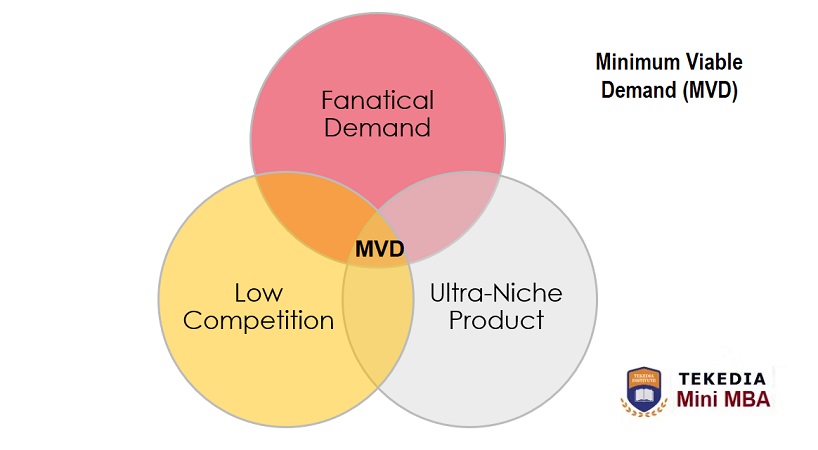
But when you are starting a new venture, how do you begin? Sometimes, you need to focus on creating “passionate” products with leverageable market demand even if the current market size is small. You have a higher chance of success if you can find extremely dedicated adopters who believe in you than trying to serve everyone and end up serving none. I have called this Minimum Viable Demand (MVD). It is a great tool when building digital products as you have more freedom to iterate and relaunch at scale.

With MVD, the demand is real and viable which means it is leverageable even though you are focusing on the smallest demand possible. The key is that the demand is viable to be leverageable even though it may be small at the moment.

In MVD, you get higher margin, lower competition and fanatical demand.  The construct is that it is better to appeal to the first 1,000 fanatical users than one  million users. Once you have won those first 1,000 users, you begin to plot how to scale for the one million users, leaving the ultra-differentiation, price-insensitivity, and niche-offering to products that appeal to more people.

In some markets, MVD will help you. If you pursue it, the innovator’s dilemma can set in for many incumbents and before they know it, you have expanded your territory.  This is what happens as I explained in startup incentive construct.

In this piece, I explain why startups win, despite the efforts of older companies who challenge them in new areas they are pioneering. The older companies can come with money, experience and technology, but most times, they are solving problems, with the wrong incentives. Consequently, they adjust the problems to accommodate their incentives and in the process, solve an entirely different problem, resulting to loss. You read it from me: African and specifically Nigerian startups, you can win and do not be bothered by the big companies. Your incentives are different and those are inherent advantages for you.