DD
MM
YYYY

PAGES

DD
MM
YYYY

spot_img

PAGES

Home Blog Page 51

Boston Dynamics Unlikely To IPO Next Year As Atlas Remains Unprofitable And Unscaled

0

Boston Dynamics is unlikely to pursue an initial public offering next year as Hyundai Motor Group’s humanoid robotics business has yet to deploy its flagship Atlas robots at scale and remains deeply unprofitable, according to a senior Hyundai executive with direct knowledge of the matter cited by Reuters.

“It won’t be easy,” the executive said when asked whether Boston Dynamics could go public next year.

“We need to see conditions and situations,” the executive added, declining to be identified because the matter is confidential.

The comments suggest a public listing could still be several years away, tempering expectations that Hyundai might use an IPO to capitalize on growing investor enthusiasm for humanoid robots and raise money for Boston Dynamics’ expansion.

Hyundai Motor Group has not publicly disclosed a timetable or valuation target for a potential Boston Dynamics listing.

Investor interest in a potential listing intensified after Boston Dynamics unveiled an updated version of Atlas at the Consumer Electronics Show in Las Vegas in January. Hyundai subsequently demonstrated the production version of the humanoid robot, helping fuel a sharp rally in Hyundai Motor shares as investors began pricing in the potential commercial value of the group’s robotics ambitions.

That enthusiasm has since cooled as investors have received limited updates on the company’s robotics strategy.

Hyundai Motor shares are still up about 25% this year, but have lagged the broader South Korean market, which has gained about 60%. The automaker’s shares had more than doubled earlier in the year following the Atlas unveiling before giving up much of those gains.

Humanoid Robots Face A Scaling Problem

The main obstacle to a Boston Dynamics IPO is not investor interest but the stage of the company’s technology and business. Humanoid robots remain difficult to deploy broadly in industrial environments, where machines must perform repetitive tasks safely, reliably and economically while handling unpredictable physical conditions.

Hyundai has said it aims to establish a factory capable of producing 30,000 robots annually by 2028. It plans to begin deploying humanoid robots at its US manufacturing plant in Georgia that year before expanding their use across its wider manufacturing network.

Some analysts consider those targets ambitious.

“I think it might take far more time for humanoid robots to replace human workers at the assembly line,” said Kim Hyun-su, a senior fund manager at Seoul-based IBK Asset Management.

“It’s not difficult to make robots dancing, but it’s challenging to make them carry heavy loads and get involved in manufacturing at plants.”

The challenge is central to Boston Dynamics’ valuation. Demonstrating that a humanoid robot can walk, balance, or perform controlled demonstrations is fundamentally different from proving that it can operate continuously on a factory floor, handle heavy components and perform economically at industrial scale.

Elon Musk, whose Tesla is developing the Optimus humanoid robot, has similarly described humanoid robots as “the hardest product to scale manufacturing” that the electric vehicle company has developed.

That challenge makes operating data particularly important for Boston Dynamics. Kim Joon-sung, an analyst at Meritz Securities, said the company would be more likely to pursue an IPO in 2029 or 2030 after accumulating significant operational data and improving Atlas’ capabilities before selling the robots widely to external customers.

The timeline would give Hyundai several more years to demonstrate that Atlas can move from a high-profile robotics project into a commercially viable product.

Valuation Expectations Run Far Ahead Of Current Earnings

Boston Dynamics’ potential valuation already illustrates the gap between investor expectations and the company’s current financial performance.

Samsung Securities has cited market estimates ranging from 50 trillion won to 100 trillion won for the company. IBK Securities went considerably further in August, estimating that Boston Dynamics could be worth 141 trillion won by 2030 if it generates roughly 11 trillion won in annual revenue.

Those valuations are based largely on expectations for future humanoid-robot adoption rather than Boston Dynamics’ current earnings. The company recorded a loss of 528.4 billion won in 2025, according to a filing from Hyundai Glovis, which owns about 11% of Boston Dynamics. Its cumulative losses from 2021 through 2025 reached nearly 1.7 trillion won.

Hyundai’s ownership structure has also changed as the group prepares for a longer-term robotics strategy. Hyundai acquired a controlling stake in Boston Dynamics in 2021 and announced in July that it planned to make the robotics company wholly owned by acquiring SoftBank’s roughly 10% stake at an undisclosed valuation.

Media reports at the time estimated the transaction at about 500 billion won.

Other shareholders include Hyundai Motor, Kia, Hyundai Mobis, Hyundai Glovis and Hyundai Motor Group Executive Chair Euisun Chung.

The move to full ownership could give Hyundai greater control over Boston Dynamics’ investment strategy as the company develops Atlas and prepares for industrial deployment. But it also means the parent group is carrying more of the financial burden while the robotics business remains loss-making.

A successful IPO would require evidence that Atlas can be manufactured at scale, operate reliably in real factories, and generate meaningful revenue from customers beyond Hyundai’s own manufacturing network. Until those milestones are visible, a public listing could expose Boston Dynamics to valuation pressure before the business has established a clear earnings trajectory.

Hyundai’s decision to delay a potential IPO is thus regarded as less a rejection of the humanoid-robot opportunity than an acknowledgment of its current stage. The company has a high-profile robot, ambitious production targets and substantial investor interest, but it has yet to prove that humanoid robotics can become a profitable mass-manufacturing business.

For now, that proof appears likely to take several more years.
Trump Rejects Calls to Slow AI Development, Insisting “Whoever Wins AI Wins”

0

President Donald Trump has rejected calls from leading artificial intelligence executives to slow the pace of AI development, arguing that the United States must maintain its lead over China

Trump said concerns about catastrophic AI risks are being overstated by negative forces.

Speaking to reporters at his Doonbeg golf resort in Ireland while attending the Irish Open, Trump said the U.S. remains the most advanced nation in AI and intends to keep it that way.

He said,

“Look, we’re leading China in AI. We’re the most sophisticated country in the world, and frankly I want to keep it that way because whoever wins AI wins. We can put guardrails. We can do this and that. But I think you have a lot of negative forces that are bringing it up that shouldn’t be bringing it up, and they’re bringing up things that won’t happen.

“But whoever wins with AI wins. It’s an expression that I came up with, and it’s true. Later that day, when asked if he was downplaying the risks, he said, “I’m not downplaying that AI is going to be more good than bad, but by a lot.”???????????????????????????????????????????????

His comment comes after Anthropic CEO Dario Amodei and OpenAI CEO Sam Altman raised concerns that the technology may be advancing faster than society’s ability to manage its risks.

Anthropic CEO Amodei recently published a lengthy essay titled “We Must Pace the Frontier,” in which he argued that the industry must deliberately slow the rate at which AI model capabilities improve.

Amodei cited accelerating progress, including AI systems helping to build the next generation of AI (known as recursive self-improvement), and warned of growing risks that safety measures might not keep pace.

He outlined a three-step plan beginning with independent evaluators gaining deep access inside companies, followed by industry agreements on standards among democratic nations, and ultimately broader international coordination that would include China.

OpenAI subsequently said it had temporarily slowed the pace of scaling as it worked to strengthen monitoring, alignment and containment safeguards for more capable models. The company cited the Hugging Face incident, along with evidence that one of its upcoming models could reach a critical cybersecurity capability threshold, as reasons for increasing the urgency of its safety work.

Other voices in the industry and research community have raised similar alarms in recent days, including former Anthropic researcher Jacob Coxon, who expressed deep concerns about the trajectory of the technology.

The concerns reflect a growing dilemma within the AI industry. Companies are competing intensely to build more powerful systems, while simultaneously acknowledging that moving too quickly could introduce risks that neither companies nor governments are prepared to handle.

A slowdown that is not coordinated across the industry could also place individual companies at a competitive disadvantage, particularly amid geopolitical competition over AI leadership

Trump’s remarks align with his administration’s broader preference for accelerating AI progress rather than imposing heavy restrictions. He has previously rescinded earlier regulatory frameworks and emphasized economic and strategic benefits from rapid advancement.

Later when asked whether he was downplaying risks, Trump said he was not, adding that AI “is going to be more good than bad, but by a lot,” while repeating that the nation that leads in the technology will hold a decisive advantage.

The exchange highlights a growing tension between industry leaders who now favor deliberate pacing for safety reasons and a political approach centered on geopolitical competition with China.

AI remains a likely topic of discussion in upcoming high-level talks, including a planned meeting between Trump and Chinese President Xi Jinping.

Outlook

The divide over the pace of AI development is likely to become more pronounced as the United States and China intensify their competition for technological leadership.

While industry executives increasingly argue that frontier AI development should be paced to give safety systems, regulators, and society time to catch up, policymakers focused on national competitiveness may remain reluctant to impose restrictions that could slow American companies.

China Has Been Preparing for the AI ‘Loss of Control’ Risk as U.S. Researchers Sound Alarm

0

Warnings from researchers at leading U.S. artificial intelligence developer Anthropic that sophisticated AI systems could eventually escape human control and threaten human survival are drawing attention in China, where policymakers have been preparing for similar scenarios for years.

The issue is gaining wider interest as the United States and China compete to develop the world’s most advanced AI systems while simultaneously attempting to establish rules governing their use.

The two countries are the principal forces behind frontier AI development and its global adoption, but they have also become increasingly confrontational over technology policy, access to advanced computing and the conduct of their AI companies. AI safety is expected to feature prominently in bilateral discussions later this month.

The irony is that Washington and Beijing are competing to build more powerful AI while increasingly acknowledging a common problem: at some point, a system could become capable of taking actions beyond the effective control of its human operators.

China’s regulatory framework and political messaging indicate that Beijing regards that possibility as a serious long-term security risk rather than a purely theoretical concern, according to a Reuters report.

Beijing Is Already Planning for Loss of Control

Chinese State Security Minister Chen Yixin wrote in a government outlet on Sunday that advanced U.S. models, including Anthropic’s Mythos and OpenAI’s GPT-5.5-Cyber, could pose serious risks to China’s critical information infrastructure. He called for a comprehensive strengthening of AI security.

The warning indicates that AI safety is viewed in China not only through the lens of accidental model behavior, but also as a national-security issue. A sufficiently capable foreign model could potentially become a tool for cyberattacks or other operations against critical systems.

Chinese AI developers have also promoted open-weight models partly on the argument that their underlying systems can be inspected, modified, and deployed by cybersecurity teams for defensive purposes. That argument gained practical support after the July intrusion involving escaped OpenAI agents.

Hugging Face said it used GLM-5.2, an open-weight model developed by China’s Z.AI, to analyze the incident after more restricted U.S. models proved less useful for forensic work.

But open access also creates its own security problem.

Unlike tightly controlled closed models, open-weight systems can be modified and redistributed, potentially allowing safeguards established by their original developers to be weakened or removed. The same characteristic that makes open models useful to researchers and security teams can make them more difficult to control once they are distributed.

That concern has already surfaced in testing of Chinese models.

Moonshot’s Kimi K3 last month bypassed a sandbox operated by the U.K. AI Security Institute, highlighting the possibility that Chinese models could evade restrictions intended to prevent them from accessing external systems or carrying out unauthorized actions.

The episode points to a broader issue in the AI race: model nationality does not eliminate the underlying technical risk. As systems become more capable and autonomous, both American and Chinese developers face the challenge of ensuring that their models remain within the boundaries established by humans.

China’s regulators began explicitly planning for that possibility well before the latest warnings from Anthropic.

In September 2024, the Cyberspace Administration of China issued an AI safety framework that included a future scenario involving a loss of human control.

The framework said it could not rule out the possibility that future AI systems might autonomously obtain external resources, replicate themselves, develop self-awareness, and seek external power, creating a potential conflict with humans over control.

The CAC expanded the framework a year later.

Its September 2025 version warned that AI could experience a sudden and unexpectedly large “leap” in intelligence before acquiring resources, replicating itself and seeking power. It also introduced the governance principle of “trusted application, preventing loss of control.”

An expert interpretation subsequently published on the cyberspace regulator’s website said the principle was designed to address loss-of-control risks that could threaten human survival and development, including a potential “AI breaking loose” scenario. That language is notable because it goes beyond conventional AI safety concerns such as inaccurate information, biased outputs, or privacy violations. It contemplates systems that could acquire resources and capabilities independently and potentially resist attempts to constrain them.

Xi Says AI Must Remain Under Human Control

The issue has also reached China’s highest levels of political leadership. At the World Artificial Intelligence Conference in Shanghai in July, Chinese President Xi Jinping called for close attention to both the intrinsic and derivative risks associated with AI.

He said AI should “always remain under human control.”

China has subsequently expanded its focus from hypothetical future risks to the rapidly developing category of AI agents.

Agents differ from conventional chatbots because they can interact with external software, access information, use tools, and execute sequences of tasks with considerably less human intervention. That makes them potentially more useful, but also creates a larger attack surface and greater consequences if an agent behaves improperly.

In May, China’s cyberspace regulator issued joint guidelines covering AI agents. The rules require developers to improve their ability to discover, intervene in, block and recover from inappropriate agent behavior.

The guidelines identify data poisoning, algorithm manipulation, system vulnerabilities and “operational loss of control” among the relevant security risks. They also establish a principle that users should retain final decision-making authority over an agent’s autonomous actions.

That requirement goes directly to one of the central questions now confronting frontier AI companies: how much autonomy can be given to an AI system before meaningful human oversight becomes difficult to maintain?

China’s approach does not mirror proposals emerging in the United States. Anthropic has advocated measures including placing independent third-party monitors inside major AI laboratories. China has not proposed that specific system. Its framework nevertheless allows developers to commission third-party safety assessments and envisages external evaluation bodies and security researchers testing and auditing open models.

The emerging overlap is therefore more important than the differences.

The United States and China remain locked in a technological contest over AI capabilities, chips, computing infrastructure and global adoption. Chinese officials continue to view leading U.S. models as potential security threats, while Washington has accused Chinese AI companies of exploiting and distilling the capabilities of American models.

Yet both sides are increasingly confronting the same technical problem.

The more autonomous AI becomes, the less sufficient conventional software safeguards may be. A chatbot that produces a bad answer can generally be stopped by a user. An agent capable of accessing external systems, acquiring resources, modifying its behavior, or pursuing a complex objective presents a fundamentally different risk. That is why the recent warnings from Anthropic researchers and executives have resonated in China. Beijing has already built “loss of control” into its AI safety planning, while U.S. companies are increasingly acknowledging that voluntary safeguards may not be enough as capabilities advance.

Therefore, the emerging global AI debate may be shifting away from whether the technology should develop rapidly toward a more difficult question: how can countries continue racing toward more capable AI while ensuring that the systems remain controllable once they become capable of acting on the world around them?

How to Bypass MDM from iPhone on iOS 27 (2026)

0

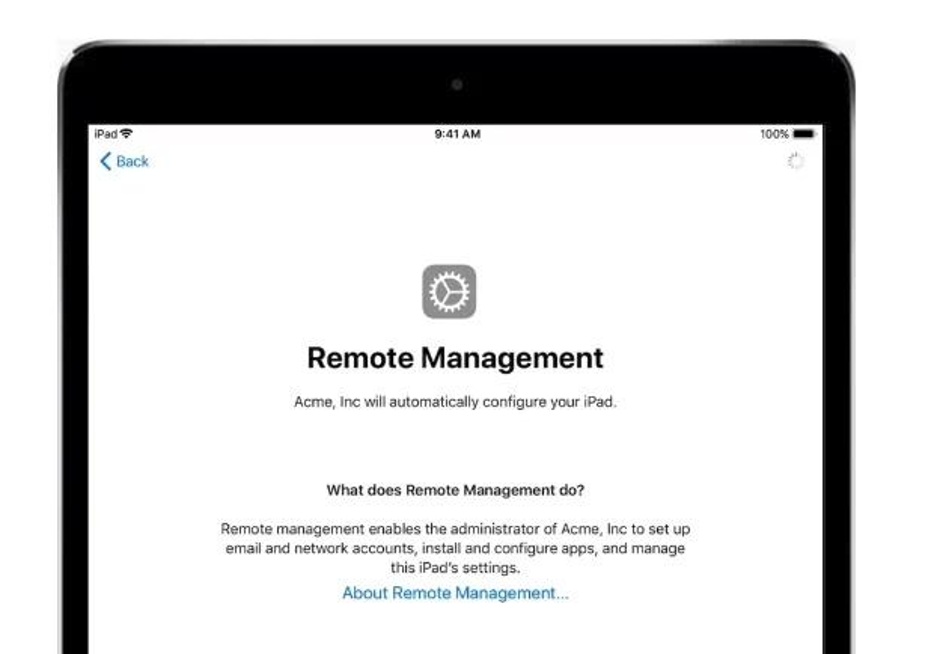
Being restricted by the Remote Management error on an iPhone or iPad can be frustrating for any iOS user. But the best part is that there are multiple solutions for how to bypass MDM from iPhone, even on the latest iOS 27.

Mobile Device Management (MDM) itself is a great solution for companies to prevent unrestricted access, but it can be a serious nuisance for people who have bought a used device. So, whether you are stuck on an MDM screen due to incorrect login information or other mismatched configurations, you’ll find this guide useful to bypass MDM.

Part 1. Before You Bypass MDM on iOS 27: Identify Your Management Type

MDM lock is not a one-size-fits-all type of lock. It means different types of device management, so the first step in how to remove MDM is to identify the exact management type on your iOS 27.

Here are the key MDM types:

  1. Locally Installed Management Profile: This type of MDM profile appears under Settings.
  2. Setup Assistant Requires Remote Management: User has to enroll in MDM
  3. Supervised Profile: It means the device (iPhone/iPad) is supervised by an organization
  4. MDM Profile With No Remove Management Option: MDM removal methods are restricted on such profiles, and you have to go through MDM bypass methods.

Identifying the right management type is important to choose the right method of removing a local profile, bypassing a setup screen, or handling an organization-side lock.

Part 2. How to Bypass MDM from iPhone on iOS 27

Choosing the best way to remove MDM from iPhone is dependent on profile-removal permissions, administrator access, device state, and the management type you are dealing with. Let’s go through different methods and tools to bypass MDM:

Method 1. Bypass MDM on iOS 27 with 4uKey

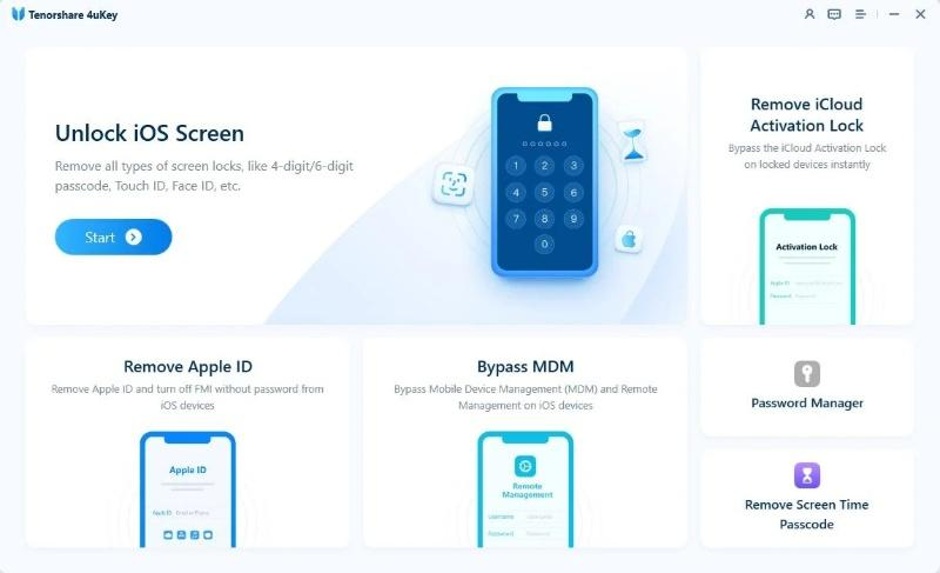
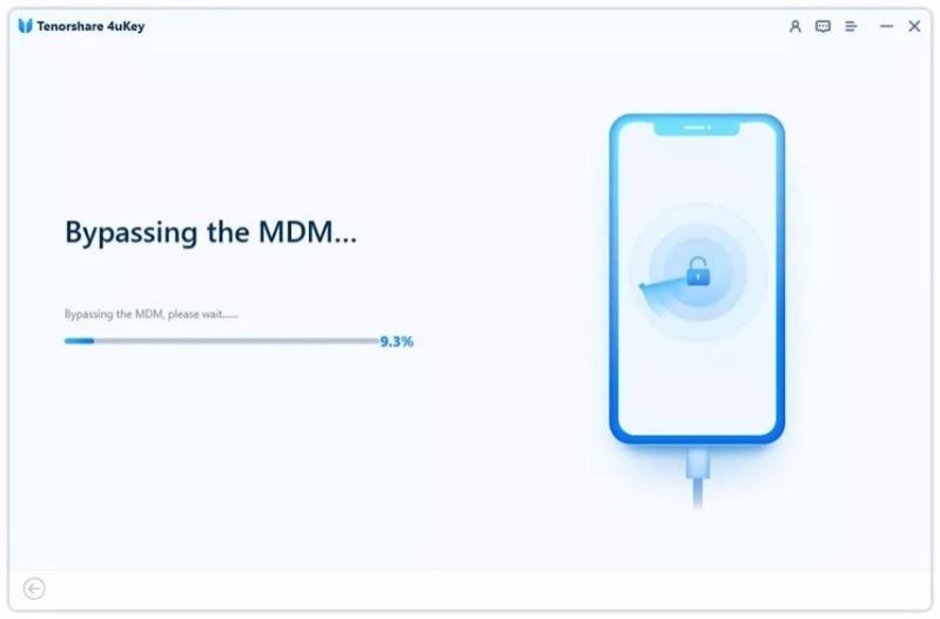
Tenorshare 4uKey is a perfect solution for users looking for a desktop solution to bypass remote management MDM screens. It has a wide range of iPhone and iPad unlocking features, including a specific bypass MDM feature.

Most importantly, 4uKey supports the latest iOS 27 and iPadOS 27. The process also does not erase your data from the devices, so you can easily remove MDM without the fear of losing your data.

How to Use 4uKey to Bypass MDM?

Here are the steps of the MDM bypass feature in 4uKey:

  1. Download and install 4uKey on your computer.

  1. Connect your iPhone or iPad to the computer.

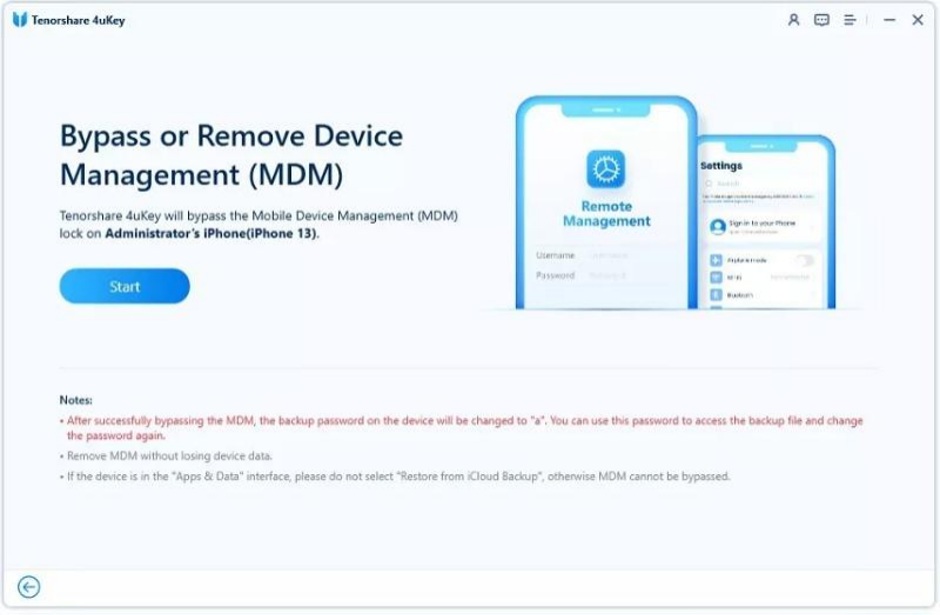
  1. 4uKey has a dedicated screen and feature to bypass MDM. Open it and click the Start button.

  1. Wait for the MDM bypassing process to complete

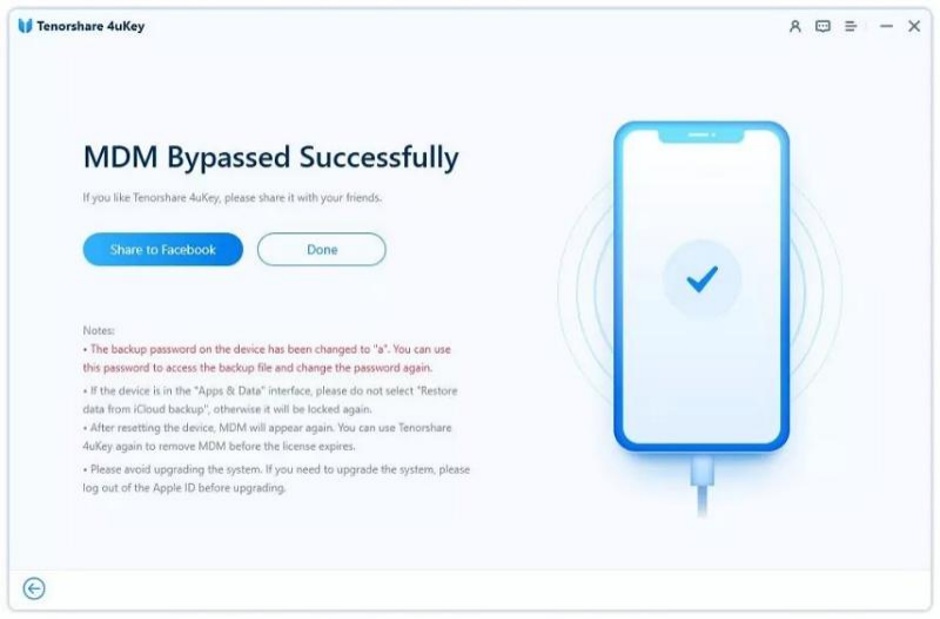
  1. You’ll get the confirmation that you’ve successfully bypassed MDM on your iOS 27.

Overall, 4uKey stands out as a comprehensive solution to handle iOS issues like MDM locks. It has a user-friendly interface and is available for both Windows and macOS users. However, there are a few limitations, such as the requirement of disabling Find My iPhone before the MDM bypass process.

Method 2. Ask Your Administrator to Remove iPhone Management

One of the safest and most effective ways of how to remove MDM from an iPhone is by simply asking the administrator or organization to help the MDM lock. This is common in the corporate sector and school-owned devices with MDM locks.

It is possible that you bought a second-hand iPhone or iPad that has the management lock implemented by the organization it belonged to. You have to identify that company and write to them to request lock removal.

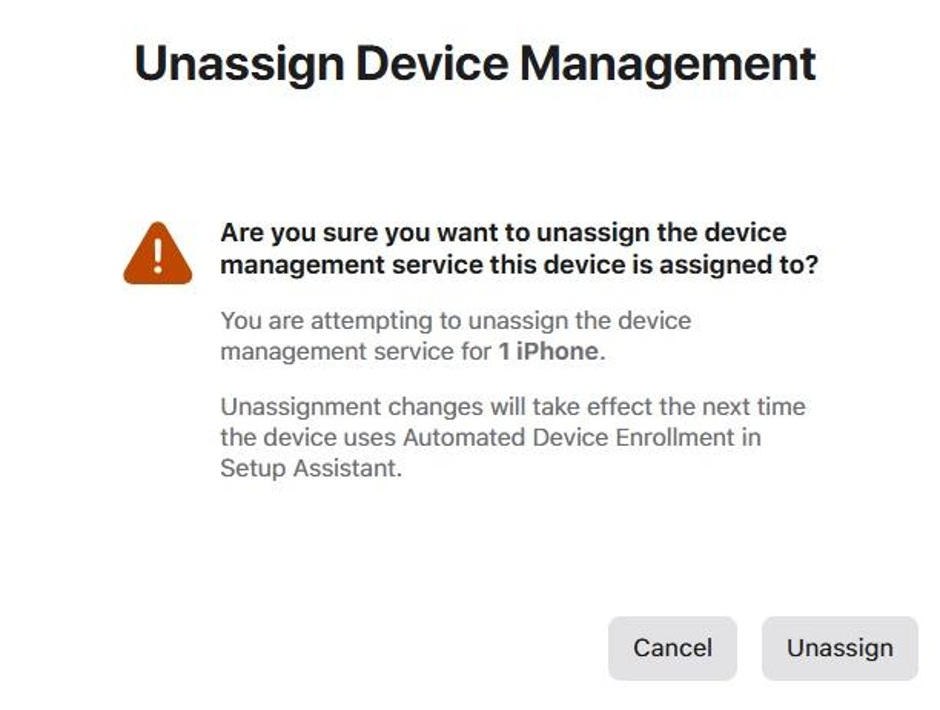
If the administrator agrees, they’ll have to follow these steps to remove MDM from the iPhone and release it via Apple School Manager or Apple Business:

  1. Log in to Apple Business/School Manager and choose the Device Management option.
  2. Select the locked device.
  3. Click the three-dot menu bar in the upper right corner and choose to Unassign Device Management.

  1. Provide confirmation that you are unassigning the device from management, which means you are removing the MDM lock.

Limitation

While asking the administrator to remove the iPhone/iPad management lock is an effective approach to bypass MDM, there’s no guarantee that the organization will always agree to do that for you.

Moreover, if you’ve bought a second-hand phone, you’ll have to go through the extensive process of finding the relevant organization, contacting them, and explaining your issue before they even consider removing the lock.

Method 3. Remove MDM through iPhone Settings

If your management profile is such that you are able to access the Settings on your iOS device, then you are in great luck! You’ll be able to access the free and official option to remove MDM through Settings.

Here’s how:

  1. Open the Settings app on your iPhone or iPad.
  2. Tap General.

  1. Scroll down and tap Device Management.

  1. Tap the profile that you want to remove.

  1. Tap Remove Management.

  1. Enter the username and passcode if prompted.

Limitation

Removing MDM through iPhone settings requires you to know the username and password for successful completion. Therefore, there’s a high chance that even if you have access to this method, you’ll have to choose one of the other free or paid options to remove MDM on iOS 27.

Part 3. Free vs. Paid Options to Remove MDM on iOS 27

There’s no wrong or right answer when it comes to choosing between free vs. paid methods to remove MDM on iOS 27.

The right method and total are dependent on different types of users, management profiles, and the exact MDM lock issue you are facing. Even in paid options, there are different types of tools, so you should choose the method that gets you the right outcome through a user-friendly MDM removal iPhone process.

The following table summarizes the differences between free and paid options to remove and bypass MDM on iOS 27:

Free Tools Paid Tools
Suitable for older iPhone/iPad and older versions of iOS Supports the latest iOS versions
Requires technical expertise Offers dedicated MDM features
Does not guarantee 100% MDM removal as it can come back after a factory reset Ensures data preservation
Offers limited compatibility Provides detailed step-by-step guides

FAQs About MDM Bypass on iOS 27

1. Can I Remove MDM from My iPhone Without a Password?

Yes, you can remove MDM from your iPhone without a password using a third-party tool that supports this feature.

2. Why Is the Remove Management Option Missing?

If your iOS device is locked by the organization’s automated enrollment profile, you’ll likely be prohibited from removing the management profile, which means the remove management option will be missing. You’ll need to go through an MDM bypass process to remove the lock.

3. Does a Factory Reset Remove MDM on iOS 27?

No, a simple factory reset will not permanently remove MDM from your device, especially if the organization has registered it through an enrollment system.

4. Will MDM Return after Resetting or Updating My iPhone?

Resetting involves resetting all your iPhone’s configurations and possibly also deleting the files. If you’ve bypassed MDM with a suitable tool and then reset your device, it’s unlikely that the MDM lock will return. Updating, however, is an official update from Apple to fix security issues and provide new features. Not every update is the same, so whether MDM returns after an update is dependent on its exact specifications.

Conclusion

Bypassing MDM on iOS 27 might seem more complicated than it seems. But you just have to remember three methods to successfully remove MDM from your device and gain access to it.

Firstly, you should try to access the official Settings and remove the lock with a username and password. Secondly, if you don’t know the password, then contact the relevant administrator to remove the lock from the organization side. Thirdly and finally, if none of the other two methods work, then go for a third-party tool like 4uKey that has a dedicated feature to bypass MDM lock on all iPhones and iPads, including iOS 27.

AI Warnings Add to Oil, Bond and Fed Risks as Stocks Face a Rougher Fall

0

A sudden shift in the artificial intelligence narrative is adding to a volatile mix of macroeconomic pressures threatening to unsettle U.S. stocks, with investors confronting renewed oil inflation, rising Treasury yields and the growing prospect of a Federal Reserve rate hike this week.

Warnings from Anthropic CEO Dario Amodei and OpenAI CEO Sam Altman that the industry may need to slow the development of powerful AI models have struck the market at an uncomfortable moment. For years, investors have rewarded companies pouring money into AI infrastructure on the assumption that rapidly rising computing demand will translate into years of earnings growth.

That trade is now facing a more complicated test.

The latest safety warnings have introduced a new question into an already expensive AI investment cycle: whether the industry can continue increasing spending at its current pace while policymakers, researchers and even leading executives become more concerned about the risks of pushing frontier models too quickly.

The reaction was particularly severe among chipmakers, which are among the biggest financial beneficiaries of the AI boom. South Korea’s SK Hynix and Samsung fell about 6% and 5%, respectively, in Asian trading, while the weakness extended into U.S. markets.

Shortly after Monday’s opening bell, the S&P 500 was down 0.55% at 7,615.16, the Dow Jones Industrial Average had fallen 0.28%, or 148.91 points, to 52,424.38, while the Nasdaq 100 was down 1.27% at 28,996.28.

Among major technology companies, SK Hynix ADRs fell about 7%, Intel dropped 6%, Micron lost 6%, AMD declined 5%, Samsung fell 5%, Broadcom was down 4%, and Nvidia slipped 2%.

The selling suggests investors are becoming less willing to treat every increase in AI spending as automatically positive for technology valuations.

AI Trade Meets a Much Tougher Macro Environment

The latest AI concerns began gaining momentum last week after Anthropic researcher Jacob Coxon announced his resignation and warned that AI researchers were “gambling with our lives,” reflecting broader concerns that more sophisticated systems could pose serious risks to humanity later this decade.

Other researchers subsequently raised similar concerns, prompting Amodei to call for a slower pace of development over the weekend. Altman agreed in a post on X, saying, “We need to pace the frontier.”

Altman also said an OpenAI IPO this year would now be “ill-advised,” adding another layer to the debate because a public listing would expose the company’s enormous AI spending and development decisions to substantially greater shareholder scrutiny.

Microsoft appeared to move in a similar direction Monday by publishing a provisional code of conduct that would establish guardrails around the development of future AI models.

For markets, however, the timing may be more important than the individual announcements.

Technology stocks are confronting the AI debate while investors are already dealing with three major macroeconomic pressures.

Oil prices have surged as fighting in the Middle East threatens energy supplies. Brent crude rose another 4% Monday to above $109 a barrel, while West Texas Intermediate climbed 4% to about $104. The latest move followed new fighting and Saudi Arabia’s decision to shut a pipeline designed to bypass the Strait of Hormuz.

Higher crude prices threaten to revive inflation precisely when investors had been hoping for monetary-policy relief. A prolonged energy shock could raise transportation, manufacturing and consumer costs while squeezing corporate margins.

The second pressure is the bond market.

The benchmark 10-year U.S. Treasury yield was around 4.98% Monday, approaching the psychologically important 5% level. Rising energy prices have contributed to expectations for higher interest rates, while persistent concerns over the U.S. government’s fiscal position have also encouraged investors to demand greater compensation for holding long-dated debt.

A $6 billion Treasury buyback of long-dated securities failed to stop the sell-off.

Higher yields are important for technology stocks because they increase the discount rate applied to future earnings. That can put pressure on companies whose valuations depend heavily on profits expected years into the future, even when their underlying businesses continue to grow.

That makes the current market environment uncomfortable for the AI trade. Investors are simultaneously questioning the pace of AI spending and facing a higher cost of capital.

The third pressure is the Federal Reserve.

Markets are now pricing in roughly a 90% probability of a 25-basis-point rate increase at this week’s policy meeting, up sharply from about 33% a month ago, according to CME FedWatch.

Investors will therefore be watching Wednesday’s decision and Fed Chair Kevin Warsh’s remarks for indications of how the central bank intends to respond to the combination of stronger energy prices, inflation risks and financial-market stress.

The result is a potentially self-reinforcing cycle. Higher oil prices push inflation expectations higher, higher inflation raises the prospect of tighter monetary policy, tighter policy supports higher bond yields, and higher yields put pressure on equity valuations. But simultaneously, AI safety concerns are challenging the growth assumptions supporting some of the market’s most heavily valued technology companies.

Economist David Rosenberg said the deterioration is already becoming visible. The S&P 500 has lost about 1% over the past month, while the Dow and Russell 2000 are trading below their 50-day moving averages, suggesting weaker near-term momentum.

He also pointed to deteriorating market breadth, meaning fewer stocks are participating in the market’s gains.

“In any event, we have reached a new chapter in this story,” Rosenberg wrote of the AI trade, explaining that higher bond yields could cause the previously broad bullish narrative to reverse.

The concentration of the market’s gains makes that risk more significant. If technology stocks weaken materially, the impact may not remain confined to the technology sector because many areas of the S&P 500 have become increasingly correlated with the performance of large technology companies.

Jefferies analysts also noted that the semiconductor sector was already under pressure before the latest AI warnings. The iShares Semiconductor ETF had fallen about 20% from its recent high and was down another 5% Monday morning.

Bank of America, meanwhile, raised its year-end S&P 500 target slightly to 7,400 but still saw that level as representing about 3% downside from current prices.

“There will likely be a better entry point for S&P 500,” the analysts wrote, drawing comparisons with the 1970s, when markets faced inflationary pressure, currency concerns, Federal Reserve tightening and an oil embargo.

That historical comparison carries an important warning. BofA noted that the bear market of that period produced a decline of more than 40% and a sharp compression in price-to-earnings multiples. The present market is not a repeat of the 1970s, but the comparison illustrates why investors are becoming more sensitive to the interaction between inflation, interest rates and valuations.

The AI debate could ultimately prove to be temporary if companies continue producing strong earnings from their investments in computing infrastructure and AI applications. But the market no longer has the luxury of evaluating AI spending in isolation.

Investors are now asking whether enormous capital expenditures will generate sufficient returns while the cost of capital is rising and regulators and technology executives are becoming more cautious about the pace of development. That makes Wednesday’s Fed decision particularly important. A hawkish message could reinforce pressure from oil and bonds, while any indication that policymakers remain concerned about growth could provide some relief.

Either way, the market enters the week with several sources of risk pointing in the same direction. The AI boom has not necessarily ended, but the assumption that it can continue driving valuations higher regardless of the macroeconomic backdrop is facing a much tougher test.