DD
MM
YYYY

PAGES

DD
MM
YYYY

spot_img

PAGES

Home Blog Page 5152

The New SEC Crypto Regulations in Nigeria – What you should know

1

On the 11th of May, 2022, the Securities and Exchange Commission (SEC) issued new rules on the issuance, registration and custody of Digital assets.

The rules define “Digital assets” as digital tokens representing an asset such as a debt or equity claim on an issuer. This can be seen as a type of Cryptocurrency-based Investment security.

“Virtual Assets” are then defined in the rules as digital representations of value that can be traded, transferred, able to be used for payment and Investment purposes and which exclude items like digital representations of Fiat currencies (such as Stablecoins).

“Digital Asset Offerings” are defined in the rules as Initial Coin Offerings (or ICOs) which are simply digital equivalents of Initial Public Offerings to subscribe to Securities regulated by SEC and which are based on digital tokens instead of subscription-based Investment units.

“ICOs” are defined here as digital Capital raising for business projects (called “ICO” projects) based on distributed ledger technology involving token issuing to the public as digital securities in exchange for cash, Cryptocurrencies and other assets. ICOs subject to exceptions cannot go beyond a ceiling of 10 Billion Naira in a 12-month period.

ICOs can only be conducted by DAOPs(Digital Assets Offering Platforms) which are corporate entities dedicated to facilitating the offer of Digital assets.

“DACs” or Digital Asset Custodians, are basically digital equivalents of Assets custodians found in traditional Collective Investment Schemes and are charged by the SEC to render safe-keeping of digital assets invested in ICOs. DAOPs can, subject to approval and licensing by SEC, also render their own internal digital asset custodian needs.

DAOPs differ from “DAXs”(Digital Asset Exchanges) which are defined in the guidelines as digital platforms facilitating the trading of Virtual and Digital assets. This seems to be a roundabout way of bringing Crypto marketplaces like Patricia and Binance to the mainstream of Nigeria’s Capital Market.

“VASPs” or Virtual Asset Service Providers which are defined in the guidelines as platforms that conduct of behalf of other parties :-

a) exchanges between Cryptocurrencies and Fiat currencies;

b). exchanges between virtual assets;

c). the transfer of Virtual assets;

d). the safe-keeping of Virtual assets;

e). the provision of financial services related to an issuer’s offer or sale of a virtual asset.

This is also a return of Cryptocurrency brokerage services.

Capital requirements:-

This is where the SEC cooked up an entirely new set of problems. While the licensing requirements for VASPs did not include any cost implications, the requirements for DAOP and DAX Licensing are as follows :-

a). A filing/application fee of 100,000.00Naira;

b). A processing fee of 300,000.00 Naira;

c). A registration fee of 30 million Naira;

d). A minimum paid up Capital requirement of 500 million Naira.

Observations & Recommendations.

  • The SEC guidelines on digital assets, while presenting a cloak of full legality over what was a grey area left by the Central Bank of Nigeria ban on Cryptocurrency support services being provided by Banks. However, these rules point to a rather worrying lack of coordination among government agencies because the Central Bank of Nigeria (CBN) has still not revoked its Cryptocurrency ban. So how do interested companies pay the SEC fees?

There may be a way out as the SEC never expressly provided for Cryptocurrency legalization but provided for the full legalization of Blockchain Technology and Virtual Assets which are far more than just Cryptocurrencies, some of them being Non-fungible tokens(NFTs). This is a nuanced area that might be latched onto by Banks.

  • The SEC guidelines with its Registration & Capital requirements simply replaced one problem with another by potentially creating an enabling environment for monopolies to spring up, killing opportunities for start-ups, seed funding, Tech incubation and lTechpreneurs who are usually most responsible for the innovation quality on which Tech and especially Fintech depends. This will most likely also lead to clumsy mergers by lots and lots of Fintech companies just to meet license qualifications and a subsequent increase in fees to justify the huge starting costs.

  • This attempts to almost eradicate the very reason for Cryptocurrencies being a thing – decentralization of individual control over personal finances. The Nigerian state has been known to sometimes greatly limit financial freedoms for almost any reason.

  • There’s still an amount of ambiguity over the existence or presence of further Capital requirements for the Registration/Licensing of VASPs, which might be included in a schedule to be released later.

  • The SEC rules might turn out to be seen as very counter-productive, designed to permanently destroy and severely limit Nigeria’s Fintech space, very discriminatory, anti-financial inclusion, and might witness more Cryptocurrency trading companies going deeper and operating underground using alternative legal structures.

  • It remains to be seen if the SEC is actually operating out of its jurisdiction because it’s not in the place of the agency to determine what constitutes legal tender, but that of the CBN which also has jurisdiction over legal tender trading rules, lending rates, and inclusion of alternative legal tender in the country’s Banking and Capital Market system. The SEC needs to be called to order by a lawsuit seeking a clear interpretation of its functions under the Investment and Securities Act.

The SEC should get its act together, review its Capital requirements, and work on a more grassroot oriented Regulatory framework in collaboration with the Central Bank of Nigeria and the Nigerian Financial Intelligence Unit (NFIU).


Join Tekedia Capital Members And Invest In These GREAT Startups

0

Tekedia Capital has a special active deal: a Lagos-based startup which processes excess of N4 billion per month and another which since launch in Sept 2021 has processed $11 million. Join our Syndicate and participate in these opportunities. We will be closing both this week. Begin here.

Tekedia Capital Syndicate requires $1,000 or N430k annual/4-cycle membership and you need to invest a minimum of $10k if investing.

Tekedia Capital offers a specialty investment vehicle (or investment syndicate) which makes it possible for citizens, groups and organizations to co-invest in innovative startups and young companies in Africa and around the world. Capital from these investing entities are pooled together and then invested in a specific company or companies.

Nigeria 2023 Presidential Election: The Few and the Majority Game

0

Citizens have expressed a variety of views since the door to form purchase for various political positions in 2023 was opened by political parties and politicians who are not expected to indicate interest in the presidential position purchased forms. According to our analysis, mixed emotions to the politicians who showed interest in the presidency are not as strong as to the sentiments exhibited towards the cost of form issued by the two major political parties, the All Progressives Congress and the People’s Democratic Party.

Our analyst discovered that the People’s Democratic Party made a total of N646 million by selling the forms to 17 aspirants, while the All Progressives Congress made a total of N1.23 billion.

Ordinary Nigerians and members of civil society organizations were startled that political parties could sell forms at a price that may improve residents’ socioeconomic position in areas where many hopefuls live. Many of the hopefuls, according to certain citizens and CSOs, bought the form in the hopes of securing political jobs after the 2023 general elections. The biggest parties, according to the submission, sell forms at a high cost in order to raise sufficient campaign funds.

Overall, our analyst believes that because all of the hopefuls cannot be candidates, the essential ones will emerge as the contest heats up. In the next days, the two parties are anticipated to use specific methods and techniques to reduce the number. President Buhari’s methods of imposing a mandatory resignation letter submission a few days ago, as well as some applicants’ inability to submit their forms before the deadline, have already paid off.

An online national newspaper reports that “No fewer than 25 presidential aspirants will contest for the presidential ticket of the ruling All Progressives Congress (APC). As of midnight Friday, the 25 aspirants were able to meet the deadline for the submission of completed forms. To this end, the 25 aspirants will slug it out at the presidential primary of the party slated for May 30.”

The critical few would emerge for the race, based on the earlier hypothesis. During the 2023 presidential election, Nigerians can anticipate five political parties to have formidable candidates. In other words, from a pool of less than 40 candidates, the critical few would be offered to Nigerians. Candidates will make up the final critical few, but the electorate will be the most important factor. The crucial major should be a requirement for one of the final critical few to become the next president.

The critical major, on the other hand, would not make the critical choice, which should be enough to change weak leadership and competence that have been the main problems of the country over the years. The low turnout in recent presidential elections, as well as voting along ethnic and religious lines, demonstrate this.

The Political Maze in Nigeria With “Anything” Office

0

In spite of his earlier payment of N100 million for the presidential Nomination and Expression of Interest forms of the ruling All Progressives Congress (APC) and launching campaign with fanfare, the former National Chairman of the APC, Adams Oshiomhole, on 14th May 2022, participated in the party’s screening for a senatorial seat.

Oshiomhole, who is an erstwhile Governor of Edo State, reportedly arrived the venue of the screening exercise at Fraiser Suite, Abuja, at about 8:12 pm on the aforementioned date.

Mr Oshiomhole had earlier declared to contest for Edo North Senatorial District. However, in a twist, he made a U-turn, then announced his presidential bid some weeks ago at an elaborate event in Abuja, the Nigeria’s capital territory.

In his declaration speech, Mr Oshiomhole claimed he was the best candidate to be Nigeria’s next president having been a labour leader and a governor. He said his government would be for the workers and working people and not the Nigerian elite.

By his participation at the APC’s Senatorial screening exercise, it is now clear that the ex-labour leader bought two forms: for President and Senate.

Despite paying N100 million for the presidential nomination form and launching his presidential campaign with fanfare, the former National Chairman of the All Progressives Congress (APC), Adams Oshiomhole, has been screened by the party for a senatorial seat.

The former Edo State governor arrived the venue of the screening exercise at Fraiser Suite, Abuja, at about 8:12 p.m. and maneuvered his way into the venue of the exercise through the crowd at the entrance.

Mr Oshiomhole had earlier declared to contest for Edo North Senatorial District. However, in a twist, he announced his presidential bid some weeks ago at an elaborate event in Abuja.

In a related development, the wife of the incumbent Ondo State Governor, Betty Akeredolu, who is currently aspiring for the seat of the Imo East Senatorial district, where she hails from, was also at the venue of the APC’s screening exercise for senatorial aspirants.

Mrs Anyanwu-Akeredolu arrived the venue very early at about 3 pm, though the screening did not start until 7 pm.

If given the ticket, Mrs Akeredolu (Nee Anyanwu) seeks to succeed the incumbent Senator for the zone in the person of Onyewuchi Ezenwa.

It’s noteworthy that the Governor of Kano State, Umar Ganduje was equally in attendance at the venue for the APC’s senatorial screening.

Mr Ganduje, who would be completing his constitutionally allowed second tenure in 2023, seeks to join other former governors who have essentially turned the senate to retirement home.

However, on the screening day being Saturday, the venue of the exercise was reportedly chaotic due to the poor arrangement.

The screening committee is expected to screen 351 aspirants who bought the senate nomination and expression of interest forms of the ruling party. The screening is billed to last for two days, though it’s unclear if the exercise would be completed within the stipulated period.

It could be recalled that Oshiomhole’s removal as the National Chairman of the APC was as a result of controversies and various factions that ensued in the party in the period under review.

Hence, it won’t be out of place if stated that the unionist turned politician is synonymous with controversy. Little wonder he is feeding the mindsets of his teeming followers with unreliable actions and inactions, ahead of the 2023 general elections in Nigeria.

Though I’m aware he’s one of the persons that were never aspiring for the Nigeria’s number-one position, am only worried about the electorate who remain gullible and has refused to face realities.

Nigerians ought to acknowledge the politicians that are genuinely willing to occupy any political position, especially the presidential seat. The proposed awareness would enable them to realize how best to take their actions, or react to events as they unfold.

One who is duly informed, can never be deceived, hence cannot be prone to vulnerability. This is, therefore, a clarion call for Nigerians to ensure that they become politically aware as the 2023 polls draw nearer by the day.

Nigerian Labour Congress’ Lamentation On Wike’s Excesses, ‘Non-Payment Of Salaries’

0

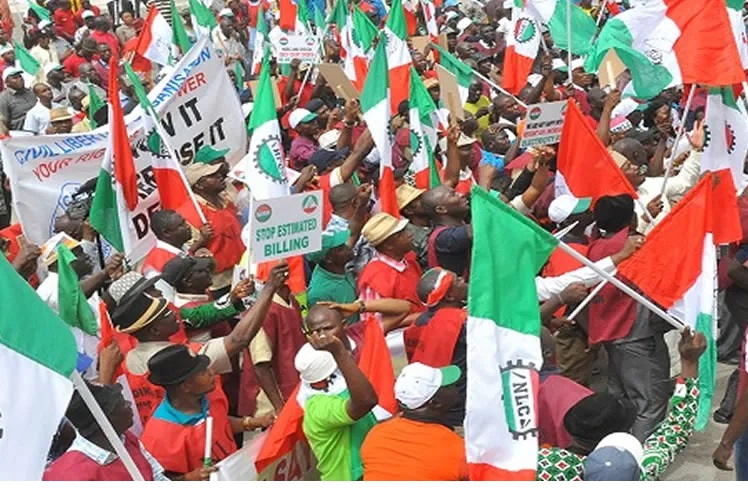
The Nigerian Labour Congress (NLC) has berated Governor Nyesom Wike of Rivers State for donating huge sums of money to other states in the country, while withholding salaries and pensions of Rivers’ workers and retirees.

The NLC, who disclosed this via its National President, Ayuba Wabba, stated that the situation had caused workers in the state to move around in black ‘mourning robes’, while children of pensioners protest naked in public.

According to the NLC, findings revealed that Wike, a presidential aspirant of the Peoples’ Democratic Party (PDP) has donated at least N7.4 billion to seven states across the country since he became governor in 2015.

“The gale of donations to different causes has not escaped the attention of hungry workers and pensioners in Rivers State who watch as their state adorns the robe of Father Christmas to other states while their salaries and pensions are withheld.”  Wabba, said this in a letter to Governor Wike, dated May 5, 2022.

The NLC also accused Wike of denying eligible civil servants promotion since 2012 till date and also refusing to implement annual salary increment and pension incremental rates in the State.

Mr Wabba said the non-payment of pension arrears, gratuities and death benefits in Rivers State had exposed retirees to unimaginable pains and trauma, saying Wike’s administration had failed to act on the report of a tripartite committee set up to resolve the issues.

The labour union expressed shock that the governor had not paid the terminal benefits of retirees for the past seven years, despite Rivers State being one of the richest states in Nigeria.

Mr Wabba wondered why Wike would donate money to other states in the country when workers in his state were not paid, thereby reminding the governor that “charity begins at home”.

The NLC further hinted that Bayelsa, Benue, Sokoto and Akwa Ibom States top the list of the seven states that had immensely benefited from Wike’s largesse, saying Wike in January 2021 donated N500 million to support the rebuilding of Sokoto Central Market destroyed by fire.

The governor, in February 2018, donated N200 million to the Benue State Government for relief materials and medicine for persons displaced after herdsmen attack.

It can be recalled that in March 2022, the Radio Nigeria reported that Governor Wike donated N400 million to victims of fire disasters at the Katsina Ala and High level main market. This was the second donation to Benue State alone, totaling N600 million.

Furthermore, there was also a report that Wike in April 2022, donated N200 million to victims of a violent attack in Kaduna State.

He also committed N5 billion for infrastructure upgrade at the Yenagoa campus of the Nigerian Law School, Bayelsa State. In February 2022, his government, again, donated N500 million to the Bayelsa State Medical Science University in Yenagoa.

Reports further indicate that the Rivers State had been rewarded with a campus of the Nigerian Law School in Port Harcourt, which is currently under construction.

Governor Wike last year, pledged N600 million to support the building of a teaching hospital in Akwa Ibom State.

However, the Rivers State Commissioner of Information, Paulinus Nsirim, declined comment on the reports when asked to do so by newsmen. His silence insinuated that the allegations of the NLC were accurate and in order.

It’s no longer news that most Nigeria’s politicians, most times act not unlike people that are placed under a certain spell. If these reports, as stated above, are something to go by or hold water, then it implies these men aren’t just heartless but ‘monsters’ in sheep clothing.

No payment of salaries and pensions has become a recurring decimal to the various sitting governors in Nigeria, yet huge amounts of monies is expended, on a daily basis, on mere frivolities by their governments.

Time has really come for the electorate to, at least for once, get it right for their future’s sake.