


Join me tomorrow at the temple of Africa’s entrepreneurial capitalism as we discuss how to discover opportunities in markets. Tekedia Mini-MBA is helping innovators and project champions to deepen capabilities across industrial sectors. The next edition begins June 6 2022; register here and beat the early deadline and save
Dissecting Munguno’s Avowal On Nigeria’s Rising Insecurity
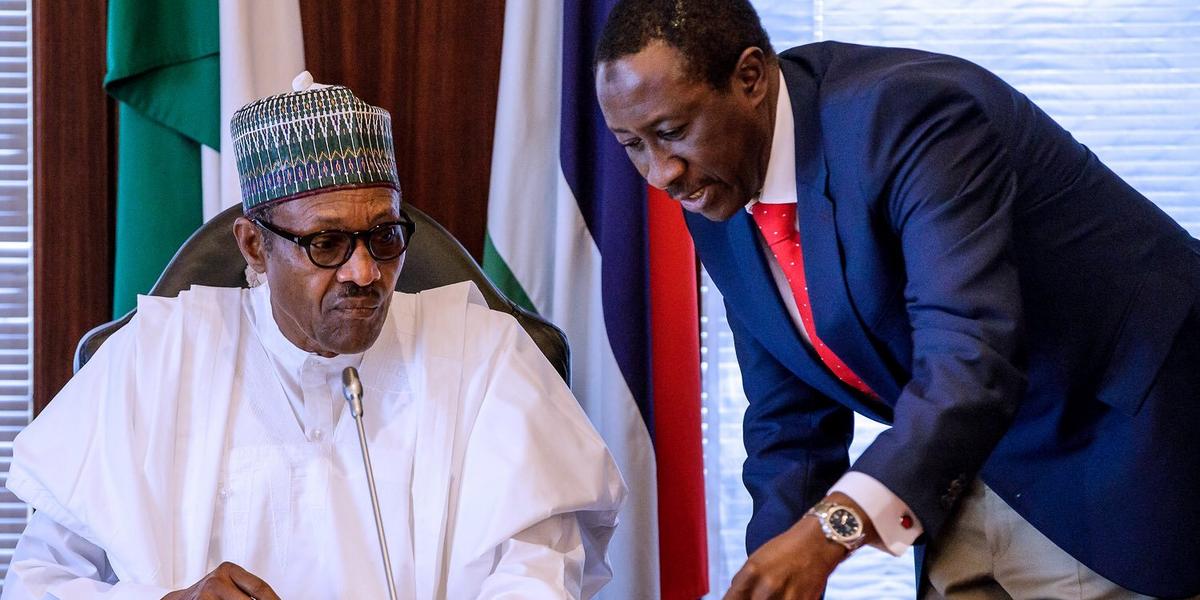
The Nigeria’s National Security Adviser (NSA), Rtd Major Gen. Babagana Monguno (rtd) had stated that the various security agencies in the country were not deploying adequate technology to combat insecurity because of its difficult procurement process.
The NSA, who made this disclosure while briefing newsmen at the State House in Abuja on 21st April 2022, attributed the non-deployment of adequate technology to its expensive nature.
While highlighting the challenges faced while procuring technological devices to fight insecurity, Monguno said the government was trying its best to meet up with its responsibilities.
“So the first question has to do with why is it so difficult to deploy technology. One, technology is expensive. Technology takes time to acquire these things since inherently we do not produce these very, very delicate equipment.
“It’s not as if the government is not making any effort to acquire but we need to know who to acquire this technology from, where, when and there are certain processes.
“For now, I know we have but the plight is that they are inadequate. So to the government, it’s a continuous process. That’s what I can say about the issue of deploying technology,” he said.
He added that one of the major causes of insecurity in Nigeria was the porosity of the country’s borders, informing that the government was working with neighbouring countries to ensure that illegal entry into Nigeria is curtailed.
“On the question on border security, obviously, we have very extensive borders, and I’m not going to deceive anyone. All of us know that we have problems of infiltration by virtue of the fact that we have a very large economy.
“It attracts a lot of people from outside and they come in illegally, not just through the land borders, but also through the maritime waters.
“Of course, in the case of the maritime borders, most of things have been done in the last one year to secure the maritime domain, up to the point that, the International Maritime Bureau has acknowledged the fact that in 27 years, our maritime borders have not been as secure and peaceful as they were in the last one year.
“That is a fact, it is not a conjecture, I didn’t cook up this thing. So we want to see how we can replicate that type of efforts put in the maritime domain on our land borders. That is something that council is looking into,” he said.
It’s not anymore news that in recent times, insecurity in Nigeria has worsened under the Buhari-led administration as the country witnessed some of the bloodiest attacks in its history.
Currently, virtually every geo-political zone within the shores of the country suffers one form of attack or the other, notably from outfits such as Boko Haram/ISWAP, IPOB separatists, herdsmen, and bandits.
The country has equally witnessed the highest number of school children abductions and hostage-taking since 2014 when the Chibok schoolgirls were abducted.
In the same vein, the highest number of jailbreaks in a single year has been experienced by the acclaimed giant of Africa, as no fewer than four prisons had been affected counting from last year.
Bandits have abruptly overshadowed the Boko Haram/ISWAP terrorists as they had made some states in the North-West and North-Central the epicentres of killings in the country.
Though the President Muhammadu Buhari-led government has repeatedly claimed that Nigerians are more secure under its watch than during the previous administrations, the assertion had been disputed by facts on the ground.
Munguno’s claims could be described as laughable, because Nigeria conspicuously possesses all it takes to ensure the needed devices are procured. Whatever protocol and financing required to do the needful can be provided by the country.
Talking about porosity of the various borders, in my capacity as a tech expert and policy analyst, I have variously taken time to provide measures needed to be deployed towards addressing the country’s porous borders, and similar advice had equally been tendered by other concerned Nigerians, yet till date, we are still singing same song as regards security challenges.
The above assertions and revelations are indications that Nigeria’s current security quagmire is attributed to lack of political will.
Buhari Summons Nigeria’s Service Chiefs
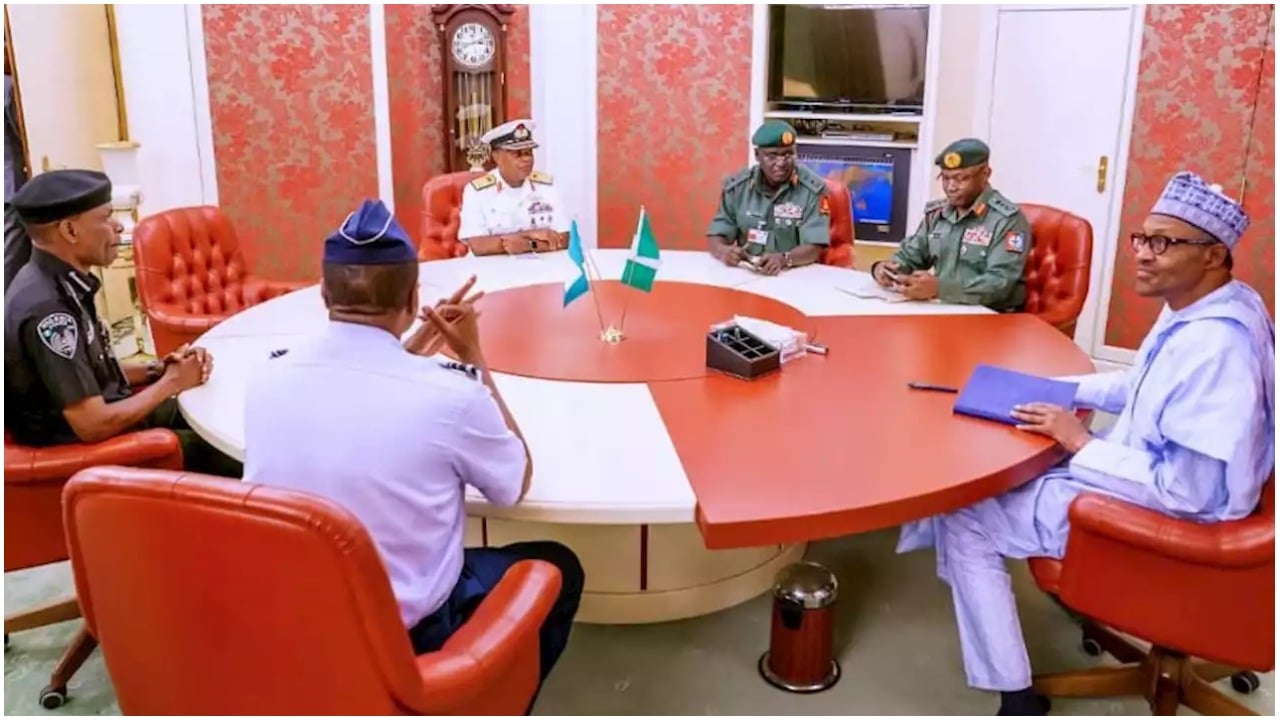
President Muhammadu Buhari, on 21st April 2022, summoned a security meeting with the entire Service Chiefs in Nigeria.
This was reportedly sequel to the recommendations by the Council of State over the myriad of security challenges facing virtually all parts of the country.
Gov. Abubakar Badaru of Jigawa State had on April 14, 2022 briefed the State House correspondents on the outcome of the meeting of the Council of State, where he announced that the president would be meeting security chiefs this week, over the current security situation in the country.
According to the governor, the proposed meeting followed recommendations and comments by the Council of State.
He said the necessary measures would be taken to ensure that farmers across Nigeria carry out their activities without any hindrance, to boost food production in the country.
President Buhari had on Wednesday, 20th April, 2022 at the meeting of the National Executive Committee (NEC) of the All Progressives Congress (APC) reportedly disclosed tougher security measures in restive parts of the country and review of operations and strategy.
He reassured Nigerians that the efforts that resulted in relative peace in South-South, and rescuing of North-East from the hold of terrorists would be ramped up.
According to the number one citizen, the major security challenges had remained in the North-Central and North-West, saying, “We are going to be very tough.’’
The Security Meeting, which was held at the Council Chamber of the Presidential Villa, was attended by Vice-President Yemi Osinbajo, some cabinet Ministers, Service Chiefs and heads of security establishments at the Presidential Villa, Abuja.
Others at the meeting included, Secretary to the Government of the Federation, Mr. Boss Mustapha; the Chief of Staff to the President, Prof. Ibrahim Gambari; and the National Security Adviser (NSA), retired Maj. Gen. Babagana Monguno.
Also in attendance were the Inspector-General of Police, Mr. Usman Baba; the Director-General of the Department of State Service (DSS), Mr. Yusuf Bichi; and the Director-General of the National Intelligence Agency (NIA), Mr. Ahmed Rufai.
In recent times, such a meeting pertaining to security issues had been held and presided over by the President for the umpteenth time, yet the same outcry is being heard at every corner across the federation as if the country isn’t governed by any authority.
Nigerians, to assert the least, have heard enough of promises from Nigeria’s leadership as regards combating insecurity and related matters, till date, they still wake up to embrace exactly the same crises ravaging the wellbeing of the country.
The funny and painful aspect of this unending quagmire taking place within the shores of Nigeria is that the concerned authorities are very much aware of the originators.
CNN Shuts Down Streaming Service, CNN+, A Month After Launch

Cable News Network, CNN, is shutting down its streaming service, CNN+, just one month after it was launched. The development comes on the heels of Netflix’s remarkable loss, suggesting a troublesome time for the streaming industry.
CNN said the streaming service, which featured hours of daily live programming and weekly shows, will shut down on April 30, but customers will receive prorated refunds of subscription fees.
The decision, which came as a shock to many, has without warning, buried the hype that followed the CNN+ idea, which was regarded as one of the “most significant developments in the history of CNN.”
While the decision to shut down the streaming service has been linked to revenue growth headwinds in the streaming industry, CNN offers a different explanation. The TV network said the decision was made by new management after CNN’s former parent company, WarnerMedia, merged with Discovery to form Warner Bros. Discovery earlier this month.
In further explanation, CNN reported on while the decision was taken:
The prior management team’s vision for CNN+ runs counter to Warner Bros. Discovery CEO David Zaslav’s plan to house all of the company’s brands under one streaming service. Some CNN+ programming may eventually live on through that service. Other programming will shift to CNN’s main television network.
“In a complex streaming market, consumers want simplicity and an all-in service which provides a better experience and more value than stand-alone offerings, and, for the company, a more sustainable business model to drive our future investments in great journalism and storytelling,” Discovery’s streaming boss J.B. Perrette said in a statement.
“We have very exciting opportunities ahead in the streaming space and CNN, one of the world’s premier reputational assets, will play an important role there,” Perrette added.
Perrette and incoming CNN CEO Chris Licht notified staffers of the decision in a meeting on Thursday afternoon. Licht bluntly told employees it was a “uniquely shitty situation.”
Hundreds of CNN+ staffers may lose their jobs. Licht said in an internal memo that “all CNN+ employees will continue to be paid and receive benefits for the next 90 days to explore opportunities at CNN, CNN Digital and elsewhere in the Warner Bros. Discovery family.”
Staffers who aren’t absorbed elsewhere in the company will receive a minimum of six months of severance, he added.
Licht said in a town hall style meeting with staffers that “this was an incredibly successful launch” but simply incompatible with the newly merged company’s plans.
“It is not your fault that you had the rug pulled out from underneath you,” he said as he vowed to minimize the impacts to staff.
One CNN+ staffer at the town hall described the sentiment as “total and utter shock” that morphed into despair.
“At first people were really freaking out,” explained the person, who requested anonymity to candidly describe the situation. “And then, toward the end of the meeting, it just turned to sadness. Every team was just huddling with each other.”
During the town hall, Perrette expressed some frustration with the “prior leadership” of CNN, which was led by Jeff Zucker until February, and WarnerMedia, which was led by Jason Kilar until early April.
“Some of this was avoidable,” he said, but “prior leadership decided to just keep going” with the planned March launch of CNN+ despite the impending merger, he said.
The streaming service ended up launching just two weeks before the WarnerMedia-Discovery merger completed, much to the exasperation of Discovery leadership, which had a different strategy but could not legally communicate with CNN executives before the deal was official.
Warner Bros. Discovery has billions in debt, much of which is a result of the deal to combine the company, and executives are under pressure to find $3 billion in savings that Wall Street is expecting from them.
The executive vice president in charge of CNN+ and all of CNN’s digital businesses, Andrew Morse, who worked closely with Kilar and Zucker, will depart the company after a transition period.
In a note to employees, Morse described his nine years at CNN as an “incredible ride” and said, “As the company enters an exciting period of change, it’s clear that the vision the new leadership has for the future is different from the one we’ve had. That’s OK. That’s all part of change.”
Licht said in the town hall that he wanted Morse to stay, but respected the decision.
Alex MacCallum, the head of product and general manager of CNN+, will run CNN Digital and work with Licht “to determine a leadership strategy going forward,” the company said in a press release.
On Thursday afternoon, CNN+ employees housed on the 16th floor of Hudson Yards, the network’s New York headquarters, broke out whiskey and wine to commiserate.
The decision to shut down CNN+ just weeks after it launched marked a stunning end to the streaming news service. Executives had touted the application as the most significant launch since Ted Turner founded CNN in 1980.
CNN had poured hundreds of millions of dollars into the new streaming app and lured top talent from other networks for it, including Kasie Hunt from NBC and Chris Wallace from Fox News.
Political Return on Investment, The Nigerian Case

After the All Progressive Congress (APC) pegged their nomination and expression of interest form at N100m, a Kebbi-based businessman quickly signed a Cheque of N100m for Ahmed Bola Tinubu to purchase the form.
People should not be deceived by this so-called philanthropic donation of the man in favor of Tinubu; this act of the man is never a philanthropic one nor is it a charitable donation; these are investments.
Anybody contributing anything for the election of any aspirant is doing so for what the giver looks forward to getting out once his or her candidate wins the election. Every contributor is looking forward to one compensation or the other which can either be monetary or in-kind from his candidate.
This is the kind of society that Nigeria has evolved into. Nobody is doing anything as an act of kindness or as an act of giving back to society and expecting nothing in return, rather with the intention of what he or she will get in return as a return on investment.
Even those contesting to fill in different political positions are not doing so because they have the interest of the nation at hand or because they want to effect some positive changes as most of them do claim, rather 99.9% of them are going there as a way of enriching their pockets and enriching their unborn generations’ pocket and laying their kleptomaniac hands on the national cake and grabbing home the one they can all take home.
For us to kill corruption or reduce it to the barest minimum we must not merchandise the political game. Politics is now made to be a game for only the rich. It is on those who can afford to purchase forms and throw money around for campaigns are wanted, those who cannot afford it are sent back home; the go hard or you go home kind of game.
Someone who paid N100m for form and spent billions for campaigns will definitely be tempted to loot the public funds to recover the money he spent contesting the election and acts like these reinforce and encourage corruption in the society.
We can do better.