DD
MM
YYYY

PAGES

DD
MM
YYYY

spot_img

PAGES

Home Blog Page 5324

The FFK forgery saga: What you should know about the crime of forgery

0

Femi Fani-Kayode has been in a legal brawl with the Economic and financial commission (EFCC). He along with former Minister of State for Finance, Nemadi Usman, were facing trial for alleged money laundering and diversion of N4.9 billion at a Federal High Court in 2018.

During the course of the case, the prosecution alleged that the former minister had allegedly brought several forged medical reports to stall the case and the case of purported forgery led to the EFCC instituting another case against the former minister for the offense of forgery, uttering of medical reports and fabrication of evidences at the special offences court on the 17th day of December, 2021 while the substantive case of money laundering and fraud is still ongoing at the Federal High Court.

The offense of forgery is provided for in the criminal code, hence it is a crime by the reason of it being provided for as an offense under the criminal code. 

What is forgery:

S.465. of the Criminal Code defined forgery thus:

  1. A person who makes a false document or writing knowing it to be false, and with intent that it may in any way be used or acted upon as genuine, whether in the State or elsewhere, to the prejudice of any person, or with intent that any person may, in the belief that it is genuine, be induced to do or refrain from doing any act, whether in the State or elsewhere, is said to forge the document or writing.
  2. A person who makes a counterfeit seal or mark, or makes an impression of a counterfeit seal knowing the seal to be counterfeit, or makes a counterfeit representation of the impression of a genuine seal, or makes without lawful authority an impression of a genuine seal, with intent in either case that the thing so made may in any way be used or acted upon as genuine, whether in the State or elsewhere, to the prejudice of any person, or with intent that any person may, in the belief that it is genuine, be induced to do or refrain from doing any act, whether in the State or elsewhere, is said to forge the seal or mark.

The term “make a false document or writing” includes altering a genuine document or writing in any material part, either by erasure, obliteration, removal, or otherwise; and making any material addition to the body of a genuine document or writing; and adding to a genuine document or writing any false date, attestation, seal or other material matter.

It is immaterial in what language a forged document or writing is expressed.

It is immaterial that the forger of anything forged may not have intended that any particular person should use or act upon it, or that any particular person should be prejudiced by it, or be induced to do or refrain from doing any act.

It is immaterial that the thing forged is incomplete or does not purport to be a document, writing, or seal, which would be binding in law for any particular purpose, if it is so made, and is of such a kind, as to indicate that it was intended to be used or acted upon.

With the advancement of ICT in Nigeria today, the definition of forgery has been made to include electronic documents; soft copies of documents, hence not just physical documents can be forged, electronic documents can be forged too.

 S.359 of the criminal law of Lagos state, 2011 and 84 & 258 of the Evidence act, 2011 recognizes and includes electronic generated documents to the purview of documents as provided in s.465 of the criminal code. 

In the case of Nigerian Air Force v. James (2002) 18 NWLR (Pt.798)295, the court held that the central theme that runs through the provisions of the statute in terms of the offense of forgery and what makes a document forged is that the document must tell a lie about itself. The false statement must relate to the authenticity of the document. 

Therefore, a document is forged when the document lies about itself as to the genuineness of the document. 

The punishment for the offense of forgery is provided for in s.467 of the criminal code and it provides that the crime is declared a felony and it carries a punishment of not less than 3 years imprisonment term. But when the forger forges a seal of the government the punishment is life Imprisonment. 

Unfortunately, Mr. Femi Fani Kayode May be looking at 3 years jail term if the court finds him guilty of the crime of forgery according to s.467 of the criminal code.

Spurred by Growth in Nigeria, Airtel Africa Recorded $3.492m Revenue and 125.8m Customer Base in Nine Months

0

Last year, Airtel Africa initiated some growth-focused changes in Nigeria, its biggest market in Africa, that included divestment to payment service with SMARTCASH Payment Service Bank Limited and approval in principle by the Central Bank of Nigeria for Airtel Commerce Nigeria Limited’s super-agent license.

These moves are believed to have buoyed its recent ground-breaking growth that puts the telecom company at the top of the Nigerian stock market.

Airtel Africa operates in 13 other African countries, but Nigeria, which leads the continent in tech and digital innovation, is key to its growth. Yesterday, in a financial report the telco said had been prepared based on International Accounting Standard 34 (IAS 34) issued by the International Accounting Standards Board (IASB) and approved for use in the UK by the UK Accounting Standards Endorsement Board (UKEB), released its nine months financial statement for the year ended December 31, 2021, with a revenue growth of $3,492 million and a customer base of 125.8 million.

Compared to other regions in Africa, Airtel recorded about 5% more revenue in Nigeria. In Nigeria, the telecoms company’s growth is up 29.0%; East Africa up 24.4% and Francophone Africa up 19.0%. Its revenue across all key services in voice is up 16.1%, while data and mobile money were both up 37.2%.

According to the statement, Airtel recorded strong growth across all key metrics, and would unlock further mobile money opportunity, given the Payment Service Bank (PSB) approval in principle that it got from Nigeria.

The telco’s aim at diversification into financial services is a game changer spurring its growth in an unprecedented manner.

The statement said the underlying EBITDA was $1,703m, growing by 31.3 per cent in reported currency with an EBITDA margin of 48.8 per cent, an increase of 326 basis points led by both revenue growth and improved operational efficiencies.

Operating profit grew by 43.1 per cent to $1,146 million in reported currency, while Profit after tax almost doubled to $514 million as higher profit before tax more than offset associated tax charges.

Basic EPS was 11.7 cents, an increase of 113.8 per cent, largely as a result of higher profit. EPS before exceptional items increased to 11.5 cents, up from 5.0 cents in the previous period.

Operating free cash flow grew by 42.2 per cent to $1,271 million and net cash generated from operating activities was up 23.1per cent to $1,499 million.

The customer base expanded to 125.8 million, growing by 5.8 per cent, with increased penetration across mobile data and mobile money services.

The growth has come on the heels of the federal government’s directive mandating Nigerian telcos to link National Identification Number (NIN) to registered SIM lines. Airtel said the new regulatory policy, which for some time, prohibited the purchase of new lines, impacted its customer base growth.

Commenting on the growth, Chief Executive Officer of Airtel Africa, Segun Ogunsanya said:  “A strong third quarter has contributed to a pleasing nine-month financial performance across all key metrics.

“Operationally we have continued to execute on our network and distribution expansion plans, driving continued strong growth in ARPUs across voice, data and mobile money. We have also seen further improvement in our customer growth trends for the Group with Nigeria returning to strong customer growth after a period affected by the implementation of new ‘know your customer’ requirements, posting 1.9 million net additions in the third quarter, taking total Group customer additions to 3.1 million.

“I am particularly pleased with developments in Nigeria, where in November we received approval in principle for both a payment service bank (mobile money) license and a super-agent license. We are now working closely with the Central Bank of Nigeria to meet all its conditions to receive the final operating licenses and commence operations. This will enable us to expand our digital financial products and reach the millions of Nigerians that do not have access to traditional financial services.

“We continued to strengthen our balance sheet, with our leverage ratio now 1.4 times underlying EBITDA, thanks both to continued increases in operating cash flow delivery and to over $550m of cash that has now been received from minority investments into our mobile money business.”

However, there is concern that Airtel’s growth could be scuttled in the near future when the 5G network becomes operational. In October, Airtel lost to MTN and Mafab in Nigeria’s 5G auction. The winners, who paid $273.6m for the licenses, are believed to be in a better position to lead the telecom industry’s growth.

But with its financial diversification moves, Airtel will likely make up for the 5G loss.  Ogunsanya said the company will focus on expanding its services, focusing on financial and digital inclusion across Africa.

“We will continue to invest in expanding and evolving our platform to further deepen both financial and digital inclusion across Africa. I continue to see huge growth potential across voice, data and mobile money and our strategy is delivering against this opportunity. Our sustained investments in both network and distribution expansion will help to ensure that both the communities and economies across our footprint will continue to benefit from increased and affordable connectivity and financial inclusion. We are committed to continue to improve the delivery of our services to our customers, with sustainability at the heart of our continued purpose to transform lives across Africa,” he said.

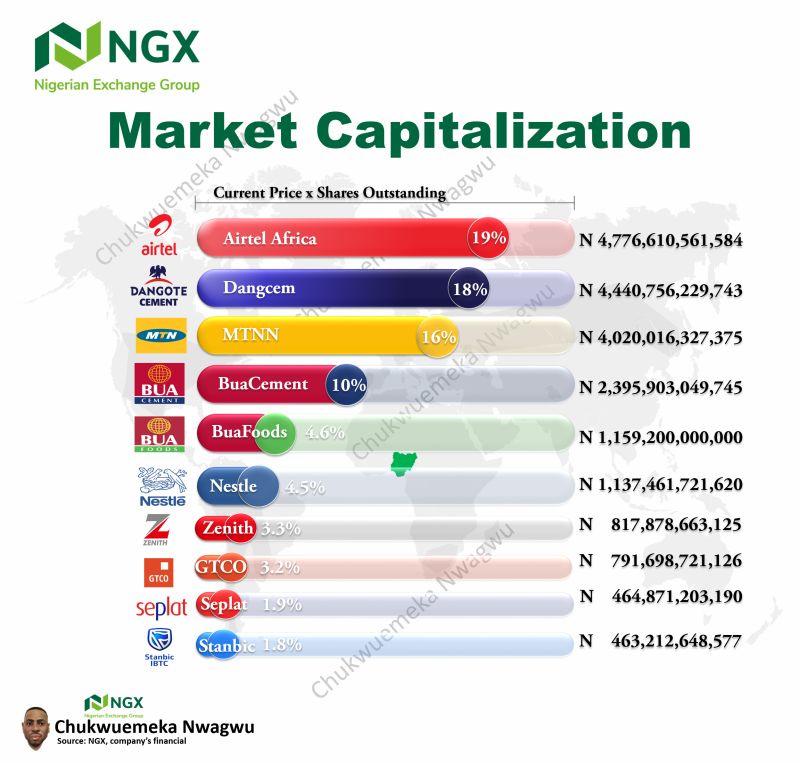
Airtel Africa has a market capitalization of N4.78 trillion, putting it in leadership position in Nigeria’s capital market.

Join Me Today With FUTO Alumni 2001 On “The Wealth in Nations”

0
FUTO is a top technical university in Nigeria

It is always an  honour whenever alumni groups of FUTO (Federal University of Technology Owerri, Nigeria) invite me to speak to them. Yes, never going to be a greater honour than the one which comes from home. Two years ago, I was to visit Abuja and got to Hilton and realized that 3 people paid reservations in my name and one put a note “his bills on me”. I came here to write: “pray that you have rich alumni friends who own big companies”.

My classmate, Chidi Nwosu will always write “Prof, you cannot spend money in Abuja when we’re here”. And you know what? They pay 100% of my bills. Pray that you are a teacher.

If you can make it today, join FUTO Alumni class of 2001. I will be having a conversation with them on Zoom. For all questions, connect with Kingsley C. Umege. MBA, SBD, BEng.

  • Join Zoom Meeting
  • Meeting ID: 881 114 8938
  • Passcode: Wf7xvX
  • Time: 7pm WAT
  • Topic: The Wealth in Nations

Great FUTOITES , I salute and thanks for the honour, as always.

Calculating your running costs, and how it affects the funds to be raised

0

Since we are talking about exploring a series of issues around fundraising for startups, I thought I would say a couple of things about the running cost and how it affects fundraising.

One of the many reasons a startup could be raising funds is to serve a war chest of some sort and give it enough running capital till it gets to the next milestone. It will be unusual to find any startup that simply raises funds and then channels all of them into the purchase of equipment or just launching a product into the market. Some funds will normally be set aside to cover the cost of running the business.

Once you understand this, you will realize that knowing your running cost can help you better decide the sum to raise. After all, what will be the point of injecting funds into a marketing campaign and not having enough money to pay the staffs that will keep the campaign afloat?

So, how do you determine your running cost?

It might surprise you that even some small business owners do not have a clear picture of their running costs. Most of the owners only keep account of salaries, which is the most obvious one. But running costs cover a whole lot more than just the salaries of your employees.

Besides the salaries, you should be looking at other costs like renting an office space (if you choose to), purchasing the right technology and equipment and so on. If you or your team members are going to have potential trips during the period, it will also be good to factor in the budget for the trips.

If you do not have a marketing or sales team yet, you should consider that when you do set them up, they will have to run with a budget as well. If you already have one, get a budget that covers whatever activities they need to carry out in line with the new milestone. Are you going to be creating a website or building an app for the next stage? Factor in the cost too. Your digital marketing team may also need to present you with their strategy and budget for running ads and setting up distribution channels.

This is only a small part of the math you need to do. In determining the sum to raise, you need to get the running cost (for the number of months) to keep the startup running till the next time you will need to raise funds, or till the point it becomes profitable. This could be anywhere from 12 months and 30 months. How much you will raise is determined by your unique needs and goals as a startup, what you have achieved and what you plan to achieve. Even if two startups are looking to raise the same amount, their budget for the money cannot be the same.

Now here is a trap you should not fall into.

After understanding running costs, some founders and entrepreneurs think that all they need do is multiply it by the number of months projected till the next milestone. So if their present monthly running cost is $2,000, they think that by simply multiplying it by 12 or 24 months, they will get the total running cost for the period.

This is very wrong, and if you do make the mistake, you will discover that you have fallen into a capital sin.

Your monthly running cost changes over time. You must factor in inflation (there is the percentage used in calculating that). You also have to factor in additions to the team. For instance, hiring two more tech developers over the span of the expansion will increase your running cost significantly. So always keep in mind that at some point, you may need to hire some more hands especially if the growth happens faster than you envisaged.

You should also factor in transition costs. Are there marketing experts, salespeople, or engineers who are currently working part-time but will need to move to full-time employment for you to achieve your next milestone? What extra will it cost you for such staff to transition into full-time employment?

When you eventually figure all of these out and do the math to cover the period before your next funding, you will have had a minimum figure of what you need to raise. A smart thing is ensuring that your budget is sufficient to cushion the impact of unexpected lags and delays which often come up. It will not be good for you to run out of funds just at the point you need all the financial momentum to push through on your targets

Airtel Africa Plc Market Cap Eclipses 14 Publicly Traded Banks in Nigeria As Telcos Become Operating Systems

2

According to Nairametrics analysis, Airtel Africa Plc has a market cap that is bigger than all the 14 banks listed in the Nigerian Stock Exchange. Airtel Africa has a market cap of N4.78 trillion while the 14 banks combine for N3.77 trillion.

This trajectory will continue because telecoms is the operating system of the knowledge economy. As banking, logistics, retail, and indeed all sectors are being digitized, telecom companies will capture more value.

Simply, everyone is growing the telecoms market. Move retail to ecommerce, you have created more data plans for the likes of MTN, Glo and Airtel. Call it being positioned at the edges of the smiling curve.


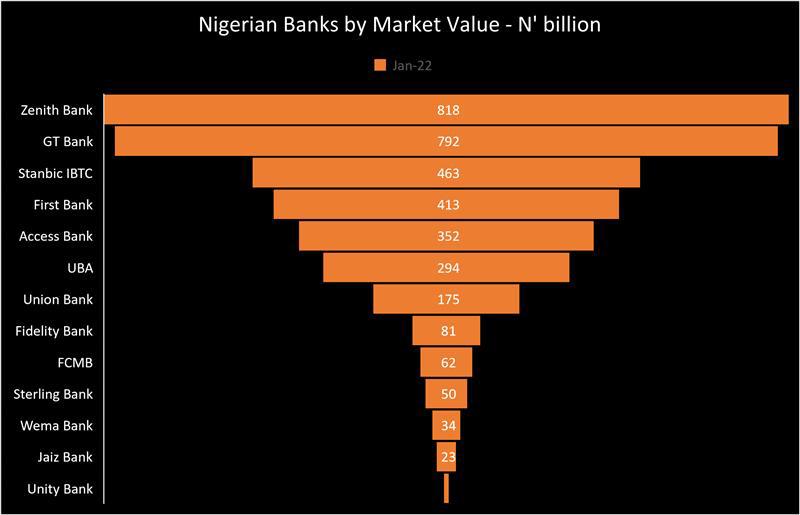
In the banking sector, Zenith Bank maintained its lead as at Jan 31 2022: “Zenith Bank maintained the top spot with a market valuation of N817.9 billion, closely followed by GT Bank with a market cap of N791.7 billion. Stanbic IBTC with N463.2 billion valuation stands in third place, while First Bank’s valuation stood at N412.8 billion as of the end of January 2022. On the flip side, Unity Bank has the lowest market capitalization with N5.96 billion, following a N351 million decline compared to the previous month. Jaiz Bank also followed with a valuation of N23.5 billion, albeit a N4.1 billion gain in the month of January 2022.”

Source: Nairametrics

The biggest threat to the Nigerian banking sector is now the telecom companies like Airtel, MTN, etc. Across most dimensions, the telcos are now at the edges of the smiling curve while the banks are clearly at the center. The fintech companies, provided they can grow their user base, will be fine as they have made us accept that they can “tax” all transactions with their 1.99% charges. Banks do not have that freedom. In short, the Central Bank of Nigeria has reduced the charges with the slash of ATM, card and electronic fees. 

Largely, can the big  banks double their market caps in the next decade at least to beat inflation and currency deterioration? Where investors do not think so, the high-growth, record-breaking telcos will be the new brides in the market.

Comment on LinkedIn Feed

Comment 1: MTN and Airtel will be the next biggest Fintechs. They make lots of revenue on inelastic demand to diversify and take over any sector that can use telecoms infrastructure as a launch pad. It’s simply the most logical next stop for MTN and Airtel. Interest rates on loans will drop,Lol, as banks will see far less patronage.

If MTN/Airtel gets a Fintech (eg Momo) that can give N10M loans via an app,It will send banks into mergers. Banks may become suited more for institutionalised and mega corporate biz banking- in addition to serving as physical vaults (like the gold vaults of old). With more progression to a cashless society,banks will struggle to make profit margins (If there aren’t newer innovative value propositions).

Comment 2: Why should banks have high market valuation, just for accepting deposits, giving loans and charging commissions here and there? That’s too traditional for investors of today, they want more.

When you go through financial statements of our banks, how many revenue streams are outside traditional banking services? If I don’t bank with Zenith Bank, which other services does it offer that I can pay for? Does any of our banks offer enterprise software it pioneered that is used across all industries? Innovation is not digitizing your operations, there’s much more.

Access Bank has branches across the country, can it build a massive logistics entity anchored on that, with those branches serving as pick up centres as well? What happens when it acquires a e-commerce firm and add it to the mix with its own payment gateway? Magically, it will become a behemoth across banking, logistics, commerce and financial services, all powered by tech!

The valuation will continue to crawl or decline, until the banks rethink everything, they cannot be too comfortable making money, just for being ordinary.

It’s a waste of time advising lazy people.

My Response to #2: I am not sure that I will want banks to become players in some of the sectors mentioned. Let them focus on lending and do just banking.