DD
MM
YYYY

PAGES

DD
MM
YYYY

spot_img

PAGES

Home Blog Page 5326

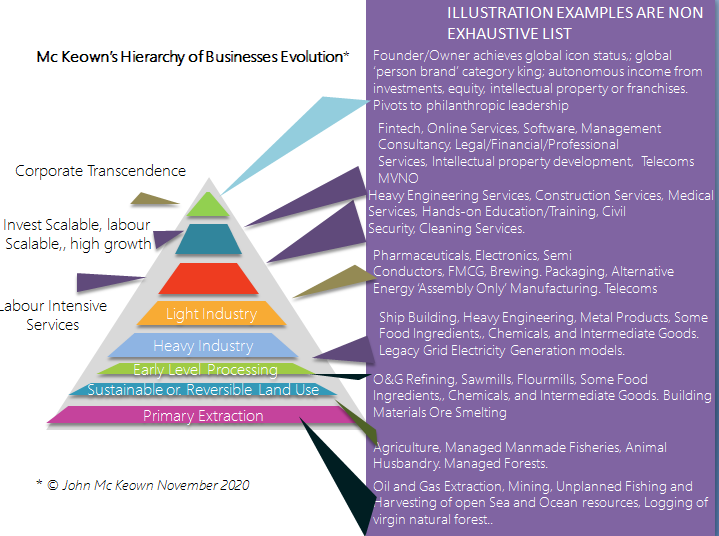
Mc Keowns’ Hierarchy of Business Evolution©

0

I created an article in 2020, ‘Idea and a Piece of Paper’ where I looked at the challenges facing young Nigerian Entrepreneurs. Over the ‘festive season’, it was suggested to me by Tekedia, that  ‘Mc Keowns’ Hierarchy of Business Evolution©‘ would be something worth bringing out as a main topic.

At the time, on top of the usual challenges of the time of year, I was also involved in preparing my last piece on Predictions of the Decade, so could not detour to do it immediately.

In fact, the Predictions of the Decade article was fulfilling another undertaking that I had given at least six months earlier, when I was having a debate by LinkedIn ‘DM’ on how at some point in the ‘medium term’ future, various ‘value instruments’ and ‘investment vehicles’ in the world would suffer collective collapse (though not entirely for the same reasons. This would then ‘conspire’ (unwittingly) to diverse and unrelated options in different parts of Africa as being the ‘safest options’ left in an ‘investment intolerant’ world.

In an age when all IMF basket currencies collapse or at least become severely degraded, keeping ‘money’ is not avoiding making investments, it becomes perhaps, the most risky asset retention strategy of all! This leads to my final prediction of the decade : WHEN AFRICA BECOMES THE ONLY SENSIBLE INVESTMENT STRATEGY POSSIBLE’

This is probably a good point to head into ‘Mc Keowns’ Hierarchy of Business Evolution©‘ because the mechanisms necessary to achieve at different levels of ascendancy on the hierarchy pyramid vary according to separate local industry profiles and dynamics. There are many complicated dependencies that aren’t visible at first glance. It is not strictly a ‘climbing the ladder’ effect, but the tiers on the pyramid do not have complete autonomy from the others either.

This is a dynamic that varies from one African nation to the next.
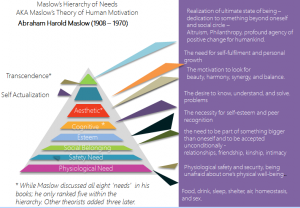
The first thing to understand about ‘Mc Keowns’ Hierarchy of Business Evolution©‘ is that it takes lead from  Maslow’s ‘Hierarchy of Need’.

The importance of Maslow is underscored by the direction taken by Tekedia Mini MBA Faculty Member Edward Hudgins in his lectures on Exponential Technologies and Business Opportunities in the Age of Singularity – ‘The final arena for the entrepreneur is ‘The arena of self’. You are the entrepreneur of your own life… You are the CEO of ‘self’… To be an efficient entrepreneur in the market… you really have to change and work first and foremost on yourself’.
As human beings are capable of transcending though different levels of ‘need’, so too,  the business ecosystem is capable of supporting elements within it. which are at various stages of upwards transcendence.

The common factor is that businesses are a product of human behaviour.

The ‘transcendence’ converges in both models, with a realization for the individual in Maslow, and a realization for the business leader in the Hierarchy of Business Evolution.

One of the major differences though is that in Maslow, it is a journey of human beings in a lifetime, and many will become arrested at various stages of progression.

In the Business Evolution Hierarchy, businesses exist at various levels of the pyramid, some locked in dependencies of symbiosis.

The Mc Keown pyramid is fairly fluid, particularly among the middle rungs. Not all ‘Light Manufacturing’ or ‘Intermediate Goods’ are in the same place on the pyramid.

Much depends on automation levels, digitization, use of robotics, AI, and other transcendence catalysts.

Ascending the pyramid is mostly about SCALING.
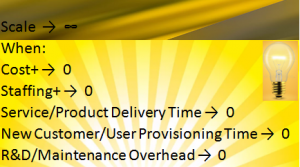
The more a business can scale, the higher a position it deserves in the ‘Mc Keowns’ Hierarchy of Business Evolution©

We can come up with many variables that can impact on a business’s ability to scale, but the primary drivers are cost, and pace of delivery. Most additional considerations are a function of one or both of these variables.

A third variable may be ‘Quality’.

The more revenue generating volume can be added while driving down impact on cost, delivery time to customers, or reduction in QoS (Quality of Service) or UX (User Experience), then the more scalability is improved. As additional overheads tend to 0 with growth expansion, then scalability tends to infinity.

Virtual businesses can be great for scalability, but that end-to-end ‘metaversity’ is only as scalable as the least ‘virtual’ component in the business model, or the most ‘bricks and mortar’ aspect of it, depending on perspective.

Dependency and Symbiosis.

Back in March of last year, Prof. Ndubuisi Ekekwe released a piece on Tekedia – The ‘Illusion of Leapfrogging – And Africa’s Missing Link’ which illustrates perfectly some of the characteristics of Dependency and Symbiosis.

Writing on Amazon, ‘Prof’ says: ‘Simply, behind the websites, great things are happening. So, if you just see the shiny website, you may not understand that Amazon is powered by the old economy which must run very well for the new economy to thrive.’

He goes on to introduce Tekedia Faculty Member, Dr.Henry Chan, explaining the dependencies and symbiosis of Alibaba’s activities in China.

His domestic reflection states: ‘The websites of Nigeria, and Africa cannot advance the region unless we still fix that power, water and support makers to make things in our economy.

So, when you see those posts, postulating on how an app could help Africa leapfrog the West, think again. When you download an ambulance finder app, remember that someone needs to have an ambulance in the city before the app offers any value.’

I have frequently made reference to the power dependency myself, though my favourite ‘go to’

is probably the burden of ‘metered’ internet access in Nigeria, particularly smartphone users and how it prevents OTT from being competitive.

This is the single most issue while services such as DsTV/Multi-choice etc, can survive in Nigeria without being usurped by services like Netflix, which reign in countries where affordable unmetered service is available with fit for purpose data transfer rates.

I was in DM with Emmanuel Saleem relating it is important that business persons looking at OTT within the Nigeria space do not pay attention to Macro data made available by so called global statistical data companies.

‘When they provide data on percentages of population with internet access, they are including people in possession of a smartphone making ex-contract ‘recharge card’ purchases as part of the ‘connected community’.

We all know this form of data use is cost prohibitive..‘. the conversation continues….
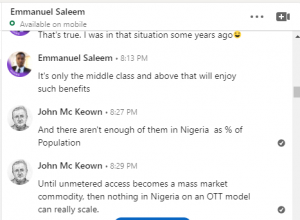


The DsTV/Multi-choice model survives.. at least for now… because they provide their own content delivery infrastructure, supported in part by independent connectivity solution operators providing additional federal backbone and international capacity circuits as and when needed.

Subscription based OTT vendors cause two cost centres, one for the subscription itself, and another from the data package to support the transfer, which the Nigeria based subscriber needs to provide.

That dependency reduces the scalability, and will not improve until 4G operators in Nigeria offer unmetered packages with fit for purpose transfer rates.

A good example of a ‘bricks and mortar’ impediment for end-to-end service scalability for example, would be the state of the Nigerian postal service compared to the standard many take for granted outside Africa.

For now, my advice to entrepreneurs in Nigeria’s virtual space is to look for models that can appeal to a global, rather than local market, so that the local market is not critical to the business model, and can grow in relevance at its own pace. Otherwise scrutinize and re-scrutinize the model for Scalability, Dependency and Symbiosis issues.

The local market has some way to go before businesses high on the pyramid can reach the resilience and robustness needed to realistically command that position within the  ‘Mc Keowns’ Heirarcy of Business Evolution©

Have You Seen the Leader for Nigeria?

1

The greatest companies in the world do not just meet the needs and expectations of their customers, they go for their perceptions. Great politicians also master the business of perception. Category-king enterprises turn customers into fans just like great politicians elevate the minds and aspirations of a people.

Yes, an unbounded future where the goalpost is a mathematical asymptote, a continuum towards the imaginary infinity. In 2023, Nigeria needs a GREAT leader who can make the people dream bigger than themselves.

Nigeria is looking for a leader, from the local to the highest. Our moments of glory are daily passing, because men are shadowing the sun from shining upon one of the most favored people on earth. We have oil, but we enjoy the darkness. We have engineers, but they have no bitumen to fix roads. We have accountants, but they have no sales records to reconcile. We have doctors, but those that pay them are never their customers. We have teachers, but they are locked out of labs and libraries with no funding. Yet, the government is busy. Busy for what?

But we are Nigerians. We are of the same blood as Achebe, Soyinka, Azikiwe, King Jaja, Ahmadu, Bayero and other heroes current and past. We are Nigerians – smart, ingenious and optimists. We want a leader who has demonstrated the capacity to rally the nation in honesty, hard work and raise our imaginations beyond where we are for a better future. A leader that can engineer a transformation for our nation with bigger and larger dreams that generations of Nigerians will unite for. He is born a Nigerian and belongs to Nigerians but to none.

A leader who can create a society to engage our brightest minds in government by evolving a new political system designed to seriously solve problems. A person who can engineer Nigeria into rebirth and restoration to offer a prosperous nation that is colorful, fluidic, vibrant and open for change. Yes, a person of immense intelligence, competence, pragmatism, and unimpeachable.

A person of integrity, broad knowledge, enormous vision and solid experience; one that can stimulate more vibrancy in the private sector and move the public sector out of its stasis. With that leadership, Nigeria will witness changes in trade, education, and commerce as a battalion of knowledge workers emerges to give us the needed clout in the global arena.

I am looking for that leader. And I know in this great nation and even greater people, they abound. I am searching for a leader for Nigeria. Have you seen one?

Who takes responsibility for company assets?

0

Sometime last year, there was news of a staff member who had mishandled company property in his possession. Precisely, he was involved in an accident with the company vehicle, and it had resulted in the death of a pedestrian. The unfortunate part though was that he absconded for fear of being lynched, and the vehicle was set ablaze by angry passers-by.

When the matter came to light, the company decided that it would pay for the burnt vehicle and structured monthly deductions over the span of two years. Within a couple of days, the staff disappeared without any proper resignation or notice, saying that there was no way he could survive on half his salary for two years.

This is a situation no business owner would want to find himself in, especially if he is just getting started and still has to battle with a budget deficit more often than not. Can this be avoided? Or maybe better managed? Yes.

Now to the question of the day; Who should take responsibility for company assets handed over to staff?

There are different assets that companies entrust to their staff. From gadgets like mobile phones, laptops, modems, or internet devices, to bigger assets like cars, houses, and the likes. For tech startups, such assets could mostly include laptops or other mobile devices. These assets are mostly entrusted to the staff, only for as long as they hold a particular position or remain on the company’s payroll. And so, if there is any reason for a suspension, demotion, resignation, or termination of appointment, the staff is naturally expected to return the same to the company.

Generally, we expect the staff to be responsible for the condition of the assets in their care. The error is that some businesses (mostly those without proper structure and processes) do not have a document spelling out the what-ifs of this arrangement.

What happens if the asset is returned in a condition worse than it was given?

Or what happens if the asset is not returned at all?

Is there any insurance cover for the asset, and what does it cover?

What happens if it has undergone the natural wear and tear expected of depreciable assets? For instance, it may not be realistic to expect staff to return a car in the same condition he had received it three years ago.

Is there any point in the arrangement that the asset can be foregone by the company, and fully claimed by the staff?

There are a lot of questions that can be answered in a clear document that will be signed by both parties before the asset is handed over. Some companies would rather avoid all of these by simply having the staff sort out things like transportation and accommodation, while the company pays a certain allowance annually for the purpose.

As a business owner or founder, you could opt for this. Otherwise, you could provide insurance for things like cars, houses, laptops, and the like. Some events are both unexpected and sometimes unavoidable. Some others happen as a result of sheer carelessness and could have been avoided. There should be a clause stipulating what happens in such events.

There is some degree of damage that the staff could be made to take responsibility for, and there are some others that the company may have to step in and bear the brunt. An insurance cover could also have a role to play in all of these.

Some agreements could allow the staff to take full possession of some of the assets after some time. For instance, it is possible to allow staff to lay claims to things like mobile phones and cars, after some years of having it in their possession. This could encourage proper maintenance of the assets.

Whatever you opt for, have it spelled out in black and white.

MTN Nigeria Accelerates Nigeria’s Economic Redesign with N1.7 Trillion Annual Revenue

1

In my Tekedia’s Empire of the Future presentation, I explained the evolution of economic systems. All nations typically begin as invention societies where ideas are in abundance, but with limited translations into products and services. But over time, some become innovation societies, with products and services, and then prosper.

Using the public stock market in the United States, I explained the redesign of that system, connecting the 2,000 years of GDP for the landmass called America today. In 1917,  the largest publicly traded companies in the United States were in construction; US Steel was dominant. Fifty years later, the tech infrastructure firms took off with IBM leading. And now, knowledge firms like Apple and Microsoft are running the show.

In Nigeria, something like this is happening at a smaller scale. Our largest publicly traded companies are in construction (BUA Cement and Dangote Cement), food (BUA Foods and Nestle) and tech infrastructure (MTNN and Airtel Africa). The only difference is that Nigeria has merged that 1917 and 1967 American evolutions into one, trajectory-wise. I expect, by 2035, the largest companies in Nigeria to be knowledge-driven (I cannot write “largest public companies” since most of our current tech startups will not likely list locally).

So, the ascension of MTNN with its market-leading N1.7 trillion annual revenue and Airtel Africa’s pinnacle moment at N5.4 trillion market cap, are part of the road to the new economic system. As these changes happen, new economic order will form in the nation.

MTN Nigeria Communications Plc (MTNN) has reported turnover in the sum of N1.7 trillion for full-year 2021, a milestone that will help firm up its status as Nigeria’s biggest listed company by revenue.

The Nigerian operation of South African-owned MTN Group attained the new height after the number of its active data users surged by 1.7 million to 34.3 million, helping income from data sales increase by 55.3 per cent to N516 billion.

MTNN cited an extension of its coverage areas for 4G services October through December as the catalyst for the higher earnings from data.

Relative to its figure for 2020, revenue for last year grew by 22.9 per cent.

Effectiveness Of Rewards And Sanctions In The Workplace

0
Young designer giving some new ideas about project to his partners in conference room. Business people discussing over new business project in office.

When there is no consequence for poor work ethic, and no reward for good work ethic, there would be no orderliness and motivation. A workplace has to have laid down rules that guide the attitudes of staff and penalize them when they go contrary to such rules. For instance, late coming to the workplace has to attract punishment or fine, but when it is tolerated and treated with levity, there would be an increase in late coming because nobody was penalized.

This often leads to disorderliness in the workplace. Imagine a school that does not punish latecomers for coming late to school. There would be an increase in the level of late coming because no student was punished which is meant to serve as a deterrent to others. Also, committed employees should be rewarded where necessary, it serves as a morale booster. Rewards and sanctions as tools in the workplace are usually used to pass a message to the staff that performance is important. Most times, what motivates employees’ performance is if there are rewards that reinforce good performance or negative consequences for poor performance.

The main essence of rewards and sanctions is to regulate employee behavior and performance at the workplace. Most times, the success of an organization is usually traced to how the organization motivates its employees through rewards. Sanctions on the other hand, which are usually carried out in response to unacceptable behavior against work policies, conduct codes, etc, is a strong tool that helps an organization reap positive performance rewards. Sanction shapes employee behavior to act and behave in a particular way to ensure that set organizational goals are achieved.

Once employees fully understand how they are expected to behave in an organization, and what the result of misconduct can cause, then obviously the purpose of the disciplinary sanction will be achieved. In an organization, the main aim of sanctions is corrective rather than punitive. Rewards and sanctions influence employees’ performance in the workplace. When there are no rewards, it often leads to low productivity. Employees begin to feel that they are not being appreciated enough and wouldn’t want to give the work their best effort. Some can even decide to intentionally be absent from work probably because of lack of motivation.

Also once there are no sanctions of wrong behavior of employees, it creates room for chaos and disorderliness. If an organization fails to sanction an erring staff who probably committed sexual misconduct. Once such an act goes without proper punishment, more cases of such are likely to occur because the first case was overlooked and not properly handled. It gives room for so many other wrong behaviors. Any organization that fails to implement the concept of rewards and sanctions is headed for failure because these things are often the prerequisite to the success of an organization.

Naturally, individual employees in exchange for hard work and commitment expect certain extrinsic and intrinsic rewards. According to research, rewarded employees tend to work harder and better when an organization shows proper concern about their well-being and properly rewards them for their effort. When employees notice that their efforts result in rewards, they are usually motivated to work harder which encourages them to reach the organization’s strategic goals.

The success of an organization is usually based on how they keep their employees motivated and in what way they evaluate the performance of employees for rewards and sanctions.

Conclusion

Organizations must ensure that employees are properly rewarded for their efforts because it always has a positive impact on improving their work performance. Once their work performance is increased, it leads to the success of the organization in achieving set goals. Rewards encourage them that their efforts don’t go unnoticed. Sanctions on the other hand must be properly implemented when necessary to avoid disorderliness in the organization. What an organization tolerates will often result in a norm.