DD
MM
YYYY

PAGES

DD
MM
YYYY

spot_img

PAGES

Home Blog Page 5437

TikTok Racks Up the Highest Revenue in 2021 As Consumer Spending on Mobile Apps Reaches $133 Billion

0
The brand is growing

TikTok, the high-flying short video app, is ending the year 2021 as the non-game app with the highest revenue, according to Sensor Tower Store Intelligence data.

App stores experienced a boom in 2019 and 2020, following huge global spending on both mobile games and non-game apps. TikTok has been on top of the trends table as young people flock to the platform, getting paid for their contents. The app has more than one billion users. 

The huge adoption saw TikTok downloads skyrocket, eclipsing other social media apps as the most downloaded on the App Store for 2021, racking up 745.9 million installs across both app stores. This is despite a dip of 24 percent year-over-year from 980.7 million installs in 2020, demonstrating the app’s global popularity even as it was removed from its top market India, according to Sensor Tower data.

Besides downloads, TikTok has also surpassed YouTube for average watch time in US and UK. Sensor Tower said the app will stay on the top of the revenue chain.

“TikTok, including Douyin on iOS in China, will maintain its dominance at the top of the chart as the non-game app that saw the most revenue across both app stores combined. ByteDance’s short video platform passed $3 billion in lifetime revenue earlier this year—in the first 11 months of 2021, the app saw $2 billion in revenue, up 67 percent Y/Y from $1.2 billion. By the end of the year, Sensor Tower forecasts that the app will see $2.3 billion in spending, bringing its lifetime total to $3.8 billion,” it said.

Generally, TikTok’s revenue growth was buoyed by the boom in adoption and spending for both mobile games and non-game apps in 2020, market trends began normalizing in 2021 as worldwide consumer spending is projected to reach approximately $133 billion on in-app purchases, premium apps, and subscriptions across the App Store and Google Play, according to Sensor Tower Store Intelligence data.

This represents 19.7 percent year-over-year growth from $111.1 billion in 2020, nearly mirroring the 21 percent Y/Y growth consumer spending experienced in 2019. Global consumer spending in non-game apps grew 19.7 percent to $133 billion in 2021.

While TikTok leads the pack, other apps also show incredible numbers in downloads and revenue. On Google Play, Facebook tops the charts with about 500.9 million installs on that marketplace alone. Across both marketplaces, the app will see about 624.9 million installs, down 12 percent Y/Y from 707.8 million, Sensor Tower said.

App stores, downloads and revenue

However, when it comes revenue, the app stores have had it differently in 2020 and 2021. Sensor Tower forecasts a drop in downloads for Apple’s App Store and increase for Google’s Play Store.

“First-time installs remain relatively flat when compared to 2020, growing 0.5 percent Y/Y across the App Store and Google Play to 143.6 billion in 2021 from 142.9 billion 2020. This is driven mainly by app adoption on Google Play, which will see installs climb 2.6 percent Y/Y to 111.3 billion from 108.5 billion; Apple’s marketplace will generate about 32.3 billion installs this year, down 6.1 percent from 34.4 billion,” it said, adding that worldwide app downloads grew 0.5 percent year-over-year to 143.6 billion in 2021.

App Store revenue is expected to increase by 17%, while Play Store will climb more than 23%.

Globally, consumer spending on the App Store will reach $85.1 billion, up 17.7 percent Y/Y from $72.3 billion in 2020. Although users have spent less on Google Play, that platform will see more Y/Y growth, climbing 23.5 percent to $47.9 billion from $38.8 billion. The two platforms’ spending relative to each other remains the same as in 2020, with the App Store seeing about 1.8 times the revenue as Google’s marketplace, Sensor Tower said.

The firm projects that Google One, which has amassed more revenue in 2021, will reach $1 billion in consumer spending, up 123% year-over-year from $448.5 million last year.
Focus on understanding how the customers use your products!

0

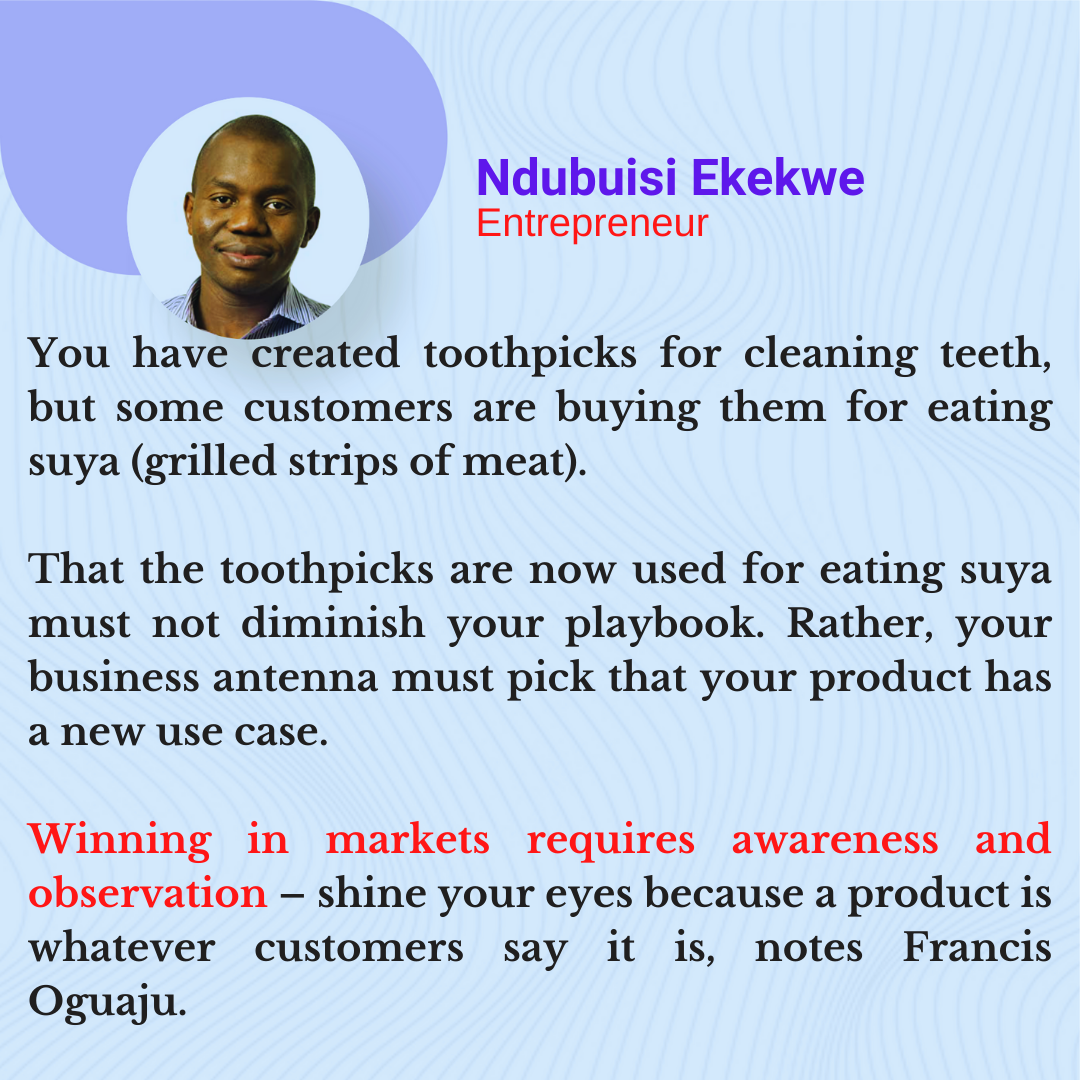
Focus on understanding how the customers use your products! They can even conceptualize a new use case which you never imagined. It is all good provided of course the usage is within the law.

You have created toothpicks for cleaning teeth, but some customers are buying them for eating suya (grilled strips of meat).

That the toothpicks are now used for eating suya must not diminish your playbook. Rather, your business antenna must pick that your product has a new use case.

Winning in markets requires awareness and observation – shine your eyes because a product is whatever customers say it is, notes Francis Oguaju.

Comment on LinkedIn Feed

Comment #1: It’s highly limiting to innovation to dictate to customers how or what to use a product for, except it’s to restrain usage from breaching ethical boundaries.

Your customers are not made for your solutions, it’s the other way round. So, your job as an innovator to guide innovation where it naturally wants to go, not where you want it to go. Your wants are heavily biased in the grand scheme of things and hence faulty.

Comment #2: This is a great example – innovation is a process, and not a destination. Identifying new applications for existing competencies and deciding which opportunities to pursue are critical to remaining relevant as new opportunities arise and existing markets evolve.

REPORT: Despite growth in Internet Use, Nigerians Consumed 69 million Volume of News in 2021

0

As part of the dissemination of outcomes of the news consumption trend analysis for 2021, our analyst has also discovered that Nigerians searched and read news categories earlier reported less despite growth in internet data subscription during the year. Generally, existing statistics shows that the internet penetration is 50.2%, while the mobile internet user penetration is equally increasing.

According to the Statista, “as of August 2021, already 48 percent of the Nigerian population was using a mobile device to access the internet. In 2026, almost all the internet users are expected to use a mobile device, 59,7 percent of 59.9 percent of total internet use.”

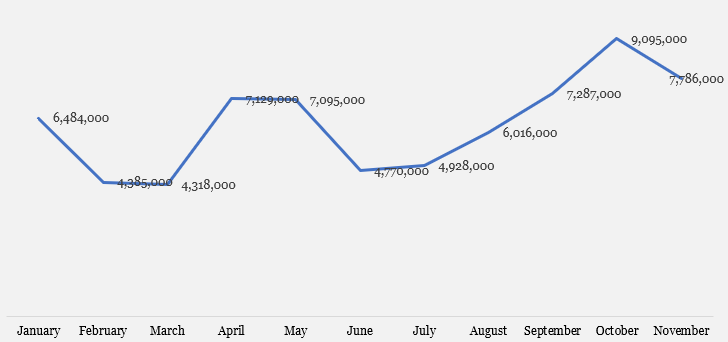
Exhibit 1: Mobile Internet Subscribers per month in 2021

Source: Nigerian Communications Commission, 2021; Infoprations Analysis, 2021

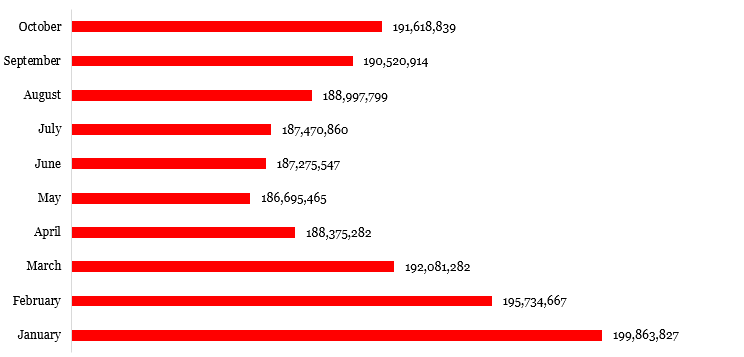
Looking at our data and the number of mobile internet subscribers, it emerged that the subscribers utilized their data for news consumption less during the period. While the subscribers were growing in three-digit of six digits of million, the volume of news consumption was in a one-digit of six digits of million [see Exhibit 1 and Exhibit 2].

Analysis of 69, 293,000 volume of news along with the mobile data subscribers reveals a negative connection of 5.1%. This suggests that the subscribers deployed their data less for news consumption. With this outcome, our analyst notes that it could be said that Nigerians used other categories of internet data subscriptions such as fixed wire or wireless during the year.

Exhibit 2: Volume of News Consumption per month

Source: Google Trends, 2021; Infoprations Analysis, 2021

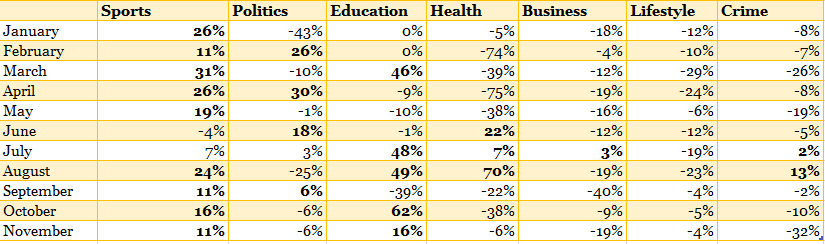
Meanwhile, analysis further indicates that sports, education, politics and health news categories were consumed most when the volume of news was considered along with the categories of news [see Exhibit 3]. Despite the fact that the earlier report indicates a high level of consuming happenings and events related to lifestyle, our latest analysis establishes less consumption of the news category in a significant proportion [see Exhibit 3].

Exhibit 3: Trending of News Volume with the News Categories

Source: Google Trends, 2021; Infoprations Analysis, 2021

It is surprising that the internet users did not deploy their data significantly for consumption of crime news. With these outcomes, our analyst notes that majority of the users might have missed information that could have helped them in making the right decision before and while engaging in business activities including personal and corporate safety.

From the insights, there is a need for a national news consumption campaign. This could be championed by the National Orientation Agency and civil society organisations with interest in information and society development. This campaign is necessary as the country looks for holistic solutions to its various challenges. Our analyst believes that teaching and guiding people on the importance of consuming business and crime news reports would go in a long way of possessing minds that would help in joining government in finding solutions to the socioeconomic and political issues in the country.

December 10: Human Rights Day.

0

10th of December every year is the day set aside by the United Nations for annual commemoration of Human rights. It is regarded as human rights day. It is the day the world celebrates the the United Nations adoption of the Declaration of Human Rights in 1948 and it is the day used to raise awareness about the inalienable rights that every individual is entitled to as a human being irrespective of the person’s tribe, color, religion, race, gender, language etc.

It is the day of worldwide celebration of the adoption of the Universal Declaration of Human Rights (UDHR) by the United Nations in 1948 and the date was chosen to honor the United Nations General Assembly’s adoption and proclamation, on 10 December 1948.

Human rights are those rights which a man cannot survive without. It is the essence of existence. These are rights a person is born with and is expected to live with until the day of his death.

These rights locally are provided for in the Nigerian constitution in chapter four of the constitution of the federal republic of Nigeria, 1999. It spans from section 33 through section 44 of the constitution.

For the sake of emphasis, those rights will be reproduced here:

  1. Rights to life (section 33)
  2. Right to dignity of human persons (section 34)
  3. Right to personal liberty (section 35)
  4. Right to fair hearing (section 36)
  5. Right to private and family life (section 37)
  6. Right to freedom of thought, conscience and religion (section 38)
  7. Right to freedom of expression and the press (section 39)
  8. Right to peaceful assembly and association (section 40)
  9. Right to freedom of movement (section 41)
  10. Right to freedom from discrimination (section 42)
  11. Right to acquire and own immovable property (section 43)
  12. Right against compulsory acquisition of property (section 44)

The importance of these rights cannot be overemphasized, even the constitution recognizes its importance as a citizen cannot survive without them and the constitution went further to provide in s.46 that if you feel that any of these rights are being threatened and it likely to be breached or it’s breached you should approach the court. This same content was also provided in article 8 of the African Charter on Human and People rights. To this effect, don’t wait until any of your fundamental rights are breached, whenever you feel they are about to be breached you should run to court; the high court of state or the federal high court.

Happy World Human Right day.

Italy Fines Amazon $1.3 Billion for Abuse of Dominant Market Position

0

Europe has continued to tighten its antitrust grip on American tech companies, with one fine after the other. Each borders on breach of anti-competition rules that keep being updated to keep the Big Tech in check.

Last month, Apple and Amazon were handed $225 million fine by Italy’s antitrust authority for anticompetitive cooperation in the sale of Apple and Beats products. Less than a month later, the authority has found Amazon guilty for abusing its dominant position, pushing third-party sellers to use the company’s logistics service Fulfillment by Amazon (FBA).

The offense came with a €1.129 billion about $1.3 billion fine, the biggest the watchdog has ever handed to a tech company.

In a 250-page report summarized by TechCrunch, the Italian authority, the Autorità Garante della Concorrenza e del Mercato (AGCM), stated its findings. It said among other things, that third-party sellers don’t get the same treatment if they’re leveraging FBA or using their own logistics stack.

Sellers who take advantage of FBA can participate in the company’s paid loyalty program, Amazon Prime. Subscribers get free deliveries on some products. In addition to Amazon’s own inventory, products from third-party sellers that come from Amazon’s warehouses thanks to FBA also get a Prime label.

This leads to far-reaching consequences as Prime products are then included in Amazon’s events, such as Prime Day, Black Friday and Cyber Monday. In other words, you have a better chance of getting featured in Amazon’s events if you use Fulfillment by Amazon.

But that’s not all. On Amazon’s product page, the company automatically selects a seller for the buy box. On a computer, the buy box is the box on the right side of the screen that lets you add a product to your cart or buy directly with the “Buy Now” button.

You can see other sellers in a tiny box below the buy box. According to Italy’s competition authority, sellers who use FBA have a higher chance of getting featured in the buy box compared to other third-party sellers.

I tried to find a good example on Amazon.it and here’s what I found on this toilet seat. Amazon itself doesn’t sell the product directly. You can only get it from third-party sellers. By default, Amazon features WOLTU GmbH in the buy box. The item is shipped by Amazon as WOLTU GmbH uses FBA. And you can get free expedited shipping with Amazon Prime.

Below that buy box, there’s a tiny box that says you can get it from another seller. This time, we can see WOLTU GmbH once again (and a used product from “Amazon Warehouse”). It’s the same seller, but they ship it directly to you and you also get free shipping.

Why does WOLTU GmbH list the same toilet seat twice? FBA isn’t a free logistics service. Amazon gets a larger cut from items that are sold through FBA. And it seems like WOLTU GmbH would get more revenue from a direct sale. But it’s unlikely that customers will choose to get the toilet seat from the seller directly because it’s hidden in a submenu.

A recent study from the Institute for Local Self-Reliance has highlighted that Amazon is generating more and more revenue from third-party sellers, highlighting that FBA is a vicious circle and that third-party sellers have become a captive audience:

In a similar fashion, Amazon has compelled sellers to buy its warehousing and shipping service, Fulfillment By Amazon (FBA). Amazon’s algorithms heavily favor sellers who do so, making FBA all but required in order to generate sales on the site. As a result, the share of sellers who have left other carriers and signed on to FBA has soared in recent years. By compelling this captive base of businesses to use its shipping service, Amazon has grown into a major logistics provider almost overnight. Its parcel delivery operation now rivals that of the U.S. Postal Service in scale. And, over the last few years, Amazon has steadily raised its storage and shipping fees, using FBA as yet another way to squeeze revenue from sellers.

After its findings, the AGCM has asked Amazon to create a new set of standards that would be fair to third-party sellers whether they are using FBA or not. The company will also have to implement behavioral measures. A monitoring trustee will review the changes.

In response, Amazon said it disagrees with the decision and will appeal.

“We strongly disagree with the decision of the Italian Competition Authority (ICA) and we will appeal. The proposed fine and remedies are unjustified and disproportionate,” the company said.

“More than half of all annual sales on Amazon in Italy come from SMBs, and their success is at the heart of our business model. Small and medium-sized businesses have multiple channels to sell their products both online and offline: Amazon is just one of those options. We constantly invest to support the growth of the 18,000 Italian SMBs that sell on Amazon, and we provide multiple tools to our sellers, including those who manage shipments themselves,” it added.