DD
MM
YYYY

PAGES

DD
MM
YYYY

spot_img

PAGES

Home Blog Page 5440

Nigeria Should Fix How It Funds Education

2

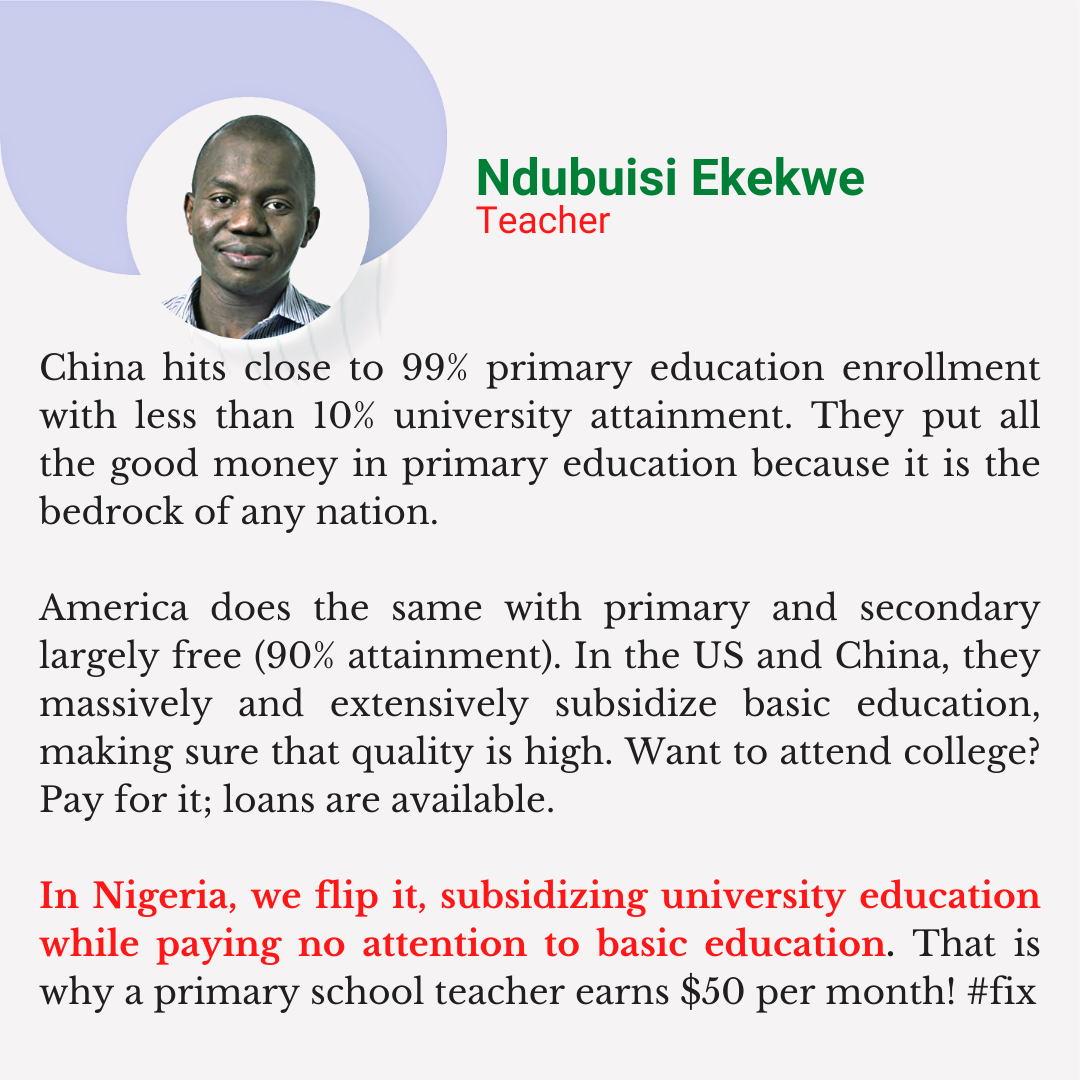
China hits close to 99% primary education enrollment with less than 10% university attainment. They put all the good money in primary education because it is the bedrock of any nation.

America does the same with primary and secondary largely free (90% attainment). In the US and China, they massively and extensively subsidize basic education, making sure that quality is high. Want to attend college? Pay for it; loans are available.

In Nigeria, we flip it, subsidizing university education while paying no attention to basic education. That is why a primary school teacher earns $50 per month! #fix

Sure many of us here benefitted from that massive university subsidy, but if you look at the data over the last few years, one thing is evident: the poor who attend poor primary schools are evidently cut-off from those university subsidies as they cannot compete to be admitted. If that trajectory continues, inequality will keep scaling in the nation.

Let’s build MINES of knowledge across Africa!

0

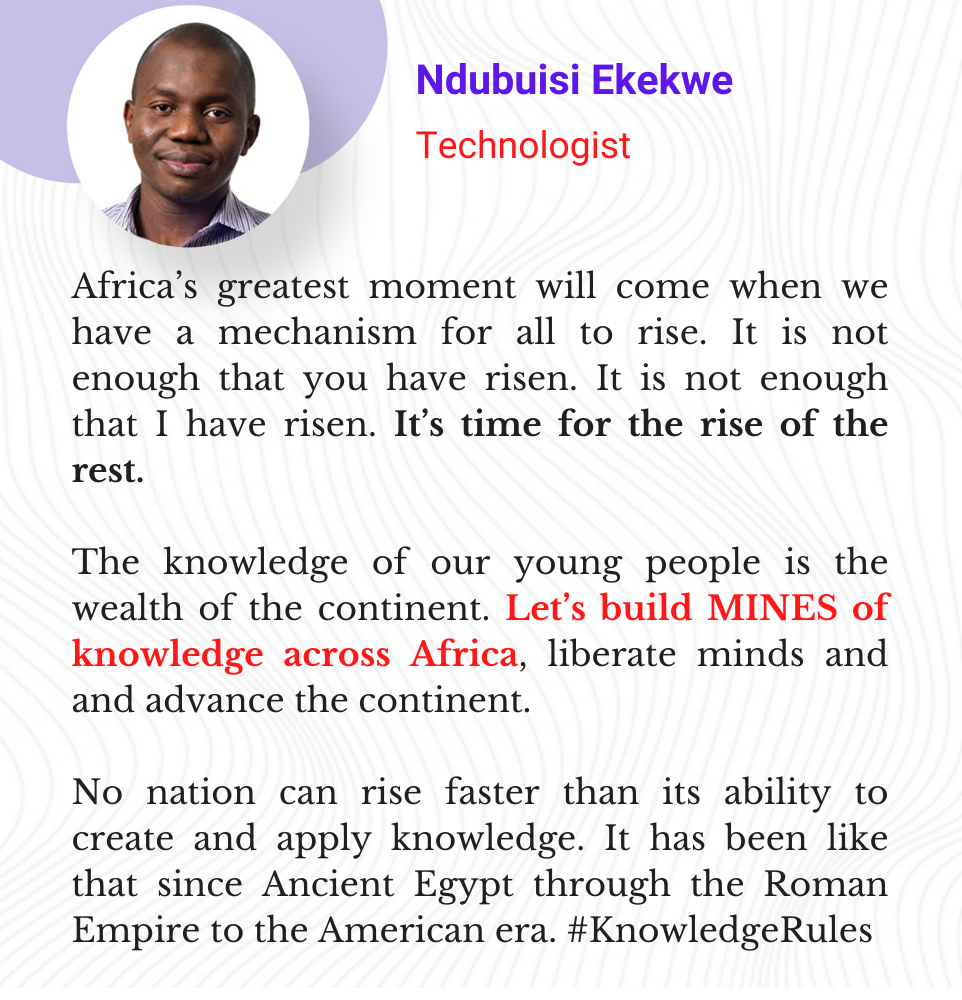
Africa’s greatest moment will come when we have a mechanism for all to rise. It is not enough that you have risen. It is not enough that I have risen. It’s time for the rise of the rest.

The knowledge of our young people is the wealth of the continent. Let’s build MINES of knowledge across Africa, liberate minds and  and advance the continent.

No nation can rise faster than its ability to create and apply knowledge. It has been like that since Ancient Egypt through the Roman Empire to the American era. #KnowledgeRules

Read my “Mines of Knowledge”.

Mines of Knowledge

Xiaomi to Build 300,000 Vehicle Annual EV Plant in Beijing

0

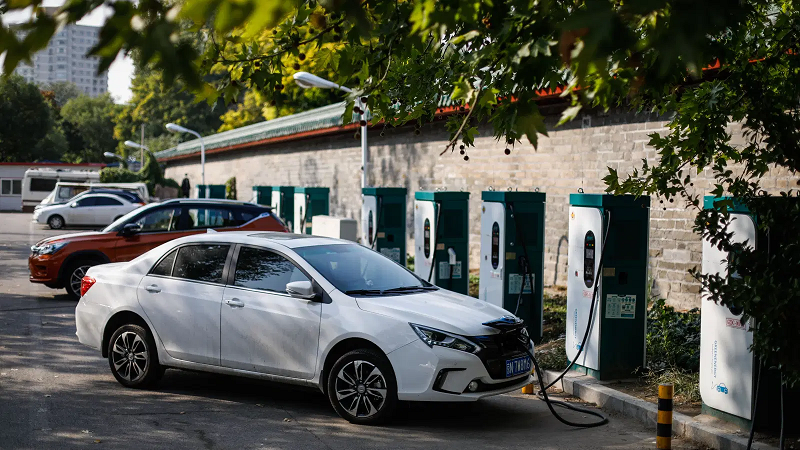
Xiaomi, a leading Chinese smartphone maker, is planning to build an electric vehicle plant with the capability to produce 300,000 vehicles annually in Beijing. The plan, which was announced by authorities on Saturday, is one of the boldest in the series of smartphone makers diversifying to electric vehicle production.

The plant will be constructed in two phases and Xiaomi will also build its auto unit’s headquarters, sales and research offices in the Beijing Economic and Technological Development Zone, Reuters reported the government-backed economic development agency Beijing E-Town, saying on its official WeChat account.

Beijing E-Town said it anticipated the plant reaching mass production in 2024, a goal announced by Xiaomi’s Chief Executive Lei Jun in October.

Apple and Baidu have also made moves to kickstart their respective EV production following Google’s steps. Apple has reportedly set a 2025 deadline for its driverless electric vehicle, with a reinforced approach focusing on self-driving capabilities.

Xiaomi took the bold step in late August when it completed the registration of its EV unit. The company had said in March it would commit to investing $10 billion in a new electric car division over 10 years.

In January, Baidu said it would set up a company to produce electric vehicles with the help of Chinese automaker Geely.

The companies all boast of a booming customer-base, holding large shares of the smartphone market. Xiaomi has thousands of smartphone stores across China which have spurred its business growth. The stores are understood to be the channel it intends to use for its plans to sell electric vehicles.

The challenge

While the increasing interest in electric vehicle production by non-traditional carmakers (even ride-hailing giant Didi has indicated interest) is welcomed, the challenge of developing efficient vehicles remains to be surmounted.

For years, Tesla, the leading electric vehicle maker, has been working to improve its technology and infrastructure to arrest cases ranging from batteries to technical shortfalls, which highlights how challenging it will be for companies without an automaking background to produce efficient electric vehicles.

Though to beat the challenge, many of the tech companies, including Apple, Baidu and Xiaomi have been seeking partnership with traditional automakers, but the automakers themselves are yet to have it all figured out. Apart from Chinese companies Nio, Li and Xpeng that are competing with Tesla in China, others are trailing far behind the American company that is seen as the pacesetter in the EV industry.

Apple had earlier in the year reportedly reached out to Hyundai for a possible partnership. But nothing appears to have materialized, and the smartphone maker seems to be in search of another automaker to meet its 2025 goal.

Beijing Asks Didi to Delist from New York Stock Exchange

0

Chinese regulators have asked Didi Global Inc. to delist from the New York Stock Exchange, in the latest move to control the country’s tech giants, Bloomberg reports, citing people with knowledge of the matter.

The report says the country’s tech watchdog wants management to take the company off the New York Stock Exchange because of concerns about leakage of sensitive data, quoting the people, who spoke on anonymity. They said the Cyberspace Administration of China, the agency responsible for data security in the country, has directed Didi to work out precise details, subject to government approval.

Proposals under consideration include a straight-up privatization or a share float in Hong Kong followed by a delisting from the U.S., the people added. If the privatization proceeds, the proposal will likely be at least the $14 IPO price since a lower offer so soon after the June initial public offering could prompt lawsuits or shareholder resistance, the people said. If there is a secondary listing in Hong Kong, the IPO price would probably be a discount to the share price in the U.S., $8.11 as of Wednesday’s close.

Deliberations continue and it’s possible regulators will backtrack on their request, the people said. Either option would deal a severe blow to a ride-hailing giant that pulled off the largest U.S. IPO by a Chinese firm since Alibaba Group Holding Ltd’s in 2014, the report said.

The move is in continuation of what started late last year. Didi has joined a host of other Chinese companies who got into the bad book of Chinese authorities. Alibaba, Ant Group and Tencent have all felt the full weight of the authorities in the tech crackdown designed to curtail the excesses of China’s tech industry.

Didi has grown to become the biggest ride-hailing company in the world, eclipsing Uber, after it purchased the American company’s  operation in China in 2016.

Didi’s trouble started when it made the decision to file for IPO with the New York Stock Exchange in July. In line with its recent reforms targeting its internet market, Chinese regulators quickly launched multiple investigations into the company. Alibaba, Tencent and others have received proportionate penalties according to the weight of their sins, and the regulator has some lined up Didi.

In July, Didi was restricted from registering new customers a few days after filing for IPO with the New York Stock Exchange, and eventually was removed from app stores in China.

While the delisting could be part of a package of punishments for Didi, the authorities are likely going to treat the ride-hailing giant the same way they treated others. The Ant Group, Alibaba and others received the government’s proposal for investment stakes in their companies that would be run by state-owned firms.

Bloomberg reported in September that Beijing’s municipal government has proposed an investment in Didi that would give state-run firms effective control. The investment could help Didi finance the repurchase of its U.S.-traded shares.

Didi is currently controlled by the management team of co-founder Cheng Wei and President Jean Liu, which received aggregate voting power of 58% after the company’s U.S. initial public offering. SoftBank and Uber Technologies Inc. are Didi’s biggest minority shareholders, according to Bloomberg.

But delisting from New York Stock Exchange wouldn’t cut all the trouble for Didi, the company will still have questions to answer at home.

“Even if Didi shifts its listing to Hong Kong, it will have to address the data security concerns that have drawn regulatory scrutiny. The company may have to give up control of its data to a third-party — again undercutting its price tag,” the report said.

However, Beijing’s move to delist Didi from NYSE could pose a big bilateral challenge to China. In the face of trade war between the US and China that has deteriorated over the years, such action could send a panic signal across.

“A withdrawal from U.S. bourses could stoke fears of an exodus of Chinese firms as Washington and Beijing quarrel about access to listed firms’ books,” Bloomberg said.

It is a concern that some officials in China are worried about. On Thursday, a senior Chinese regulatory official said such delistings would be a setback for relations with the U.S., while offering broad support for Hong Kong as an alternative venue.

The battle to protect private data has intensified in recent times, with both the U.S. and China enacting reforms targeting data-collecting companies. However, the two largest economies in the world have left room open for diplomatic solutions to their bilateral differences.

At home, China has been insouciant about the billions of dollars being wiped off its tech industry as a result of its tech crackdown, and the push for ‘common prosperity.’ But deteriorated relationship with the U.S. has broader consequences that may very much depend on how Beijing handles Didi’s NYSE listing.

Young people, start building – The greatest business in Nigeria has not been started.

1

Young people, start building. The greatest business in Nigeria has not been started. We’re just entering the application utility era in the nation and the cambrian moment of entrepreneurial capitalism is still at infancy.

If anyone tells you that the future does not offer a promise, ignore. Simply, Abundance is in the future.

The only way to overcome market friction is by unleashing the forces of products and services. #Build