
DD
MM
YYYY

PAGES

DD
MM
YYYY

spot_img

PAGES

Home Blog Page 5445

World Mobile Launches Balloon Internet in Zanzibar

0

In January, Google announced it’s winding down Loon, a balloon internet project the tech giant had been working on for years. Loon was designed to provide affordable internet for the underserved, particularly in Africa.

But Loon’s balloon internet project was up against Elon Musk’s Starlink and Jeff Bezos’ Kuiper – all satellite internet projects with the same ambition, to provide affordable internet for all. At the collapse of Loon, the goal of providing affordable internet for the underserved was left for the satellite companies to fulfill – balloons were out of the question until now that another company is launching a balloon internet service.

World Mobile has announced the launch of its unique hybrid mobile network which is supported by low altitude platform balloons in Zanzibar. The company says it plans to roll-out its innovative service providing reliable mobile internet to more people at lower cost across African. These balloons act as floating cellular base stations transmitting radio signals to ground stations and personal devices.

World Mobile CEO Micky Watkins said the launch will make Zanzibar world’s first smart region.

“We want to help create a world where everyone can access affordable connectivity, a world where economic freedom is a truth, and a world where people are able to jump on the opportunities that internet creates. Zanzibar will become the world’s first smart region powered by World Mobile, connecting businesses, schools, and society as a whole,” he said.

This ambitious project comes after a successful $40 million funding round and seeks to deliver access to the digital economy for over a million customers by the end of 2023. It also represents the first step in a mission to help bring nearly four billion people online before 2030, in line with the UN and World Bank’s sustainable development goals.

The company says the balloons are the first to officially launch in Africa for commercial use, providing a more cost-effective way to provide digital connection to people compared to rolling out legacy internet infrastructure. Beyond Zanzibar, World Mobile is in discussions with government officials in Tanzania and Kenya, as well as other territories underserviced by traditional mobile operators.

It plans to have 20 mesh sites – local WiFi nodes – rolled out by January 2022 and 120 sites during the first six months of 2022 including the first aerostat balloon launch. Although, given the failures of Alphabet’s Project Loon which shut down in early 2021, these goals seem unlikely.

The rollout will cover approximately 75% of Unguja Island and provide access to the wider digital economy including communications, e-commerce, finance, healthcare, and education to the islands’ almost 900 000 inhabitants.

The remotely controlled aerostat balloons are powered by solar panels, inflated by helium, and tethered to the ground.

World Mobile says it already has agreements in place with the Zanzibarian government to provide connectivity for three hundred schools, and a four-step plan is in place to unlock Zanzibar’s Blue Economy, across marine industries. It is hoped that this time, the balloon internet project will live up to its purpose.
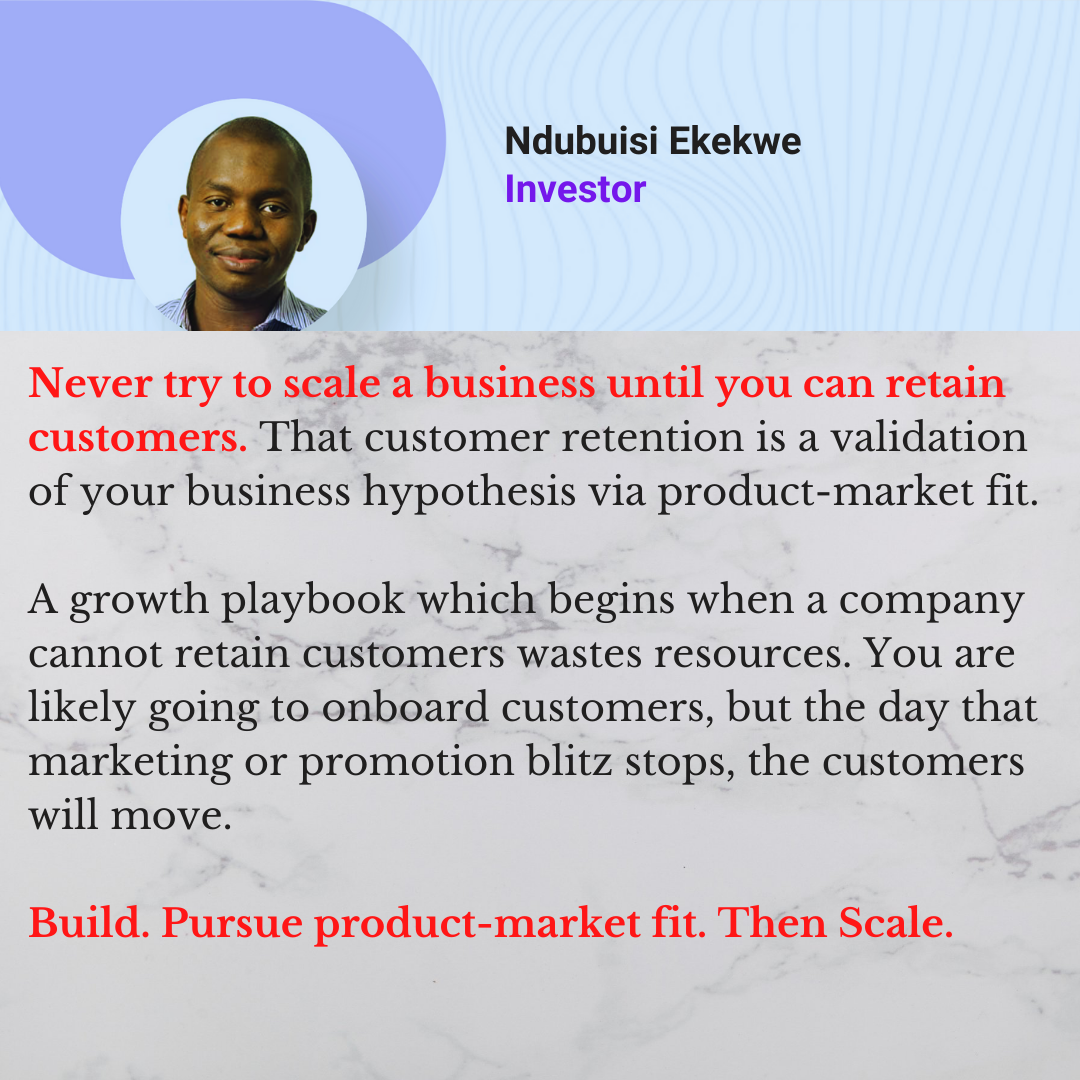

Never try to scale a business until you can retain customers!

0

Money does not solve most fundamental growth problems; product improvements do! Work hard to understand your customers and do all to retain them before you begin to spend on massive scaling.

Never try to scale a business until you can retain customers. That customer retention is a validation of your business hypothesis via product-market fit.

A growth playbook which begins when a company cannot retain customers wastes resources. You are likely going to onboard customers, but the day that marketing or promotion blitz stops, the customers will move.

Build. Pursue product-market fit. Then Scale.

The Ecommerce Model for Africa Is Here As TradeDepot Raises $110M, Disintermediating Banks

1

I have written extensively on my admiration of B2B Ecommerce in Africa. I have also been consistent that I do not like B2C ecommerce business models like the type run by Jumia. Africa’s B2C ecommerce has a marginal cost problem and if you examine the cost, you will realize that there is nothing “electronic” in the model.

That noted, I have made the case that a new generation of ecommerce companies will rise and they are going to be B2B. By Q1 2023, they would have larger market capitalizations than Jumia which is the largest in the continent now.

Today, we are reading that TradeDepot has raised $110 million: “TradeDepot, a Nigeria- and U.S.-based company that connects consumer goods brands to thousands of retailers and helps with distribution, has raised $110 million in new equity and debt funding as it looks to bring in more retail stores and expand its buy now, pay later service across the continent.”

`In this business are Supplias, Omnibiz, Alerzo, and Mintyn. All these firms are just focusing on Lagos, Port Harcourt and Abuja and have growth ahead. They are yet to get to Ovim, my village in Abia state. It would take time to digitize African retails and I see this to be decades-long!

I am also bullish on the B2B business model that we invested in Africa’s largest downstream digital tech in the oil and gas. TradeGrid is growing in triple digits quarter by quarter. Tekedia Capital members who invested in it are smiling. We also pushed that business model for a new startup that we’re unveiling in January. Again, Tekedia Capital members came really big on it.

Good people, it is about marginal cost. B2B solves that problem at scale. That is why these companies are raising millions of dollars. Pay attention because what these companies are doing will make our banks very irrelevant in the near future: “just as any B2B e-commerce platform offering BNPL services, TradeDepot does not provide these merchants with cash advances. Instead, it sends the products directly to them while they pay in installments. The monthly effective interest rate stands at almost 5%.” Yes, that is 5% monthly and every retailer wants it because there is no paperwork since it is Buy Now Pay Later.

Depending on how you look at it, that is a 60% annual interest on trade financing – and the company has $110m to take more traditional bank customers.

Do Not Waste Time Starting B2C Ecommerce Business in Nigeria


The dying declaration of Silvester; the legal implication

0

The dying declaration of Silvester; the legal implications.

A dying declaration is a statement made by a person who is unavailable to testify in court  typically because of the declarant’s death, who made the statement under a belief of certain or impending death. It is the last statement; oral or written made by a person in his or her dying bed before he dies.

Whatever a person says in his or her dying bed which is referred to as a dying declaration is presumed to be true and regarded as a credible piece of evidence. Therefore, the purported statement made by Junior in his dying bed about being beaten, harassed and bullied by his colleagues and them forcing him to drink poisonous chemicals which eventually led to his death will be presumed to be true and credible. 

The statement will be held to be credible piece evidence useful for the prosecution’s case and useful to the court while passing their judgements in this case. 

This evidence (dying declaration) is held to be so strong at law that it requires no corroboration to lead to conviction. So, the dying declaration of Silvester that he was beaten and poisoned by his colleagues needs not be corroborated by any other piece of evidence for there to be conviction as the conviction of the accused can be based on the dying declaration alone. 

CloudTrucks, A Tech-based Trucking company, Raises $115m in Series B Round

0

CloudTrucks, a tech-driven trucking company based in the US, announced that it has raised $115 million in a Series B funding round led by Tiger Global to facilitate intelligence-based trucking services. Other participants in the round include Menlo Ventures, Flexport and angel investors Michael Ovitz and Opendoor CEO Eric Wu.

Founded 2019 by Tobenna Arodiogbu, George Ezenna and Jin Shieh, the company has witnessed record-setting growth for a two-year old startup. CloudTrucks raised $20.5 million in a Series A funding round last year, bringing the total capital raised to $141.6 million.

CloudTrucks uses technology to streamline administrative bottlenecks—making it easier for drivers to run their business and produce more revenue, especially in the United States, one of the largest trucking markets in the world.

In the U.S., trucking is responsible for most of the overland freight movement, with the market being worth 791.7 billion U.S. dollars in 2019. At that time, there were over 947,000 truck drivers employed in the U.S., which is less than the industry requires. Currently, the market is grappling with driver-shortage amidst government’s struggle to accelerate both domestic and international supply chain.

CloudTrucks says the new funding will enable it to expand existing services, create new ones and help small trucking businesses and entrepreneurs streamline administrative bottlenecks and keep more revenue. Areas of priority includes expanding its technology to meet the needs of more drivers, grow its existing team, and broaden its digital integration with brokers and shippers.

CEO Tobenna Arodiogbu, says the idea is to change the status quo in the trucking industry with modern techniques that will benefit owner-opeartors. He says the trucking industry has been rapidly changing and getting much more complex, while the owner-operators, the lifeblood of the trucking industry, were being left behind. So the company wanted to change this by building something from the ground up to ensure that owner-operators — and really all trucking entrepreneurs — have the tools to succeed and thrive in the industry.

“Nearly every sector of the economy relies on drivers to transport its goods and we are eager to use this latest round of funding to continue optimizing the trucking business—especially as our country needs new truck drivers more than ever,” he says. “We’ve seen the number of loads completed on our platform grow 8x since last year, and we recognize the importance of providing a complete business-in-a-box solution for drivers to make the most of every run.”

CloudTrucks’ determination to solve the challenges in the trucking industry is seen in the number of new products it has launched recently. Over the past year, CloudTrucks has launched these three new products: CT Cash, Flex, and Business Intelligence. CT Cash is designed for drivers who are looking to get paid faster and alleviate cash-flow constraints, providing instant pay and cash card options in addition to receiving cash advances.

Similar to Virtual Carrier, CloudTrucks’ existing product for independent owner-operators, the new Flex product line is designed exclusively for small trucking businesses and those drivers who are not looking to drive under CloudTrucks’ authority. In addition, CloudTrucks’ Business Intelligence dashboard provides a comprehensive breakdown of a driver’s performance, personal expenses and revenue for drivers to better determine how they can yield the most profit.

“CloudTrucks has always seen the trucking industry as the backbone of America and has made it its mission to create world-class tools and services that empower truck drivers to make a greater profit with fewer headaches,” said John Curtius, Partner, Tiger Global Management. “We’re excited to see the company continue to transform some of the industry’s broken practices like antiquated payment services and processes.”