Good People, it’s graduation week – and Tekedia Institute Mini-MBA edition 6 will conclude this week. It has been a great academic excursion on the mechanics of market systems. Over the last 12 weeks, more than 60 faculty members have led those excursions across different topics and domains.
For this week, we will begin live sessions on Tuesday with “Winning in Markets” to be followed by “The Call to Business Execution”. On Saturday, we will have the finale with “It’s Graduation Day”. Zoom links in the Board.
Registration for the 7th edition (Feb 7 – May 7, 2022) has since started – register here for the early benefits
Tue, Nov 30 | 7pm – 8pm WAT | Winning in Markets – Ndubuisi Ekekwe
Thur, Dec 2 | 7pm – 8pm WAT | The Call to Business Execution – Ndubuisi Ekekwe
Sat, Dec 4| 7pm – 8pm WAT | It’s Graduation Day – Ndubuisi Ekekwe
I was actually going to give the rest of this week a miss with posts… I have a lot on, and it just isn’t a good time to get into producing a major piece of ‘durable’ content… that is, until I saw this.
Not sure if anyone remembers a piece I did some time back…
johnmckeown.tiny.us/LI-dontknow-NG ….
This post was where I questioned why LinkedIn can’t tell anybody when they have viewers in Nigeria.
I started using TinyURL about eighteen months ago when all the drama became too much with these really long LinkedIn post URLs and all these alphanumeric sub-directories. They weren’t neat and they were taking up too much space.
The free service doesn’t provide any analysis stats, but I’m fine with that. TinyURL comes in three package options, and the next one up from the ‘free’ one is $120 USD a year. However, in the ‘Black Friday’ sale, they offered an upgraded package for under $30 for the year, and I was persuaded to go for it.
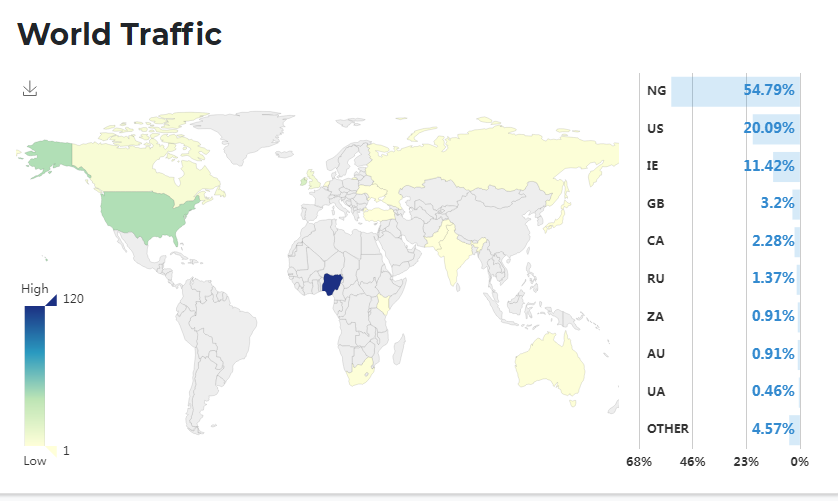
This is what allowed me to see the stats in the feature picture and as you can see, TinyURL (unlike LinkedIn) are very aware who and what Nigeria is!
LinkedIn Stats, unlike TinyURL, still don’t know Nigeria
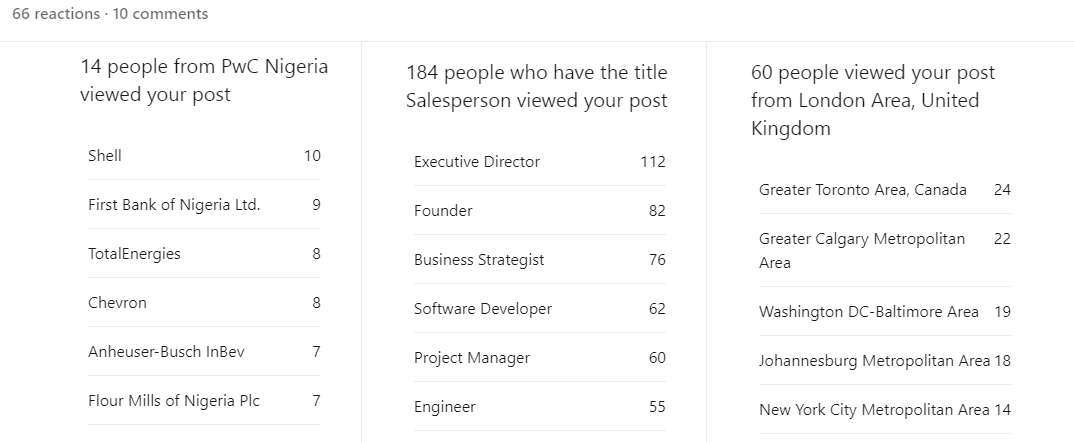
I decided to take a look at the LinkedIn stats today for my most recent post before this one. As you can see, nothing has changed. What we do know though, is that neither PwC Nigeria, First Bank of Nigeria, or FMN are in London UK, Toronto, or Calgary, Canada, or DC, US. It’s also most likely that the Shell, TotalEnergies, Chevron and AB Inbev presence is also in Nigeria.
Being thorough, and wanting to check things out a bit, I did a bit of digging on TinyURL and they are still owned by TinyURL LLC. So their ability to provide more accurate stats has nothing to do with being bought out by a tech behemoth with deep pockets.
If I had any small gripe about the TinyURL stats offering, it would be that the global map ‘legend’ doesn’t exactly match the stats. The colour scheme goes from deep navy (max saturation) to green (zero). They have Nigeria a deep navy, which is fine, but US is the next highest statistically. US is a green colour which makes no sense, while lighter shades of blue exist in places like Bangladesh, Papua New Guinea, Guatemala and Madagascar, where I have no viewers at all.
Nevertheless, LinkedIn is owned by Microsoft since 2016, and could do a whole lot better here. TinyURL by comparison is a fairly small outfit. They have also been hit by income challenges. Heavy Twitter users became heavy TinyURL users to keep their tweets below the service-imposed 140 character limit. However, from 2009, Twitter now ports an automatic translation of links longer than 31 characters using its ‘t.co’ domain in conjunction with rival URL shortening service ‘bit.ly’.Twitter also since doubled the character limit to 280.
It would be useful if LinkedIn upped their game here. Nigeria already has a lot of big problems without some of the worlds tech giants being dismissive.
I know you own a landed property or you desire to own one some day and I also know that you might have heard from estate developers, surveyors, land sellers or even lawyers that Certificate of Occupancy (CofO) of the land you acquire grants you a root of title as an evidence that you are the legal owner of the land or proves that you are the owner of the land.
Well, I’m not a bearer of bad news but the bad news is that the Certificate of Occupancy doesn’t prove ownership as it is not enough to grant you a good root of title and it’s not ultimate prove that you are the legal owner of the land. It only raises a presumption of ownership in your favor which can be rebuttable. So take it from me that the certificate of occupancy of the property you own or you intend to own doesn’t really prove or show you are the owner of the property.
This rule was established by the Supreme Court while upholding the decision of the Appeal Court in the case of Joshua OGUNLEYE v. Babatayo ONI (S.C. 193/1987)[1990] NGSC 63. The court in it’s dictum stated and I quote; “however, a general statement that may be made about the certificate of occupancy is that it raises a presumption in favour of the holder; albeit a rebuttable presumption that the holder has a right of occupancy”- per Belgore Jsc.
In the above case, Mr Joshua Ogunleye bought a land from a community who was proven does not have the ownership of the and therefore cannot sell the land as the land belongs to Babatayo Oni’s father.
Mr. Ogunleye after the purchase of the land acquired a certificate of occupancy on the land from the state government and started developing the land.
Mr. Oni the rightful owner of the land got to know that his land has been sold by the community without his consent went to the land and demolished the structures already erected on the land by Ogunleye. Ogunleye took Oni to court for trespassing on his land.
At the high court, the court held that by the reason of Joshua Ogunleye acquiring the certificate of Occupancy on the land he’s the bonafide and legal owner of the land. Damages was awarded to him against Mr. Oni for Trespass.
Mr. Oni went on appeal, the court of appeal reversed the decision of the high court and established that although Ogunleye acquired a certificate of occupancy on the land in question which raises the presumption that he is the legal owner of the land but you cannot acquire a property from the wrong means and get a certificate of occupancy to cover it up. When you acquire a property from the wrong owner, even if you get a certificate of occupancy on that property it won’t prove you are the rightful owner.
The matter went on to the Supreme Court were the court upheld the judgement of the court of appeal and reemphasizing that certificate of occupancy alone is not an evidence of ownership or a good root of title, you must show that you acquired the property from the rightful owner before the certificate of occupancy comes into play.
His Lordship Nnaemeka Agu Jsc in his dictum stated; “This appeal by the plaintiff brings into focus what is required to prove by a plaintiff who relies upon a grant for his proof of title to land. Incidentally, it exposes the weakness of a certificate of occupancy which has been granted where the grantee has no title to the land”.
By this judgement, the Certificate of Occupancy granted to a purchaser of land does not confer any title on him if the seller of the land have no title to the land or not the rightful owner of the land in question as it is he rule that you cannot give what you don’t have (Nemo dare potest quod non habet).
My best advice (out of goodwill) to you is to always consult a lawyer before you get into any transaction, it will save you a lot.
JOSHUA OGUNLEYE V BABATAYO ONI (S.C. 193/1987)[1990] NGSC 63 (27 APRIL 1990).
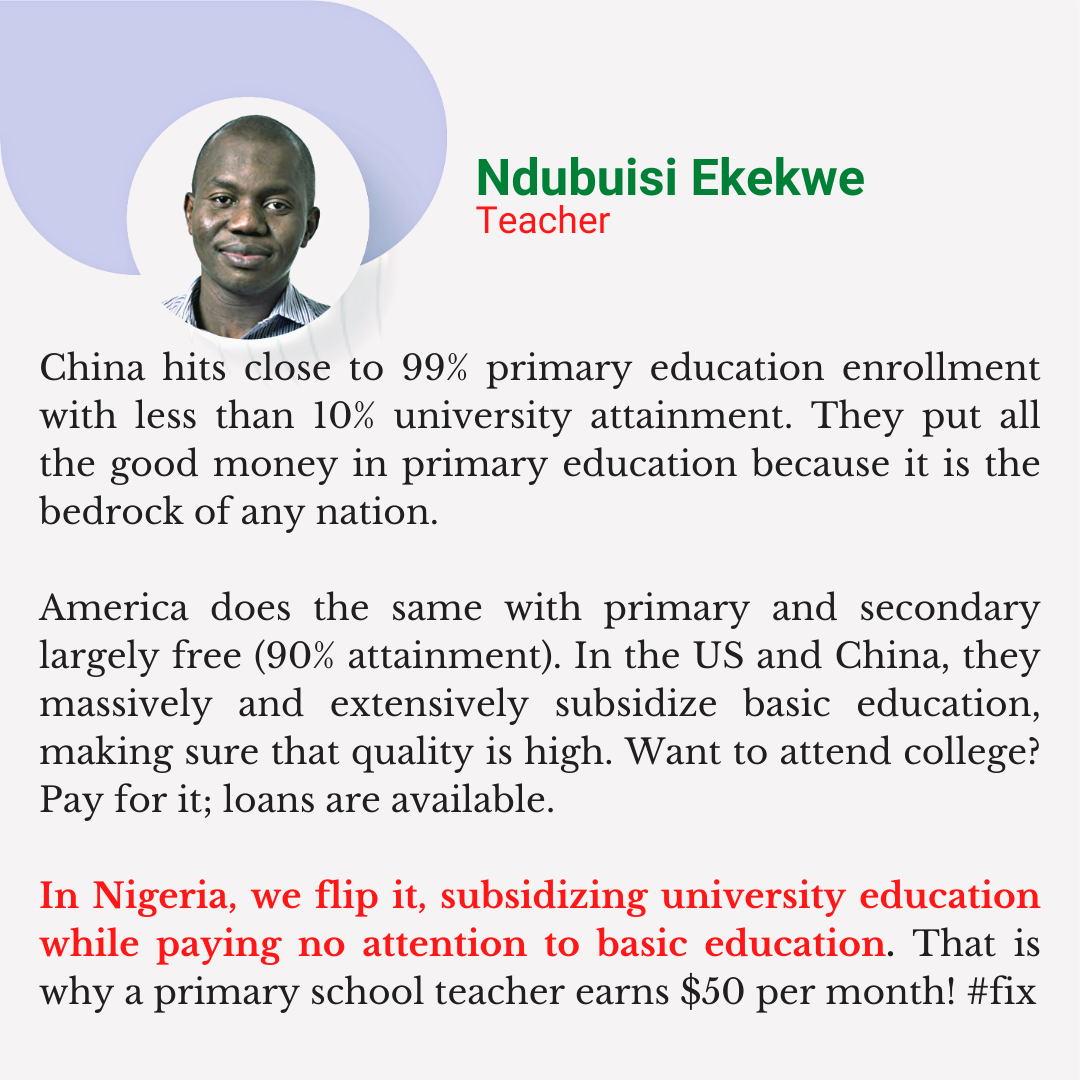
China hits close to 99% primary education enrollment with less than 10% university attainment. They put all the good money in primary education because it is the bedrock of any nation.
America does the same with primary and secondary largely free (90% attainment). In the US and China, they massively and extensively subsidize basic education, making sure that quality is high. Want to attend college? Pay for it; loans are available.
In Nigeria, we flip it, subsidizing university education while paying no attention to basic education. That is why a primary school teacher earns $50 per month! #fix
Sure many of us here benefitted from that massive university subsidy, but if you look at the data over the last few years, one thing is evident: the poor who attend poor primary schools are evidently cut-off from those university subsidies as they cannot compete to be admitted. If that trajectory continues, inequality will keep scaling in the nation.
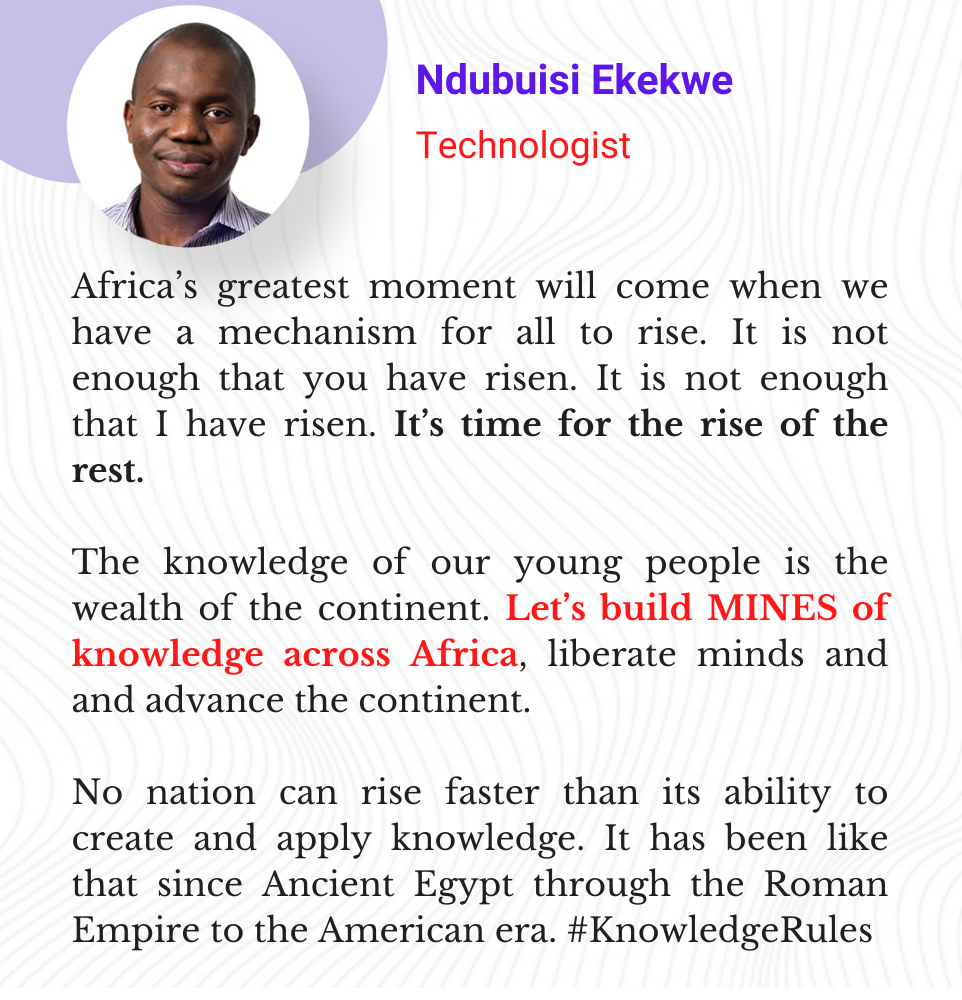
Africa’s greatest moment will come when we have a mechanism for all to rise. It is not enough that you have risen. It is not enough that I have risen. It’s time for the rise of the rest.
The knowledge of our young people is the wealth of the continent. Let’s build MINES of knowledge across Africa, liberate minds and and advance the continent.
No nation can rise faster than its ability to create and apply knowledge. It has been like that since Ancient Egypt through the Roman Empire to the American era. #KnowledgeRules