
DD
MM
YYYY

PAGES

DD
MM
YYYY

spot_img

PAGES

Home Blog Page 5453

You can sue your bank if its ATM fails to dispense cash to you!

0

Let me tell you some amusing fact I’m sure you may likely not be aware of:

Do you know that you can sue a bank if their Automated Teller Machine (ATM) fails to dispense cash to you as long as you have money in that account?

Yes, you read right! 

Did that surprise you?

Well don’t take my word for it, it is the word and the decision of the court.

The Background story!

Mr. Moses G Jwan is an Ecobank Plc customer and owns an account with the bank in which an Automated Teller Machine (Atm) debit card was issued to him. He tried using the debit card to make a withdrawal in a United Bank of Africa’s ATM gallery. He was debited but cash wasn’t dispensed to him by the teller machine.

He decided to take legal action. He sued both EcoBank Plc his bank and United Bank of Africa (UBA) the bank that owns the teller machine that didn’t dispense cash to him.

The matter was dismissed in the high court for the technicality of plaintiff’s failure to discharge the burden of proof placed on him and he (Mr Moses Jwan) went on appeal and appealed to the court of appeal.

In the court of appeal, Plateau state judicial division, the court held that Automated Teller Machine (ATM)  is like a Cheque and failure of it  to dispense cash is a breach of Banker/customer duty in as much as the customer has a withdraw-able sum in the bank account.

This case is therefore a judicial precedent, laying down the precedent that if your bank’s teller machine fails to dispense cash to you while you’ve got a withdraw-able sum in the account, the bank is in breach of their duty to provide cash to you and damages will be awarded against them.

If you are interested in reading up the case, the case is reported in the Nigerian Weekly Law Report (NWLR) where it is reported: Moses Jwan V. Eco Bank Plc (2021) 10 NWLR (PT 1785 ) 449 (CA)
Experience a New Form of Education At Tekedia Institute

0

I like this comment, left by a Tekedia Mini-MBA member who has registered for our Feb 2022 edition; we give access to many materials ahead, including my exclusive books. In Tekedia Mini-MBA, we teach the necessity of brands to pursue perception, not just needs and expectations of customers. In Harvard, I have also written on that construct, making the point that fandom comes when companies turn their customers into fans, and that only happens when we meet them at perception level, well beyond their needs. 

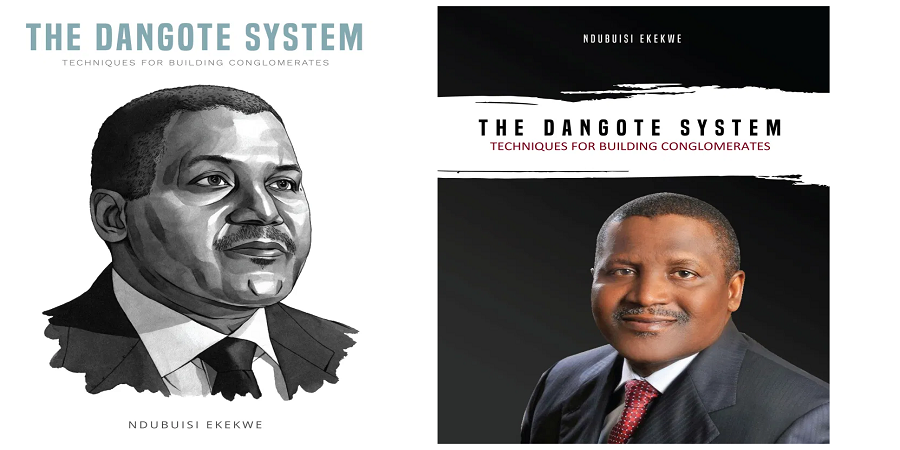
On “The Dangote System: Techniques for Building Conglomerates” book, our member left this one: 

“After reading and listening to the presentation, I had to go check again the meaning of perception. “The act or faculty of perceiving, or apprehending by means of the senses or of the mind; cognition; understanding. immediate or intuitive recognition or appreciation, as of moral, psychological, or aesthetic qualities; insight; intuition; discernment: an artist of rare perception”. My conclusion, perception in business, is the ability to think for and beyond the customer needs and expectations. Now, I need to work with great intuition. Thank you prof.”

 I invite you to experience a new type of education at Tekedia Institute.

 Comment on LinkedIn Post

Comment #1: You speak of literal perception whereas Prof is using the term metaphorically to refer to something that people want/need but hadn’t imagined until it was presented to them.

Comment #2: Perception Demand Leadership entails demonstrating through a feat of Innovative Genius that you understand the solutions to the needs of your customers more than they themselves do.

People don’t really know what they want, but they know they want it anyway and they want it now! Henry Ford said that if he had asked people to tell him what they wanted, they would have said “a faster horse,” but Ford has uncommon perspective on the solution and when it was engineered into existence as the famous “Model T” through a stroke of Innovative Genius, the people knew at once the equation to their mobility needs could not have been resolved any better. Also when Steve Jobs engineered the iPhone into existence through a feat of Innovative Genius, people knew at once their communication couldn’t get any smarter.

It’s relatively useless to ask your customers what they want because they simply don’t know. It’s your job as an Innovator to figure it out and demonstrate it through what the Professor has christianed Perception Demand Leadership.

Comment 3: Expectation comes before perception in the customer experience journey in business management.

Expectation is what customer visualizes to experience before using a service or product. A customer can expect to arrive a destination early enough to carry out some transactions. Perception is formed by user/customer during the actual experience. And this experience informs the customer possible conclusion on whether to repeat or not.

Therefore, if the customer’s expectation is greater than the perception formed at the end of the service, the service is said to be poorly rendered. On the other hand, If the perception is greater than the expectation, the service is said to be of quality.

It is wise for businesses to always examine and bridge operations gaps within the customer and company domains to get to the perception level of customer satisfaction to retain customers.

Thank you, Prof.


The Journey of 5G Innovation – Tekedia Mini-MBA

0

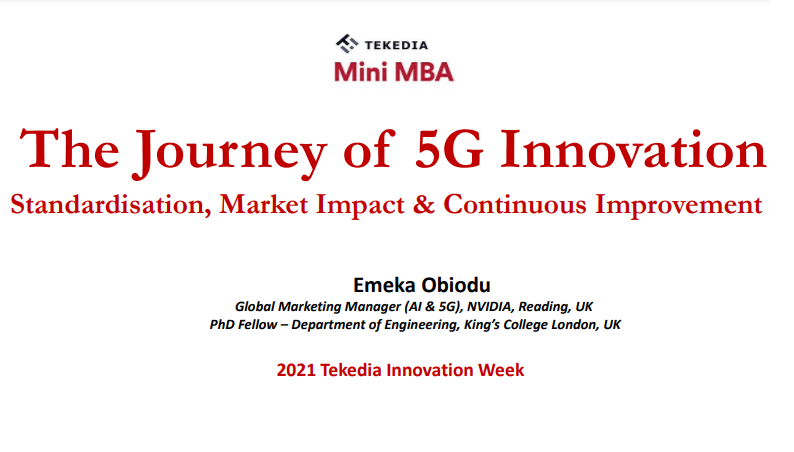
Good People, remember that the Tekedia Innovation Week continues. Today, one of the zen-masters in the 5G world will be anchoring the session. A graduate of FUT, Owerri (the best EEE department in the world), Queen Mary (UK), Warwick MBA (UK) and soon PhD (King’s College, UK).

Formerly the Strategy Director & 5G Taskforce Lead in GSMA, the #1 industry association in the GSM community, he is currently the Global Marketing Manager – Telecoms: 5G, Accelerated Computing, Edge AI at global chip category-king NVIDIA.

Tekedia Faculty Emeka Obiodu will help you understand the business of 5G. Time is 7pm WAT; Zoom link in the Board school.tekedia.com


Sabi, Nigeria’s B2B Marketplace, Raises $6m for Expansion

0

Sabi, Africa’s leading B2B marketplace has raised a $6 million bridge round to expand its services to the informal sector. The round was led by CRE Venture Capital among others.

The company has witnessed rapid growth since it began operations in Nigeria over a year ago, expanding to Kenya. Sabi serves Nigeria’s $244 billion informal trade sector by providing the digital infrastructure to help SMEs grow their businesses. Merchants use the platform to manage their businesses, carrying out B2B businesses.

In August, the company announced that it has 150,000 businesses in its customer-base, a figure that has increased to 175,000 now. Merchants’ transactions at Sabi stood at over a US$100 million GMV annualized rate.

The company has more than 10,000 agents who interact with merchants across all 36 Nigerian states, delivering the online and offline support needed to properly service the over 41 million micro, small, and medium-sized enterprises in Nigeria alone, where its service is largely operational.

Sabi’s bridge round follows the company’s seed round closed in mid-2020 which also attracted leading international investors including Janngo Capital, Atlantica Ventures, and Waarde Capital. This bridge round financing will help fuel the company’s rapid growth as it eyes new markets including South Africa, which is also home to a multi-billion dollar informal sector.

Anu Adasolum, CEO of Sabi said the round will help to accelerate the platform’s growth, building on its increasing transaction volume.

“We are excited to have closed this bridge round as Sabi continues to grow at an incredible pace. Our merchant users are taking advantage of every part of our platform, and the quality of the B2B partners we have brought onto the market is clear from the ever-increasing transaction volume.”

Pardon Makumbe, Co-founder & Managing Partner of CRE Venture Capital, commenting on the investment, said CRE Venture Capital is proud to support Sabi’s continued growth across Nigeria and expansion into Kenya and South Africa.

Sabi has developed an online/offline approach that is endearing to informal businesses, in addition to the quality of its platform and service provider curation, which has clearly taken root in Nigeria.

Ademola Adesina, co-founder of Sabi, while commenting on the round said it will help the company to expand beyond Nigeria to other African countries.

“Now that Sabi is operational all across Nigeria, we look forward to bringing our solution into new markets with similar informal sector challenges, starting with Kenya and then South Africa. Sabi’s team, platform, and investors are ready to continue scaling Sabi into Africa’s leading B2B marketplace.”

With the $6 million round, Sabi has proved itself as a leader in Africa’s B2B market, and it is on the verge of becoming one of the fastest-growing African companies of 2021.

Master The Innovation Equation At Tekedia Mini-MBA [REGISTER Now]

0
innovation

Innovation = Invention + Commercialization.

The purpose of innovation is to improve the efficiency of the utilization of factors of production, and by doing so we fix market frictions in better ways, creating a new basis of competition that will unlock compounding competitive advantages. Innovation comes in many domains – technology, marketing, pricing, etc.

At Tekedia Institute, we make this translation easy for members. Our members do indeed master them – and they go into the market and WIN.

I invite you to register for the next edition of Tekedia Mini-MBA. Early bird deadline ends tomorrow. Begin here https://www.tekedia.com/mmba7/

You will meet me live thrice weekly in Zoom, and we will discuss business, and how we can unlock alpha in market systems. Become an innovator, attend the best school.

We have got more than 200 faculty members. The very best in the world and our members have rated Tekedia Mini-MBA “Excellent” value for money. It goes for $170 or N90,000. Experience 12 weeks of academic excursion by the best team in business education. Check these experts; you will like them to teach you https://school.tekedia.com/faculty/

Comment on LinkedIn Feed

I think this definition should be Standardised in Corporate Nigeria, because it’s simply revolutionary.

It’s empirical, it’s condensed, it’s simple and indisputable as opposed to the loose and vague high-flying definition in Silicon Valley and mainstream media which basically regards every new invention as an innovation irrespective of its viability and market validity. Adding new features, churning out new products and catalogues or the number of patents a company has all count as being innovative.

Thought Leadership is critical to Innovation.

E=MC^2 propounded by Albert Einstein is just a definition for energy but in mathematical language, but it has revolutionised science ever since and in turn technology.

In that light, I also think that Innovation (I) equals Invention (V) plus Commercialisation (C), or in other words I=V+C (if I am allowed some poetic licence), can revolutionise Socioeconomics.

The Marketing and Sales of Technology/Inventions are Socioeconomically determined. This definition unites two worlds… Technology and Socioeconomics. See my point?