DD
MM
YYYY

PAGES

DD
MM
YYYY

spot_img

PAGES

Home Blog Page 546

$1M Avalon X Giveaway Explained: How RWA Utility Could Outperform Dogecoin & PEPE In 2025

0

Both the PEPE coin price and the Dogecoin price have shown signs of revival in the past week. Although they remain highly volatile, the altcoins are known to provide high returns to those who invest at the right time.

However, the risk associated with them is very high. This is why investors are now looking at sustainable and use-case-oriented projects that deliver actual value in the market. One such newcomer in the real estate tokenization crypto industry is Avalon X (AVLX).

Its use case as a real estate-backed cryptocurrency is undoubtedly very interesting on its own. However, what is driving viral growth to this project is its $1M crypto giveaway. Below is a detailed look at PEPE and Dogecoin price predictions, and also Avalon X’s potential as one of the top new crypto projects of 2025.

Why are PEPE and Dogecoin Prices Going Up?

Memecoins remain as risky as ever. Recent market data shows Dogecoin price moving around the $0.21-$0.24 range. It has gone up by over 12% in the past week, and the trading volumes are also seeing a massive increase. This may reflect retail flows rather than fundamental acceptance in the market.
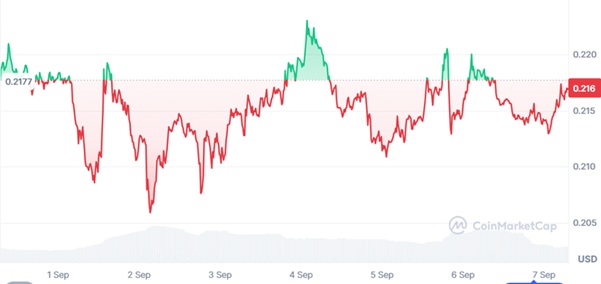
PEPE price has also experienced gains of over 6% in the past week. It currently trades at $0.00001039 and faces fast volatility. Making a price prediction for these memecoins is never easy. They are generally dominated by whale activity and overall market conditions.

This is why investors now trust crypto backed by real-world assets. The RWA industry is also growing, as its utility can generate organic demand, which in turn creates sustainability.

This creates an environment where real estate-backed cryptocurrency projects can get hold of larger and more durable investment flows.

What the $1M Avalon X Giveaway Actually Does

It is more than a marketing stunt. The Avalon X giveaway (a $1M crypto giveaway) is designed to get viral and build a community. Giveaways often encourage users to participate in the activities, which then helps the ecosystem grow.

Moreover, there is also a crypto townhouse giveaway, which just requires a minimum investment of $250 in AVLX coins. This fully deeded townhouse is located in the gated Eco Avalon development.

Moreover, investors rightly worry about presale execution. Avalon X crypto solves this big problem by putting out a formal CertiK audit report, showing security checks and ongoing monitoring. This builds practical trust for both retail and institutional buyers.

Beyond blockchain technology, the Avalon X token is directly tied to Grupo Avalon’s real properties in the Dominican Republic. That operational backing gives further credibility to the project. Investors are impressed by the fact that Avalon X real estate crypto links token utility to hospitality services, discounts, and membership perks.

What Does The Avalon X Presale Offer?

Avalon X has a capped 2 billion supply and, along with that, it has deflationary mechanisms and staged presale pricing. The presale prices start at $0.005 in Stage 1, and a 10% bonus is currently available to all.  These low prices, along with the active offers, essentially reduce the cost of capital. This will help investors looking for high ROI in the RWA crypto presales market.

In a market where Dogecoin price prediction and PEPE price scenarios are primarily run on sentiment, AVLX’s problem-solving tech makes it one of the best options for those looking to invest in real estate crypto.


Join the Community

Website: https://avalonx.io

$1M Giveaway: https://avalonx.io/giveaway

Telegram: https://t.me/avlxofficial
X: https://x.com/AvalonXOfficial

USDH Validator Vote Positions Hyperliquid As A Leader in Decentralized Governance and Stablecoin Innovation

0

Hyperliquid’s governance token, HYPE, surged past $50, reaching a new all-time high of $51.92, driven by anticipation around the upcoming validator vote on September 14 to assign the USDH stablecoin ticker.

The vote, set to occur between 10:00 and 11:00 UTC, will determine which team—Paxos Labs, Frax Finance, Agora, or Native Markets—will deploy the native stablecoin, with proposals emphasizing regulatory compliance and HYPE buybacks.

Whale activity has fueled the rally, with wallets like qianbaidu.eth purchasing 260,900 HYPE ($13M) and 0xe0f0 opening a $6.9M long position, among others, totaling over $24M in buys within 16 hours. Open interest in HYPE hit record levels, with $181M on Binance alone and over $2B market-wide.

The USDH launch aims to reduce Hyperliquid’s reliance on USDC, potentially redirecting $5.5B in volume and yielding $220M annually for HYPE holders. However, risks include regulatory scrutiny and competition from Tether’s dominance. Technical analysis suggests HYPE could test $52.16 but may face selling pressure if it fails to hold above $45.

The validator-driven vote underscores Hyperliquid’s commitment to decentralized governance, allowing stakeholders to shape the platform’s stablecoin strategy. This process, conducted fully on-chain, enhances transparency and aligns with DeFi’s ethos of community oversight, setting a precedent for future stablecoin deployments.

By empowering validators to select the team (Paxos Labs, Frax Finance, Agora, or Native Markets) to issue USDH, Hyperliquid ensures that the stablecoin aligns with community priorities, potentially reducing reliance on centralized stablecoin issuers like Circle (USDC).

However, risks of governance capture exist if a few large validators dominate, potentially undermining decentralization. A balanced validator set is critical to maintaining equitable decision-making. USDH aims to capture a portion of the $5.5 billion in USDC liquidity on Hyperliquid, with estimates suggesting a 15% share could generate $220 million annually for HYPE token holders through yield-sharing models and buybacks.

Proposals, such as Paxos’ plan to redirect 95% of USDH yield to HYPE buybacks, enhance token scarcity and value accrual, strengthening HYPE’s utility as a governance and economic asset.

The stablecoin’s integration could position Hyperliquid as a payments and real-world asset (RWA) infrastructure hub, boosting trading volume and platform revenue, which already stands at $1.13 billion annually.

USDH is designed to reduce Hyperliquid’s dependence on USDC, which currently dominates as the settlement currency for derivatives trading. A shift to USDH could redirect significant yield internally, enhancing ecosystem self-sufficiency.

This move aligns with regulatory trends, as proposals emphasize compliance (e.g., Paxos’ MiCA and GENIUS Act compliance), potentially mitigating counterparty risks associated with external stablecoins. The validator vote intensifies competition among stablecoin issuers, with major players like Paxos and Frax vying for control of USDH.

This could elevate Hyperliquid’s influence in the stablecoin market, challenging USDC and USDT dominance. However, risks include regulatory scrutiny, as stablecoins face increasing attention from global regulators, and Tether’s market dominance remains a formidable barrier.

Alongside the USDH vote, Hyperliquid’s 80% reduction in spot trading fees for dual-quote asset pairs and permissionless access to quote assets will deepen liquidity and lower trading costs, attracting more users and boosting HYPE’s utility.

These upgrades could make USDH a central settlement currency, enhancing Hyperliquid’s position as a leading DEX for perpetual futures trading, with $400 billion in monthly volume. Recent whale activity has significantly influenced HYPE’s price surge past $50, reflecting market confidence in Hyperliquid’s USDH strategy and governance model.

Notable whale transactions include qianbaidu.eth injecting $13 million to purchase 260,900 HYPE at an average price of $46.85, and address 0xe0f0 opening a $6.9 million long position. Other wallets, such as 0x746, deposited $2 million to buy 42,449 HYPE at $47.35. These moves, totaling over $24 million in 16 hours, signal strong bullish sentiment.

Whales are likely accumulating HYPE to secure voting power in the USDH validator vote, as voting is stake-weighted. This accumulation has driven open interest to record levels, with $181 million on Binance and over $2 billion market-wide, fueling price momentum.

HYPE’s price surged 12% since the USDH announcement, reaching $51.92, just below its all-time high of $53.21. Technical indicators, like an ascending triangle pattern and rising RSI, suggest potential for further gains toward $55–$60 if the $52 resistance is breached.

Whale activity, such as the $3.3 billion BTC-to-ETH rotation on Hyperliquid, demonstrates the platform’s ability to handle large, permissionless trades, further boosting confidence in HYPE’s value proposition.

While whale accumulation drives price, it raises concerns about validator centralization. Large stakeholders could dominate the USDH vote, potentially skewing outcomes and affecting decentralization. Liquidation risks in DeFi perpetuals, as seen in the XPL price spike wiping out millions in shorts, highlight the fragility of leveraged positions.

If USDH captures projected liquidity and maintains regulatory compliance, it could solidify Hyperliquid’s role in DeFi, though regulatory and competitive challenges remain. Traders should monitor the $52 resistance and $45 support levels for HYPE’s next move, while stakeholders await the vote’s outcome to gauge USDH’s long-term impact.

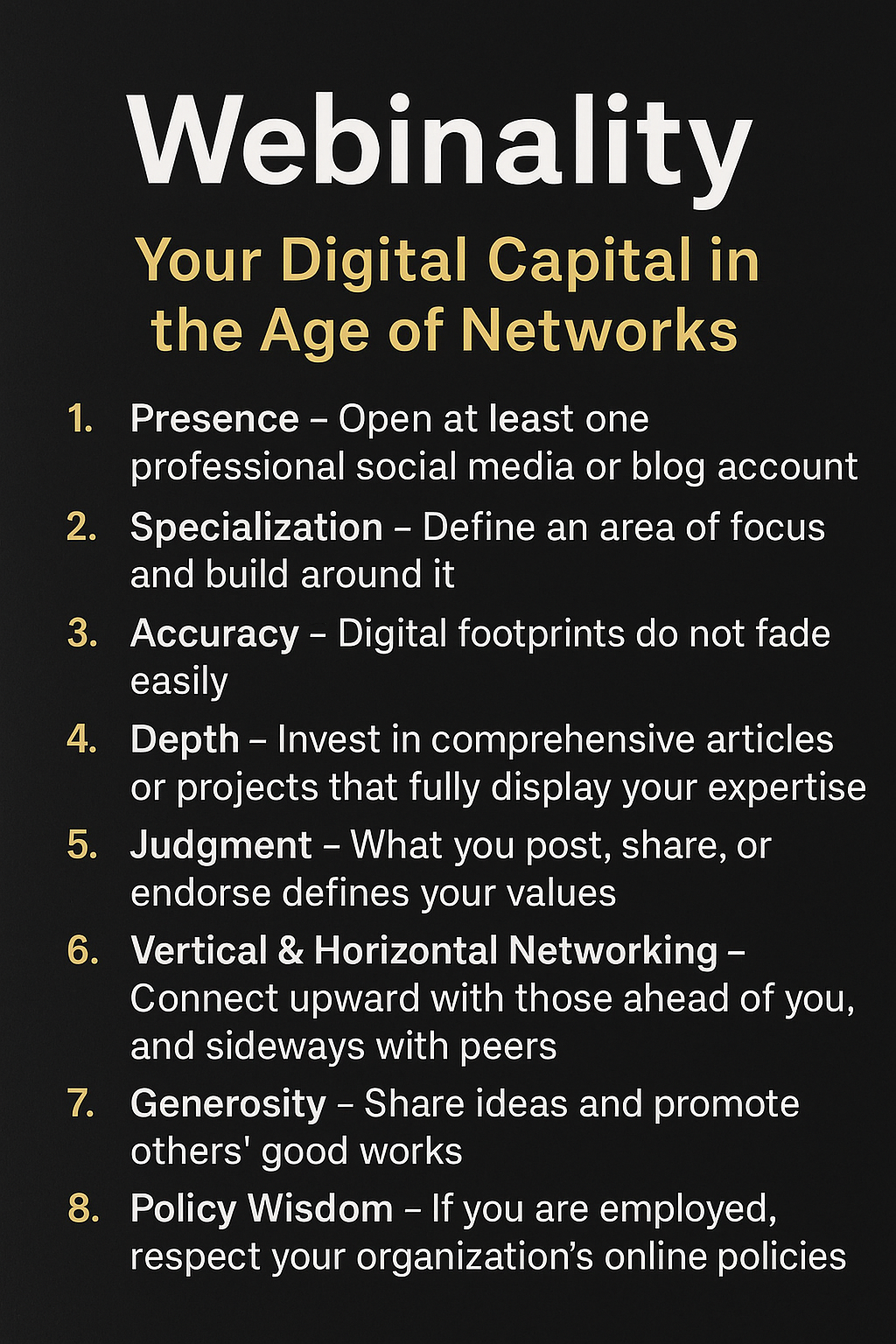
Webinality – Your Digital Capital in the Age of Networks

1

In the industrial age, factories and machines were components of production. In today’s digital economy, your online persona has become one of your most important assets. I call it Webinality – a fusion of web and personality. It is the sum of how you appear, behave, and engage on the internet. In a world where first impressions increasingly happen online, a strong Webinality is not a luxury; it is a competitive advantage.

A well-crafted Webinality signals credibility, competence, and character. It is how you stand out in a noisy digital marketplace and become discoverable for your unique skills and capabilities. Just as companies build brands, professionals must build digital brands.

Here are some pillars to strengthen your Webinality:

  1. Presence – Open at least one professional social media or blog account. If you are invisible online, you may be invisible in opportunity.

  2. Specialization – Define an area of focus and build around it. A five-minute online search should tell anyone exactly what you stand for. Differentiation is the beginning of relevance.

  3. Accuracy – Digital footprints do not fade easily. If you exaggerate your accomplishments, a former classmate or co-worker can challenge it instantly. Accuracy sustains trust.

  4. Depth – While micro-posts keep you visible, also invest in comprehensive articles or projects that fully display your expertise. Expand classwork, create thought pieces, publish deep insights. Half-baked content will not take you far.

  5. Judgment – What you post, share, or endorse defines your values. Employers want reliable, ethical team leaders. Let your Webinality reflect reliability.

  6. Vertical & Horizontal Networking – Connect upward with those ahead of you professionally, and sideways with peers. A network built in two directions creates opportunities in multiple directions.

  7. Generosity – Share ideas. Promote others’ good works. Write professional reviews of books and journals. In time, goodwill compounds into influence.

  8. Policy Wisdom – If you work for an organization, respect its online policies. Your personal profile should not become an accidental leak of competitive information. Separate your personal brand from your employer’s, where necessary.

  9. Continuity – Webinality is never “done.” It is a living system requiring constant updates of networks, content, and profiles. Nurture it like a garden.

In Igbo, we say “ihe e ji ama onye bu aha ya” – you are known by your name. In the digital age, you are known by your Webinality. Build it intentionally. In a marketplace of billions of IP addresses, that is your foundational factor of production.

LinkedIn Post

Webinality is a portmanteau of web and personality. It refers to your professional digital identity — who you are online, how the world sees your knowledge, values, and capabilities.

It is more than presence: it is how you are known in your absence. If people cannot recommend you when you are not in the room, your Webinality is weak.

Webinality involves building credibility, visibility, and trust via content, networks, and consistent alignment of what you say with what you do. It is about making your expertise discoverable.

In Tekedia Mini-MBA Personal Economy module, I do teach that this refers to your professional online persona or digital identity. In a world where first impressions often happen online, your webinality is considered one of your most important assets.

Indeed, a strong webinality is a competitive advantage that signals credibility, competence, and character. It’s how you stand out in the digital professional marketplace and become discoverable for your unique skills and capabilities.


Replit Hits $3bn Valuation With $250m Raise as AI Coding Race Intensifies

0

Replit, the fast-growing collaborative coding startup, has closed a $250 million funding round at a $3 billion valuation, marking one of the most notable financings in the developer tools and AI coding space this year.

The new funding was led by Prysm Capital, with participation from Amex Ventures and Google’s AI Futures Fund. Existing backers — including Y Combinator, David Sacks’ Craft Ventures, Andreessen Horowitz, Coatue, and Paul Graham — also contributed to the round.

With this raise, Replit has now brought in about $478 million in total funding, according to PitchBook estimates.

A Rare Gap Between Funding Rounds

Unlike many high-growth AI startups that turn to venture capital every few months, Replit has paced itself. Its last raise came in 2023, when it secured $100 million at a $1.16 billion post-money valuation. The new $3 billion valuation means its worth has nearly tripled in just over a year.

The decision to raise now comes amid surging demand for AI-assisted coding platforms.

Explosive Revenue Growth

Founded in 2016 by programmers Amjad Masad and Faris Masad, along with designer Haya Odeh, Replit has positioned itself as a go-to platform for developers experimenting with AI-assisted tools.

The company says its annualized revenue has skyrocketed from $2.8 million to $150 million in less than a year. By June, Replit had already reached $100 million ARR, CEO Amjad Masad tweeted at the time — underscoring its rapid monetization curve as AI coding gains mainstream adoption.

Big Tech Ties: Google and Microsoft in the Mix

Google’s involvement in the latest round is no surprise. Replit has long been a close partner with Google Cloud, and many “vibe-coded” apps built on the platform are hosted there.

Yet Replit’s rise has forced competitors to adjust. In July, Microsoft began offering Replit as an option on its Azure cloud platform, signaling the company’s growing importance in the broader developer ecosystem.

The dual embrace by Google and Microsoft highlights how central Replit has become in the race to integrate AI-powered coding into mainstream developer workflows.

Replit vs. Copilot and Claude Code

Replit’s trajectory differs notably from rivals in the AI coding boom. GitHub Copilot, owned by Microsoft, has leaned on its deep integration with GitHub and Visual Studio Code to win over professional developers. Its adoption is massive, but its growth has been tied to Microsoft’s bundling strategy across enterprise software.

Anthropic’s Claude Code, launched earlier this year, has taken another path by positioning itself as a safe and aligned AI assistant for coding, with uptake driven by companies that prioritize governance and AI safety in enterprise environments.

By contrast, Replit has married accessibility with scale. The platform began as a tool for hobbyists and students but has quickly grown into an enterprise-capable service, bridging the cultural gap between “vibe-coding” communities and serious professional development. Its rapid rise in ARR from $2.8 million to $150 million in under a year demonstrates a monetization curve few in the sector have matched.

This positioning gives Replit a dual advantage: cultural relevance among younger coders experimenting with AI and increasing credibility with larger organizations adopting it at scale.

Replit’s latest valuation places it in the same league as some of the most closely watched AI developer startups, though with a unique growth model. Where foundation model labs like OpenAI or Anthropic compete on building cutting-edge models, Replit has turned those models into practical tools that everyday users and enterprises can deploy instantly.

The $250 million injection also highlights the next wave of venture focus: not just the AI models themselves, but the platforms enabling millions to build on top of them.

Oracle Stock Jumps on Report of $300 Billion OpenAI Cloud Deal

0

Oracle shares surged in after-hours trading on Tuesday following reports that the company had secured several multi-billion-dollar contracts with major customers. Now, details are emerging that one of those customers is none other than OpenAI, the Microsoft-backed artificial intelligence company at the center of the current AI boom.

According to a report from the Wall Street Journal, OpenAI has agreed to purchase $300 billion worth of compute power from Oracle over a five-year period starting in 2027. If confirmed, the deal would represent one of the largest cloud contracts ever signed, placing Oracle in a commanding position within the fast-expanding AI infrastructure race.

Oracle declined to comment on the report, and OpenAI did not respond to requests for confirmation. Still, Wall Street reacted swiftly to the news, with the shares of Oracle climbing as investors digested the significance of a potential anchor contract that would rival or exceed the largest commitments ever disclosed in the cloud industry.

The deal also underscores a deepening partnership. OpenAI first began tapping Oracle for compute capacity in mid-2024, diversifying away from its heavy reliance on Microsoft Azure. In January 2025, the shift became more pronounced, with OpenAI moving further away from Azure as its exclusive cloud provider. The decision coincided with the launch of the so-called “Stargate Project,” a $500 billion initiative backed by OpenAI, Oracle, and SoftBank to build out massive domestic data centers over the next four years.

The reported agreement suggests that OpenAI is locking in as much long-term compute supply as possible, hedging against both soaring demand and potential bottlenecks in GPU and cloud capacity. Already this year, OpenAI has expanded its cloud footprint beyond Microsoft and Oracle, reportedly striking a deal with Google as well, according to Reuters. That move illustrated the paradox at the heart of the AI race: even fierce competitors are becoming infrastructure partners as the hunger for computing power outpaces what any single provider can supply.

Oracle’s Bet on OpenAI Could Redefine the Cloud Race

If confirmed, OpenAI’s $300 billion commitment to Oracle would cement the database giant’s transformation into a heavyweight contender in cloud computing—an arena long dominated by Amazon Web Services, Microsoft Azure, and Google Cloud. It would also position Oracle as one of the few companies directly enabling the compute-heavy workloads that underpin OpenAI’s ambitions, from training ever-larger models to deploying them at scale.

For Oracle, which has spent years lagging behind the big three cloud providers, the deal could prove pivotal. Analysts say the agreement would not only lock in revenue visibility but also establish Oracle as an indispensable partner in AI infrastructure at a time when the company is working to redefine its relevance in the cloud era.

A $300 billion contract spread over five years would deliver stable, recurring revenue on a scale previously unseen in Oracle’s cloud business. Combined with the Stargate Project, the contract could cement Oracle’s place as an indispensable partner for the most compute-intensive workloads in the industry.

For OpenAI, the benefits would be equally transformative: locking in access to massive compute resources would provide the security needed to train ever-larger AI models while insulating it from shortages and pricing spikes. In this scenario, Oracle’s stock could continue its rally as investors re-rate the company’s cloud prospects, while OpenAI secures the infrastructure necessary to maintain its lead in artificial intelligence.

However, there are challenges. For Oracle, the concentration of so much revenue from a single client could expose it to volatility if OpenAI changes course or runs into financial or regulatory headwinds. The deal’s sheer size raises questions about execution: can Oracle scale its infrastructure to reliably deliver $300 billion in compute capacity starting in 2027?

For OpenAI, spreading contracts across Oracle, Microsoft, and Google reduces dependency, but it also locks the company into long-term commitments at a time when AI compute efficiency is improving rapidly. Should breakthroughs lower the cost of training and inference, OpenAI could find itself bound to overpriced contracts. And with regulators in the U.S. and Europe increasingly scrutinizing AI concentration and cloud dominance, the partnership could draw political as well as financial risks.

However, OpenAI is sending a strategic message that it cannot afford to be dependent on a single provider if it hopes to sustain its aggressive growth and model development. By spreading contracts across Microsoft, Google, and Oracle—and anchoring massive projects like Stargate—the company is building a compute safety net that ensures it has access to the resources needed for its next leaps in artificial intelligence.