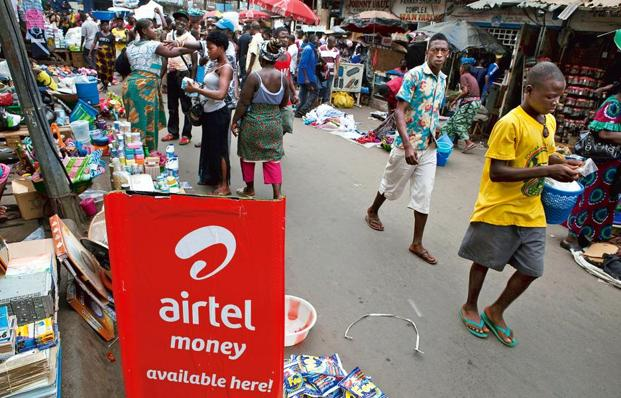
The Nigerian financial industry has newcomers that are likely going to stir disruption. The Central Bank of Nigeria (CBN) has granted approval in principle to MTN and Airtel to operate a payment service bank (PSB) across the country, as the regulator pushes to deepen further financial inclusion in Nigeria.
Three years ago, the CBN said it would allow non-financial companies to apply for mobile banking licenses – either as PSBs or Mobile Money Operators (MMOs). The decision was drawn up from the push to increase Nigeria financial inclusion that has for years been limited to financial companies.
Nigeria has a huge financially underserved population of about 38 million adults as of 2020, mostly scattered across rural areas where banks and other financial companies are not operational. Giving telcos license to offer financial services means that rural dwellers will hence have access to adequate financial services.
Under the guidelines, mobile network operators are allowed to provide financial services to millions of unbanked Nigerians. However, they can do so only as PSBs and through a subsidiary separate from their core operations. This means, MTN and Airtel will be providing PSB services via their respective subsidiaries, MoMo and Smartcash.
PSBs accept deposits from individuals and small businesses, offer payment and remittance services, issue debit & prepaid cards, operate electronic purses, and other activities prescribed by the CBN.
MTN announced the issuance of the PSB license through a statement signed by its Company’s Secretary, Uto Ukpanah on Friday.
“MTN Nigeria Communications Plc (MTN Nigeria) as promoter, received an Approval in Principle (AIP) dated 4 November 2021 from the Central Bank of Nigeria (CBN) for a licence application for the proposed MoMo Payment Service Bank Limited. This is the first step in the process towards a final approval, subject to the fulfilment of certain conditions as stipulated by the CBN. The decision to issue a final approval is firmly within the regulatory purview of the CBN and we respect their right and judgment in that regard,” he said.
The South African telecom giant said it would leverage the opportunity to deepen the financial inclusion agenda of the CBN and the federal republic of Nigeria.
The other recipient of the PSB license, Airtel, also announced the approval through a statement signed by the Group Company Secretary, Simon O’Hara.
“Airtel Africa, with presence in 14 countries across Africa, announces that its subsidiary SmartCash Payment Services Bank Limited has been granted approval in principle to operate a payment service bank business in Nigeria. Final approval is subject to the Group satisfying certain standard conditions within six months,” he said.
Also commenting on the approval, the CEO, Airtel Africa, Segun Ogunsanya, said: “I am very pleased that Smartcash has been granted an approval in principle to operate a service bank business in Nigeria. We will now work closely with the Central Bank to meet all its conditions to receive the operating licence and commence operations.
“The final operating licence will enable us to expand our digital financial products and reach the millions of Nigerians that do not have access to traditional financial services. I am looking forward to working closely with the government, the Central Bank and traditional financial institutions to expand financial inclusion and meet the evolving needs of our customers and the economy.”
However, the approval of the PSB license to MTN and Airtel, which is likely going to be extended to other operators, mainly, Globacom and 9mobile, Nigeria’s domestic telcos, will spell further trouble for Nigeria’s traditional financial institutions.
Already, the fintech boom is increasingly immobilizing the growth of players in the traditional financial industry. The International Monetary Fund (IMF) disclosed in its Financial Access Survey 2021 Trends and Developments on Monday, that Nigerian banks closed 234 branches and 649 Automated Teller Machines, ATMs, in 2020 leading to a decline in the country’s Financial Access Score (FAS) to 4.44 in the year against 4.78 in 2019.
This means that there is still a huge financial inclusion gap to be filled even in urban areas. With millions of subscribers in their customer-base, telecom operators are about to rule Nigeria’s financial industry. But it is not clear what it will mean for the newly launched Nigeria’s central bank digital currency – the eNaira.
Like this:
Like Loading...