DD
MM
YYYY

PAGES

DD
MM
YYYY

spot_img

PAGES

Home Blog Page 5484

How Far With The Lagos’ New Building Technology?

0

A few years back, the Lagos State government under the reign of Governor Akinwunmi Ambode graciously introduced a new building technology towards addressing various ongoing anomalies in the State’s housing sector as well as erecting a structure fast and easily.

It’s noteworthy that the emergence of the technique was as a result of the colossal housing deficit recorded thus far in the State. Survey indicates that over two million losses had been recorded across the length and breadth of Nigeria’s biggest city.

It isn’t anymore news that building collapse alongside allied matters has in recent times been a plight for public discourse within the shores of the Nigerian building industry at large. It suffices to assert that decadence is ubiquitous.

However, it seems that Lagos is on the rampage compared to other states, perhaps owing to the fact that the territory consists of the highest number of erected structures coupled with the deplorable atmospheric condition faced by its residents.

In his speech to newsmen, the then State’s Commissioner for Housing, Mr. Gbolahan Lawal disclosed that the new technology was already being used in its ongoing housing estate at Idale in Badagry and would further be deployed in the site situated at Imota in Ikorodu, in a bid to achieving the government’s motive of delivering 2,000 houses across the cosmopolitan city.

Mr. Lawal, who equally disclosed that the technique ensures construction of bungalow within 48 hours, stated therein “We want to see how to go into the manufacturing of houses. We make it seamless and produce about 100 units in a month. We have three companies; one is already at site.”

He went ahead to opine that investment in the housing sector usually have a multiplier effect on the economy as he informed that various gadgets and accessories such as tiles, electronics, water cum electricity meters, mattresses, TV subscription, in addition to menial jobs for artisans, are tied to construction of houses.

When announced, I was elated that Lagos as an over-populated State could eventually arrive at a point where erection of formidable structures was considered as priority and could be done with ease by the builders.

It had overtime been insinuated in some quarters that the Nigerian polity was yet to embrace building technology to the fullness considering the level of quackery and mediocrity invariably witnessed in the sector. But it appeared the Lagos government’s lofty move disabused some persons of the notion that Nigeria lacks the apt resources to get it right.

Nevertheless, I made it clear then that before we celebrate in haste, it would be pertinent for the government to critically consider some factors with a view to ensuring the newly discovered technique doesn’t fade away in no distant time as well as being fully domesticated in the State.

We aren’t unaware that the firms contracted to handle the job were mainly foreign, hence the need for every discerning mind to worry about the future of the initiative. Though the housing commissioner disclosed that some indigenous workers were being trained in the technique and process of construction, I was of the strong view that there’s need to institutionalize the training.

Institutionalizing the said application would enable our teeming professionals, and the prospective ones, to passionately key into the process. Consequently, our indigenous designers and builders would be in charge of the initiative thereby helping to greatly boost the economy. So, Lagos was expected to take a lead in this aspect.

Similarly, there’s a compelling need to establish a strict policy to guide the housing sector in the State. We were notified that a new housing policy aimed at tackling the State’s housing deficit had been drafted. Such a policy, which was expected to be fully functional by now, must bear every clause needed to address all forms of lapse currently observed in the State’s building sector.

The policy, which was required to be designed with the aid of well-experienced and reliable town planners, needed to enshrine reasonable penalties for anyone guilty of violating the development control laws. It’s in record that Lagos was the first state to create a full-fledged Housing Ministry in 1999 because of the priority it accorded shelter, hence such prioritization must be fully upheld by the policy.

It’s appalling that three years later, nothing tangible has been recorded in respect of Lagos’ new building technology. Hence, at such a time like this when expectations are very high, an onward review coupled with apt implementation of the needed policy is consequential. We aren’t unaware that successive governments in Nigeria are not good in continuing with the capital projects or initiatives introduced by their predecessors. This is why they are charged to have a rethink in this regard.

It’s also time we started recognizing the use of materials like wood, clay and bamboo in the construction of standard structures, either residential or commercial. We were informed that the Lagos Housing Ministry had in years back experimented on the use of the aforementioned items but the availability and speed of delivery was the reason it dropped the proposed initiative.

It’s amusing for one to assert that the required wood for building construction is unavailable, or can’t be found in abundance, in Nigeria. What the governments at all levels need to do is to raise the profile of timber-based architecture toward promoting the demand. It’s needless to assert that everything centres on adequate recognition of the technique in question and the onward quest to deploy its lofty use.

In addition, the Nigerian government must begin to promote afforestation by assigning grievous punishment to unapproved deforestation via viable policies. By doing so, the needed wood would become more accessible and cheap than concrete and bricks, thus construction with the former would be done swiftly.

As we once again commend Lagos for recording this feat, the current government led by Mr. Babajide Sanwo-Olu must equally be urged to think deeply towards making advanced building technologies stand the test of time in the State, so other states can borrow a leaf from them. 

Who Owns Published Outputs? Supervisors or Supervisees

1
University Graduation Cap with Scroll Icon Student Education Symbol Isolated Realistic Design Vector Illustration

One of the key responsibilities of lecturers and other tutors in higher educational institutions is supervision of students during preparation of dissertation and thesis as parts of the requirements for the award of various degrees. In some schools, it is the duty of a coordinator in a department to assign students to lecturers, who will coach and engage the assigned students for a certain number of months towards the production of quality output in the areas chosen by the students and aligns with the supervisor’s areas of specialisation or interest.

Typically, this process represents an advanced learning curve for the students because they have access to their lecturers within the direct knowledge transfer framework, which has been described as one of the best approaches for equipping what were taught in the classroom. For the students who participated fully in the learning process, there are chances that they would fix into the academia environment more than those who paid lip services to the expected rigor in dissertation and thesis production.

Apart from the fact that the lecturers are taking supervisory roles and students are the receivers of the constructive intellectual provision of the lecturers in the area chosen, lecturers are also collaborators in the production process. One of the existing submissions in this regard is that “collaboration can be a hierarchical relationship, like the one between a professor and a doctoral student, or a mutual relationship between two or more colleagues of equal status.”

The main product of the engagement for the students is the submission of dissertations and theses to their departments or postgraduate schools through departments. However, publishing journal articles and chapters in books are secondary outputs. Executing these depends on the supervisors’ interest in the main outputs. In most cases, supervisors do encourage their supervisees to modify the main outputs and present a journal article or a chapter in a book manuscript. In our experience, such manuscript gets refined by the supervisors when it is obvious that the manuscript may not be accepted by the editors of journals and books of interest.

Refining the manuscript for publication is not a bad idea as it signifies what our analyst called ‘redeploying learning research supervision curve’. A curve that helps students to further engage in another process for development of new academic products. What is really surprising in the second engagement is the removal of students’ names in publications by most supervisors. In our experience, this practice is not only pronounced in Africa, it is also in existence in other continents, most importantly in Asia, Latin America and others in the global south.

As the trend continues, there are different schools of thought regarding who owns the published outputs. As long as the supervisors refined the students’ works by removing the literature section and reworked the methodology part to align with the nature of the data collected by the students, supervisors own the outputs. The first school’s views. The second school believes that as long as the students are the basis of supervising. They are the ones who went to the field, spending their time and money for data collection, publishing without including their names is unethical and represents one of the key academic dishonesties to the fellow collaborators [in this case, the students]. What is your thought? Do you subscribe to any of these schools? Why? Let us discuss in the comment section.

Even Angola Spends More Than Nigeria!

3

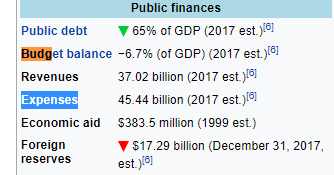
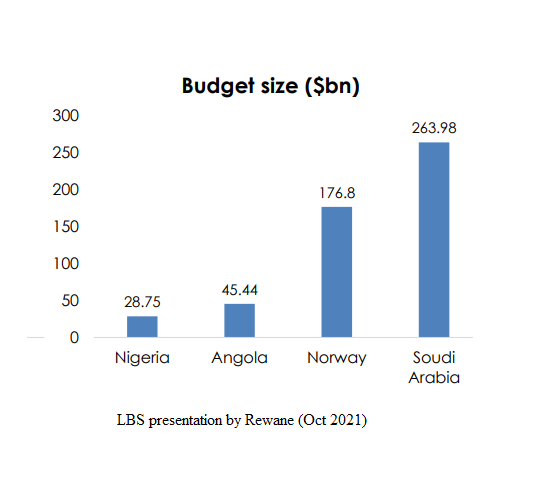
Is Nigeria really a giant? I do not understand the basis of that illusion! These days I have stopped using South Africa in my speeches because many told me that it was not a fair comparison. So, I switched to Angola, and no one has explained why Angola budgets $45 billion for 33 million people when Nigeria can only manage $35 billion for 210 million with most of that $35 billion borrowed.

Angola data (Wikipedia)
Oct 2021 Lagos Business School presentation by Bismarck Rewane, CEO of Financial Derivatives Company Ltd


Fellow citizens, Angola is an oil nation. How can we retire all these men who have been running Nigeria since 1999 since whatever they are doing is not working? I mean we are severely underperforming as a nation across major metrics.

Sure, Angola may be running a unitary government which means most of its spending is concentrated at the federal level; Nigeria runs a federal system with states having their own budgets. Yet, that does not change the underperformance of Nigeria. Except Lagos with $2.3 billion and Rivers state with $1 billion, many of the states in Nigeria spend really not much; Zamfara is around $300 million. That noted, even if you add all the states in Nigeria, on per capita income, Angola does better than Nigeria.

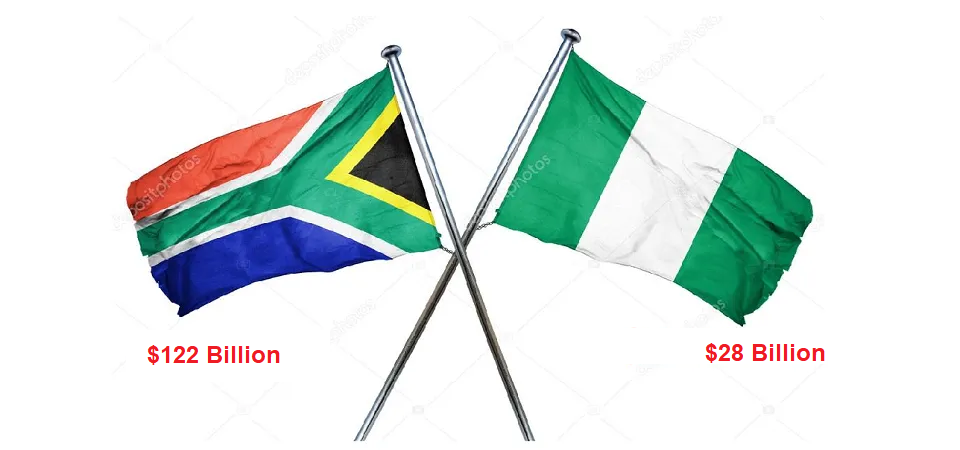
Nigeria vs South Africa budget, 2019


Notice after the post:

Good People, I have received dozens of inmails asking for the source of my Angolan budget. But one from a Director-General in one of our government agencies is driving this notice. Possibly, there are many people asking for the same thing.  Typically, anything I post here has an extended copy in my blog (next time, just go to tekedia as I archive all posts there).

But in summary, I relied on the Oct 2021 Lagos Business School presentation by Nigeria’s smartest financial analyst, Bismarck Rewane, CEO of Financial Derivatives Company Ltd. On page 25 of that presentation, he has this plot on the left. He is certainly a smarter man than yours truly that anything he puts out there must be correct. In short, he put the budget of Nigeria at $28.75 billion when I was gracious to put it at $35 billion. He is certainly right considering that our budget execution is never 100%.

But just to be sure it was not a typo, I also checked Wikipedia and saw the public expense at $45 billion. With that, I entered that number for Angola.

This is the full piece https://www.tekedia.com/even-angola-budgets-more-than-nigeria/ where I also noted the unitary structure of the Angolan budgetary system. But despite all, the trajectory is evident.

(I cannot share Mr Rewane’s 115-page document due to copyright issues. But you can go to LBS library for the Oct edition)

Nigeria Needs To Make It “We Rise Together”

1

In the next 10 years, Nigeria is going to experience one of the fastest and largest accumulation of wealth in its recorded history. The indicators are evident – this is a cambrian moment of entrepreneurial capitalism at an unprecedented level. But as this happens, many would be left behind. In short, the inequality would create many pockets of nano-conflicts in the nation if policymakers fail to lead. 

Wealth which will be created between now and 2030 would be concentrated in the hands of extremely well educated young people, and creating that wealth will not touch many people through employment.

Today, we have startups in Lagos with valuations in excess of $50 million with just 25 staff when banks that employ more than 6,000 people are struggling with a valuation of $40 million. 

If our policymakers are thinking, now is the time to begin to look at ways to ensure the Nation can rise #together. And most importantly, investing in digital education should be a human rights matter in Nigeria now. If not, the dislocation will trigger huge consequences in our future.

Right to protest is a constitutional right

0

By recent events, it may have seem that protesting or ‘peaceful’ protest is a crime against the state, not just a minor crime but a grievous one which attracts capital punishments as protesters have been treated like common criminals in Nigeria; harassed, intimidated, brutalized, arrested and detained for lengthy period of time by security agents in Nigeria. This circumstance makes one to wonder if it is really legal and a fundamental right to protest in Nigeria.

No matter how the government of Nigeria May try to rewrite the law, right to protest is a constitutional right; a fundamental right duly provided for in the constitution of the federal republic of Nigeria, 1999. Citizens have the right to assemble, organize and lead ‘peaceful protest’. This right is not just an ordinary right but a fundamental human right, just like individuals have right to life, freedom to move about, right to vote and be voted for etc so also citizens have right to hold opinion, join peaceful association, register their displeasures with the government when they feel that the policies and decisions of the government doesn’t not serve their interest.

This citizens’ right to peacefully protest; join associations, assemble freely and hold public opinion was provided for in sections 39 & 40 of the constitution of the federal republic of Nigeria, 1999. These sections read:

39. (1) Every person shall be entitled to freedom of expression, including freedom to hold opinions and to receive and impart ideas and information without interference.

(2) Without prejudice to the generality of subsection (1) of this section, every person shall be entitled to own, establish and operate any medium for the dissemination of information, ideas and opinions:

Provided that no person, other than the Government of the Federation or of a State or any other person or body authorised by the President on the fulfilment of conditions laid down by an Act of the National Assembly, shall own, establish or operate a television or wireless broadcasting station for, any purpose whatsoever.

(3) Nothing in this section shall invalidate any law that is reasonably justifiable in a democratic society –

(a) for the purpose of preventing the disclosure. of information received in confidence, maintaining the authority and independence of courts or regulating telephony, wireless broadcasting, television or the exhibition of cinematograph films; or

(b) imposing restrictions upon persons holding office under the Government of the Federation or of a State, members of the armed forces of the Federation or members of the Nigeria Police Force or other Government security services or agencies established by law.

40. Every person shall be entitled to assemble freely and associate with other persons, and in particular he may form or belong to any political party, trade union or any other association for the protection of his interests:

Provided that the provisions of this section shall not derogate from the powers conferred by this Constitution on the Independent National Electoral Commission with respect to political parties to which that Commission does not accord recognition.

The right to protest is not just a territorial fundamental human right as provided in section 39 and 40 of the constitution of the federal republic of Nigeria as it not limited to the jurisdictional shores of Nigeria, it is a continental right which is duly provided for in Article 11 of the African Charter of Human and People’s Right. It provided thus:
Every individual shall have the right to assemble freely with others. The exercise of this right shall be subject only to necessary restrictions provided for by law in particular those enacted in the interest of national security, the safety, health, ethics and rights and freedoms of others.

When a right is provided for in the constitution it points to how important that right is to individuals of the community and democracy cannot flourish when citizens of the state accepts whatever been thrown at them by the government hook line and sinker.

This is not just a political thing or a political agenda as people may think, so when citizens protest it is not a sponsored attack against the ruling government but it is a way of citizens who have the interest of the state at heart register their displeasures and force the government to see reasons with them, rethink and revisit their previous decisions and policies. It is in the human nature to resist some events or policies which he feels won’t benefit him.