DD
MM
YYYY

PAGES

DD
MM
YYYY

spot_img

PAGES

Home Blog Page 5493

Possibility of Disable Economies in the World With Growing Language Disorders

0

From 55 countries of the world, language disorders have largely occupied the minds of many global citizens in the last 5 years. According to the world interest in the receptive and expressive disorders, Zambia remains the leading country, where people have been developing interest in the last 5 years. Germany, Dominic Republic, Chile and Austria follow the East African country.

The United States of America is 36th among the countries that have been developing interest in the disorders since 2016. Different sources have shown levels of varied forms of disorders. Between 6 and 8 million individuals in the United States have some form of language impairment.  Approximately 7.5 million people in the United States have trouble using their voices. Disorders of the voice involve problems with pitch, loudness, and quality. The American public interest in language disorders from infancy through adolescence mostly common in the United States of America is on increase since 2016.

A number of academic and industrial sources show that the world language disorders impact both the understanding and use of language. Failure to identify the symptoms of the disorders early on has been linked to the inability to have proper care for the affected with the possibility of ensuring total cure. One of the sources lists symptoms of specific language impairment in older children and adults as “limited use of complex sentences, difficulty finding the right words, difficulty understanding figurative language, reading problems, disorganized storytelling and writing and frequent grammatical and spelling errors.”

These symptoms are not exclusive to a particular country or continent. They are almost emerging in every country and continent. This specifically explains the essence of rapidly working towards full realisation of strategic objectives in the World Disability Action Plan 2014-2021 [PDF] and carrying unrealised objectives to the next years.

Exhibit 1: Interest in Select Language Disorders’ Symptoms
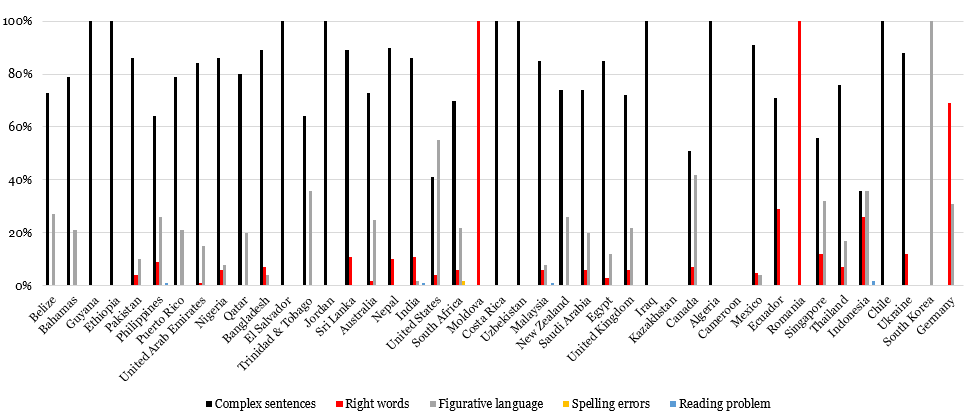
Source: Google Trends, 2021; Infoprations Analysis, 2021

Between November 5, 2017 and October 31, 2021, our analysis reveals significant relational interest in complex sentences, right words, figurative language, spelling errors and reading problem. According to our analyst, the global public, especially people in countries listed in Exhibit 1, had a strong interest in understanding how to use complex sentence and right words in their conversations [both written and verbal].

One percent interest in learning complex sentences translated to 89.1% in knowing the right words for sentence construction and use during verbal conversation. It significantly emerged that when the global public had a 1% interest in understanding complex sentences, it led to 96% of seeking knowledge about spelling errors and 90.9% in finding possible tactics for overcoming reading difficulties. Seeking knowledge about reading difficulties, in our analysis, largely connected with interest in understanding spelling errors.

These insights are further explored with a series of conversations with educationists and language therapists. They all agreed that the surge in complex sentence and right words is not surprising considering the fact that the world is not really interested in reading printed books where they could be easily learned. They note that emerging technologies such as social networking sites are impacting acquisition and use of appropriate language skills.  Beyond these, some of the symptoms emerged from the deficient childhood care.

Addressing language disorders using holistic and inclusive approaches would significantly help countries in reducing the number of people who dive into intellectual disability yearly, which has the tendency of impacting economic growth severely, especially in the developing world. The definition of the World Health Organisation on intellectual disability absolutely resonates with the listed symptoms of language disorders. According to the global health body, “a significantly reduced ability to understand new or complex information and to learn and apply new skills (impaired intelligence).”

Our analyst believes that collective strategies and tactics from concerned stakeholders in the private and public sectors are needed to avert disable economy, most importantly in countries where a significant number of the population is having different language disorders which prevent them from delivering appropriate the assigned tasks.

Join Tekedia Startup Masterclass And Improve Your Business

0

Good People, you have got those great ideas. At Tekedia Institute’s Startup Masterclass: from start-up to unicorn, we have a process to help you turn them into great companies. Register today and let us work together on the mechanics of starting and scaling business ideas. It runs for 8 weeks and you will have the opportunity for one-on-one eight Zoom sessions with me. You do not even need to be a startup founder, you can be a unit lead in a big bank, operational manager in a FMCG, etc.  

We work with entrepreneurs and intrapreneurs, helping them to improve efficiency on the utilization of factors of production, for productivity and business growth. I have been a business guy, right from Oriendu Market in Ovim, Abia state, where I sold garri and yam for my mother, after school. With close to 200 faculty members, those experiences compound and we have impacts at Tekedia Institute. 

We understand business – register here and let’s meet in the class 

BIG ISSUE: Marginalising Informal Sector in an Informal Driven Continent

0

From the West to the South and East to the North parts of Africa, informal sector employs a significant number of people, giving them a means of livelihood. Several reports and statistics indicate that agriculture is the main industry where informal businesses thrive on the continent. Apart from the industry, local manufacturing industry, especially in countries where attention is being paid to indigenous form of production, the industry also employs many Africans.

Our checks show that in both industries, female Africans are more engaged in agriculture than their male counterparts. Despite the government’s failure in quantifying the informal sector as expected by scholars and experts, the sector remains a major contributor to the local economy and invariably to the national economy in many African countries when one looks at indirect taxes being collected from the players and professionals in the sector.

As the debate rages on, some scholars in Africa have put together researches that further reveal the extent to which the sector has been marginalized over the years and possible continuation of the neglect by the concerned stakeholders in the government and non-government cycles if urgent actions are not taken. The researches are recently published in the Journal of African Business, Volume 22, Issue 4 (2021), which was guest edited by Professor Nnamdi O. Madichie and other colleagues in entrepreneurship and business development fields in Africa.

Examination of the editorial of the scholars and articles contributed by others indicate a large call for reengineering processes, people and products/services in the sector towards inclusive and sustainable businesses in Africa. From Nigeria to other countries, cases were made in recognition of the sector in terms of action policy formulation and implementation.

According to the contributors, this is necessary as the continent survival seems to be depended on the sector considering the degree at which it employs many Africans and provide sustainable livelihood. Some of the contributors, specifically made cases for uplifting female entrepreneurs through tailored policies and intervention programmes, most importantly those in the agriculture industry.

Referring to some previous scholars, who have studied the sector, Professor Madichie and other colleagues note that “Firstly, there is a general notion of two sectors of the economy: the private sector and the public sector, neglecting the informal. Secondly, the education systems train students to be employed thus, neglecting self-employment or entrepreneurship.”

Our analyst further notes that since some of the policies and interventions in formal sector are not delivering adequate outcomes, African governments need to do more for the informal sector by moving beyond rhetoric policies creation and implementation when new elections close by. The main thesis, our analyst pinpoints from the contributions to the journal, is that Africa needs informal sector more than the formal sector in its quest for sustainable businesses and economic growth.

As the Guest Editors suggest, the usefulness of the sector in growing ‘the borrowed formal sector’ needs further analysis by academic scholars and independent researchers on the continent. Both the scholars and researchers need to develop more interest in studying strategy, finance, people, process and technology in the sector. These will go in a long way of giving the players and professionals in the sector opportunity to always have access to best practices from the emerging insights.


The JAMB’s Big Error for Nigerian Students

9

The Joint Admissions and Matriculation Board (JAMB) has remitted N3.51 billion to the federal government as operating surplus for 2021. The Board registrar, Prof Is-haq Oloyede, continues his turnaround which makes him one of the finest public servants in the nation; well done Prof. He turned a money-losing Board into a surplus-making one.

But as Nigeria celebrates this continuous record from JAMB, I want to be on record as one person who will not commend JAMB. While it is uncommon, in Nigeria, to see a leadership that is prudent to have managed resources and then honestly returned excesses to the Federal Government, I think using data from the last few years, by now, this would not be necessary in JAMB.

Yes, JAMB should reduce fees or waive fees on many things and help Nigerian families instead of keeping its current cost model. It has been declaring surpluses for years, largely due to having top-rate management, but it is time we do the right thing: there is no need to be sending money to that ocean called the Federal Government purse which swallows whatever goes in , with largely nothing to show.

Alternatively, the university system through National Universities Commission and allied regulators should enter an MOU so that JAMB will use the excess funds to offer reduced tuition in all universities, polytechnics and colleges of education, both public and private, in Nigeria.

Nigeria MUST not make JAMB a revenue generating institution like NNPC and Corporate Affairs Commission. That message must be clear! For everything wrong in Nigeria, affordable education remains the only gift – and we can open the entrance phase for more families.

Comment on Feeds (LinkedIn, Facebook)

Comment #1: It’s sad that prospective undergraduates have to rewrite jamb, after passing but couldn’t secure admission into the university. Jamb can create a policy that guides students whose results scale over let’s say 200,have their results valid for 2 or 3 years, should they not be admitted into the higher institution In that current year they wrote the exam.

Not gaining admission in the current year is enough to demoralise any prospective student from rewriting the said exam, also considering the unavailability of space to accommodate new entrants in these universities nationwide.

Comment #2: Prof. JAMB had reduced the application form fee when the same man came on board in his first tenure. Again, the surge in revenue I guess has to do with the continuous yearly increases in enrollees’ population.

Now to me, N3,500 as an application fee is moderate for an annual examination. This fee is not even up to what an average family or even the JAMB candidate spends on data or airtime weekly in Nigeria.

Sometime, I do ask myself what do we really wants in this country, get every government service free?

The same parents we are advocating for, and tag the poor, don’t blink an eyelid when paying for foreign examinations such as IELTS exam , SAT, TOEFL, etc. but we suddenly remember they are poor when it concern’s Nigeria. Previous Registrars charged higher fees in the region of N5,000 with less millions of Naira returned to the Treasury we didn’t complain and we didn’t remember the parents were poor. To me the N3,500 application fee is in order. Now, concerning how the generated fund should be utilized, except we want the exam body, an agency under the ministry of Education to contravene the constitution which will ultra-vire JAMB. The constitution states that all revenues generated must go into the national treasury, and be shared by Federal, State and Local governments in Nigeria.So, how do we want JAMB to go about this when the provisions of the constitution and revenue mobilization law of the federation is cleared and details?
Respond to #2: This comparison is actually faulty. While the current JAMB Management is superb, in the old JAMB, your fees included checking your result. My understanding is that your current fee does not cover scratch card, etc. Also, it would be unfair to compare any system in 2021 with say 2012 since tech has reduced cost of operations. With CBT exam, JAMB does not print papers or hire security to send them to CBN vaults across the nation. There is no transportation, etc to move scripts. JAMB is a software company with improving marginal cost. But its gains should not be sent to government. It can use excess to reduce tuition for all year 1 students in universities, etc.
Comment #2a: I do agree that JAMB is a software company, however, its marginal cost is not perfectly inelastic. I also do agree that other incidental costs such as the scratch card purchases should and as matter of fact be eliminated. Candidate Registration number and Email should suffice in checking the result.
In respect to it’s gain not being sent to the government, Mr President might need to issue executive order to that effect, or a constitutional amendment.
My Response to 2a: There is one thing Mr President can do that will help: JAMB results can last for 3 years. That means, if you take it in 2021 and unable to gain admission, you can use it up to 2023. JAMB costs many rural students money to come to cities to take them. That money is not captured in the form. We can reduce that burden as done in SAT, TOEFL, etc across the globe.

Obi Cubana’s rights are already being violated

0

As Obi Cubana spends the second day in the detention facility of the Economic and Financial Crimes Commission it should be known to all and sundry that the law mandates that nobody should be detained by any security agency in Nigeria for more than 24 hours or at most 48 hours without court order if not the detainee’s right of personal liberty as constitutionally provided is already being violated. 

Mr. Obinna Iyegbu, aka Obi Cubana is said to have been arrested on Monday morning, 1st of November, 2021 for alleged crimes of money laundering and tax evasion. Three days and 2 nights later, the renown businessman is yet to be released by the anti crime agency as he is still being held captive in bondage in the commission’s facility. 

According to S.35 of the constitution of the federal republic of Nigeria, 1999 (as amended) every Nigerian citizen is entitled to his personal liberty and when a person is arrested by any security agency in Nigeria for any offense or alleged crime, he must not be detained longer than 24-48 hours which is considered to be ‘a reasonable time’ without being released on bail or charged to court:

S.35(5) hereby states; In subsection (4) of this section, the expression “a reasonable time” means –

(a) in the case of an arrest or detention in any place where there is a court of competent jurisdiction within a radius of forty kilometres, a period of one day; and

(b) in any other case, a period of two days or such longer period as in the circumstances may be considered by the court to be reasonable.

In as much as the law charged the officers of the Economic and Financial Crimes Commission to go against economic and financial criminals or those they have every reason to believe are breaking the law and make them face the law, they must as well learn to do same in accordance to the law, especially the fundamental human rights of individuals as provided by the constitution which is the ground norm of the society; right to personal liberty of suspect(s)  by respecting the rights and liberties of the alleged cyber criminals or suspect; be it Obi Cubana who has spent 2 cold nights in their facility or any other individual who may have been arrested or will be arrested by the agency at any time.