DD
MM
YYYY

PAGES

DD
MM
YYYY

spot_img

PAGES

Home Blog Page 5515

#EndSars Memorial: Remembering the Victims A Year After

0

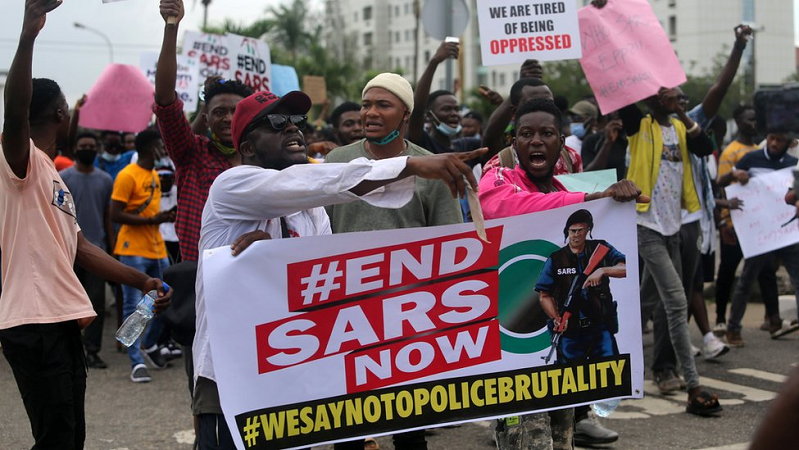
On this day, a year ago, Nigerian youths had gathered at the Lekki Toll Gate in Lagos, following days of protest against police brutality dubbed #EndSARS. The EndSARS protest, which unprecedentedly spiraled into a global movement, was described as the most successful demonstration in Nigeria’s history.

It was a situation the government, under President Muhammadu Buhari, did not want to see. In the eve of October 20, 2020, Nigerian soldiers had arrived at the Lekki Toll Gate and started shooting on the protestors, killing scores and putting the protest to a deadly end.

The shooting of October 20, 2020, has come to be known as “Lekki Massacre,” a bloody stain that has further strained the relationship between the Nigerian government and its young people. A year later, in remembrance of their brothers, sisters and friends, who sustained injury and those who lost their lives to the brutal firepower of those in uniform, Nigerians have convened #EndSarsMemorial, in outcry for justice for the victims and reforms for safe policing.

“On the first anniversary of October 20th, 2020, like many Nigerians, I have struggled with coming to terms with the sobering events of that day,” former President of the Senate, Dr. Bukola Saraki said. “My thoughts and prayers are with those who lost their lives, loved ones, and sustained injuries or other losses at the Lekki Toll Gate and at various locations in Lagos and around the country when security agencies were deployed to clamp down on the protests and non-state actors took advantage to cause chaos and mayhem.”

As the memories of the ugly incident reechoe through pictures, videos of the victims and blood stained Nigerian flags circulating on social networks, the pain deepens. Not only because no one has taken responsibility for what happened in Lekki Toll Gate nor because the victims of the massacre are yet to get justice, but also because one year after, not much has changed.

SARS was disbanded in an apparent attempt (which has been a ritual for years) to appease protesters, and a seeming move to meet their 5 for 5 demands. A new anti-robbery squad named SWAT was formed, in what many believe to be a whitewashing of the same characters that constitute rogue police units.

The 5 for 5 demands of EndSARS protestors are: (1) Immediate release of all arrested protesters; (2) Justice for all deceased victims of police brutality and appropriate compensation for their families; (3) Setting up and independent body to oversee the investigation and prosecution of all aspects of police misconduct (within 10 days); (4) In line with the new Police Act, psychological evaluation and retraining (to be ascertained by an independent body) of all officers of the defunct SARS before they can be redeployed and (5) Increase police salary so that they are adequately compensated for protecting lives and property of citizens.

Out of these five demands, none could be said to have been fully implemented. Although EndSARS panels of inquiry were convened across several states in the country, awarding hundreds of millions of naira in damages to a few victims of police brutality who summoned courage to file complaints, most of the officers involved in the crime are yet to be prosecuted.

A recent report noted that about 300 EndSARS protesters are still languishing in different correctional centers (prisons) across the country.

“It is worrying that despite the acceptance of the “5 for 5 Demands,” nothing has really been done to resolve the issues that caused the protest in the first place. None of the policemen accused of torturing and extrajudicially murdering Nigerian citizens have been brought to justice, there has been no marked improvement in the funding or quality of equipment available to the Nigerian Police Force and these incidents of torture continue in many security facilities nationwide,” Saraki said.

“None of the perpetrators of the attacks on Nigerians exercising their rights to peaceful assembly have been arrested or prosecuted, despite many of them being identified,” he added.

A typical evidence of this is in the statement issued by the Lagos State Police Commissioner, Mr. Hakeem Odumusu, warning that the police will not allow any kind of street protest. In his words, “the police will use legitimate means within their constitutional powers to suppress the planned protest… therefore, individuals or groups sponsoring such protest are warned to desist from such unpatriotic plan or face the full weight or wrath of the law.”

The question that many have not stopped asking is; which law was Mr. Odumusu talking about when he issued this statement?  Given that the right to protest is constitutionally enshrined in Section 38 of the 1999 Constitution of the Federal Republic of Nigeria, and the Court of Appeal ruling in IGP vs ANPP 2008, stated that it is the right of citizens to conduct peaceful processions, rallies or demonstrations without seeking and obtaining permission from the police.

Contrary to this constitutional provision, the Nigerian Police Force, like always, have taken their station at Lekki Toll Gate in their numbers, in a show of force designed to deter the commemoration of Lekki Massacre. Across other states where the protest is billed to take place, the measures are the same. Reports coming from the protest grounds say that many have been tear-gassed and arrested.

According to rights advocates and civil liberty organizations, the unfolding events in a democratic society is an indication that Nigerian security agencies have lost the capacity to learn or show the civility that their work requires. It is also an indication of failure by the Nigerian State, to modernize its institutions and educate its personnel to reflect democratic ideals in their operations.

At the high cost of blood and livelihood, the status quo has been sustained to the detriment of Nigeria’s young generation, who inadvertently have to reckon with the institutionalized brutality by those who are supposed to protect them.

“I can’t even describe how I feel seeing this picture (talking about a slain youth). This is one of the Many Untold Stories,” Actor Mr. Macaroni wrote on Twitter. “Pelumi Onifade, a 20 year old journalist, covered the viral video of a Nigerian politician shooting at protesters. He was arrested and killed in custody.”

For generations Y and Z who wanted a change and have given their blood and resilience for it, the backdrop indicates that they will have to wait longer for it.
Two Nigerian Banks With Highest Exposure To Fintech’ Target Customers

0

Looking at the half-year reports of leading banks in Nigeria, I can confirm that fintechs are finding seats at the old traditional tables reserved for banks. Yes, it is clearly evident that most banks seem to be struggling with growing interest income, the gold standard of banking. 

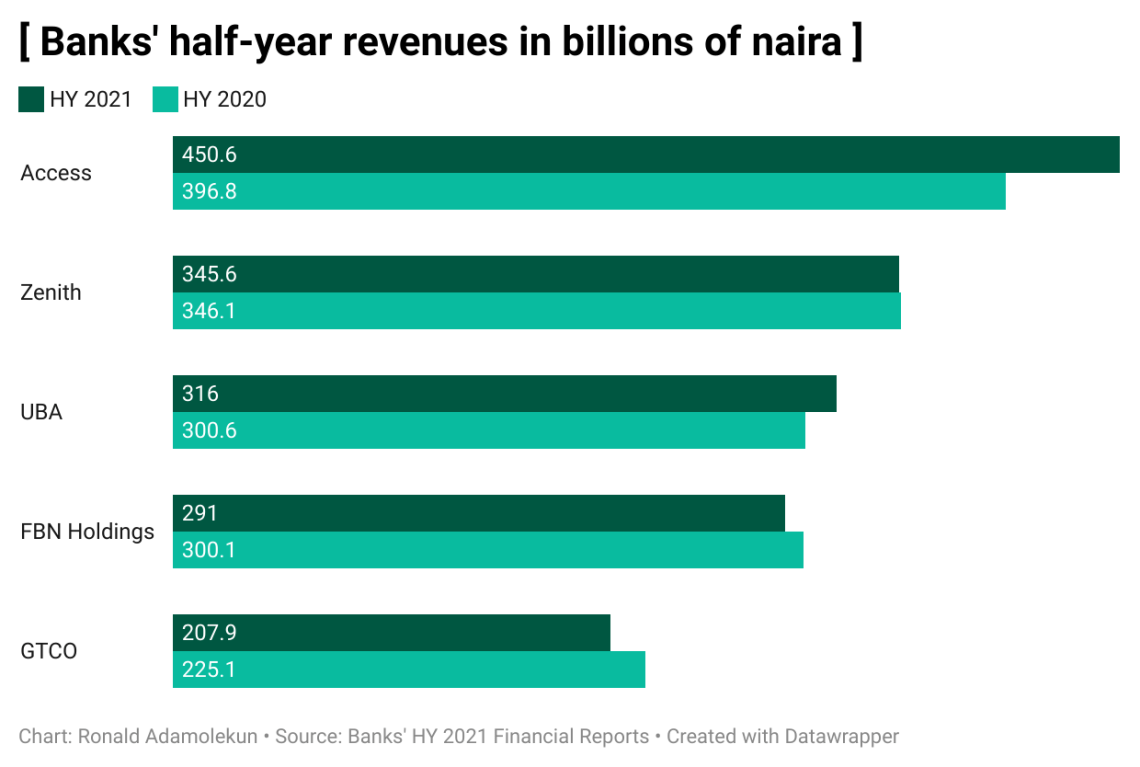
The FUGAZ (First Bank, UBA, GTBank*Access  and Zenith) grew revenue by paltry 2.7% to N1.61 trillion in H1 2021;  H1 2020 revenue was N1.57 trillion. That is a very poor performance when you remember that some fintechs are growing in top double digits month-on-month. 

Access Bank is picking so much momentum that it may be the bank of the decade if that redesign continues. I spoke in a Lagos-based investment banking Board meeting last week, and one of the board members asked me to comment on GTBank* and Zenith Bank’s drop in revenues. In summary, this was my response:

Chairman, in the current fintech space in Nigeria, the bank that has the highest overlap with the potential target customers are Zenith and GTBank. They are the banks for professionals with smartphones who can patronize these fintechs across many product lines. In our model, we see more than 80% overlap unlike UBA which drops below 50%. So unlike UBA and Access Bank which welcome any customer (carpenter, bricklayer, etc), these banks for professionals have threatened moats. Yet, I expect Zenith and GTBank to update their playbooks knowing that as fintech rises, their customers are the first targets.

This market is going to be super-competitive as supply of providers is increasing even when the demand base (the credit-worthy customers) is either shrinking or has remained flat. Nigeria’s broad banking sector is super-competitive and the fintechs are adding fudge factors that by 2026, we will certainly have fewer banks.

(Please all our banks are doing well. None has any known issue. This is purely an academic analysis and do not panic.)

PROLOGUE: The Agbowo Evening Economy

2

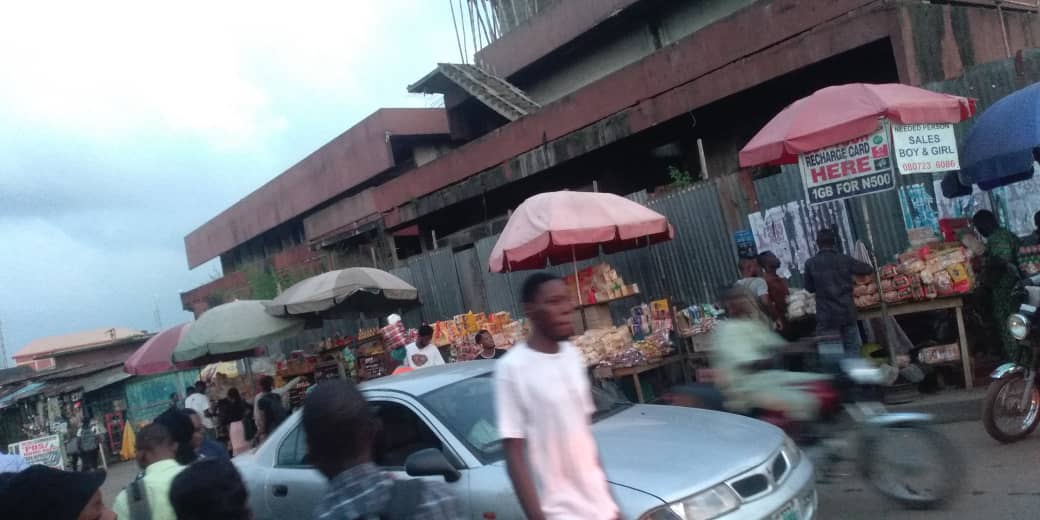
What is expected of a typical market in a particular environment defines the status of that market most times. Each market has its peculiarities and these are the things that make some markets to be known for them. In the case of Agbowo market, the rambunctiousness of the market while the sun is setting is enough to define it distinctive among other markets in the Samonda-UI-Ojoo axis.

Every pedestrian unused to the rowdiness of the market at this period may find it difficult to understand the status of this market axis especially when drivers of different vehicles hoot and honk their vehicles’ horn horrifically and angrily as some of the drivers can be pissed off either by the pedestrian making a cross or are waited by the traffic warden dexterously controlling the traffic frenetically. At this period of the night, careless onlookers are prone to colliding with pedestrians on the road. The clumsiness of those making ways on the cross from the UI is another peculiar thing that this area is known for.

The cyclists in their preposterous and comical Ibadan accent also make derogatory words against passersby or cab drivers who refused to allow them to pass through unruly in their usual overtakes. This is also absurd to one who is alien in this boisterous market arena. A cyclist making efforts to rush home after cycling between the dawn and sunset hours in this route is likely to make a jam with a driver of an auto rickshaw resting in his vehicle while gulping a bottle of soda drink. Agbowo market at this time is always at rush.

Prospective commuters of cab wait endlessly for cabs to board them in this route. The old and the young, the agile and the fragile, the men and the women drag one another while scrambling for the vehicles to commute them. At this point, the young is not a respecter of the old, all are equal in the agitation for seats in vehicles. Some are even at the helpless state of begging drivers who do not want to go their routes. During this time, the fares charged by the cyclists claim the helplessness of the passengers going to far places especially the stranger who does not seem to be wary of his or her destination.

More so, the hawkers in different advertising tones come on the street in their multitude to sell their commodities. While some shop owners close for the day, some others are just opening. One can even conclude that it is another batch of sellers coming to the market for sales of goods and commodities. The ones, who cannot afford owing a shop to oneself, set up a kiosk or bring himself under an umbrella to display all that he sells. At this point, the market status is the beginning of the day for some people. The fruit vendor stylishly organizes his fruits in quarters to catch the glimpse of every passerby.

The same way vendors selling bread and ‘akara’ call for people to patronize them while they dexterously fry the ‘akara’ is evident enough to arrest anyone passing to request for some. At this period of the night, any careless onlooker is likely to walk into another person as the case of a stranger may be. The vendors selling clothing materials beckon at everyone passing by to have a look into their shops for clothes of different types. The young boys and girls who had just returned from school pick up basins, arranged in them chilled soda drinks of different varieties and roll into the market to make sales. The road side food vendors otherwise called ‘mama put’ also entice the prospective customers with the aroma of their stew or ‘jollof rice’.

The queue of customers causes commotion on the road with others passing by the vendor’s stand. The roasted plantain sellers also attract passersby with the aroma of what they sell. It is a peculiar feature for every market to be faced with noises from different angles. The deliberate hooting of car horns by the drivers and the cyclists, the call for prayer from different mosques in this area, the barbing salons playing different sorts of songs; blues, R&Bs, Apala, Reggae, rap, faith-based songs, Fuji among others remain some of the features that add to the sassiness of this market at sunset.


Additional Reports by Abdulqudus Oyeniyi

Register for Tekedia Online Corporate Training – Many Areas Available

0
Computer screen mockup. Laptop with white blank screen on a wood desk, office background, copy space

Tekedia Institute offers virtual (online) seminars and workshops to startups, SMEs, NGOs, companies and public sector entities. On engagement, we design, develop and deliver live seminars and workshops on many business domains (see below) using our Faculty. Using our global and local faculty, we train in these areas:

-Logistics & Supply Chain Management
-Business Innovation, Growth & Sustainability
-Business Transformation & Project Management
-Risk Management
-Business Administration
-Innovation & Design Thinking
-Accounting, Auditing, Forensics & Taxation
-Workplace, Teams, Communication and Collaboration
-Media, Advertising & Branding

-Startup and Small Business Management
-Exponential Technologies and Singularity
-Marketing and Sales Management
-Digital Business Growth
-Agribusiness Management
-Human Resources Management
-Personal Finance & Wealth Management

Pricing and Registration

Learn more here and let us schedule your class.

80% Of Nigeria’s Richest By 2030 Will Be Tech-Made And They Will Lead Building Critical Infrastructures

0

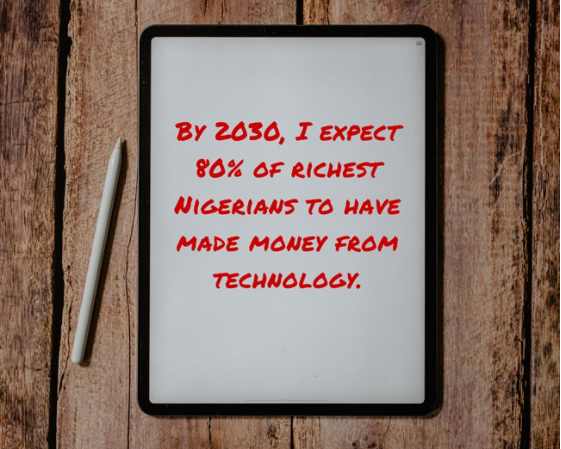
By 2030, I expect 80% of richest Nigerians to have made money from technology. Nigeria is having its finest cambrian moment on the formation of enduring companies. The last time we were this bold, on entrepreneurial capitalism, was in the early 1990s when some of Nigeria’s current  leading banks were established.

The 1990s gave us the new generation banks. The 2000s brought voice telephony. The 2010s ushered mobile internet. The 2020s would deliver the era of application utility across industry sectors and market territories.

We will see software systems change the ordinance of markets by “eating” frictions along the way. From education to healthcare, from financial services to logistics, and beyond, it would be exciting. The empires of the future are being built – get ready, Nigeria is a promise!

That is going to be the Wave 1 (biased for Nigeria)  as I noted in this presentation on “Investing in Africa’s Next Unicorns”. The Wave 2 for Nigeria will be when young men and women suddenly have resources and they will begin to build catalytic infrastructures. The people that will fix clean water, electricity, etc problems in Nigeria are going to come from men and women who are passing this application utility moment. I expect that to begin 2035, the Critical Infrastructure Era.

Be optimistic and #believe.